
RaeRae Reacts · One Piece Episode 174
Robin Gives Yama a One-Hundred-Hand Exit
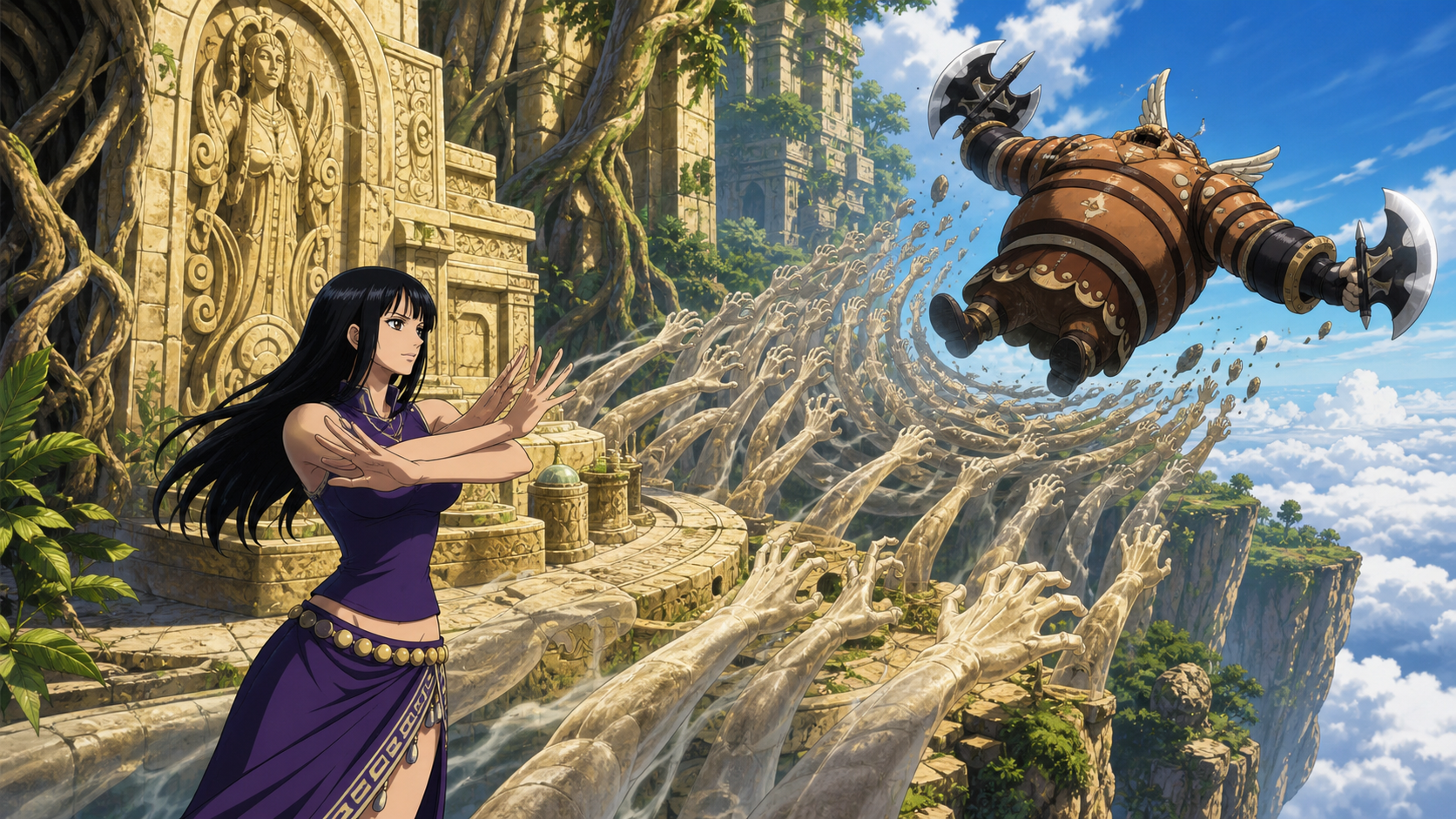
One Piece Episode 174 lets Robin protect Shandora, dismantle Yama with Delphinium and Clutch, and discover the magnificent lower city.
Pagaya returns a rebuilt Waver while Merry still needs triage
Episode 174 begins aboard the Going Merry with Conis, Pagaya, and Aisa reunited with Nami. Pagaya has repaired the Waver, giving the group a fast way to move across cloud terrain.
The delivery arrives after lightning injuries, a Dial fight, and blast damage to the ship. Mobility helps only if the crew knows who can travel, who needs treatment, and who remains responsible for Merry.
Pagaya should explain every repair, remaining defect, control change, and fuel or Dial limit before Nami leaves the deck. A successful test ride cannot substitute for a handoff.
Conis and Aisa need life protection, a return route, and a signal plan. The Waver should not become one more fast vehicle carrying people into Enel’s game without coordination.
Nami tests the Waver and confirms power before confirming the mission
Nami takes the refurbished craft for a quick run and finds the response stronger than expected. The Waver can now support reconnaissance, evacuation, or rapid contact across Upper Yard.
High acceleration also magnifies steering error. Nami should test braking, turning radius, low-speed balance, restart behavior, and emergency cutoff away from patients and damaged railings.
She needs goggles, secure footing, and a route that avoids swamp clouds, unstable ruins, and active lightning zones. Speed does not make unknown ground safer.
The group should decide whether the first task is finding Chopper, carrying medical supplies, locating Luffy, or moving vulnerable people. A powerful vehicle without a priority list becomes another distraction.
Robin shields a monument because knowledge cannot dodge Yama
At the ruins, Robin uses Veinte Fleur: Calendula to protect an ancient monument from Yama’s attack. Sprouted arms form a living barrier between the impact and irreplaceable stone.
Her body shares the strain through every manifested limb. Protecting the artifact may prevent immediate breakage while transferring force into Robin’s shoulders, back, and concentration.
The monument should be documented after the strike for cracks, shifted blocks, abrasion, and vibration damage below the visible surface.
Robin understands that avoiding the attack personally would leave the archive exposed. Yama weaponizes that responsibility by making her choose between safety and preservation.
Yama destroys evidence deliberately after Robin explains the value
Yama learns that the ruins matter to Robin and begins treating destruction as a way to provoke her. Damage becomes intentional rather than incidental.
His choice exposes the cruelty beneath obedience. He does not need the carvings destroyed for Enel’s objective; he enjoys controlling somebody by threatening what she values.
Robin should stop explaining individual targets and move him away from the site. Every visible reaction helps Yama identify the next vulnerable object.
A preservation team would create decoys, close access lanes, and mark structural supports before combat. Robin has none, so relocation becomes the only useful defense.
Robin leads Yama out because restraint inside the archive favors the vandal
Robin draws Yama away from the monument and deeper ruins before committing to a full counterattack. The move changes the acceptable force available to her.
Inside the site, every throw, collision, and heavy landing can destroy history. Outside, Robin can use Yama’s mass against him without placing carvings behind the target.
She should choose open ground with a stable edge, no hidden workers, and no fragile lower structure beneath the surface.
Yama follows because he mistakes controlled withdrawal for weakness. Robin is not surrendering terrain; she is selecting the only battlefield where victory will not defeat her purpose.
Stomach Mountain makes Yama’s mass a moving wall
Yama drives his enormous body forward with Stomach Mountain, attempting to crush Robin through momentum and area rather than precision.
Direct resistance would force Robin’s manifested arms to absorb his full mass. Dodging without controlling direction could send him back toward the ruins.
Robin needs lateral redirection, stable anchor surfaces, and a path that carries Yama farther from the protected site.
Yama should recognize that size reduces his ability to correct once committed. Every charge gives a careful opponent control over the destination of his momentum.
Calendula distributes force without pretending the force disappears
Robin’s defensive bloom places many arms between her and an incoming attack. Multiple contact points spread force and keep one limb from carrying the whole load.
Distribution is not cancellation. Enough mass can injure every participating arm, tear anchor surfaces, or drive the barrier backward.
She should release before joints overextend and shift from blocking to guidance. Medical review afterward needs both her original limbs and the pain feedback produced through duplicated limbs.
The technique suits protection when movement remains limited. Once Yama reaches open ground, Robin no longer needs to spend strength holding a wall.
Drop Mountain fails when Robin refuses to stand beneath the answer
Yama launches Drop Mountain after Robin announces that the ruins no longer restrict her. His descending mass aims to turn the ground into the final weapon.
Robin uses Treinta Fleur to catch, redirect, or counter the approach rather than accepting the impact at its strongest point.
A vertical attack gives Yama power but reduces correction. Robin can select where supporting arms appear and alter the landing before his body regains control.
The open battlefield proves her earlier restraint. Yama interprets the sudden change as new strength, but Robin finally has permission to use the strength she already carried.
Axe Mountain becomes self-harm when Robin turns the Dials inward
Yama activates axe-like Dials on his arms for another heavy attack. Robin manipulates the limbs so the cutting forces point back toward his own equipment and body space.
The counter attacks system orientation rather than armor. A weapon mounted to the user becomes dangerous when an opponent controls the joint between operator and effect.
Robin should keep cutting edges away from herself and release before damaged housings discharge unpredictably.
Yama needs emergency cutoffs and range limits. His equipment assumes that strength guarantees alignment, a design failure Robin exposes immediately.
Robin breaks Yama’s grip before controlling the whole descent
When Yama tries to seize her, Robin grows arms across his body and disables the grasp. Small joints remain vulnerable even when the opponent’s total mass is enormous.
She does not need to lift him from one point. Distributed limbs can rotate, pull, and guide different body segments in sequence.
That method requires careful placement because losing one anchor under Yama’s weight can overload the rest. Stable ground and repeated contact matter more than one heroic hold.
Yama’s hands were designed to dominate smaller opponents. Robin turns each finger and wrist into an access point for control.
Cien Fleur Delphinium creates a road made from one hundred decisions
Robin uses Cien Fleur: Delphinium, blooming a long sequence of arms across the ground. The arms pass Yama along a controlled route toward the cliff.
The technique converts impossible lifting into repeated short transfers. Each pair moves only part of the distance while the full chain controls direction.
Robin must verify that the route contains no fragile carving, ally, or unstable ledge before committing. A hundred hands can produce precision only when the destination is chosen correctly.
Yama experiences the opposite of his usual charge. His mass still moves, but Robin owns every stage of the movement.
Clutch turns the fall into a final controlled defeat
Robin locks Yama with Clutch as Delphinium carries him over the edge. The hold prevents recovery and compounds the impact that ends the fight.
The technique can injure the spine, joints, and breathing structures before the fall. Chopper would treat the defeated commander as a high-risk trauma patient.
Robin should confirm where he lands without entering an unstable lower level, record the last position, and warn anyone traveling below.
The victory protects the remaining ruins, but preservation ethics do not erase battlefield lethality. Yama created the confrontation and refused every opportunity to leave the archive intact.
Robin returns to work instead of turning victory into a performance
After defeating Yama, Robin resumes the survey. The transition reflects her actual objective: the fight mattered because the ruins mattered first.
She should revisit every area Yama crossed, photograph new damage, gather loose fragments without changing their order, and mark unsafe structures.
Her Arabasta memories reinforce the search for historical text while reminding her that interpretation can attract rulers who want ancient power rather than truth.
The crew needs copies of her notes stored separately. Robin remains the only reader, but the physical record should not depend on one notebook surviving Upper Yard.
She should also inventory every object left by the defeated commander. A broken Dial, armor fragment, or boot print can establish which damage came from Yama and which cracks predated the battle.
That separation protects the archaeological record from a convenient story later. Enel’s forces should not be allowed to blame centuries of decay for destruction witnessed during their occupation.
A lower level explains why the grand city seemed to vanish
Robin discovers that the visible ruins sit above a hidden lower layer. Shandora was not erased completely; sections survived beneath the later ground and destruction.
Buried architecture preserves context that exposed ruins lost. Street alignment, foundations, enclosed chambers, and sealed surfaces can reconstruct how the city functioned.
Entry requires air testing, structural assessment, marked routes, and a second person who knows where Robin went. Hidden chambers can contain collapse, gas, water, animals, or active traps.
Robin enters alone because the battlefield offers no archaeological team. Her discovery is magnificent and operationally unsafe at the same time.
Shandora survived eight hundred years beneath occupation and myth
The lower ruins reveal intact parts of the legendary city. Shandora becomes a physical place rather than a story people can dismiss or exploit without evidence.
The survival of architecture strengthens Shandian claims to memory and stewardship. Enel’s title cannot overwrite a city that predates his rule by centuries.
Robin should separate observations from conclusions, document construction phases, and involve Shandian knowledge before naming functions for unfamiliar spaces.
Gold may draw Enel, but the true discovery is continuity. A city presumed destroyed still speaks through layout, stone, and the people whose history remained attached to the land.
Environmental readings matter too. Temperature, moisture, airflow, root growth, and cloud pressure can explain why some chambers survived while exposed buildings failed.
The intact city changes the rescue plan as much as the history
Shandora’s lower level may contain routes, shelter, trapped people, forced-labor access, or structures Enel intends to use. Archaeological mapping now supports survival planning.
That practical value increases the danger of careless entry. A shortcut used by fighters can destroy sealed evidence or destabilize chambers before Robin completes documentation.
The resistance needs separate lanes for evacuation, combat movement, and protected research. Every route should include surface exits and collapse alternatives.
Robin’s information must reach Gan Fall and Wyper. A discovery held by one isolated person remains vulnerable to Enel’s surveillance and Yama’s replacements.
Preservation is an active form of resistance in Enel’s Survival Game
Enel measures success by reducing people to five survivors. Robin rejects the entire frame by preserving names, structures, inscriptions, and connections across centuries.
Yama destroys because destruction creates immediate obedience. Robin documents because memory creates accountability beyond the ruler’s deadline.
The city proves that survival includes more than bodies standing after three hours. Language, place, evidence, and community also need protection.
Every mapped wall contradicts Enel’s claim that his game defines reality. Shandora existed before him and can remain after his authority ends.
RaeRae’s verdict gives Robin the whole episode and Yama the exit route
Keep this one. Robin spends half the fight protecting stones from a man shaped like a wrecking ball, then changes venues and demonstrates that restraint was the only thing keeping Yama competitive.
Delphinium is the perfect answer because one hundred hands do not meet mass head-on. They turn mass into scheduled transportation toward a cliff, with Clutch handling the final paperwork.
The operational list remains serious: inspect the monument, map Yama’s damage, secure the lower entrance, duplicate Robin’s notes, brief the Shandians, test the Waver safely, and reconnect the archaeologist with her crew.
RaeRae’s final note: if an archaeologist asks you to stop breaking an eight-hundred-year-old city, the correct response is not Axe Mountain. Robin has now provided the practical demonstration.