
A Ninja’s Job!
Boruto asks for a dramatic mission, finds a discarded game programmer behind the bank bomb, saves Haguruma with fandom and Lightning Release, then helps build an after.
Series: Boruto: Naruto Next Generations
Episode: 42 · A Ninja’s Job!
Arc: Byakuya Gang Arc
Release: 2018-01-24
Previous: Episode 41 · Strength in Unity
Directory: All 293 Boruto episodes
Bottom line
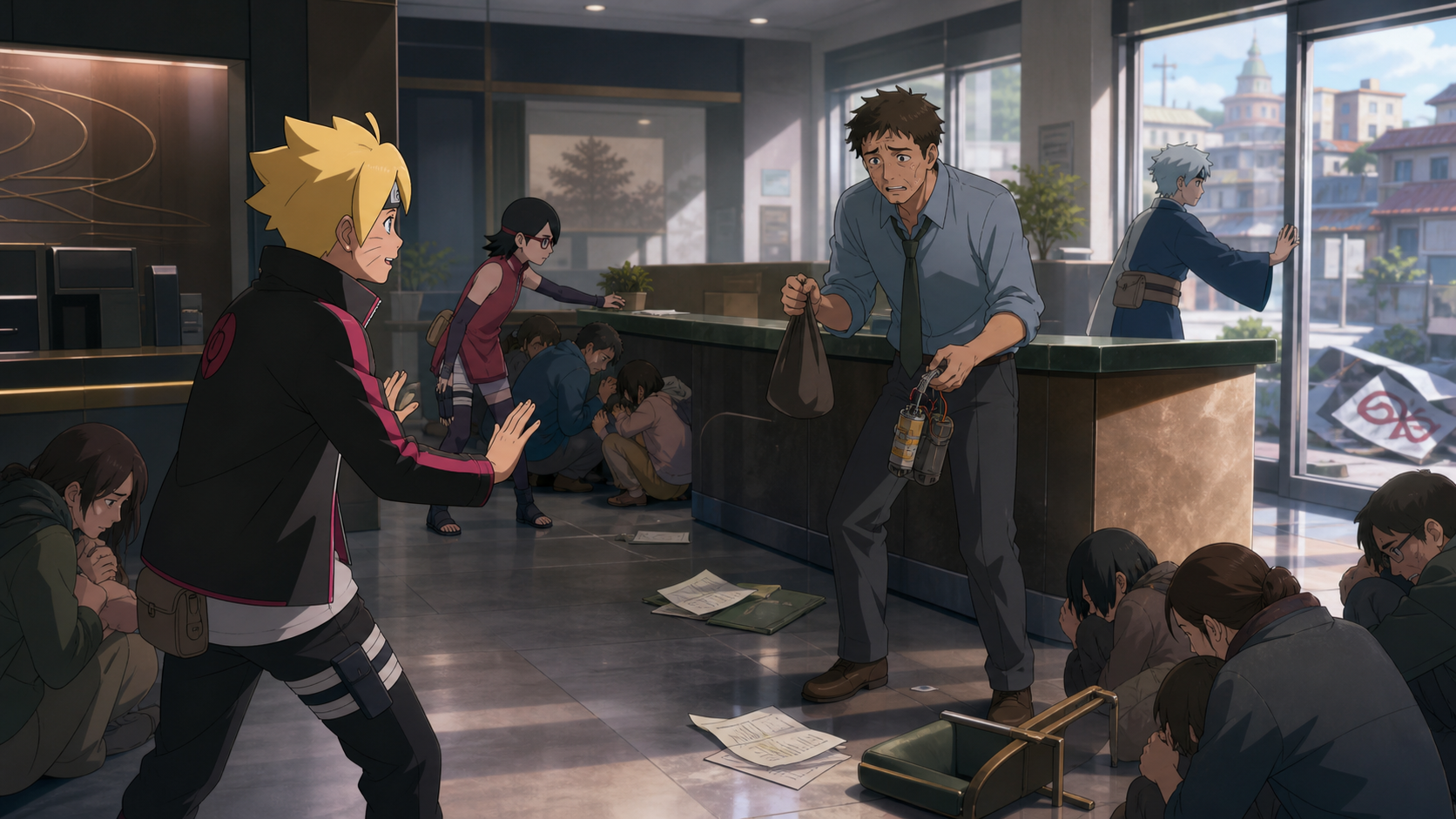
Boruto Episode 42 gives Boruto the exciting mission he has been begging for and then removes every glamorous part. Team 7 reaches a bank expecting hostages, combat, and a dangerous criminal. They find Haguruma alone with a bomb strapped to his chest, terrified enough to die and awkward enough that Boruto immediately realizes this man is not a hardened robber. Haguruma was a game programmer crushed by impossible deadlines, framed after his team complained, blacklisted, buried in debt, and nudged toward the bank by somebody who wanted a distraction. Boruto walks inside as an impatient genin trying to perform negotiation and becomes the first person who listens to the man behind a game he loves. The bomb still activates. The trigger still fails. Boruto uses Lightning Release to disable the device, and Haguruma walks outside alive. Then Boruto asks Denki to help him find work. That final choice is the episode’s answer to the title. A ninja’s job is not only stopping the explosion. Boruto stays interested after the dramatic danger ends.
Boruto is already tired of the peaceful era he inherited
Team 7 finishes another neighborhood mission by catching a runaway pet, and Boruto treats the work like an insult. He imagined shinobi life through Naruto’s legends: battles, impossible enemies, and somebody cheering when the hero returns. Chasing animals does not match the picture. Sarada reminds him that genin usually receive simple missions, while Konohamaru explains that combat against other shinobi is rare during peace. Boruto hears “rare” as “boring.” The irony is delicious because Naruto fought so Boruto could complain about not fighting enough.
The runaway pet matters even when Boruto cannot feel the stakes
The pet owner cares about the animal Team 7 returns. That small relief will never become a village legend, but the mission changes somebody’s day. Boruto measures importance through danger because danger makes his talent visible. Service asks a harder question: did somebody need help? The episode does not scold him with a speech. The bank assignment will make him discover that even a flashy mission becomes meaningful through attention to one frightened person, not through the size of the explosion.
Boruto asks for something dramatic and receives a bank crisis
At the mission desk, Boruto wants work worthy of his image of a ninja. The call about a man barricaded inside a bank sounds perfect. He lights up because “bank robber” arrives with an entire action sequence already playing in his head. That excitement is funny until Team 7 reaches the scene. Real danger has no obligation to flatter the person responding. Boruto wanted an enemy he could defeat. Haguruma looks like somebody already defeated by everything that happened before the police arrived.
Kōtarō immediately punctures the hostage fantasy
Captain Kōtarō Fūma explains that no civilians remain inside. Team 7’s task is to persuade the man not to detonate himself and the bank. Boruto is visibly disappointed before recommitting to the mission. I appreciate that ugly little reaction because Boruto is a kid, and the episode lets him be one. He wanted spectacle. A lonely man threatening his own life feels less heroic than rescuing hostages. The story will teach him that a life does not become less valuable because nobody else needs saving.
Haguruma is terrible at looking like a bank robber
Boruto enters alone and finds a nervous man whose posture, speech, and homemade device do not match the villain he imagined. Haguruma does not command the room. He barely seems able to command himself. Boruto starts by trying to act like a negotiator and even offers himself as a hostage, but the performance falls apart because there is no audience inside. The awkwardness becomes useful. Boruto stops reciting what a shinobi should sound like and starts noticing who sits across from him.
Boruto walks inside because bravado and compassion share a door
Entering alone is risky, and experienced negotiators would probably have several things to say about a twelve-year-old improvising beside a bomb. Within the story, the choice works because Boruto’s recklessness gets him close enough to hear Haguruma without a wall of uniforms between them. He begins from ego, yet empathy takes over once the man speaks. Boruto’s best qualities often arrive tangled with the traits that scare everybody around him. He runs too quickly toward danger, but he also refuses to look away after arriving.
Haguruma built games people loved under conditions that broke him
Haguruma explains that he worked as a programmer on a game series Boruto knows. His team faced an unforgiving production schedule and finally decided to complain about the workload. This detail hit me because the episode aired inside an industry famous for brutal deadlines. Haguruma is not angry because creative work was difficult. He is angry because management treated workers as replaceable while profiting from what they made. The shiny finished game hides the exhausted people behind every feature.
The complaint should have protected the team
Haguruma and his coworkers try to raise the problem together. Collective action should give vulnerable employees enough weight to challenge an abusive schedule. Instead, the boss learns about the complaint and isolates Haguruma as an example. The company protects production by punishing the person easiest to sacrifice. Everybody else learns what speaking up costs. The episode does not need a boardroom scene. Haguruma’s collapse shows the result.
False evidence steals more than one job
The boss fabricates proof that Haguruma sold company secrets to a competitor. Firing him is only the first injury. The accusation follows him through the industry, making other employers unwilling to hire him. Haguruma loses income, reputation, community, and the ability to explain himself through normal channels. Debt grows while the game he helped build approaches release. The company continues using his labor after removing his name from the future. That is the kind of injustice that makes a desperate person vulnerable to anybody offering a dramatic way to be heard.
Boruto recognizes the pain of being unseen
Haguruma says nobody knows what happened to him, and Boruto connects with that feeling more than he expected. Their lives are not equivalent. Boruto has family, housing, friends, and the Hokage’s name. What he recognizes is the anger of believing the person whose attention matters most does not see your effort. Boruto has spent years resenting Naruto’s absence. That emotional bridge lets him listen without pretending he understands every debt notice or workplace betrayal. Sometimes empathy begins with one familiar ache.
The game cartridge changes the entire conversation
Haguruma plans to die on the release day of the last game he worked on, turning his death into a final accusation against the boss. Boruto reveals that he just bought the game and loved the earlier entry. Suddenly Haguruma hears from an actual player. Somebody enjoyed the world he helped make. Somebody waited for the next release. The praise does not repair the firing or erase his responsibility for bringing a bomb into a bank. The praise interrupts the belief that his work disappeared completely.
Boruto becomes a fan before he becomes a rescuer
This is where RaeRae’s fandom brain takes over because Boruto does not save Haguruma with perfect negotiation language. He talks about the game like a kid who genuinely cares. Specific enthusiasm reaches the creator in a way generic reassurance cannot. Haguruma knows Boruto is not flattering him to escape. The boy already owns the new release. That little consumer detail becomes proof that the programmer’s work traveled beyond the office that discarded him.
Haguruma changes his mind, but the device does not
Feeling heard gives Haguruma enough space to abandon the plan. Then the trigger malfunctions and the bomb activates anyway. The scene refuses an easy emotional solution. A sincere change of heart cannot reverse every dangerous choice already made. Haguruma built or accepted a device he could not reliably control. Now Boruto has to solve the physical emergency after helping with the human one. Both parts matter. Listening without technical action would leave them dead. Force without listening might have pushed the trigger earlier.
Lightning Release turns Boruto’s training into precision
Boruto fries the bomb mechanism with Lightning Release. The technique is not a giant attack designed to look impressive. He uses chakra against a specific component at the exact moment precision matters. That is the flashy ninja work he wanted, but the emotional context changes the victory. Boruto is not defeating Haguruma. He is helping Haguruma survive his own irreversible mistake. The lightning feels heroic because somebody walks out, not because something explodes.
Walking out together is the real mission result
Boruto exits the bank beside Haguruma rather than dragging a defeated villain behind him. The image matters. Haguruma will face the police and consequences, but he reaches those consequences alive. Boruto’s posture communicates that surrender did not make the man disposable. For a franchise built around Naruto refusing to give up on people after they cause harm, that continuity feels right. Boruto inherits talk-no-jutsu jokes and the deeper principle beneath them: understanding somebody can change what becomes possible next.
Kōtarō keeps accountability proportional
At the station, Kōtarō explains that the device would not have caused mass casualties and that Haguruma acted under extreme emotional distress, so severe punishment appears unlikely. The episode does not pretend nothing happened. A bank was occupied, emergency services responded, and a bomb threat terrified people. The response considers actual capability, intent, duress, and cooperation instead of flattening every fact into one dramatic charge. That is a surprisingly grounded ending for a shinobi episode.
Boruto asks the question stories often skip
Mitsuki asks what Haguruma will do after the immediate case. That question exposes how incomplete a rescue would be if Haguruma returned to the same blacklisting, debt, and isolation. Boruto turns to Denki because Kaminarimon Company may have work for a skilled programmer. He cannot guarantee employment, erase the record, or fix the industry. He identifies one practical next step through a relationship already available to him. The gesture is small enough to feel believable and meaningful enough to give survival a future tense.
Denki becomes the bridge between compassion and infrastructure
Boruto can connect emotionally, but Denki has access to a company that can use Haguruma’s skills. Their friendship turns concern into a concrete possibility. Later episodes confirm Haguruma does work with Kaminarimon, which makes this moment even sweeter on replay. Boruto’s impulsive idea becomes part of the show’s world instead of vanishing after the credits. Denki does not need a fight scene to matter. He helps build the life waiting after the crisis.
Somebody pushed Haguruma toward the bank
Kōtarō tells Konohamaru that another party encouraged Haguruma to barricade himself inside. That reveal changes the episode without erasing Haguruma’s choices. The Byakuya Gang saw a fired worker, a grievance, and a building worth distracting. Haguruma believed the protest was his final statement. Gekkō treated him as stage noise for a vault robbery. The manipulation fits the arc’s larger pattern: real pain enters first, and the gang hides its private objective behind that pain.
The bank was never the whole crime scene
While police, Team 7, and civilians focus on Haguruma, masked thieves use the crisis to reach the vault. Episode 43 will reveal the frozen evidence and missing jewels. That makes Boruto’s successful negotiation emotionally complete but operationally incomplete. He saves Haguruma and still misses the larger move. I like that outcome because competence grows through limits. Team 7 did its assigned job well. The gang designed the distraction so doing that job would keep every eye pointed away from the theft.
Peace changes ninja work without making courage obsolete
Konohamaru is right that Boruto’s generation should not expect constant shinobi battles. Their dangers come through technology, workplaces, public trust, and people manipulated inside civilian life. Lightning Release still matters, but so does recognizing a game programmer under the bomb. The new era does not need less courage. The courage looks different. Sometimes the mission is listening long enough for a frightened man to decide he wants to live.
The episode talks about game-industry crunch inside an anime schedule
The workplace story lands with extra weight because animation and game production both carry histories of exhausting schedules and invisible labor. Haguruma’s suffering is dramatized, but the premise is not fantasy. Fans celebrate releases without seeing every worker who stayed late, lost health, or disappeared from credits. The episode does not blame players for loving games. Boruto’s love becomes part of the rescue. The point is that appreciation should extend past the product toward the people who made the product possible.
Boruto’s empathy works because the episode lets him be imperfect
He complains about pet missions, gets excited by a bank crisis, feels disappointed that no hostages need rescuing, and improvises far beyond what a careful plan would allow. Then he listens, connects, disables the bomb, and thinks about Haguruma’s next job. Growth does not require Boruto to become polished. He remains loud, impatient, and emotionally direct. Those qualities become useful once he stops treating the mission as a stage for himself.
What changed on every replay
My first watch remembered the game connection and Lightning Release save. On replay, the most painful detail was Haguruma choosing the release day for his death because the company would celebrate his labor without him. Another pass made Denki’s role stand out. Boruto offers hope, but Denki can connect hope to an employer, and the series later proves that connection mattered. The final detail I kept watching was Kōtarō’s quiet reveal. Haguruma thought the bank was his protest. The Byakuya Gang knew he was their distraction.
Compassion cannot stop at preventing the explosion
Boruto saves Haguruma from the immediate device because listening creates enough time for action. The game cartridge gives them a shared language. Haguruma expected police orders or heroic condemnation. Hearing a player describe joy created by his work interrupts the belief that nobody saw him.
Survival still needs a next morning. Haguruma faces legal consequences, unemployment, public shame, and the same industry conditions that helped push him toward the bank. Telling a desperate person that life matters sounds hollow when every practical road remains closed.
Denki turns empathy into infrastructure. His family has connections, technical work, and the ability to recognize Haguruma’s skill beyond the scandal. Boruto asks whether another job can exist. Denki knows whom to contact. Neither boy can guarantee an outcome, but the question becomes a route rather than a comforting speech.
Kōtarō also keeps accountability proportional. Haguruma endangered people and brought a bomb into a bank. The absence of conventional hostages does not make the act harmless. Police intervention remains necessary. Compassion changes how Haguruma is treated without pretending no crime occurred.
That balance gives the episode weight. Punishment alone cannot explain why the crisis happened. Sympathy alone cannot remove the danger Haguruma created. A responsible response holds the person accountable while refusing to treat death, permanent exclusion, or public disposal as the only available conclusions.
The Byakuya Gang exposes how easily desperation becomes cover. Haguruma believes the bank is the center of his protest. The gang sees a loud distraction capable of moving police while another crime happens elsewhere. His pain becomes useful to people who have no interest in whether he survives the usefulness.
Boruto’s intervention breaks that ownership. The gang designed Haguruma as a disposable piece. Boruto keeps asking about the person after the piece leaves the board.
Peaceful-era ninja work still demands courage
Boruto wants danger because danger resembles the stories told about Naruto’s generation. A runaway pet feels too small to prove identity. A bank alarm finally sounds like the mission he imagined.
The episode corrects him without making the pet mission meaningless. One owner needed help. Catching the animal required patience and responsibility rather than combat. Peace shifts the daily job toward needs the old generation rarely had time to notice.
Haguruma’s crisis requires another kind of courage. Boruto walks inside before a careful plan exists, which remains reckless. He also listens after realizing the heroic fantasy does not fit. Changing the approach becomes more important than looking fearless.
Lightning Release solves the mechanical problem because training gives compassion a practical tool. Talking keeps Haguruma present. Technique disables the bomb. Denki creates a path toward work. Kōtarō handles the legal aftermath. No single action earns the whole rescue.
That shared result defines modern shinobi work better than a dramatic fight could. Protecting the village may mean catching a pet, defusing a device, recognizing workplace abuse, connecting someone to employment, and investigating whoever exploited the crisis.
Boruto begins the day asking for a job worthy of him. He ends by helping make the job worthy of the person in front of him.
The follow-through will decide whether the rescue lasts. Haguruma needs legal counsel, safe work, medical support, and distance from the people who weaponized his despair. Boruto cannot provide all of that. A healthy village response connects compassion to adults and institutions capable of carrying the next steps.
Rescue must continue after Boruto leaves.
RaeRae’s final reaction
Episode 42 starts with Boruto begging for a real ninja job and ends by redefining “real.” Catching a runaway pet helped one owner. Listening to Haguruma saved one programmer. Disabling the bomb prevented one desperate choice from becoming final. Asking Denki about work gave the man somewhere to look after the police station. None of those actions needs a battlefield to matter. I am furious at Haguruma’s boss, furious at the gang for seeing his collapse as useful cover, and relieved that Boruto’s fandom becomes the one thing the man did not expect to hear inside that bank. The episode is messy in a human way. Haguruma causes danger and deserves accountability. Haguruma also deserves to survive. Boruto understands both before he has the language to explain either, and that is why this quiet “job” feels heroic.
Sources and lawful viewing
Official episode reference: Naruto Official episode guide
Licensed episode route: Crunchyroll licensed series page