
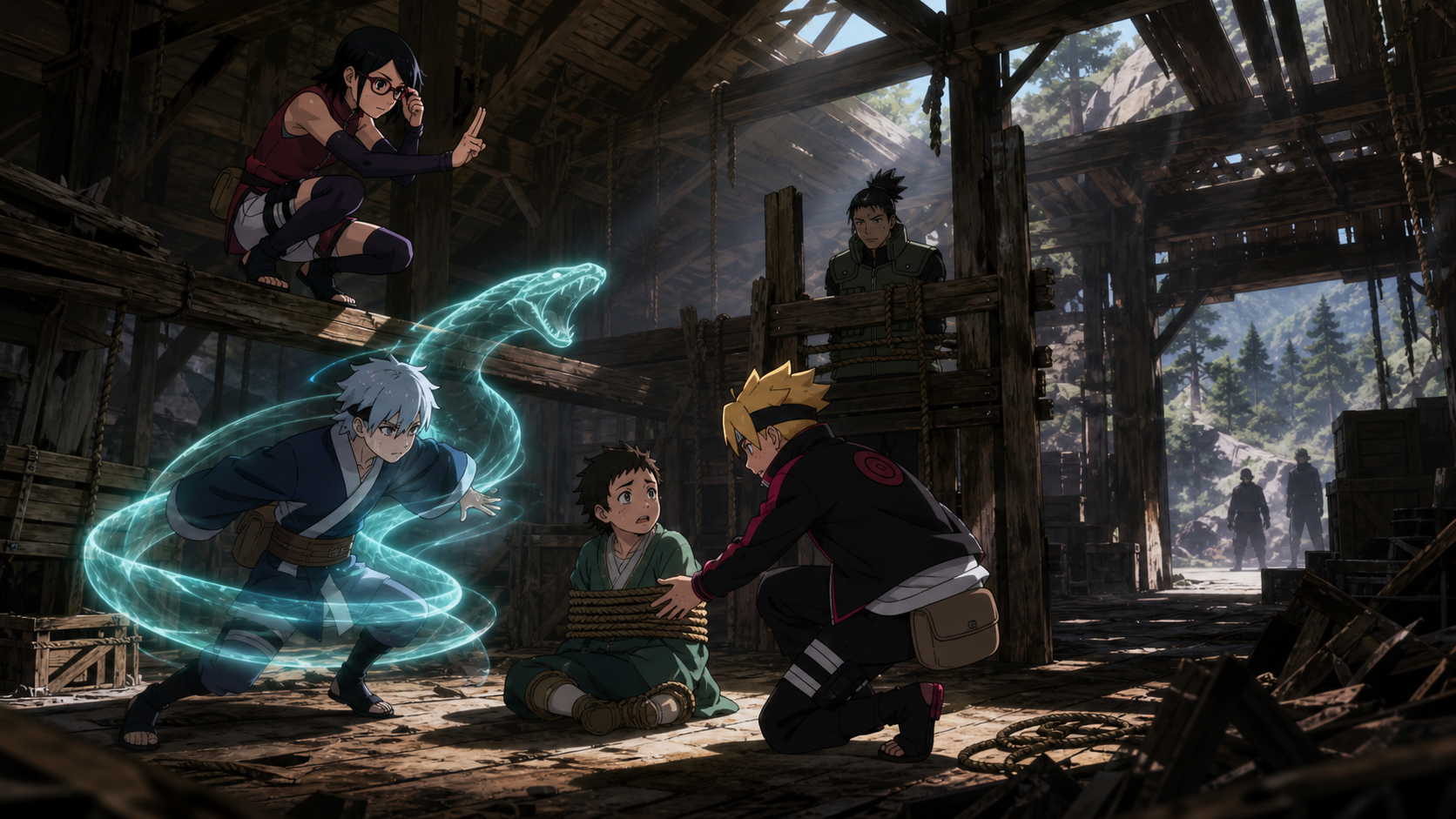
Strength in Unity
Kiri’s rescue becomes an ambush, Konohamaru chooses restraint, and Team 7 turns Sarada’s read plus two Wind Releases into one glorious finishing strike.
Series: Boruto: Naruto Next Generations
Episode: 41 · Strength in Unity
Arc: Genin Mission Arc
Release: 2018-01-17
Previous: Episode 40 · Team 7: The First Mission!
Directory: All 293 Boruto episodes
Bottom line
Boruto Episode 41 gives Team 7 its first real finishing move, but Sarada earns the center of that moment. Kiri has been kidnapped, Iori admits he sold out Green Banks after killing her father, and the enemy shinobi demand the bridge deed in exchange for her life. The trade becomes an ambush. Konohamaru throws Kiri toward Boruto, orders the genin to run, and gets trapped with Hidari while Ashimaru chases the children. Kiri finally admits that living under her father’s reputation made asking for help feel like failure. Team 7 answers that confession by showing what unity actually looks like. Mitsuki and Boruto keep Ashimaru busy. Sarada studies his habit of blocking and countering instead of dodging. The boys combine Wind Release to launch her straight through the opening she found, and Sarada lands the blow. No speeches about interchangeable teamwork. No pretending all three contributed in the same way. They win because one teammate reads, two create speed, and everybody trusts the timing. That is the Team 7 chemistry I wanted.
Sarada tends Boruto before anybody plans the rescue
The episode opens with Sarada caring for Boruto’s injury from the previous attack. That small act establishes the team before the title can announce unity. Boruto is not a heroic idea. He is a teammate who got hurt because the mission was more dangerous than expected. Sarada can criticize his recklessness and still make sure he is ready to move. Care and frustration belong in the same friendship. The scene also slows everyone down long enough to absorb that Kiri is gone.
The ransom note names the bridge as the real target
The kidnappers demand the Green Banks bridge deed for Kiri’s return. That confirms the attacks were never random bandit harassment. Pale Blue Valley wants legal control of the route, and hired shinobi supply the violence needed to force a transfer. A piece of paper becomes more valuable than the village leader’s life because ownership decides who can move people and goods through the region. Kiri’s kidnapping is personal, but the strategy aims at the community’s future.
Iori confesses after hiding beside the villagers
Iori admits that he worked for Pale Blue Valley and killed Kiri’s father. He accepted money for the bridge deed and expected Kiri to fail because she insisted on solving every problem alone. That confession is vicious because he used familiarity as access. He watched the village grieve, remained close enough to understand Kiri’s habits, and turned her isolation into part of the plan. Green Banks did not only face attackers from outside. The betrayal had been living among them.
Kiri’s independence became the vulnerability Iori counted on
Kiri has tried to carry her father’s leadership without letting anyone see uncertainty. Iori knows she will avoid asking for help until the problem becomes impossible. The trait she believes honors her father becomes the opening used against her. That does not make Kiri responsible for the kidnapping. The episode is showing how pressure to appear strong can isolate a leader from the people who want to stand beside her. Unity begins before the battle, with admitting that one person should not carry a village alone.
Green Banks gives up the deed without hesitation
The villagers hand Konohamaru the bridge deed and ask him to save Kiri. Nobody weighs infrastructure against her life for dramatic tension. They choose their leader. The gesture tells Kiri something she has not allowed herself to believe: the village values her as a person, not only as her father’s replacement. A bridge can be reclaimed. She cannot. Their decision becomes the emotional opposite of Pale Blue Valley reducing her to leverage.
Team 7 plans instead of letting Boruto charge
Konohamaru organizes the exchange and rescue while Boruto, Sarada, and Mitsuki take assigned roles. Episode 40 showed Boruto treating danger like a shortcut to recognition. The kidnapping has ended that mood. He listens because Kiri’s life now sits inside every mistake. Team 7’s unity starts with accepting a plan from their leader, not with three children improvising independently and hoping friendship makes the chaos work.
Iori delivers Kiri and discovers betrayal has no retirement plan
Iori brings Kiri to Hidari and Ashimaru after doing everything Pale Blue Valley required. Ashimaru kills him anyway, dismissing the idea that former shinobi deserve trust. The scene offers no sentimental absolution. Iori murdered Kiri’s father and helped kidnap her. His death still exposes the people he served. The hired shinobi treat collaborators as disposable once their access has been used. Iori believed money could move him safely between loyalties. Ashimaru proves that the new side never considered him family.
The body becomes part of Hidari’s trap
Hidari leaves an explosive tag on Iori’s corpse for the exchange. That detail tells us everything about his contempt. A dead accomplice becomes another weapon. Konohamaru arrives willing to trade the deed for Kiri, while Hidari has already planned to keep the deed, kill the rescuer, and erase the witness. The exchange was never negotiation. Pale Blue Valley hired men who understand every promise as a chance to position the next attack.
Konohamaru gets Kiri into Boruto’s arms
When the ambush starts, Konohamaru throws Kiri clear and trusts Boruto to catch her. That action turns his body into the space between the client and two enemy shinobi. He does not ask whether Team 7 feels ready. He gives them the one job that matters: take Kiri and move. Boruto catches her, and the rescue becomes real before the fight is won. The protected person is no longer in enemy hands. Every battle choice after that should serve her escape.
Konohamaru orders the genin away from his fight
Konohamaru tells Team 7 to leave while he handles Hidari and Ashimaru. He understands that the first mission has escalated far beyond a D-rank assignment. This is where the old draft was right about danger but wrong in tone. The scene is not a safety report. The scene is a mentor choosing to hold two killers because three children need time to get an injured girl home. Konohamaru looks most like a jōnin when he makes himself the risk.
Hidari’s trap separates the leader from the team
Hidari immobilizes Konohamaru and sends Ashimaru after the genin. Suddenly Team 7 has no adult beside them and cannot know whether Konohamaru will escape. The separation tests whether their training survives fear. Boruto could turn back immediately. Sarada could freeze under the responsibility. Mitsuki could reveal more power than he wants anyone to see. Instead, they keep moving with Kiri because Konohamaru’s order remains their clearest way to honor him.
Team 7 stops because Kiri needs care
The children pause, set traps, and tend Kiri’s injury. Running without checking her condition might create distance while making the rescue fail in another way. Sarada again treats the person in front of her, and the team uses preparation to buy time. I love this beat because “Strength in Unity” does not mean constant forward motion. Sometimes unity means one teammate watches the trail, one prepares a defense, and one helps the injured person breathe.
Kiri finally explains why she kept choosing alone
Kiri says she felt compelled to live up to her father’s reputation. Leadership became imitation under pressure. If he solved problems alone, she believed asking for support would expose her as the weaker successor. The village never demanded that performance as clearly as Kiri demanded that performance from herself. Her confession arrives while three new genin are proving the opposite lesson. Team 7 is not weaker because no single child can handle Ashimaru alone. Their combined answer is the strength.
Ashimaru catches them because rescue rarely gives enough time
The traps and brief rest cannot keep Ashimaru away forever. He reaches Team 7 with the confidence of a trained sword user facing children. The genin have Kiri behind them and no safe path left. Choosing to fight is not Boruto chasing excitement this time. The danger has cornered the mission. Their job is to prevent Ashimaru from reaching Kiri, and that shared purpose removes the ego from the decision.
Boruto and Mitsuki make Ashimaru show his habits
Boruto and Mitsuki engage Ashimaru directly while Sarada watches through her Sharingan. Their attacks are not wasted because they do not land immediately. Every exchange gives Sarada more information about how he responds. Ashimaru prefers to block and counter rather than dodge. That makes him look immovable, but predictability is an opening. Boruto and Mitsuki turn pressure into data, and Sarada turns data into a plan.
Sarada is the strategist and the finishing striker
Sarada identifies the pattern, communicates what she sees, and takes responsibility for the decisive attack. The episode does not make her stand behind the boys after supplying the idea. Her Sharingan gives her the timing to read Ashimaru’s counter, but her willingness to be launched at him makes the plan work. Leadership here is not issuing instructions from safety. Sarada puts her body inside the conclusion she reached.
Two Wind Releases become Sarada’s runway
Boruto and Mitsuki combine Wind Release to send Sarada toward Ashimaru at high speed. The move is gloriously extra for a first mission, and I mean that with love. Their chakra does not duplicate her strength. The wind gives her the velocity needed to force the reaction she already predicted. Three separate abilities create one clean line. This is why the episode title works better in the fight than in the old abstract draft. Unity is visible.
The Sharingan lets Sarada move through the counter
Ashimaru blocks and prepares his usual response, exactly as Sarada expected. Her Sharingan reads the motion, she avoids the counter, and she lands the finishing strike. The victory belongs to preparation as much as power. Sarada does not overpower a grown sword user through unexplained strength. She studies the repeated choice he trusts most and makes that habit betray him. Sasuke would recognize the logic even if the team launch is pure new-generation chaos.
Konohamaru answers Hidari with restraint
Hidari prepares to kill Konohamaru, who breaks the trapping technique with a Wind Release: Rasengan. The attack displays a level of force Hidari clearly cannot handle. Then Konohamaru deliberately misses the fatal line. Hidari collapses from the shock and damage around him. That restraint matters. Konohamaru proves control instead of proving willingness to kill. He protects the team, recovers the deed, and leaves room for consequences beyond execution.
Konohamaru arriving with the deed completes both halves
Team 7 defeats Ashimaru and keeps Kiri safe. Konohamaru defeats Hidari and retains the bridge deed. Neither side alone completes the mission. A rescued leader without the deed would leave Green Banks vulnerable to the same takeover. A recovered deed without Kiri would be an unbearable victory. The team reunites with both, turning the ransom strategy inside out. Pale Blue Valley receives neither the route nor the life used as leverage.
Kiri returns as herself, not her father’s replacement
Back in Green Banks, Kiri apologizes for trying to do everything alone. The apology is not surrendering leadership. She is finally accepting that leadership includes trusting the village. Her father’s legacy can remain important without becoming a costume she must wear perfectly. The villagers already proved they would sacrifice the bridge to bring her home. Now Kiri can build with them rather than carrying their future as a private burden.
The first mission report has more truth than Boruto expected
Konohamaru reports to Naruto after returning to Konoha. Team 7’s first assignment included concealed shinobi involvement, a kidnapping, ransom, murder, genjutsu, a sword fight, and a bridge deed. Boruto wanted a mission that felt worthy of his talents and received far more danger than the classification promised. The experience gives him something better than bragging rights. He has seen how quickly a client’s silence, a village rivalry, and hired force can change the work.
Boruto compares first missions with the other genin
Boruto talks with Shikadai, Iwabee, and Denki about their first assignments. That conversation brings the scale back down after the fighting. Every team is becoming a working unit through different kinds of tasks. Boruto can tell a dramatic story now, but Episode 42 will show that the drama does not satisfy him for long. Growth is not a straight climb from easy missions to exciting ones. The meaning keeps changing depending on who needs help.
Iori and Kiri are opposite lessons about isolation
Iori chose private betrayal for money and assumed he could move between sides alone. Kiri chose private responsibility and assumed she could protect the village alone. Both choices gave Pale Blue Valley leverage. Their motives and harms are not equal, but the structure rhymes. Iori dies because the people who bought his loyalty never valued him. Kiri survives because Green Banks and Team 7 refuse to let her remain a solitary piece.
What changed on every replay
My first watch remembered Sarada flying through the air and punching Ashimaru, because obviously. On replay, Konohamaru deliberately missing Hidari became my favorite display of skill. He shows enough power to end the fight and enough control not to end a life. Another pass made the villagers handing over the deed hit harder. They choose Kiri before she admits how afraid she is of disappointing them. The last detail I kept returning to was Sarada bandaging Boruto at the beginning. Unity starts with care before anybody combines a jutsu.
Sarada builds the finish because leadership begins with observation
The episode gives Sarada several kinds of work before the final punch. She treats Boruto’s injuries, listens to Kiri, studies Ashimaru’s responses, and waits long enough to identify the blocking habit. The finishing strike succeeds because care and analysis happen first.
Boruto and Mitsuki pressure Ashimaru from different angles. Their attacks look like failed attempts until Sarada turns the reaction pattern into a plan. Ashimaru blocks according to habit, which means predictable defense can become a route.
Two Wind Releases create the runway, but the combination does not reduce either boy to support furniture. Boruto supplies force through his own training. Mitsuki adds control and timing. Sarada uses Sharingan perception to move through the counter and converts their shared opening into contact.
That is Team 7 unity without flattening personality. Boruto remains direct. Mitsuki remains precise. Sarada remains analytical and decisive. Cooperation amplifies difference rather than asking everybody to perform the same skill.
The bandage scene establishes the same principle quietly. Sarada does not wait for a dramatic strategy meeting before acting like a teammate. She sees pain and responds. Leadership becomes credible because the person calling the final attack has already shown concern for the bodies expected to follow the call.
Kiri learns a parallel lesson. She believes responsibility requires becoming a solitary replacement for her father. Green Banks answers by surrendering the deed immediately. The villagers value her life more than the legal paper she thought she had to defend alone.
Accepting rescue does not make Kiri less capable. She still makes decisions, explains the enemy’s leverage, and returns to serve the village. Unity allows her to remain a person instead of becoming a monument to inherited duty.
Konohamaru demonstrates power through restraint
Hidari expects Konohamaru to prove strength through destruction. The trap separates the leader from the genin and creates a fight where spectacle could swallow the mission. Konohamaru refuses that invitation.
Deliberately missing shows that he controls the Rasengan rather than merely possessing a dangerous technique. The near strike communicates exactly how the fight could end. Hidari receives a chance to stop without Konohamaru turning victory into a body count.
That restraint distinguishes mature shinobi work from Boruto’s early fantasy about exciting missions. The objective is protecting Kiri and recovering the deed. Killing an opponent for applause would add harm without improving either result.
Konohamaru also trusts Team 7 enough to divide responsibility. Ordering the genin away protects them from his battle while recognizing that Kiri still needs escort and care. A leader cannot personally occupy every part of the mission.
The separation becomes a test of what his teaching produced. Team 7 stops when Kiri needs treatment rather than treating speed as the only measurement. They listen to the client, respond to pursuit, and create a coordinated finish.
Konohamaru returns with the deed after resolving his half. The reunion completes one plan carried across separate fights. Nobody needs to claim sole ownership because the mission only succeeds when both halves survive.
Iori and Kiri reveal two forms of isolation
Iori hides beside the villagers while selling information. He believes private betrayal gives him control over both sides. Pale Blue Valley knows better. A person willing to sell one community becomes disposable after usefulness ends.
Kiri hides fear behind private responsibility. She wants to protect Green Banks and preserve her father’s legacy, so she withholds the burden until enemies can exploit the silence. Her motive comes from love rather than profit, but isolation still creates leverage.
The difference appears in what happens when other people learn the truth. Pale Blue Valley kills Iori because no relationship existed beyond transaction. Green Banks hands over the deed because the villagers’ relationship with Kiri matters more than property.
Team 7 extends that choice. They protect Kiri without demanding that she become helpless or grateful enough to surrender agency. Rescue returns options rather than replacing one controller with another.
Episode 41 therefore defines unity as more than a combined attack. Unity means treating injuries, sharing information, trusting separate assignments, surrendering property for a life, and allowing inherited responsibility to become communal work.
RaeRae’s final reaction
Episode 41 understands Team 7 because nobody becomes smaller to make the teamwork visible. Boruto catches Kiri, pressures Ashimaru, and supplies wind. Mitsuki controls the fight and adds the second current. Sarada reads the enemy, designs the opening, and lands the finish. Konohamaru protects the client, survives Hidari’s trap, and recovers the deed without killing for applause. Kiri learns that her village never asked her to become her father alone. I hated Iori’s betrayal, gasped at how quickly Ashimaru disposed of him, and cheered when Sarada turned one stubborn blocking habit into a runway. That is a first-mission finale worth remembering.
Sources and lawful viewing
Official episode reference: Naruto Official episode guide
Licensed episode route: Crunchyroll licensed series page