
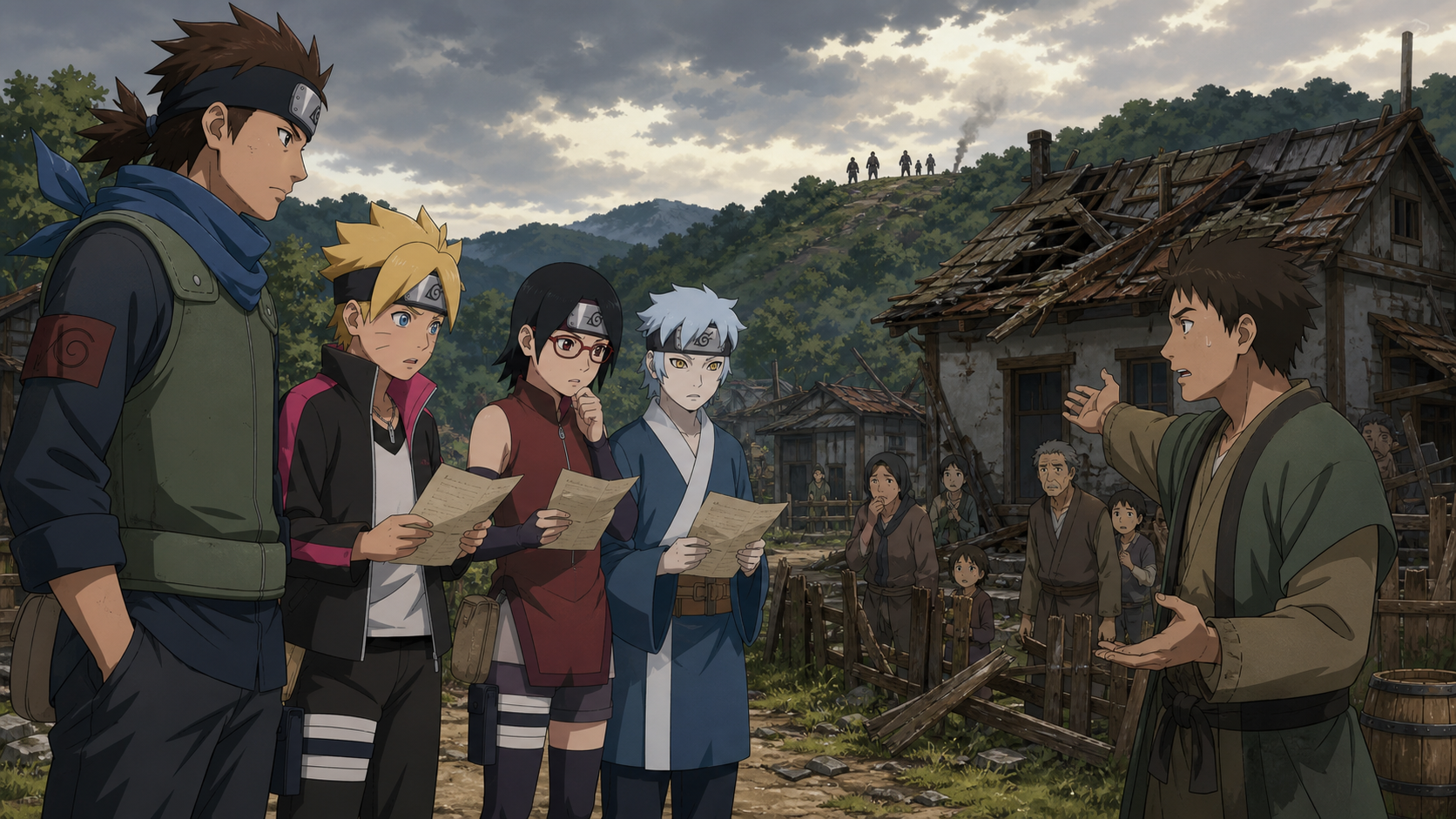
Team 7: The First Mission!
Boruto treats D-rank work like a hurdle until Green Banks, Kiri’s guarded leadership, a bridge deed, and Ashimaru reveal how much danger the mission form missed.
Series: Boruto: Naruto Next Generations
Episode: 40 · Team 7: The First Mission!
Arc: Genin Mission Arc
Release: 2018-01-10
Previous: Episode 39 · The Path Lit by the Full Moon
Directory: All 293 Boruto episodes
Bottom line
Boruto Episode 40 sends the new Team 7 on its first official mission and immediately punishes Boruto for treating D-rank work like paperwork before the “real” adventure. Green Banks is suffering through a drought, neighboring villages are desperate, food is disappearing, and Kiri has inherited leadership after her father’s sudden death. She asked Konoha to repel bandits. What she did not say was that Pale Blue Valley hired shinobi and wants control of the bridge connecting the communities. Konohamaru recognizes that the job is no longer D-rank the second trained opponents enter the picture. Boruto still charges because he wants the first mission to prove something. Ashimaru nearly turns that excitement into a funeral before Konohamaru intervenes. I love how the episode places Naruto’s warning at the front: no mission is something you “get over with.” Boruto hears a father lecturing him. Green Banks makes him understand that the rank on a form does not measure how deeply the outcome matters to the people waiting behind a raised bridge.
Boruto reaches the Hokage’s office already chasing the next rank
Boruto joins Sarada and Mitsuki on the way to receive Team 7’s first mission. Konohamaru explains that fresh genin begin with low-rank assignments. Boruto immediately decides they should finish those jobs as quickly as possible so somebody will hand them better ones. He treats missions like levels in a game, where the early stages exist to be cleared rather than experienced. That attitude feels completely believable for a talented kid raised on stories about famous shinobi. He wants the legend before learning the work.
Naruto refuses to let his son call any mission disposable
Naruto overhears Boruto and says no mission is something a shinobi merely gets over with. The line carries the weight of his entire childhood. Naruto knows what happens when powerful people treat small villages, anonymous clients, or low-ranking ninja as disposable pieces. Boruto hears another correction from a father who always seems ready to become Hokage when he needs Dad. I hear Naruto trying to give his son the lesson beneath every old Team 7 disaster: somebody trusted you enough to ask for help.
Green Banks sounds easy on paper
The assignment is to drive bandits away from a small village called Green Banks. A drought has damaged harvests throughout the area, and nearby farming communities are stealing food from storehouses. Boruto hears “bandits” and imagines a quick fight. The mission description makes hunger sound like a combat category. Before Team 7 even leaves Konoha, the situation contains more than a target. Crops failed, several villages need food, and one community’s protection can push desperation toward another community.
Sarada is offended when Boruto makes the whole team look unserious
Konohamaru tells them to take the assignment seriously, and Sarada bristles at being grouped with Boruto’s attitude. Her path toward becoming Hokage already includes a mental record of how each mission reflects on her judgment. Boruto wants recognition now. Sarada wants a reputation sturdy enough to support leadership later. Their priorities clash, but both are thinking about how the work will be seen. Mitsuki watches them bicker and says they get along well, which naturally annoys them both because he is correct.
Hinata remembers a first mission shaped by war
At home, Boruto asks Hinata about her first mission. She remembers being nervous because the world was less stable and shinobi work carried more danger. Hinata does not sell him a thrilling story. She tells him a first mission is not necessarily something to celebrate like a performance. I appreciate this scene because Boruto rarely asks his mother about her ninja life. Hinata was a genin, fought in war, and learned what missions cost. Her quiet answer gives Boruto context he is not ready to absorb.
Peace is why Boruto gets to be disappointed
Boruto thinks low-risk missions diminish him. The adults know those missions are evidence that Naruto’s generation changed the world. Children can begin with crop theft instead of assassinations because peace created room for training to be gradual. That does not make Green Banks unimportant. Peace changes which dangers reach genin first. Boruto’s frustration is a privilege built from victories he knows mostly as family history.
Team 10’s first assignment is hilariously ordinary
Shikadai, Inojin, and Chōchō escort a wealthy woman while carrying her purchases. Shikadai and Inojin look like every complaint they have ever swallowed has gathered in their arms. Chōchō chats comfortably with the client because of course she does. The cutaway is funny and useful. Not every first mission contains an ambush. Teamwork can begin through bags, patience, conversation, and surviving somebody else’s shopping schedule. Boruto would hate every second, which is precisely why he needs the comparison.
The road lets Team 7 rehearse its old argument
On the way to Green Banks, Sarada warns Boruto not to damage her record or interfere with her Hokage ambition. Boruto pushes back. Mitsuki observes their chemistry. Konohamaru reminds them not to resolve problems independently. This team already knows how to fight beside one another, but accepting a leader and a client changes the shape of responsibility. Academy exercises let them chase solutions. A mission requires them to carry somebody else’s priorities.
A wild boar humiliates their combat readiness
A rustle in the brush puts all three genin on edge, and the threat turns out to be a wild boar. Konohamaru tells them they have a long way to go if every noise produces that reaction. The gag works because Team 7 has plenty of raw power. What they lack is field rhythm: knowing which sounds deserve alarm, how to spread attention, and how not to broadcast fear. Their first mission begins teaching the boring sensory discipline Boruto keeps undervaluing.
Green Banks lives behind a bridge and a bell
Team 7 reaches a suspended bridge and rings a bell so the village can lower the crossing. The entrance makes Green Banks’ vulnerability visible. The bridge protects the settlement, connects trade, and can isolate everyone when raised. Control of that route means control of food and movement during a drought. Pale Blue Valley does not need to destroy Green Banks if the neighboring village can own the connection keeping everyone alive.
Kiri sees children where she expected protection
Kiri looks at Boruto, Sarada, and Mitsuki and doubts whether they can handle the job. Her skepticism stings their pride, but she has a point. Her community is losing food, her father recently died, and the first help crossing the bridge includes three kids. Team 7 sees rank and opportunity. Kiri sees whether these strangers can keep people fed. The age gap between genin power and genin appearance has always been one of Naruto’s strangest tensions, and Episode 40 lets the client react honestly.
Kiri inherited a title before she had space to grieve
The previous village leader died around the time the attacks began, leaving his daughter in charge. Kiri carries his reputation while trying to manage drought, theft, and pressure from neighboring Pale Blue Valley. She is young, guarded, and determined to prove she can solve the crisis without becoming the leader who lost everything. Her secrecy is dangerous, but the episode gives that secrecy an emotional source. Kiri thinks asking for more help means admitting she cannot fill her father’s place.
Drought turns neighboring villages into competitors
Green Banks has defended its stores while surrounding farming communities face the same failed harvests. Scarcity creates conflict between people who would rather be trading. The attacks are not only hungry residents grabbing food, though. Pale Blue Valley wants the bridge and has hired shinobi to force the issue. Powerful actors use the drought as cover for expansion. Once again, Boruto enters a problem where visible “bandits” are only the nearest layer.
Kiri withholds the shinobi because the truth changes the mission
Kiri reveals that Pale Blue Valley hired trained ninja. Konohamaru immediately says shinobi opposition would raise the assignment to at least B-rank, beyond what he believes new genin should face. This is the crucial information she should have shared with Konoha. I understand why she feared the cost or cancellation. I also understand Konohamaru’s anger. He cannot plan around an enemy nobody names, and the children trusted him to know what kind of danger they were entering.
Konohamaru asks the question the mission form missed
He presses Kiri to explain what Pale Blue Valley truly wants. The answer is not merely food. The bridge deed is the prize. Once Konohamaru knows that, every attack makes strategic sense. Starve confidence, prove the young leader cannot protect supplies, and force Green Banks to surrender the route. Accurate information turns scattered raids into a coherent threat. Konohamaru’s leadership shows through his insistence that the client stop protecting the secret and start protecting the people.
Boruto still hears “real shinobi” as an invitation
Learning that trained enemies are involved should make Boruto cautious. Instead, part of him lights up because the mission finally looks worthy of Team 7. That excitement does not mean he wants Kiri hurt. Boruto has not yet separated danger from validation. If he defeats a real shinobi on his first mission, nobody can call the assignment small. Ashimaru is about to teach him how little the enemy cares about his coming-of-age narrative.
The first attack exposes the difference between confidence and readiness
When the hired shinobi strike, Team 7 reacts with skill but limited field experience. Boruto moves aggressively, convinced that initiative will close the gap. Ashimaru reads him, counters, and nearly lands a fatal blow. Boruto has trained hard. He is still a new genin facing an adult who treats combat as paid work. Talent does not erase that difference.
Konohamaru intervenes before the lesson becomes permanent
Konohamaru blocks Ashimaru’s attack and protects Boruto. The save is not an embarrassment for Team 7. The jōnin leader is doing the exact job Konoha assigned him. He recognizes that the threat exceeds the mission and places himself between a student and the consequence. Boruto wanted independence because independence looks impressive. Survival comes through the adult he was tempted to treat as a chaperone.
Ashimaru retreats because the children were never the real objective
The enemy receives an order to withdraw rather than fighting Konohamaru to the end. That retreat confirms organization. These are not random hungry bandits taking whatever they can carry. Somebody is coordinating targets, timing, and acceptable risk. Boruto can no longer pretend a quick victory will close the case. The attack was reconnaissance and pressure inside a larger plan.
Kiri disappears while everybody is learning the truth
The episode ends with Kiri kidnapped, turning the bridge dispute into ransom leverage. Her effort to protect the village alone gives Iori and the hired shinobi the opening they expected. Team 7’s mission changes before the first day can settle. They came to repel bandits. Now they have to rescue the village leader from trained opponents who know exactly what deed they want. The cliffhanger earns Episode 41’s urgency.
Naruto’s warning follows Boruto across the whole mission
No mission is something to get over with. The line sounds almost quaint in the Hokage’s office and devastating after Kiri vanishes. Boruto treated D-rank work as a gate keeping him from better stories. Green Banks is somebody’s entire world. The food stores, bridge, bell, and young leader all matter regardless of what letter Konoha printed on the assignment. Naruto did not ask Boruto to think small. He asked him to understand that service has no disposable rank.
Sarada’s record becomes about more than promotion
Sarada begins worried that Boruto’s behavior will stain her progress toward becoming Hokage. Green Banks makes the ambition concrete. A Hokage sends children based on the information available, trusts a jōnin to protect them, and owes remote villages serious attention even when the fee says D-rank. Sarada cannot reduce leadership to a clean personal record after seeing Kiri struggle under her own inherited title. Both girls are learning that the position is responsibility before prestige.
Mitsuki watches the team become something chosen
Mitsuki comments on Boruto and Sarada’s chemistry, follows Konohamaru’s instructions, and remains calm when the mission shifts. He is often the least visibly rattled person in the group, but Episode 40 matters for him too. This is the first time his connection to Boruto and Sarada becomes a working team identity outside the Academy. Mitsuki has chosen Boruto as his sun. The mission begins teaching him how to choose the team around that light.
Kiri and Boruto share the same dangerous need to prove themselves
Boruto wants to show that Team 7 deserves higher-ranked work. Kiri wants to show that she deserves her father’s position. Both minimize risk because admitting uncertainty feels like surrendering the identity they want. Boruto charges Ashimaru. Kiri hides the shinobi threat. Neither choice comes from cowardice. Both choices endanger other people. Episode 41 will give them the same answer through different scenes: strength grows when somebody else is allowed to help.
What changed on every replay
My first watch remembered the wild boar joke and Konohamaru saving Boruto from Ashimaru. On replay, Hinata’s answer about wartime missions became much more important. Boruto’s safe boredom is part of what her generation fought to create. Another pass made the bridge feel like the real character at the center of the dispute. Green Banks raises the crossing for Team 7, Pale Blue Valley wants the deed, and Kiri will become leverage because ownership of that route decides the village’s future. The final detail I kept returning to was Naruto’s face when Boruto said they could get the low-rank missions over with. He already knew somebody would be waiting at the other end.
Peace makes small missions possible, not meaningless
Boruto compares his first assignment to stories from Naruto’s generation and sees a downgrade. Catching animals, guarding travelers, or resolving local disputes cannot compete with wars and legendary enemies in the version of shinobi history he inherited.
Hinata understands the comparison from the other side. Her first missions existed inside a world where children could meet lethal danger before understanding what the mission meant. Boruto’s boredom is evidence that the old generation succeeded at creating safer ordinary life.
Safety still carries responsibility. A lost animal matters to the owner. A bridge matters to villages dependent on trade and water access. A client matters before the assignment becomes dramatic enough to impress Boruto.
Naruto hears danger in the phrase “get the low-rank missions over with.” Rank measures expected risk, not the value of the person waiting at the destination. Treating a D-rank client as a training prop creates exactly the carelessness enemies can exploit.
The wild boar exposes that gap through comedy. Team 7 has techniques, confidence, and a famous name. The animal ignores the résumé. Coordination collapses because each genin approaches the task as an individual performance.
Konohamaru keeps the humiliation useful. He does not rescue their pride. He lets the team see that basic field discipline matters before a trained shinobi ever appears.
Green Banks then proves how quickly a simple mission changes when the form contains incomplete information. The bridge, drought, deed, and pressure from Pale Blue Valley transform local protection into a struggle over survival and control. Low rank never guaranteed low importance.
Kiri and Boruto share the same dangerous definition of leadership
Kiri inherited her father’s title while still grieving. Villagers look toward her for continuity, and she mistakes continuity for becoming capable of everything alone. Admitting fear feels like admitting that the inheritance was a mistake.
Boruto arrives with a similar need. He wants Team 7 to earn prestigious work and treats every complication as a chance to prove readiness. Asking Konohamaru for help feels like losing the argument about whether the children can handle a real mission.
Both choices minimize risk through silence or bravado. Kiri hides the presence of enemy shinobi. Boruto charges Ashimaru before the team has a reliable plan. Neither act comes from selfish indifference. Each person wants to protect an identity under pressure.
The harm reaches other people. Kiri’s silence prevents Team 7 from evaluating the real threat. Boruto’s charge forces Konohamaru to intervene before Ashimaru turns a lesson into a fatal result. Proving personal worth becomes more important than giving the group accurate conditions.
Sarada recognizes the problem because she already thinks about leadership as responsibility. Her irritation with Boruto is not only about promotion records. His behavior makes the whole team less able to protect the client.
Mitsuki watches the argument with familiar calm, but his position matters too. He has chosen Team 7 as part of a life built outside Orochimaru’s plans. Every reckless solo act tests whether the group can become something stable enough to deserve that choice.
Konohamaru asks what the mission form missed because professional leadership depends on revising assumptions. The original assignment no longer describes reality. Continuing as though nothing changed would protect bureaucracy instead of people.
Kiri disappears while everybody processes the truth, showing how isolation creates openings. The enemy does not need to defeat Team 7 directly when pressure can convince the client to separate herself.
Episode 40 therefore gives Boruto and Kiri the same unfinished lesson. Strength does not mean carrying every threat alone. Leadership begins when somebody else receives enough truth to help.
RaeRae’s final reaction
Episode 40 is a good first-mission story because Team 7 does not arrive polished. Boruto is overeager, Sarada is protective of her record, Mitsuki is watching everybody, and Konohamaru has to remind them that clients are not training props. Kiri is not written as a perfect victim either. She hides the worst part of the threat because grief, money, and inherited expectations have convinced her that leadership means carrying everything alone. I wanted to shake both her and Boruto, which usually means the parallel worked. The mission begins with stolen food and ends with a kidnapped leader, a bridge deed, and trained shinobi. D-rank never looked so fragile.
Sources and lawful viewing
Official episode reference: Naruto Official episode guide
Licensed episode route: Crunchyroll licensed series page