
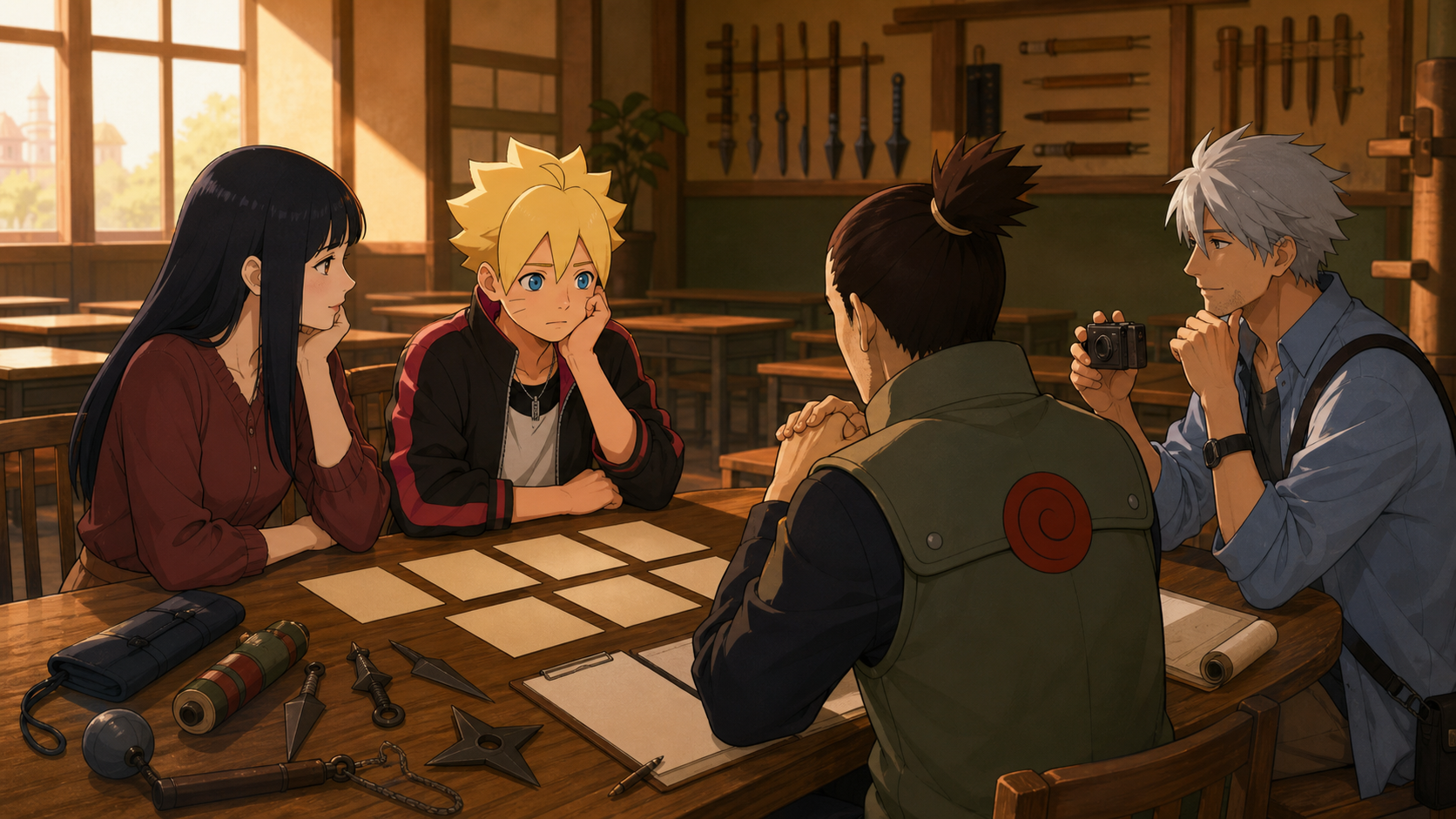
The Parent-Teacher Conference!!
Boruto cannot explain his future, Hinata opens the Hyūga family history, and Sukea’s class interviews reveal the reason Boruto keeps pulling people together.
Series: Boruto: Naruto Next Generations
Episode: 35 · The Parent-Teacher Conference!!
Arc: Academy Graduation Arc
Release: 2017-11-29
Previous: Episode 34 · The Night of the Shooting Stars
Directory: All 293 Boruto episodes
Bottom line
Boruto Episode 35 takes the loudest child in class, sits him between his mother and teacher, and discovers that nobody in the room can get a straight answer about why he wants to become a shinobi. Boruto has the grades. He has the bloodline. He has enough natural ability to treat the graduation exam like another obstacle that will politely move when he arrives. What he does not have is a future he chose on purpose.
Sukea enters as a curious journalist and lets Boruto hear classmates describe ambitions, family pressure, and fear. Of course Sukea is Kakashi in disguise, because apparently Sixth Hokage retirement includes freelance investigative cosplay. The trick works because Boruto finally understands that everybody around him has been making decisions while he has been coasting toward graduation. His eventual answer is still imperfect. He wants the class to remain together, so he will become a shinobi and figure out the rest later. Yet that answer contains something real: Boruto’s deepest motivation has never been rank. His gift is pulling people toward one another, and Mitsuki is the first person who makes him see that gift clearly.
Boruto walks into the conference expecting praise
Shino tells Hinata that Boruto occasionally lacks commitment in class but performs exceptionally well. Nothing about that assessment surprises Boruto. He knows school comes easily. His confidence has been rewarded often enough that graduation feels less like a decision than the next page turning itself.
The conference becomes uncomfortable only when Shino asks what kind of shinobi Boruto wants to be. Skill cannot answer that question. Boruto has prepared to prove he can graduate, not explain what graduation means to him.
Hinata hears the hesitation immediately
Hinata does not need a Byakugan to see Boruto scrambling. She sits beside him with that calm maternal attention that somehow feels more exposing than a lecture. Boruto cannot hide behind Naruto’s fame because Hinata knows the child underneath the surname.
Her presence keeps the scene from becoming a simple teacher evaluation. Shino can describe performance. Hinata understands the family assumptions wrapped around that performance. Both adults recognize that Boruto’s easy answer is not an answer at all.
Shino is proud and worried at the same time
Shino has watched Boruto change the class, solve crises, ignore instructions, and pull off results that should have required more preparation. A teacher can admire that student and still lose sleep over him. Boruto’s ability means he may pass tests without developing respect for what those tests represent.
Shino’s concern feels earned because he is not denying Boruto’s strengths. He is asking whether talent has allowed Boruto to avoid choosing a direction. Graduation will place real responsibilities behind skills Boruto currently treats like toys he happens to use well.
“I’ll figure something out” sounds different near graduation
Boruto assumes inspiration will arrive before the deadline. That attitude has served him in battles where the next thirty seconds matter more than the next five years. A career does not cooperate with the same rhythm.
The line is also deeply teenage. Plenty of children stand near a major transition and discover that adults expect a polished identity on command. Boruto’s uncertainty is not a moral failure. His indifference is what alarms Kakashi later. Not knowing is honest. Pretending the choice deserves no thought is the dangerous part.
The classmates have answers because life pushed them
Boruto and his friends compare parent-teacher conferences. Their plans reflect family traditions, personal interests, and the kinds of pressure each child understands. Even uncertainty has a shape when somebody has wrestled with the question.
Boruto listens for one explanation that will suddenly make shinobi life feel necessary. None arrives. His friends can explain their reasons, but borrowed conviction will not fit him. He has to find the part of the future that belongs specifically to Boruto Uzumaki.
Graduation threatens the class before anyone fails
The students discuss the graduation exam, possible proctors, and stories about earlier tests. Underneath the speculation is a quieter fear. Graduation means teams. Teams mean separation. The classroom that became Boruto’s social world will not continue in the same form.
Episode 34 already showed Boruto trying to preserve one last class memory through the Eternal Carp camping trip. Episode 35 reveals that his career anxiety is tangled with the same fear. Becoming a shinobi feels obvious partly because everybody he loves appears to be moving in that direction.
Sukea arrives with a camera and suspicious timing
After class, Sukea approaches Boruto as a journalist writing about graduating students. Boruto sees an opportunity to show off his fascinating classmates. Sukea sees a route into the class before serving as their exam proctor.
Kakashi’s disguise remains one of the funniest recurring bits in the franchise because he commits completely. Different face, different voice, little camera, and the confidence of a man who knows nobody expects a former Hokage to spend his afternoon conducting student interviews under an alias.
Boruto becomes Sukea’s enthusiastic producer
Boruto takes Sukea around to interview classmates. That choice says more about him than his conference answer did. When asked about his own future, he has nothing. When offered a chance to spotlight other people, he becomes instantly useful.
He knows who has an interesting story. He can move between social circles without making the shift feel forced. Boruto may not know what kind of shinobi he wants to become, but he already behaves like somebody who notices connections and creates room for people to be seen.
Every interview gives Boruto a different mirror
Sukea’s questions let Boruto hear his peers explain themselves in complete sentences instead of playground shorthand. Friends stop being familiar personalities for a moment and become young people making choices under pressure.
The episode does not need every interview to become a dramatic confession. The accumulation matters. Boruto has assumed graduation is happening to the class as one shared event. Sukea reveals many separate decisions hiding inside that collective milestone.
Sukea asks the question Boruto keeps dodging
Why did Boruto join the Academy? Boruto says he wanted to become better than his father. That answer contains years of frustration, admiration, competition, and longing. Naruto remains the measuring stick even when Boruto insists he wants distance from him.
Wanting to surpass Naruto can get Boruto through training. Surpassing somebody is not a complete life plan. Once the comparison is removed, Boruto still has to decide what he wants to protect and what kind of responsibility he is willing to carry.
Boruto’s relationship with Naruto clouds every career answer
Shinobi life is not an abstract profession inside the Uzumaki home. The Hokage’s work is the reason Naruto misses meals, conferences, and ordinary family moments. Boruto experiences public service through an empty chair as often as through heroic stories.
That conflict makes his uncertainty richer. He wants to beat Naruto and gain Naruto’s recognition, but following the same broad path risks repeating the life that made him resentful. No wonder his answer keeps collapsing into attitude.
Hinata tells the truth about Hyūga expectation
At home, Boruto asks why Hinata became a shinobi. She explains that becoming one was simply expected of her and Neji as Hyūga children. Boruto is startled to hear how strict Hiashi once was.
The conversation gives Hinata history beyond “supportive mother waiting at home.” She knows what a predetermined future feels like. Her childhood offered far less freedom than Boruto’s, and she refuses to turn that inherited pressure into a rule for her son.
Neji’s name changes the temperature
Mentioning Neji brings family expectation, talent, sacrifice, and stolen choice into the same room. Neji spent years furious at a system that claimed his future before he could speak for himself. Hinata does not need to deliver a speech for that history to matter.
Boruto grew up after Neji’s sacrifice and inside the gentler Hyūga family that sacrifice helped reshape. The freedom to choose is part of what the previous generation bought for him. Taking time to choose does not dishonor them. Refusing to think about the choice would.
Hinata supports Boruto without demanding a replica
Hinata tells Boruto that she and Naruto will support him whether he becomes a shinobi or not. That promise is one of the episode’s warmest moments because she does not treat his talent as family property.
She has every reason to understand tradition, and she chooses freedom for her child. Hinata’s strength here is quiet but firm. Boruto does not owe the village a uniform merely because his parents wore one.
Naruto’s empty place still interrupts the reassurance
Boruto wonders whether Naruto would truly support another path and notices his father’s absence again. The doubt is not irrational. Naruto loves his children, but the Hokage role has repeatedly communicated priorities through absence.
Hinata can speak with confidence about Naruto’s heart. Boruto is still waiting for Naruto’s presence to confirm the promise. The episode lets both truths live together without turning the family into villains or pretending love automatically solves scheduling wounds.
Namida’s decision makes uncertainty concrete
The next day, Boruto sees Namida and Wasabi talking. Sarada explains that Namida has decided not to become a shinobi. Suddenly the alternative future is not theoretical. One of their classmates may step away.
Boruto’s first response is tied to loss. If Namida leaves the path, the class will not remain together. Her personal decision collides with his wish to preserve the group, and he has to learn that caring about somebody does not mean choosing for her.
Peace created careers beyond the forehead protector
Sukea explains that declining demand for shinobi has made Academy skills valuable in civilian fields. That detail is one of Boruto’s most interesting pieces of worldbuilding. Konoha built an education system around war and missions, then peace widened what trained children could become.
The Academy is no longer only a conveyor belt toward combat service. Observation, discipline, chakra control, strategy, and teamwork can travel elsewhere. Boruto’s generation inherits options that Naruto’s generation barely had time to imagine.
Orochimaru attends a conference because this show loves chaos
Boruto tries to bring Mitsuki to Sukea, but Mitsuki is late for his own parent-teacher conference. The parent is Orochimaru. Somewhere in Konoha, normal conference etiquette takes one look at that situation and quietly leaves the building.
Naruto meets Orochimaru while Shikamaru remains understandably suspicious. Naruto still thanks him for analyzing Danzō’s data, which aided Sasuke’s investigation. The scene folds enormous old-generation history into a routine school obligation and somehow plays both tension and comedy.
Mitsuki’s future cannot be separated from Boruto
Mitsuki later says he wants to remain a shinobi in Konoha because of Boruto. That answer could sound alarming from anybody else, but Mitsuki speaks from a life built around discovering his own will. Boruto became the sun he chose to follow while learning what choice means.
The responsibility lands on Boruto whether he requested the role or not. Somebody he loves has built a future partly around him. Boruto’s influence is already larger than his self-image.
Sarada hesitates because helping can become interference
Sarada does not immediately involve herself in the conflict between Namida and Wasabi. Her hesitation makes sense. Namida’s family pressure is personal, and barging into somebody’s decision can cause more harm than support.
Boruto challenges Sarada by connecting the moment to her Hokage ambition. If she is too afraid to engage with a friend’s difficult problem, how will she carry the village’s problems? The point is not that every leader should invade private choices. The point is that care sometimes requires asking the uncomfortable question.
Namida finally says what she wants
Sarada talks with Namida and helps her admit that she truly wants to become a shinobi despite family complications. The resolution works because Sarada does not manufacture a dream for her. She creates enough pressure and safety for Namida’s own desire to surface.
Wasabi’s concern also comes from attachment rather than simple judgment. These children are learning that a friend’s future belongs to that friend, while friendship can still provide courage to speak honestly.
Boruto’s best advice appears when somebody else needs clarity
Boruto cannot explain his own career, yet he knows exactly how to push Sarada toward hers. He remembers her ambition, recognizes the fear holding her back, and says the sentence that reconnects her action to her goal.
That pattern is Boruto all over. Self-reflection makes him squirm. Reading a friend in motion comes naturally. His future may not begin with a title. His future begins with the role he already plays in other people’s lives.
Mitsuki names Boruto’s actual talent
Walking home, Mitsuki points out how Boruto changed Denki, Iwabee, Sumire, and Mitsuki himself. This is the answer Sukea’s interviews have been circling. Boruto’s power is not only clones, lightning, or inherited chakra. He changes the emotional direction of a room.
Sometimes he does that through stubborn loyalty. Sometimes he annoys people into honesty. Sometimes he sees the version of a classmate who could exist and treats that version as real before anybody else does. Mitsuki recognizes the pattern because he is one of the people who found a future through Boruto’s attention.
Wanting everyone together is not childish nonsense
Boruto says he wants everyone to remain together. The wish cannot literally survive unchanged because team assignments and careers will separate the class. Still, the desire reveals his center.
He does not dream first about rank, glory, or becoming Hokage. He dreams about keeping bonds alive. Episode 37 will turn that instinct into the answer Kakashi wants during the bell test. Episode 35 plants the emotional reason before Boruto knows how to name the principle.
Becoming a shinobi first is still a partial answer
Boruto decides he is fine becoming a shinobi and figuring out specifics afterward. Sukea may not consider that sufficient resolve, and honestly, neither do I. Yet Boruto has moved beyond total indifference.
He now knows the decision affects relationships, obligations, and people who look to him. The answer remains unfinished because Boruto remains unfinished. A believable coming-of-age story should leave room for the child to grow after choosing the next step.
Kakashi removes the face and reveals the exam
Sukea speaks with Iruka and removes the disguise. Kakashi wanted to meet the students, gather intelligence, and verify what kind of class he would test. Iruka is grateful Kakashi volunteered as proctor and immediately asks him not to be too hard on them.
Iruka knows this man. That request is the educational equivalent of checking whether a storm has promised to use indoor voices. Kakashi says peaceful times still cannot excuse contemptuous attitudes toward shinobi work and wonders how many students will remain standing.
Sukea was gathering more than cute quotes
The interviews become sharper once Kakashi’s identity is known. He was listening for motivation, pressure points, loyalties, and the assumptions students carried toward graduation. Every friendly question was exam preparation for the examiner.
That hidden layer makes Kakashi effective and deeply nosy. He understands Boruto better before the forest test begins because Boruto unknowingly showed him the gap between ability and commitment. Kakashi will attack that gap without mercy.
RaeRae’s take
This episode had me laughing because Kakashi truly put on an entire second face to conduct career interviews with children instead of scheduling a meeting like a normal adult. Then Mitsuki calmly explained that Boruto changed his life, and suddenly I was emotional in the middle of Kakashi’s undercover journalism project.
Boruto’s answer frustrates me in the right way. He still thinks he can become a shinobi now and discover the purpose later. Sir, that is exactly why the retired Hokage is about to terrorize you with a bell. Yet his wish to keep everybody together is not empty. The class became a class because Boruto keeps reaching across distances other people accept. He has a reason. He just does not understand the adult language for that reason yet.
Hinata gives Boruto freedom without pretending freedom is simple
Hinata's conversation carries more weight than a standard supportive-parent scene because she grew up under a family system that treated duty as identity. The Hyūga clan decided what kind of daughter she should become, measured her against Hanabi, and connected personal worth to inherited ability. Hinata knows how a future can feel chosen before a child has language strong enough to object.
She refuses to repeat that pattern with Boruto. Hinata does not demand the Hokage path, the Hyūga path, or even the shinobi path. She tells him that uncertainty is allowed and that his eventual decision should belong to him. Her support has boundaries, though. Freedom does not excuse drifting forever while teachers and classmates prepare for real consequences. Boruto still has to examine why he keeps moving toward the forehead protector.
Naruto's absence complicates every reassurance she offers. Boruto wants independence from his father while measuring every possible future against Naruto's enormous public shadow. Becoming Hokage would look like imitation. Rejecting the shinobi life could feel like surrendering ground to the father who keeps missing dinner. Hinata understands enough to avoid forcing a conclusion, but she cannot remove the emotional knot for him. Boruto has to separate anger at Naruto from judgment about the work Naruto performs.
Namida proves that choosing another path can require more courage
Namida's family conflict broadens the episode beyond Boruto's privileged uncertainty. Her choice is not between several equally celebrated futures. Family expectations push her toward a path she does not want, and speaking honestly risks disappointing people whose approval matters. The academy has trained her for shinobi work, but training does not create consent.
Sarada's hesitation around Namida also feels honest. Sarada knows how strongly she values the Hokage dream, so she cannot assume that urging somebody else toward graduation counts as support. Helping Namida means listening long enough to understand whether fear is blocking a desired future or warning her away from somebody else's plan. That distinction is easy to flatten in stories where perseverance automatically becomes the moral answer.
Namida finally naming her own desire gives the episode a necessary counterweight. Boruto can afford to say he will decide later because talent and social confidence keep doors open for him. Namida needs clarity because other people are already trying to close a door. Their problems are different, but both children need ownership over the choice.
Kakashi studies motivation because combat skill cannot answer every crisis
The Sukea disguise lets Kakashi collect information that a formal proctor would never receive. Students perform certainty around teachers. A harmless journalist with a camera invites jokes, boasts, and unguarded admissions. Kakashi hears who has a plan, who repeats a family script, who understands the profession, and who expects talent to carry them through.
That intelligence shapes the graduation exam. Kakashi knows Boruto can fight. He needs to discover what Boruto does when confidence collapses and personal success conflicts with loyalty. The interviews are not filler before the action. They establish the emotional pressure points Kakashi will use with frightening accuracy. A bell can test movement. Scarcity, shame, and threatened separation test resolve.
Sources and lawful viewing
“The Parent-Teacher Conference!!” is Boruto: Naruto Next Generations Episode 35 and part of the Academy Graduation arc. The episode follows Boruto’s uncertain conference, Sukea’s student interviews, Namida’s family conflict, Mitsuki’s declaration, and Kakashi’s reveal as the graduation-exam proctor.
Official episode reference: Naruto Official episode guide
Licensed episode route: Crunchyroll licensed series page