
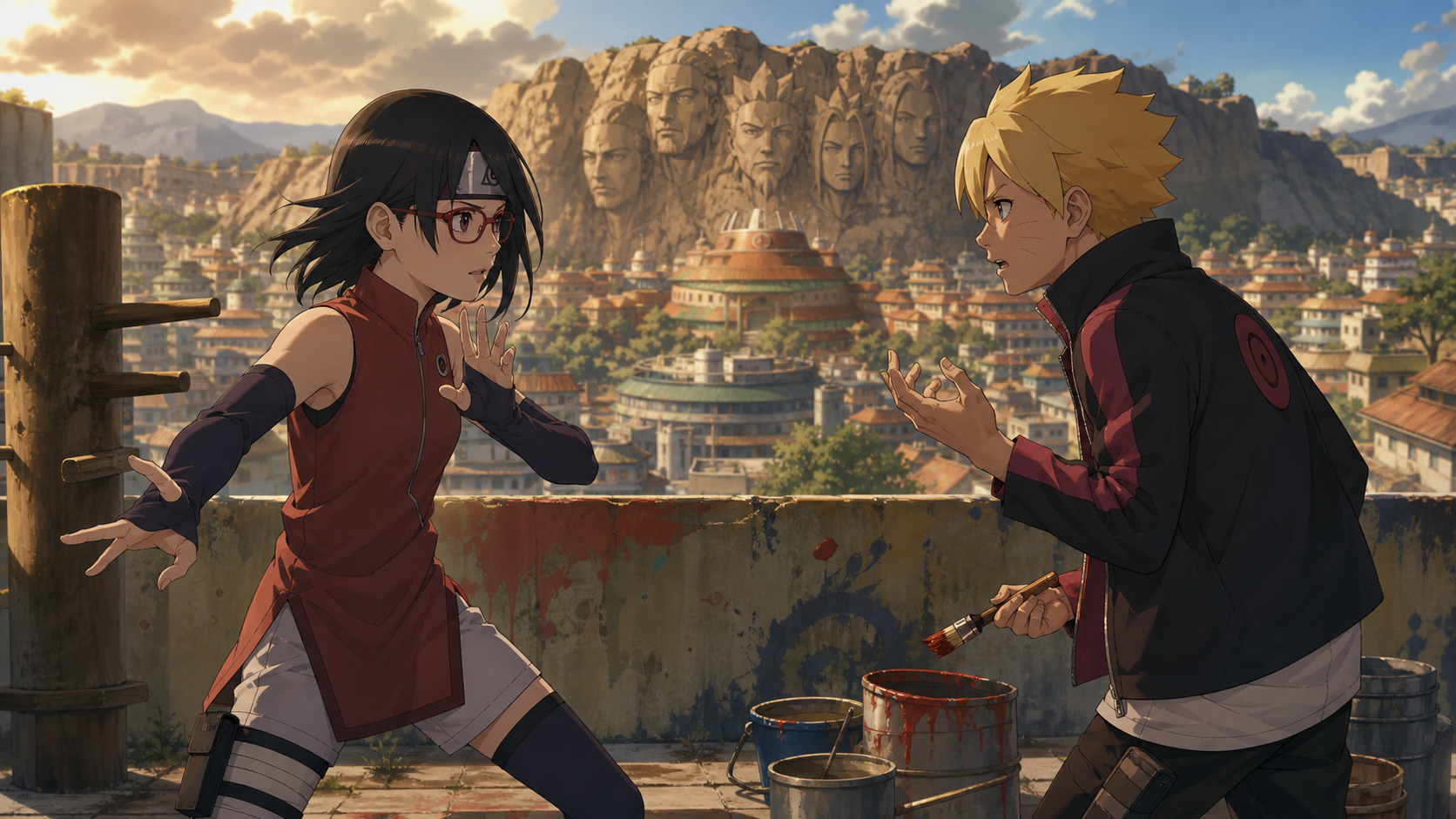
Boruto and Sarada
Sarada chooses the Hokage dream, Boruto chooses paint, and both children fight across Naruto’s stone face while the actual Five Kage discuss a threat beyond Kaguya.
Series: Boruto: Naruto Next Generations
Episode: 24 · Boruto and Sarada
Arc: Sarada Uchiha Arc
Release: 2017-09-13
Previous: Episode 23 · Bonds Come in All Shapes
Directory: All 293 Boruto episodes
Bottom line
Boruto Episode 24 closes Sarada’s family arc by letting her choose an ambition bigger than the questions that started the journey. She wants to become Hokage. Naruto listened to her, protected her, trusted her to fight beside him, and showed her a version of leadership that feels personal rather than ceremonial. Sarada looks at the Hokage Monument and sees a promise. Boruto looks at Naruto’s stone face and sees the office that keeps stealing his father from dinner.
Naturally, the two children process this disagreement by fighting across the monument while Boruto carries paint. Sarada tries to stop him from vandalizing the face attached to her new dream. Boruto mocks the title because the Hokage he knows arrives late, sends shadow clones, and belongs to the village before belonging to his family. Sarada says she will become Hokage. Boruto says he has no interest in the office and eventually slips past her to paint the monument anyway. A draw, according to Boruto. Sarada’s expression suggests the scoring committee disagrees.
Meanwhile, the actual Five Kage meet below them to discuss Sasuke’s investigation into Kaguya’s dimensions and a threat larger than the war generation expected. Some Kage worry peaceful children cannot handle another crisis. Naruto insists the next generation will surpass them. The episode places that confidence beside two Academy students arguing on his face. Naruto may be right. The next generation has power, conviction, and absolutely no respect for wet paint boundaries.
Naruto studies the last damaged tree
Naruto stands beside a tree scarred by the recent Shin conflict and tells Shikamaru only one remains from the attack. The image keeps the previous arc physically present even while Sarada’s family begins rebuilding.
Shikamaru asks whether preparations for the Five Kage Summit are complete. Naruto confirms the village is ready, or at least as ready as Konoha ever becomes before Boruto discovers paint.
Konoha prepares for the Five Kage
The other Kage arrive, bringing guards, attention, and enough security to make Boruto’s next prank objectively harder. The village treats the summit as a major event because the leaders who once met under war pressure now gather as allies.
Peace has changed the room. The danger Sasuke found may change the agenda.
Iwabee and Metal debate the strongest Kage
At the Academy, Iwabee and Metal spar while arguing over which Kage is strongest. Their enthusiasm turns geopolitical leadership into tournament brackets, which feels completely correct for twelve-year-old ninja.
The match accidentally knocks out Shino. The strongest Kage remains undecided. The weakest classroom spatial awareness has a winner.
Sarada and Sakura hang the new family photo
Sarada and Sakura place the photograph from Episode 23 inside their rebuilt home. The picture includes the family as Sarada now knows them, not the old image that sent her searching for Karin.
A photograph cannot replace Sasuke’s years away. The new frame still matters because Sarada helped create the reunion rather than inheriting another mystery.
The Uchiha home begins again without pretending nothing happened
Sakura has her daughter back, Sasuke has finally acknowledged the distance, and Sarada has answers. Nobody receives a magical domestic reset.
The house and photo offer a starting point. The family bond survived confusion, but survival should lead to more presence, not merely another beautiful goodbye.
Sarada trains the Sharingan with Chōchō
Sarada practices using her awakened Sharingan while Chōchō keeps her company. Chōchō has spent the entire arc accidentally joining an Uchiha family crisis and remains available for the training epilogue.
Her loyalty deserves snacks, a vacation, and permanent immunity from suspicious parent photographs.
Sakura tells Sarada to keep the eye quiet
Sakura advises Sarada not to announce the Sharingan. Powerful eyes attract people who treat bloodlines like inventory, and the Uchiha family has more than enough history supporting the warning.
Sarada begins her Hokage path by learning that strength can create attention before strength creates safety.
Sarada says the goal aloud
Sarada tells Chōchō she wants to become Hokage. The ambition grows directly from her time with Naruto.
She watched him carry danger without making her feel small. She saw authority listen. For a child who spent years receiving partial answers, that quality matters more than the hat.
Naruto became the example Sarada needed
Sasuke gave Sarada lineage and mystery. Sakura gave her love and endurance. Naruto showed her how leadership can meet a frightened child at eye level.
Her admiration does not diminish her parents. The goal comes from recognizing a trait she wants to build inside herself.
Konohamaru explains the Sharingan
Konohamaru helps Sarada understand the eye and the responsibilities surrounding her new ability. He has spent his life near Hokage ambitions, first chasing Naruto and then building his own path.
Sarada gains a teacher who knows how a dream can begin as imitation and slowly become personal.
Konohamaru declares a rivalry
Konohamaru tells Sarada that becoming Hokage makes them rivals. The line is playful, encouraging, and slightly alarming if one remembers this adult has just challenged an Academy student for future public office.
Sarada accepts the energy. Konoha’s succession planning now includes competitive trash talk.
Boruto sees the summit as a prank window
The heightened security and attention surrounding the Kage give Boruto a reason to target the Hokage Monument again. He wants Naruto to notice, and Naruto is currently busy proving why attention is scarce.
Boruto’s graffiti is childish. The feeling beneath the paint is not.
Shikadai and Inojin decline the invitation
Boruto invites Shikadai and Inojin into the plan. They understand both the appeal and the consequences, which means Boruto proceeds without enough accomplices to distribute blame properly.
Shikadai has inherited the survival instinct that arrives when one’s father works directly beside Naruto.
Sarada catches Boruto at the monument
Sarada discovers Boruto before he can complete the vandalism. She has chosen the Hokage office as her dream and immediately encounters the office’s loudest family critic carrying paint.
The monument becomes a perfect battlefield because each child sees a different person in the same stone face.
Sarada protects a symbol that just became personal
Sarada objects because Naruto’s face represents the leader she admires. Painting the monument feels disrespectful to the people and history she wants to serve.
Her defense has fresh emotional force. Naruto helped restore her faith in bonds, and Boruto is aiming a brush at that faith.
Boruto attacks the office through the father
Boruto does not separate Naruto from Hokage. The title explains every interruption, absence, and shadow clone at home.
When Sarada praises the office, Boruto hears praise for the reason Himawari and Hinata keep waiting. His mockery protects hurt he would rather turn into a prank than name directly.
Their argument becomes a fight
Sarada and Boruto trade attacks across the stone faces. Both are skilled, familiar with one another, and much too stubborn to let the disagreement remain verbal.
The sequence previews the partnership they will eventually build. Sarada holds the line. Boruto searches for the angle nobody expected.
Sarada uses the Sharingan carefully
Sarada’s eye gives her better movement reading, but she has already learned not to flash the new power without thought. The fight tests technique without becoming a grand Uchiha reveal.
Boruto does not yet understand how much changed during her trip with Naruto and Sasuke.
Boruto calls the result a draw
Neither child earns a clean victory, so Boruto declares a draw. The statement mostly means he has located a way to continue the prank while Sarada processes the argument.
Competitive interpretation may be Boruto’s most reliable jutsu.
Boruto paints the monument anyway
He slips past Sarada and succeeds. The Hokage faces receive another layer of Boruto’s resentment, comedy, and desperate need to be noticed.
Sarada tried to protect Naruto’s symbol. Boruto reminds her that symbols have families living beneath them.
The Five Kage discuss Sasuke’s warning
Inside the summit, Naruto shares Sasuke’s findings from other dimensions. Kaguya was preparing for something, and the possibility of enemies beyond her changes the scale of their peace.
The war ended, but the Ōtsutsuki problem did not sign the treaty.
Sasuke investigates where nobody else can travel
Sasuke’s Rinnegan lets him move through dimensions and pursue evidence unavailable to ordinary shinobi. His absence from home has a mission attached, though a vital mission does not make Sarada’s loneliness imaginary.
Episode 24 keeps that tension intact: necessary work can still cost a family.
The older Kage worry peace made children soft
Some leaders question whether the new generation can respond if another war arrives. These children grew up with trains, game cards, tourist field trips, and fewer funerals.
Calling them soft mistakes the point of everything the older generation fought to build. Peace was supposed to give children different problems.
Naruto believes the children will surpass them
Naruto answers with faith. The next generation will grow beyond the previous one, not by recreating the same suffering but by starting from everything their parents learned.
His confidence includes Boruto, even while Boruto decorates his face above the meeting.
Sarada wants the burden Boruto resents
Sarada sees Hokage work as a chance to protect people. Boruto sees the same work consuming the parent he wants at home.
Neither perspective cancels the other. The office saved Sarada during her crisis and disappointed Boruto during ordinary life.
Boruto wants a path outside inherited office
Boruto comes from Hokage blood on both sides of his immediate legacy: Naruto and Minato. Rejecting the title becomes one way to insist he will not become a copy.
Later, Sasuke’s shadow role will offer him another model. Episode 24 plants the difference before either child has a team assignment.
Sarada’s dream is not just becoming Naruto
Sarada admires Naruto, but her leadership will have to carry Uchiha history, Sakura’s strength, Sasuke’s distance, and her own demand for answers.
The dream begins with imitation. The woman who eventually wears the hat would need to make the office hers.
Konohamaru sees both futures coming
Konohamaru recognizes Sarada’s ambition and Boruto’s refusal. He also knows Naruto once vandalized the same monument while dreaming of the title Boruto rejects.
Children declare permanent identities early. Adults who survived childhood know to leave room for surprise.
The monument holds an argument about Naruto’s legacy
Naruto’s stone face is leader, father, hero, absentee, dream, and prank canvas at once. Sarada and Boruto are not arguing over geology.
They are deciding which part of Naruto’s legacy belongs to them and which part they intend to challenge.
Sarada's Hokage dream begins with being seen during a family crisis
Sarada does not choose the office because Naruto delivers a perfect speech about public service. She chooses after watching him make room for her questions, protect her without treating her as useless, and trust her to participate when the Shin conflict becomes dangerous. Leadership becomes real through attention.
That origin distinguishes her ambition from a generic desire for prestige. Sarada has spent much of her childhood trying to understand an absent father and a family story full of gaps. Naruto offers a model where power can create belonging instead of silence. The Hokage becomes the person who refuses to let somebody face uncertainty alone.
Her dream still contains idealization. Sarada sees Naruto during a crisis where his best qualities are visible. She has not lived through the missed birthdays, administrative exhaustion, or family resentment surrounding the office. Boruto's anger supplies the part of the picture she cannot yet see.
Boruto's monument prank is an argument nobody at home has answered
Painting the Hokage faces looks like attention-seeking because Boruto absolutely wants attention. The prank also places his complaint on the public symbol that replaced private time. Naruto's face belongs to the village in stone, on paperwork, and in every conversation about peace. Boruto wants evidence that the father beneath the title still belongs to the family too.
His attack on the monument does not mean he hates what Naruto accomplished. Boruto resents the assumption that public admiration should satisfy a child waiting at home. The village receives Naruto's protection and celebrates the sacrifice. Boruto experiences the sacrifice as an empty chair.
That conflict gives his rebellion more substance than simple misbehavior. Boruto lacks the language and patience to separate Naruto from the office, so he paints the office and waits for Naruto to respond as a father. The cycle keeps failing because punishment acknowledges the prank without resolving the absence.
Their fight works because both children defend a relationship with Naruto
Sarada protects the monument because Naruto has just become personally important to her. Boruto attacks the monument because Naruto has always been personally important to him. They appear to defend opposite positions while acting from attachment to the same person.
The Sharingan lets Sarada read Boruto's movement, but she uses the eye carefully rather than turning the disagreement into a serious assault. Boruto responds with improvisation and enough pride to call the outcome a draw. Their techniques already express their values. Sarada observes, plans, and protects a chosen goal. Boruto disrupts, adapts, and refuses a conclusion imposed by somebody else.
Neither wins the argument. Sarada cannot tell Boruto that public leadership should erase private harm. Boruto cannot tell Sarada that Naruto's family failures make his leadership meaningless. The unresolved draw is the correct result because both possess evidence the other needs.
Sakura and Sarada hanging the new photograph begins repair without pretending repair is complete
The Uchiha home receives a new family image after years built around an old, misleading picture. The act is gentle, but the episode does not claim one photograph solves Sasuke's absence or Sakura's earlier secrecy. A truthful image can begin replacing a false arrangement. The relationships still require time and presence.
Sarada's Sharingan becomes part of that beginning. She awakened the eye through powerful emotion connected to family, then entered a conflict that could have pushed the ability toward fear and revenge. Training with Chōchō lets the eye exist inside friendship and ordinary life. Sakura's warning to keep the ability quiet protects Sarada from unwanted attention without treating the eye as shameful.
The home scene gives Sarada a foundation strong enough to imagine a public future. She does not need every family question answered before choosing an ambition. She needs enough truth to stop living inside somebody else's photograph.
Konohamaru recognizes a rivalry that can keep both dreams honest
Konohamaru understands the Hokage dream as a lived aspiration rather than a decorative slogan. He chased Naruto, studied the office, and built his own identity beside a famous family name. Hearing Sarada declare the goal allows him to recognize genuine commitment.
His rivalry declaration carries humor, but the moment also gives Sarada another adult who takes her ambition seriously. Nobody tells her that the Uchiha history makes the office impossible or that a girl should choose a smaller role. Konohamaru responds as a competitor and future mentor.
Boruto's resistance creates a different kind of pressure. Sarada will need to understand the private costs hidden by public symbols if she wants to lead well. Boruto will need to understand that rejecting Naruto's office does not remove his own responsibility to other people. Their friction can expose the blind spots inside both paths.
The Five Kage summit gives the children's argument a larger horizon
While Boruto and Sarada fight over paint, the Kage discuss Sasuke's warning and threats connected to Kaguya's world. The adults carry knowledge the children do not possess, and Sasuke works in places far beyond the village's public life. The peaceful setting depends on labor and danger mostly invisible to the Academy class.
The older Kage worry that peace may have weakened the next generation. Naruto answers with confidence that the children will surpass them. His belief does not require the children to reproduce wartime childhoods. Surpassing can mean developing strength without the same trauma, building cooperation before catastrophe, and questioning institutions their parents had no time to question.
Sarada and Boruto already demonstrate that possibility. She studies leadership through care. He challenges the cost of leadership from inside the Hokage's family. Their concerns may look small beside an otherworldly threat, but those concerns will shape what they protect when the threat arrives.
Sarada wants the burden while Boruto wants freedom from inherited expectations
Sarada sees the Hokage title as a chosen route toward service and recognition. Boruto sees the same title as an inherited expectation waiting to swallow his identity. Being Naruto's son means every success can be attributed to blood and every failure can be measured against a legend.
His desire for another path is not laziness. Boruto wants achievements nobody can file beneath the Hokage's name. Sarada's ambition is equally personal. Becoming Hokage would let an Uchiha girl define the clan's relationship to Konoha through public trust rather than inherited suspicion.
The episode does not force one dream to validate the other. Sarada can move toward the hat. Boruto can move toward work outside the spotlight. Their futures become complementary only if each child retains the right to choose.
Boruto Episode 24 gives the next generation two directions
“Boruto and Sarada” ends one family arc and quietly establishes the central partnership of the next era. Sarada leaves the Shin conflict wanting to stand where Naruto stands. Boruto watches the same Hokage and wants distance from a title that has taken too much space inside his home. She will chase the public light. He will eventually look toward Sasuke’s work beyond public view.
The Five Kage summit raises the threat of Kaguya’s world while the children fight over paint. That contrast is not proof that the new generation is unserious. The older generation once fought over loneliness, recognition, clan resentment, and who got to define strength. Those personal conflicts became the foundation for world-changing choices.
Naruto tells the Kage that these children will surpass them. Sarada has already chosen the hat. Boruto has already chosen to challenge whatever the hat demands. Their argument on the monument shows why they may need each other. Sarada can remind Boruto that leadership can protect people. Boruto can remind Sarada that every symbol has a home beneath the stone.
Sources and lawful viewing
Official episode reference: Naruto Official episode guide
Licensed episode route: Crunchyroll licensed series page