
Bonds Come in All Shapes
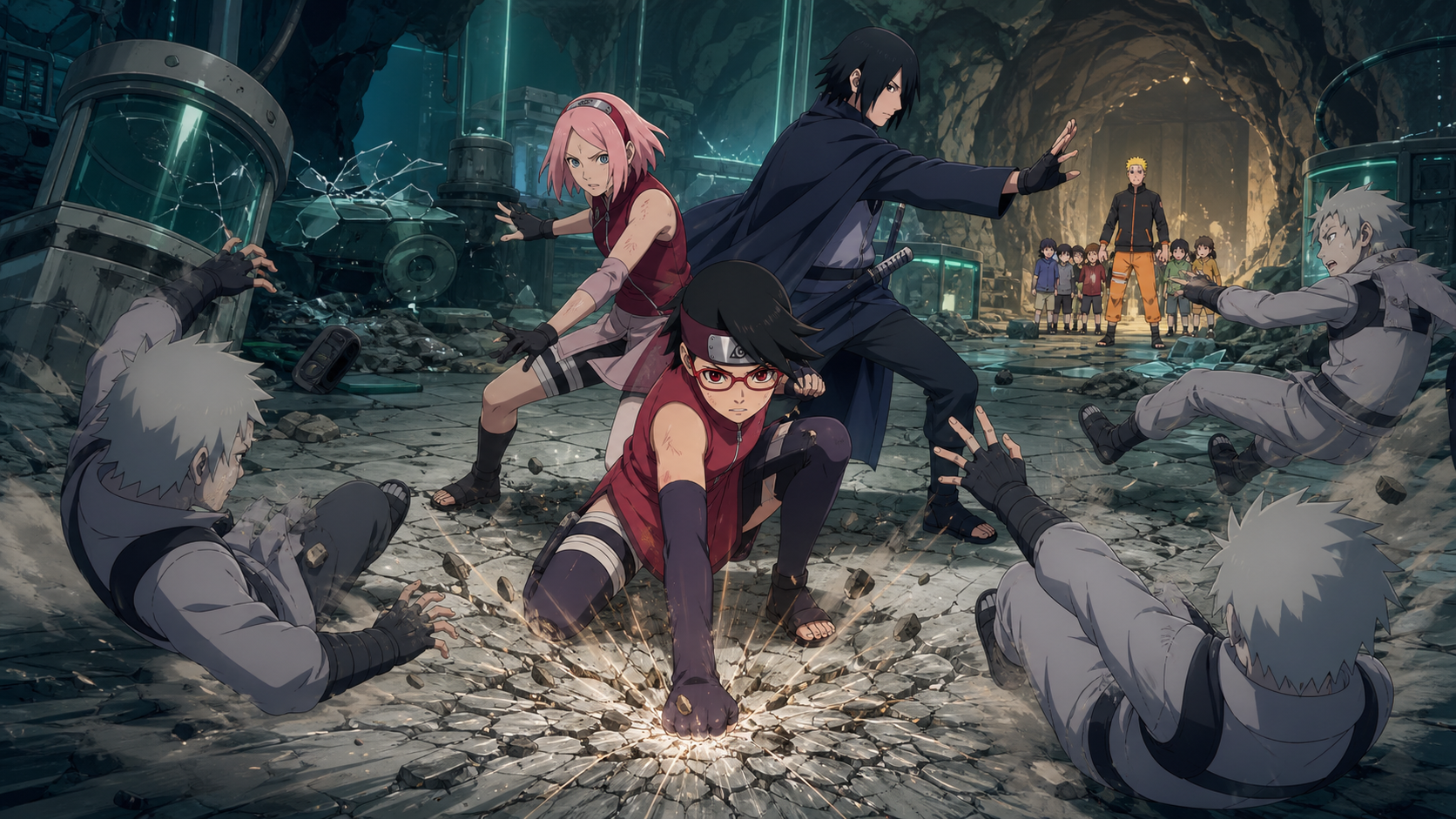
Sakura and Sasuke turn one look into a finishing combo, Sarada introduces Shin’s clone army to her mother’s strength, and Karin explains Suigetsu’s disastrous DNA test.
Series: Boruto: Naruto Next Generations
Episode: 23 · Bonds Come in All Shapes
Arc: Sarada Uchiha Arc
Release: 2017-09-06
Previous: Episode 22 · Connected Feelings
Directory: All 293 Boruto episodes
Bottom line
Boruto Episode 23 gives Sakura the fight the Sarada arc has been promising, gives Sasuke and Sakura approximately four seconds of eye contact worth more than several marriage certificates, and gives Sarada a chance to punch the ground so hard that an army of Shin clones learns genetics through impact. “Bonds Come in All Shapes” closes the mystery by showing the Uchiha family in motion before explaining the umbilical cord that Suigetsu should never have touched.
Sakura spends captivity studying Shin’s body and ideology, then opens the rescue with a punch instead of waiting near the operating table. Sasuke reaches her, loses a leg from Susanoo because the anime wants drama, and coordinates a Rinnegan switch with Sakura without either spouse needing to announce a plan. Sarada watches them understand each other across twelve years of distance. Their marriage is still ridiculous. Their combat trust is not.
The biological answer arrives later. Sakura is Sarada’s mother. Karin helped deliver Sarada while Sakura traveled with Sasuke. The “Karin sample” was Sarada’s own umbilical cord, meaning Suigetsu compared Sarada with Sarada and somehow treated a perfect match as a maternity investigation. Science has filed a complaint. By then, Sarada already knows the answer that matters emotionally. Sakura came when she was in danger. Sasuke came for Sakura. Sarada came for both.
Sakura listens while Shin explains his terrible plan
Shin talks about reviving Akatsuki and returning the world to conflict because war drives evolution. Sakura keeps him speaking while studying his condition, his blades, and the children surrounding him.
He mistakes a medical ninja’s attention for agreement. Sakura is diagnosing the man she intends to hit.
Shin thinks family means replacement parts
The clones call Shin father, but he treats them as bodies, organs, and obedient extensions. One injured child already became surgery material.
Shin wears the Uchiha name while missing the family bond Sarada has spent the arc trying to understand. Eyes and symbols cannot manufacture care.
Sakura attacks before the rescue arrives
Sakura finishes gathering information and drives a fist into the battlefield. The punch throws debris, breaks Shin’s control of the conversation, and reminds everyone that kidnapping Sakura creates a hostage only until Sakura gets bored.
She tells Shin that attacking her husband and daughter was the wrong choice. Understatement survives another episode.
Naruto, Sasuke, Sarada, and Chōchō reach the hideout
The rescue group arrives through Sasuke’s Susanoo and finds Shin’s clones waiting. Sarada refuses to remain behind because saving Sakura has become her decision.
Chōchō remains inside an Uchiha rescue mission she joined while looking for her “real” father. Commitment deserves recognition even when the original premise has collapsed.
Naruto handles the clone army
Naruto stays with the children blocking the path while Sasuke and Sarada move toward Sakura. His shadow clones and chakra give the others room to reach the central fight.
The Hokage protects Sarada’s chance to save her mother rather than taking every decisive moment for himself.
Sarada runs ahead because this rescue belongs to her
Sasuke warns Sarada, but she keeps moving. The girl who began the arc chasing answers now chases the parent she briefly believed was not biologically hers.
The DNA result hurt. The danger clarifies which bond Sarada will act on before any adult corrects the laboratory disaster.
Shin pins Sakura’s arm with blades
Shin uses his Mangekyō-linked weapon control to drive blades into Sakura and restrict her movement. The attack turns every marked object into part of his reach.
Sakura absorbs the pain, studies the angle, and waits for the opening her husband is about to create.
The giant shuriken arrives for maximum drama
Shin sends a huge shuriken toward Sakura while she remains pinned. The weapon is large enough to carry several episodes of Uchiha family communication problems.
Sasuke interrupts before impact. Sarada watches her father move for Sakura without hesitation.
Sasuke reaches Sakura before explaining anything
Sasuke saves his wife and immediately turns on Shin. He has spent the arc failing nearly every verbal test Sarada gives him. Action becomes the language he can still speak fluently.
Sakura never doubts that he came. Sarada notices the absence of doubt.
Susanoo loses a leg
Shin’s attack damages the Susanoo and takes out a leg. Sasuke’s defense looks enormous until Mangekyō weapon control finds a route through the structure.
The injury raises the danger without stopping Sasuke. An Uchiha family reunion apparently requires structural damage to at least one chakra giant.
A clone shields Shin
One of the children places himself between Sasuke and the original. Shin accepts the sacrifice because he treats clones as disposable.
Sarada asks Sasuke not to attack through the child. Her instinct protects somebody Shin refuses to recognize as a separate life.
Shin stabs through his own son
Shin drives a weapon through the clone to reach Sasuke. The act completes the contrast the episode has been building.
Sasuke has been absent and emotionally inept. Shin is physically surrounded by children and still sees only tools. Presence without love is not parenthood.
Sakura and Sasuke share the plan in one look
Sakura moves away. Shin sends blades after her. Sasuke understands before the audience receives an explanation.
The two exchange a glance built from years of missions, conflict, travel, and knowing how the other fights. Sarada sees trust operating where photographs and stories failed.
Amenotejikara turns Sakura into the finishing blow
Sasuke switches places with Sakura using his Rinnegan. Shin’s blades lose their target, and Sakura appears exactly where one punch can end the fight.
The combination is perfect Uchiha family nonsense: dimensional eye technique used to deliver a furious medical ninja directly to a man’s face.
Sakura drops Shin with one punch
Sakura lands the hit and destroys his ability to continue. No speech about evolution survives contact with Strength of a Hundred-era chakra control.
Sarada has spent the arc wondering which woman gave her life. The woman in front of her is busy rearranging the battlefield.
The clones reject the father who used them
Shin orders his children to eliminate the intruders. The clones turn on him instead, tired of being consumed, discarded, and defined as replacements.
The revolt proves that shared DNA does not guarantee loyalty. Shin created bodies and expected ownership. Individual will appeared anyway.
More Shin clones arrive than anyone ordered
The situation expands into an entire crowd of identical children. Naruto recognizes that killing them would repeat Shin’s view that they are disposable products.
The clones need somewhere to go, names to develop, and adults who do not carry scalpels while saying “family.”
Sarada sees Sakura surrounded
The clone army closes around the fight, and Sarada sees her mother in danger. Fear becomes chakra control before hesitation can win.
Sakura’s strength has always looked impossible from the outside. Sarada is about to discover which part of the family resemblance lives in her fists.
Sarada punches the ground into a crater
Sarada channels chakra and smashes the battlefield. The impact splits the ground, throws clones, and produces Sakura’s exact expression of proud maternal recognition.
Chōchō compliments Sarada’s strength because understatement apparently remains contagious.
Sakura recognizes herself in Sarada
The punch gives Sakura an answer before the parentage conversation. Sarada inherited precise chakra control and the instinct to solve an army by changing the terrain.
The family resemblance is not limited to facial features or eye color. Sarada carries Sakura’s training potential inside the movement.
Shin dies after his children abandon him
The original Shin succumbs to his wounds after the clones reject him. His plan to revive Akatsuki ends without the glorious ideological war he imagined.
He dies surrounded by the children he created and never learned to see.
Naruto chooses childhood over punishment
Naruto argues that the clones are children who need teaching and a chance to learn right from wrong. The decision reflects the boy he once was, feared for a power and origin chosen by adults.
He refuses to let creation inside a laboratory become a permanent sentence.
Kabuto receives the world’s strangest orphanage intake
The clones go to Konoha’s orphanage under Kabuto, who now cares for children after a life that included identity theft, war crimes, and becoming a dragon through questionable medicine.
Naruto believes Kabuto understands children without individual identities. Fandom is allowed one long stare before accepting that the setup is canon.
Each clone gets the chance to become a person
Kabuto wants the children to develop separate names and selves. Shin treated sameness as obedience. The orphanage begins from the opposite premise.
Their faces match. Their futures do not have to.
Chōchō finally sees slim Chōji
On the way home, Chōchō spots Chōji in his Butterfly form and fails to recognize him. Ino confirms the handsome stranger is her father.
Chōchō’s entire “real dad” plot ends with the revelation that her actual father can become thin. She immediately asks him to teach her. Priorities remain flawless.
Karin learns what Suigetsu did
Back at Orochimaru’s hideout, Karin hears about the DNA test and reacts with the appropriate level of rage. Suigetsu took stored material, guessed the source, ran one comparison, and detonated a child’s identity.
He deserves every word Karin delivers.
The umbilical cord belonged to Sarada
Karin explains that the cord was Sarada’s. She helped Sakura deliver the baby while Sakura traveled with Sasuke.
Suigetsu compared Sarada’s DNA with Sarada’s umbilical cord. The perfect match proved that Sarada is Sarada, a scientific breakthrough available without laboratory equipment.
Karin was the midwife, not the mother
Karin’s place in the story matters. She supported Sakura during birth, preserved the cord, and gave Sarada glasses. Those actions created the clues Sarada misread.
Sakura remains the biological and caregiving mother. Karin remains part of the unusual village surrounding Sarada’s arrival.
Sakura tells Sarada directly
At dinner, Sakura confirms that Sarada is her daughter. Sarada apologizes for doubting her, but the adults created enough secrecy and confusion to make doubt inevitable.
The important change is directness. Mother and daughter finally speak without photographs, computer results, or missing fathers standing between the question and answer.
Sasuke says Sarada proves the bond
Sarada asks Sasuke whether his feelings truly connect with Sakura. Sasuke points to Sarada as proof.
The line is romantic, infuriating, and extremely Sasuke. One daughter apparently carries an entire marriage’s supporting documentation.
Sasuke leaves again on better terms
Sasuke resumes his mission, but the departure differs from the absence that opened the arc. Sarada understands where he is going and knows he recognizes her.
Better terms do not erase the need for future presence. They give father and daughter a relationship capable of having a future argument.
The forehead tap reaches Sarada
Sasuke taps Sarada’s forehead, passing down the gesture Itachi once used with him and Sakura later used with Sarada.
The touch carries affection, delay, family history, and Sasuke’s terrible inability to say a complete emotional sentence.
Sarada tells Boruto she wants to become Hokage
Back at the Academy, Sarada announces her new goal. Naruto’s care during the journey gave her a model of leadership, while Sakura and Sasuke gave her a family bond she can finally trust.
The arc ends with Sarada looking forward rather than searching backward.
Boruto Episode 23 makes family visible through action
“Bonds Come in All Shapes” resolves the DNA mystery, but the episode wisely makes Sarada watch her parents before anyone explains the cord. Sakura and Sasuke fight like people who know where the other will move. Sakura trusts the Rinnegan switch. Sasuke trusts Sakura to finish the opening. Sarada enters the same battlefield and contributes a crater worthy of her mother.
The correction still matters because Sarada asked a biological question and deserved the truth. Sakura gave birth to her. Karin delivered her. Suigetsu tested Sarada against Sarada and should never operate unsupervised near family records again. Love did not need biology to become real, but biology never contradicted the love.
Sarada leaves the arc with more than an answer. She sees bonds formed through birth, daily care, combat trust, friendship, adoption, and chosen responsibility. Then she chooses the Hokage dream. After watching Naruto gather a broken family and a clone army without treating either as disposable, Sarada knows what kind of leader she wants to become.
Sakura's fight answers the insult hidden inside Shin's family theory
Shin describes children as replacement bodies and treats genetic continuity like a supply chain. Sakura listens long enough to understand the plan, then attacks because every part of her life contradicts his premise. A child is not useful tissue. A parent does not prove authority by consuming the next generation.
Her resistance carries special weight after Sarada spent the arc questioning whether daily motherhood counts without biological proof. Sakura has raised, protected, trained, worried over, and loved Sarada through Sasuke's absence. Shin reduces parenthood to ownership of matching material. Sakura's fist becomes an editorial response with excellent timing.
The battle also reminds everybody that Sakura is not waiting helplessly for rescue. She studies the hideout, challenges Shin directly, and remains dangerous after the blades pin her arm. Sasuke arriving matters emotionally. Sakura's competence remains visible before and after he enters.
Sasuke and Sakura communicate through battlefield trust because ordinary communication failed them
The Uchiha marriage has serious problems, including years of absence and a family history explained so badly that Sarada needed an international incident to obtain basic answers. The fight does not erase those failures. The fight reveals a bond that survived beneath them.
Sasuke reads Sakura's movement and uses Amenotejikara to create the opening she needs. Sakura trusts the switch without hesitation and supplies the finishing punch. Their coordination comes from shared history, knowledge of each other's abilities, and confidence that the other person will complete the action.
Sarada witnesses that trust directly. A photograph could be staged. A vague reassurance could avoid the truth. The battlefield gives her behavior she can evaluate. Her parents move like people whose connection remains active even when their domestic life has been painfully incomplete.
Sarada's crater connects inheritance to training and chosen example
Sarada's ground-shattering punch resembles Sakura immediately, but the moment is not a simple genetic reveal. Sakura's strength comes from precise chakra control and years of training. Sarada has watched her mother, inherited useful aptitude, and begun developing the same discipline. The similarity grows through relationship as much as blood.
Sakura's recognition carries pride because she sees her own work continue in Sarada's hands. Sarada does not become a copy. She uses the technique to protect Sakura and challenge a clone army inside a crisis shaped by the Uchiha name. Her action combines both sides of the family without letting either side define the complete person.
The crater also gives Sarada physical evidence that she belongs. After episodes spent asking whom she resembles, she creates a movement nobody on that battlefield can mistake. The answer arrives through what she learned and chose to do.
The Shin clones reject a father who denied their personhood
Shin assumes shared genes guarantee obedience while insisting bonds and individual identity are obsolete. His contradiction becomes fatal. The clones have enough consciousness to observe that he treats them as disposable bodies. Once replacement becomes their promised future, loyalty loses every reason to survive.
Their revolt does not automatically make them harmless. They arrive in overwhelming numbers with weapons, confusion, and no stable experience outside Shin's ideology. Naruto responds by seeing children before enemies. That decision changes the ending from extermination to responsibility.
Naruto's choice reflects the leadership Sarada has been watching. He can restrain the clones, recognize danger, and still refuse the easiest violent solution. Power gives him options. Compassion determines which option he uses first.
Kabuto's orphanage creates a strange but meaningful second beginning
Kabuto receiving an army of genetically similar children is one of the franchise's strangest forms of narrative symmetry. He spent much of his life copying identities, altering his body, and searching for a self through other people's abilities. The orphanage has forced him to build routines where children need names, care, education, and room to become distinct.
The placement does not make his history disappear. Kabuto's past should make any adult supervision plan extremely serious. The thematic fit still works because he understands how identity can fracture when adults treat children as instruments. Each clone needs a chance to develop preferences and relationships beyond the face Shin reproduced.
Naruto chooses childhood over punishment because the clones did not design the laboratory or consent to the ideology. Accountability belongs to actions and decision-makers. A shared body does not create shared guilt.
Karin's explanation restores fact without reducing motherhood to the fact
Karin confirms that she helped Sakura give birth and kept the umbilical cord. Suigetsu's test compared Sarada's DNA with Sarada's own cord, creating a scientific result that was technically accurate and interpretively ridiculous. The correction matters because Sarada deserved reliable information about her birth.
The arc's larger argument survives the correction. Sakura's motherhood would remain real if the biology differed. Daily care, sacrifice, protection, discipline, and love had already formed the relationship. Biological truth does not need to be dismissed to protect chosen bonds, and chosen bonds do not become secondary because the DNA matches.
Karin's role adds another bond rather than threatening Sakura's place. She assisted during a vulnerable moment, preserved the cord, and remained connected to the family's history. Family stories can include helpers, friends, and complicated former teammates without converting every woman near Sasuke into a secret-mother twist.
The forehead tap gives Sarada a family gesture with complicated history
Sasuke passing the forehead tap to Sarada connects her to Itachi, affection, distance, and promises deferred. The gesture is tender because Sasuke rarely communicates warmth easily. The gesture also carries a warning because he learned the habit from a brother who used love and separation in devastating ways.
Sarada receives the affection without knowing every layer. For her, the tap confirms that Sasuke sees her and intends to return. Future behavior still has to support the promise. A gesture cannot parent a child across years of absence.
That tension fits the episode's refusal to make bonds simple. The tap is real love. The departure is real pain. Sarada can hold both truths while deciding what kind of family relationship she wants to build next.
Choosing the Hokage dream turns the arc's private search toward public responsibility
Sarada began by asking who her mother was and whether her father's absence meant the family bond was false. She ends by choosing a role defined by responsibility for an entire village. The expansion does not erase the private need. Naruto's care showed her that public leadership can make a lonely child feel included.
Her dream also gives the Uchiha legacy another possible relationship to Konoha. Instead of seeking power through separation, Sarada wants the office built around service and recognition. The ambition will require her to understand the failures behind both the clan and the village, not merely inherit a heroic symbol.
Telling Boruto establishes the contrast that will shape their partnership. Sarada wants to become like the leader Boruto experiences as an absent father. Boruto sees costs she has not yet lived. She sees purpose he has stopped recognizing. Both perspectives can sharpen the other.
Sources and lawful viewing
Official episode reference: Naruto Official episode guide
Licensed episode route: Crunchyroll licensed series page