
Sarada Uchiha
A cropped Team Taka photograph, no Konoha birth record, and one demolished house give Sarada every reason to stop accepting vague family answers.
Series: Boruto: Naruto Next Generations
Episode: 19 · Sarada Uchiha
Arc: Sarada Uchiha Arc
Release: 2017-08-09
Previous: Episode 18 · A Day in the Life of the Uzumaki Family
Directory: All 293 Boruto episodes
Bottom line
Boruto Episode 19 begins with Boruto getting chased by his father and ends with Sarada deciding to chase hers. That parallel is simple, painful, and exactly why the episode works. Boruto complains because Naruto keeps showing up as the Hokage instead of the dad he wants. Sarada watches them argue and realizes that she would gladly take an annoying father who actually appeared in front of her.
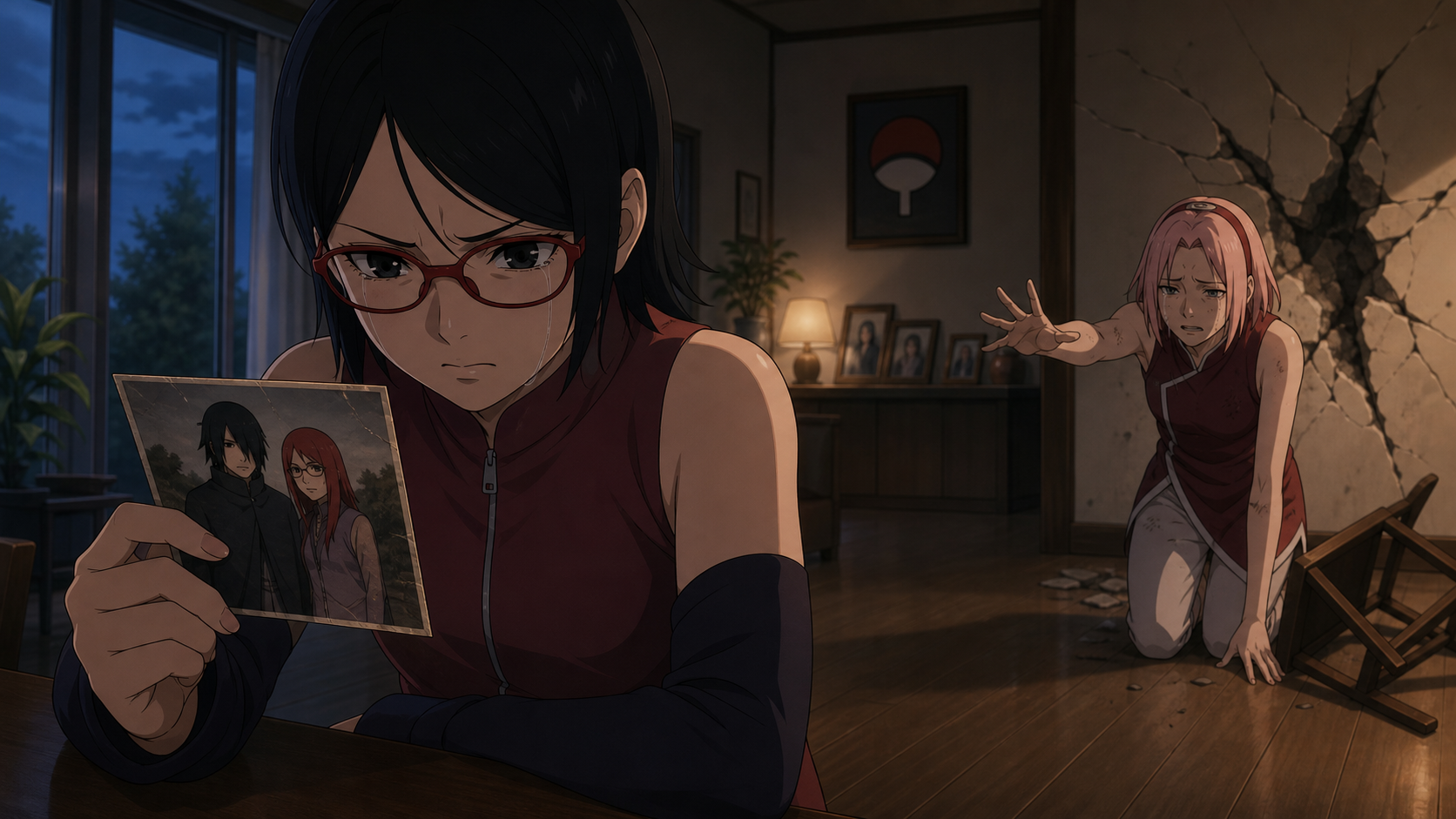
Then the family story starts falling apart. Sakura cannot tell Sarada whether Sasuke wore glasses. The public records lock away information about him. Sakura destroys the house after Sarada asks whether she is even married to Sasuke. Inside the ruins, Sarada discovers that the framed photograph of her father was cut from an old Team Taka picture. Karin stands beside him wearing glasses that look like hers. This family could not have designed a more suspicious evidence trail if Orochimaru gave them a checklist.
Sakura loves Sarada. Nothing in the episode makes that love fake. The problem is that love has been asked to carry every fact the adults refuse to explain. Sarada does not suddenly stop loving her mother because she asks who gave birth to her. She wants the truth about her own life, and every evasive answer makes the ugliest possibility feel more credible.
Boruto's prank shows Sarada what she is missing
Boruto defaces the Hokage Monument because he wants Naruto's attention. Naruto chases him, Shikamaru catches him, and the whole scene plays like another round in a familiar family argument. Sarada thinks Boruto is ridiculous. She is also jealous.
Boruto has enough history with his father to resent him. Sarada has almost no history with Sasuke at all. Watching Naruto scold Boruto gives her a glimpse of ordinary conflict, the kind that can happen only when both people share the same space.
Shikamaru sees the father inside the son
Shikamaru comments that Boruto resembles Naruto, and Boruto reacts exactly like a child who has heard that comparison too many times. Shikadai receives the same treatment from his own father.
Sarada stands nearby while resemblance moves through the conversation like proof of belonging. Nobody can tell her what she shares with Sasuke beyond a surname and a photograph.
Sarada cannot remember Sasuke
She has not built a childhood around visits, training sessions, arguments, or embarrassing stories. Sasuke left when she was too young to keep a clear memory of him.
That absence turns every small question into a major clue. Did he need glasses? What did he eat? How did he speak when he was home? Other children collect those details by living with a parent. Sarada has to investigate.
Dinner becomes an interrogation because the easy answers never came
Sarada asks Sakura whether Sasuke wore glasses when he was young. Sakura cannot remember clearly and offers another vague response. The uncertainty sounds harmless until Sarada places the answer beside everything else she does not know.
Sakura's hesitation may come from exhaustion, painful memories, or fear of explaining too much. Sarada hears another adult avoiding the subject. By this point, a simple “I don't remember” cannot remain simple.
Sakura has raised Sarada alone
The episode never lets viewers forget who has done the daily work. Sakura built the home, paid the bills, treated illnesses, handled school, and carried the emotional consequences of Sasuke's mission. Sarada's frustration does not erase any of that.
The same labor explains why Sakura reacts so sharply. She has held a family together with one parent physically absent and the other refusing to admit how heavy the arrangement feels. Sarada touches the weakest point when she questions whether the marriage is real.
Sarada researches the Uchiha clan
She turns to official records because family conversation has failed. The archives explain the Sharingan and identify Sasuke and Sarada as the last living members of the clan.
The information gives her a public identity without a private history. She can learn how Uchiha eyes work, but not why her father has never sat across from her at dinner.
Sasuke's records are restricted
Sarada tries to research her father and finds information blocked from public access. The restriction makes sense given Sasuke's criminal past, covert mission, and knowledge of threats beyond Konoha.
The seal also deepens her suspicion. Every route ends at a locked door. The village knows something. Sakura knows something. Sasuke knows everything and remains gone.
The Sharingan lesson becomes personal
Sarada learns that strong emotion can awaken the Uchiha eye. She has not yet activated hers, and the absence becomes one more reason to wonder whether she belongs to the clan she supposedly represents.
Biology is not determined by whether a power appears on schedule, but children do not experience identity questions like calm scientists. Sarada is collecting every mismatch because nobody has given her a reliable whole.
Sarada asks whether Sakura is truly Sasuke's wife
The question is brutal. Sakura hears years of sacrifice being dismissed. Sarada hears herself finally naming the doubt every adult response has helped build.
Neither person enters the argument trying to destroy the other. They are trapped inside a family structure where the missing adult does not have to absorb any of the daily anger. Sasuke's absence leaves Sakura and Sarada fighting over the shape of his silence.
Sakura punches the ground and destroys the house
Sakura loses her temper and slams the ground. She apologizes quickly and tells Sarada that her feelings remain connected to Sasuke. Then the house collapses.
I love Sakura, but demolishing the family home while trying to prove the family is stable is spectacularly unfortunate timing. The joke lands because the sadness underneath is real. Sakura is exhausted, financially strained, and carrying far too much alone.
The house reveals the photograph
Sarada searches the ruins for the framed family picture. The image of Sasuke comes loose and exposes a larger photograph hidden behind the crop.
That physical reveal is excellent storytelling. The family display literally contains a concealed history. Sarada does not invent a conspiracy. She pulls the public version away and finds people nobody ever mentioned.
Team Taka enters Sarada's life all at once
The full photograph shows Sasuke beside Suigetsu, Jūgo, and Karin. Sarada has no context for any of them. She sees her father standing with a woman who looks more like her than Sakura does.
Fans know Team Taka's history and know the photograph does not prove a romance. Sarada does not have that advantage. The adults denied her even the names required to interpret what she found.
Karin's glasses become the loudest clue
Sarada focuses on Karin because both wear red-framed glasses. The resemblance is thin evidence, but visual inheritance carries enormous weight in family conversations. People constantly tell children they have a mother's eyes or a father's smile.
Sarada follows the same logic and reaches a frightening possibility. If Sakura cannot explain the birth, and Karin looks like her, maybe the missing history has a simple answer nobody wants to say.
The crop makes Sakura's choice look worse
The framed image did not merely happen to exclude Team Taka. Somebody used Sasuke's portion of a group photograph as the family portrait. Even an innocent practical reason looks suspicious once Sarada sees the original.
Sakura may have lacked a better recent photograph of Sasuke, which is depressing on its own. The choice turns Karin into hidden evidence because nobody explained where the picture came from.
Sakura faints under the weight of the moment
After the house falls, Sakura collapses and ends up in the hospital. Stress, exhaustion, debt, and emotional shock catch up with her at once.
Sarada is left with guilt and still has no answer. The adult who could speak is now unconscious, and the child has to sift through rubble created by the conversation.
Shizune confirms the family and then becomes vague
Sarada asks Shizune whether Sakura and Sasuke are truly her parents. Shizune confirms the relationship, but the follow-up questions produce the same strained hesitation.
Sarada also learns there is no ordinary Konoha hospital record for her birth. Viewers later learn why, but the missing record looks terrible now. Every fact that should settle the question creates another question.
No village birth record changes the stakes
Sarada is no longer wondering only about a photograph. Her birth cannot be traced through the place where she has lived and received medical care. That gap makes the mystery concrete.
The truth is less scandalous than the evidence suggests: Sakura gave birth while traveling with Sasuke, and Karin helped deliver Sarada. The adults' secrecy allows a complicated but loving history to look like betrayal.
Chōchō arrives with the wrong crisis at the right time
At the restaurant, Chōchō announces that Chōji and Karui cannot be her real parents because she does not resemble them enough. Her confidence is hilarious, especially because neither parent has given her any actual reason to doubt them.
Her plan to search for her “real” parents gives Sarada an idea. Chōchō reaches the wrong conclusion from a loving home. Sarada borrows the journey because her own evidence deserves an answer.
Mitsuki does not buy Chōchō's theory
Mitsuki responds with the calm disbelief the situation requires. His presence adds another quiet irony. The child with the most unusual origin in the group is not the one panicking about whether his parents match his face.
Sarada does not need him to validate Karin as her mother. She needs someone to recognize that finding Sasuke is the only remaining direct route.
Sarada decides to ask Sasuke herself
She stops waiting for Sakura, Shizune, the archive, or the village to choose the right moment. Sasuke was present for the history. He can answer whether Sakura gave birth to her and why the family has no shared life.
The decision is risky because she does not know where he is or what his mission involves. The risk grew from adult silence. Children go looking when every safe door stays closed.
Sasuke enters through a dimensional portal
The episode closes away from Konoha as Sasuke emerges from another dimension. His work is dangerous, lonely, and tied to threats the village barely understands.
That image provides context for his absence without excusing the total lack of contact. Sasuke has reasons to travel. Sarada still deserves proof that her father remembers the home he is protecting.
A mysterious attacker finds Sasuke first
Before Sarada can reach him, the younger Shin attacks. Sasuke activates his Sharingan and recognizes something impossible in the boy's eyes.
The family mystery and the external threat collide through the same bloodline. Sarada is searching for the meaning of being Uchiha while a stranger has already turned that identity into a weapon.
Boruto Episode 19 lets a photograph start a necessary rebellion
“Sarada Uchiha” does not argue that Sakura failed to love her daughter. The episode argues that love cannot answer a factual question by itself. Sakura has been the present parent. Sasuke has been the absent one. Karin helped during Sarada's birth. All three truths could have been explained without making a child uncover Team Taka in the rubble of her own house.
Sarada's suspicion is wrong about Karin, but her reasoning is not foolish. She has a cropped photograph, matching glasses, no birth record, restricted files, an absent father, and adults who visibly panic when she asks direct questions. Any fan with that evidence would start a conspiracy board before dinner.
Her decision to find Sasuke launches the arc because Sarada refuses to keep accepting love as a substitute for knowledge. She wants both. She deserves both. The next episode will prove that reaching her father is possible. Getting him to act like one will be the harder mission.
Boruto's argument with Naruto gives Sarada a painful comparison
Boruto experiences Naruto's attention as inadequate because the Hokage title interrupts family time, changes promises, and turns ordinary parenting into scheduled access. His frustration is valid. Sarada watches the same conflict from the position of a child who cannot remember her father's face from lived experience.
The comparison does not make Boruto ungrateful or Sarada automatically wiser. Their families created different absences. Naruto returns home physically and still arrives emotionally exhausted or divided. Sasuke remains away for a mission so long that Sarada has no relationship strong enough to argue with. Both children want evidence that the father sees them outside public duty.
Sarada's envy reveals how low the standard has fallen inside her own home. An embarrassing chase through Konoha looks intimate because Boruto and Naruto possess enough familiarity to annoy each other in real time. Sarada wants the chance to be angry at Sasuke while he is actually present.
Sakura's love is visible, but her answers collapse under avoidable secrecy
Sakura has carried the daily labor of parenting. She knows Sarada's routines, health, temperament, schooling, and questions. The episode never doubts that devotion. The dinner interrogation becomes painful because Sakura tries to use devotion as cover for facts she cannot or will not explain.
Sarada asks when Sasuke will return, why he stays away, and what proof exists of the marriage. Sakura responds from exhaustion and fear. She has defended the relationship for years while receiving very little practical support from the absent partner. Sarada's questions expose wounds Sakura has been containing for herself.
Punching the ground externalizes that strain and destroys the home holding the incomplete story. The accident is funny in the exaggerated Sakura way and devastating in context. Sarada needs stability. Her mother responds to a request for certainty by removing the roof.
The cropped photograph turns adult privacy into a child's conspiracy evidence
The image in the Uchiha home presents a family portrait that never happened. Sakura inserted herself beside Sasuke by cropping Team Taka from an older photograph. The choice may have protected dangerous histories or created a simple visual for a child. The altered image becomes proof that the household narrative was manufactured.
Karin's face and glasses appear when the rubble exposes the full source. Sarada has no context for Team Taka, Sasuke's travels, or Karin's role during her birth. The visual information therefore carries more authority than Sakura's increasingly fragile reassurances.
Adults often treat a hidden detail as harmless because they know the surrounding explanation. Sarada does not possess that explanation. Every removed person becomes a possible answer, and every panic response makes the answer look worse.
Restricted records make Sarada's search feel dangerous before any enemy appears
Sarada researches the Uchiha clan because ordinary family conversation has failed. The archive teaches her about the Sharingan and the clan's history while withholding the files most relevant to Sasuke. Restrictions may protect mission intelligence and painful village history. The restrictions also tell a child that her father belongs to classified information more than family memory.
Learning that strong emotion can awaken the Sharingan turns the lesson inward. Sarada carries the potential ability without a parent available to explain the physical and emotional experience. Her inheritance arrives through documents instead of guidance.
The village record system cannot replace a father, but appropriate access could have prevented the search from becoming an unsafe chase. Sarada finds gaps wherever she looks, so leaving Konoha begins to feel more rational than trusting another closed file.
Shizune's vagueness confirms that the adults share a script
Shizune knows Sakura gave birth to Sarada and knows why no Konoha birth record exists. A clear answer could reduce the immediate panic. Her hesitation tells Sarada that another trusted adult is protecting information from her.
The reaction matters more than the eventual fact. Sarada has learned to read discomfort because discomfort appears every time she approaches the truth. Shizune may intend to respect Sakura's privacy or avoid speaking beyond her role. From Sarada's side, the entire village seems coordinated around silence.
That perception explains why she decides to ask Sasuke directly. The choice is not impulsive curiosity after one photograph. The choice follows repeated evidence that local adults will not complete the sentence.
Chōchō brings a ridiculous theory and the exact companionship Sarada needs
Chōchō believes her parents may not be her real parents because she cannot imagine being related to them while Akimichi transformation techniques complicate the visual evidence. Her theory is comedic, but the search gives Sarada a companion who does not treat the family crisis as shameful.
Mitsuki refuses Chōchō's logic with appropriate calm. Sarada does not need him to disprove every fear. She needs somebody willing to travel when the fear becomes action. Chōchō provides that loyalty without demanding a polished explanation.
Their different motives also keep Sarada from disappearing inside Uchiha mythology. She remains an Academy student with friends, food stops, arguments, and a world beyond Sasuke's history. The friendship may be chaotic. The friendship is present.
Sakura fainting reveals how little support the present parent has received
Sakura's collapse follows the destroyed house, Sarada's accusations, and years of holding the family structure together. The moment cannot excuse secrecy, but the exhaustion deserves recognition. Sasuke's mission removed him from daily parenting while Sakura carried practical care and defended decisions she did not make alone.
Sarada sees the fainting as another interruption before the truth arrives. Sakura's body forces the conversation to stop, which may feel like avoidance even when the collapse is genuine. The family keeps producing emergencies at the exact moment direct communication becomes possible.
A healthier arrangement would have given Sakura honest language, outside support, and a plan for age-appropriate disclosure. Love has been doing too much work inside a system built without those tools.
Shin's arrival turns identity confusion into an external claim on the Uchiha name
Sarada is asking whether she belongs to Sasuke when another child appears carrying the Sharingan and Uchiha affiliation. Shin possesses visible markers without the family relationship she wants. His presence makes bloodline identity feel both less exclusive and more dangerous.
Sasuke encounters the attacker first and recognizes the threat before learning his daughter is traveling toward him. The mission and family plots converge because both involve people deciding what the Uchiha legacy means. Shin treats the name as a weapon. Sarada wants the name to connect her to a father.
The collision ensures that meeting Sasuke cannot remain a private reunion. Sarada reaches him inside the danger his secrecy was supposed to keep away from her. The protection strategy has failed before he sees her face.
Sarada's rebellion is necessary because obedience has produced no answer
Leaving the village without permission creates risk and forces Naruto to manage another problem. The decision is still understandable. Sarada used the available routes first: asking Sakura, researching records, questioning Shizune, and examining the family photograph. Every route ended in restriction or panic.
Children should not need to pursue classified operatives to learn basic birth history. Sarada's journey exposes an adult failure rather than proving she lacks patience. She is patient enough to have lived twelve years inside the gap.
Her rebellion also begins a shift from passive inheritance to chosen identity. Sarada will learn the facts, evaluate her parents, and decide what the Uchiha name means in her life. The adults can guide that process only after they stop treating knowledge as a privilege she has not earned.
Sources and lawful viewing
Official episode reference: Naruto Official episode guide
Licensed episode route: Crunchyroll licensed series page