
A Day in the Life of the Uzumaki Family
Himawari’s fever revives the story of a torn panda, one terrifying Byakugan awakening, Naruto missing his own inauguration, and Konohamaru saving the ceremony.
Series: Boruto: Naruto Next Generations
Episode: 18 · A Day in the Life of the Uzumaki Family
Arc: Uzumaki Family
Release: 2017-08-02
Previous: Episode 17 · Run, Sarada!
Directory: All 293 Boruto episodes
Bottom line
Boruto Episode 18 reminds everybody that Himawari Uzumaki once awakened the Byakugan over a torn stuffed panda, shut down Naruto and Kurama with one Gentle Fist strike, and forced Konohamaru to impersonate the Seventh Hokage at Naruto's own inauguration. The franchise spent hundreds of episodes getting Naruto to that ceremony. His daughter removed him from the schedule before breakfast. I am sorry, but that is legendary family lore.
The comedy sits inside a warmer episode about what changed after Naruto became Hokage. Himawari has a fever in the present, Boruto watches over her, and Naruto rushes home with his cloak inside out because worry beat dignity. Boruto still resents how rarely his father is home, but he also remembers a time when Naruto belonged to the house before the village claimed most of his day. Their argument does not end with a grand speech. Hinata throws both loud men out, and they reconnect over ramen.
That smaller ending fits the Uzumakis. Naruto knows how to save the world and still struggles to enter a sickroom without starting a competition over food. Boruto knows his father loves him and remains angry about the empty chair. Himawari looks gentle until somebody breaks her panda. Hinata runs the entire household and apparently holds the Ichiraku record at forty-six bowls. Every member contains a surprise, and the family works because affection survives the chaos without pretending the chaos never happened.
Himawari's fever changes the whole house
The episode begins with Himawari sick in bed. Her usual energy is gone, which makes everybody else nervous. Boruto stays close while Hinata leaves to collect medicine.
His care is immediate and unforced. Boruto complains loudly about Naruto, school, and village expectations, but his little sister never has to wonder whether he will show up for her.
Boruto becomes the responsible sibling
He checks on Himawari, keeps the room calm, and takes her discomfort seriously. The scene gives Boruto a domestic competence that the louder Academy episodes sometimes hide.
He also carries anger on her behalf. Naruto's absence feels worse when Himawari is ill because Boruto knows she will minimize her own disappointment rather than demand attention.
The fever brings back inauguration morning
Watching Himawari rest reminds Boruto of the day Naruto officially became the Seventh Hokage. The memory begins as a family milestone and turns into one of the funniest disasters in the franchise.
The flashback also catches the Uzumakis before the office changed their routine. Naruto still wakes up in the family home, Hinata organizes everybody, and the children expect their father to leave with them rather than live behind a desk.
Naruto oversleeps on the day of his dream
Naruto spent his childhood shouting that he would become Hokage. On inauguration morning, he has to be dragged out of bed. That is not noble symbolism. That is adulthood.
The joke makes him human after the war turned him into a near-mythic hero. Naruto achieved the impossible and still cannot defeat a pillow without family assistance.
Hinata keeps the ceremony moving
Hinata handles the schedule, clothing, children, and the emotional temperature of the house. Naruto's public milestone depends on her invisible preparation before anyone reaches the ceremony.
The episode does not pause to announce that labor. Hinata simply does what needs doing, which is exactly why viewers should notice how much of the family runs through her.
Himawari wants her stuffed panda
Himawari plans to bring her favorite panda toy to the inauguration. The request is small and perfectly child-sized. She wants comfort beside her while the adults celebrate something huge.
Boruto objects, not because the toy creates a real problem, but because siblings can turn one object into a constitutional crisis before breakfast.
Boruto and Himawari pull until the toy tears
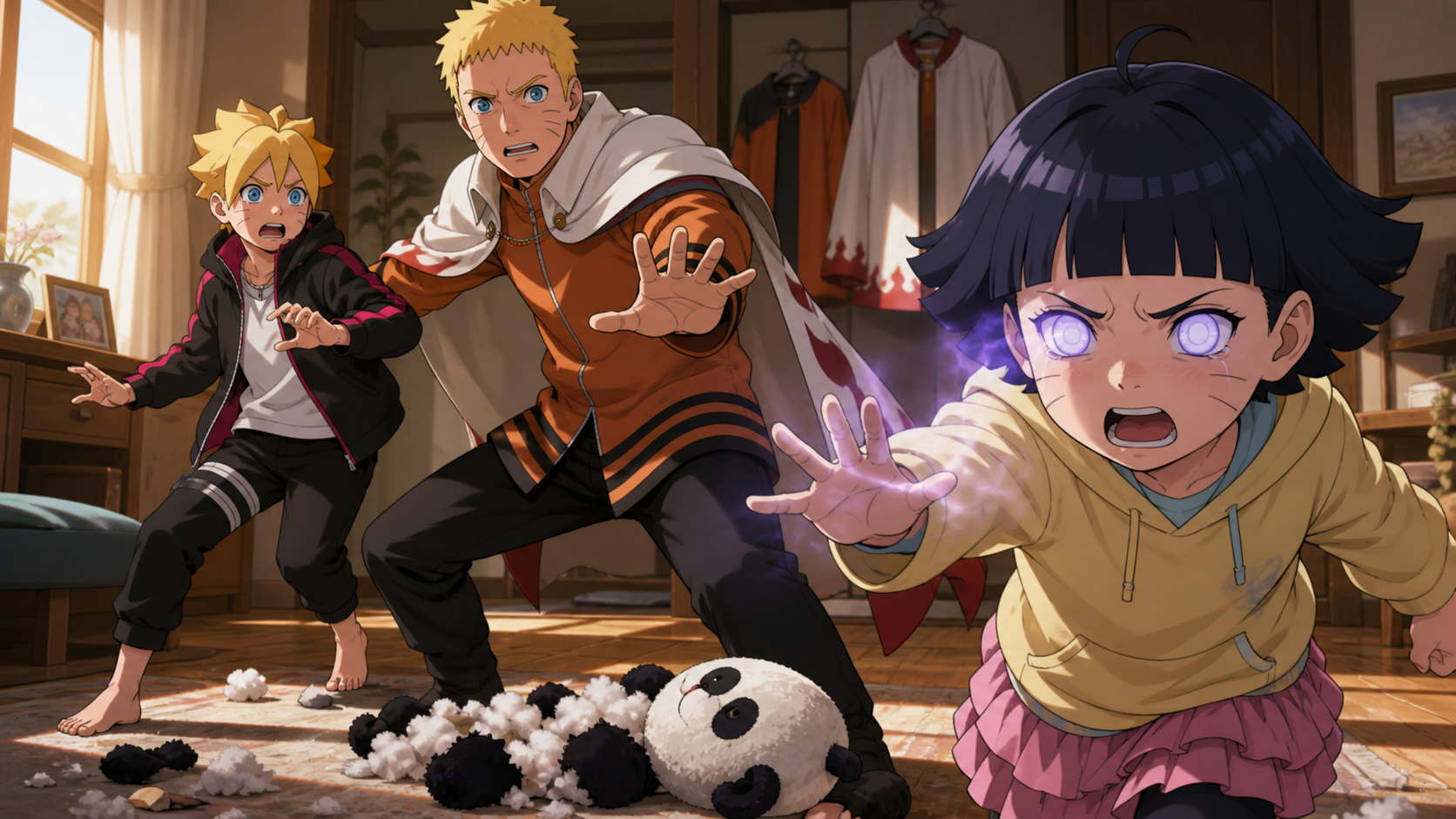
They fight over the panda, each pulling from one side until the stuffed animal splits. The room goes quiet because Boruto realizes too late that he has crossed a line.
Himawari's sadness does not stay sadness. Hyūga blood enters the conversation.
Himawari awakens the Byakugan
Her pale eyes activate with no training and no warning. The sweet little sister Boruto thought he understood suddenly carries the visual power of the Hyūga clan.
The awakening comes from anger and grief over something precious. A torn toy may look trivial to an adult, but the panda held real meaning for Himawari. Chakra does not grade feelings by adult standards.
Boruto recognizes danger immediately
Boruto sees the Byakugan and runs. Excellent instinct. He knows enough about Hinata's family to understand that apologizing within striking distance may not be the best first move.
His panic is funny because Himawari remains small, barefoot, and terrifyingly focused. The episode turns a sibling quarrel into a miniature horror chase without losing the family tone.
Naruto steps between his children
Naruto tries to protect Boruto and calm Himawari. The choice is automatic. Whatever else changes after he becomes Hokage, his first instinct in that moment is father before leader.
Unfortunately, Naruto approaches a newly awakened Byakugan user as though being the strongest shinobi alive will cover every possible problem.
One Gentle Fist strike drops Naruto
Himawari hits a chakra point near Naruto's abdomen and knocks him unconscious. Kurama feels the shutdown too. The Nine-Tails survived wars, Madara, Obito, and the Ten-Tails. Himawari sends him into darkness over a panda.
The gag works because Gentle Fist attacks the chakra network rather than competing through raw strength. Naruto does not lose a power contest. His daughter finds the switch.
Boruto hides from his little sister
With Naruto down, Boruto realizes the family shield has failed. He hides while Himawari searches for him with the Byakugan.
The visual joke becomes even better when viewers remember that those eyes can see through walls. Boruto is not concealed. He is delaying the inevitable.
Naruto misses his own inauguration
The village gathers to celebrate the dream that carried the original series. Kakashi prepares to hand over the office. Naruto lies unconscious at home.
Fans waited years to see him take the title, so the choice remains controversial. I understand the frustration. I also think the ridiculous absence fits a story that refuses to let public legend erase private life. Naruto becomes Hokage because the village recognizes him, even when he misses the pose.
The scene works better as family comedy than as the only payoff to Naruto's lifelong dream, which explains why some fans still hate the choice. The ceremony deserved emotional room after the war. Boruto inherits the gag from the earlier OVA and uses the missing moment to explain the household that exists now. Both reactions are fair. I laugh at Himawari flattening two jinchūriki with one finger, and I still wish Naruto had received a second quiet scene where he put on the hat as himself.
Konohamaru transforms into Naruto
Konohamaru uses the Transformation Technique and attends the ceremony in Naruto's place. The child who once challenged Naruto for the title now helps preserve Naruto's inauguration.
The solution is dishonest, loyal, and very shinobi. Konoha gets the image the ceremony requires. Naruto gets the office once he wakes up. Konohamaru gets the strangest rehearsal for his own ambitions.
The village celebrates a substitute
Most citizens do not know that the Naruto onstage is Konohamaru. That detail turns the ceremony into another Boruto-era question about public symbols. The office needs a body in the robe, and the village accepts the image.
At home, the real Naruto has already acted as a father by shielding Boruto. The private choice costs him the public moment. That trade feels more meaningful than a perfect speech would have.
Hinata repairs the panda
The torn toy does not remain broken forever. Hinata repairs Himawari's panda, restoring the small object that started the disaster.
That quiet act captures her role in the family. Everybody else creates chaos through pride, power, work, or panic. Hinata finds the torn seam and makes the household usable again.
Becoming Hokage changes Naruto's presence
After the inauguration, Naruto spends less time at home. The dream brought responsibility on a scale his younger self could barely imagine.
Boruto understands that the village needs him. Understanding does not remove the loss. He remembers the father asleep upstairs and compares that man with the Hokage who arrives late or not at all.
Naruto rushes home for Himawari
In the present, Naruto learns about the fever and returns in a hurry. His cloak is inside out, which proves that concern beat presentation.
The detail matters to Boruto. Naruto did come. He may be overworked and disorganized, but Himawari's illness pulled him out of the office and through the door.
Father and son argue over what to cook
Naruto and Boruto try to prepare food for Himawari, then turn the kitchen into a competition. Both want to help. Neither knows how to cooperate quietly.
Their resemblance becomes impossible to ignore. Boruto hates being compared to Naruto, yet both express concern by getting louder and more stubborn.
Hinata throws them out
The noise reaches the sickroom, and Hinata removes both sources. Correct decision. Himawari needs rest, not two blond men debating lunch like the fate of the Five Nations depends on an egg.
Hinata's authority resets the house. Naruto may lead Konoha, but the Hokage rank offers no immunity from being sent outside by his wife.
Naruto takes Boruto to Ichiraku
With nowhere useful to stand at home, Naruto invites Boruto to eat ramen. Ichiraku is the right place because the restaurant holds Naruto's personal history before titles and paperwork.
He can speak to Boruto there as a father who once sat at the counter hungry, lonely, and grateful for anybody who treated him normally.
Naruto shares family history over ramen
Naruto mentions that Ichiraku was connected to his early time with Hinata, giving Boruto a glimpse of his parents before they became Mom, Dad, and Hokage.
Children often forget that parents had awkward dates, favorite places, and unfinished dreams. The story helps Boruto see a person behind the office that keeps taking Naruto away.
Chōji and Chōchō bring the eating contest
Chōji and Chōchō arrive for their regular ramen challenge. The Akimichi family turns eating into competition, ritual, and quality time.
Their easy closeness offers another model of fatherhood beside Naruto and Boruto's tension. Chōji is present, enthusiastic, and completely prepared to lose with dignity if enough noodles are involved.
Hinata is the legendary Queen of Gluttony
Boruto learns that the record holder ate forty-six bowls and that the champion is Hinata. The quiet Hyūga mother has apparently been hiding a second monster behind the gentle smile.
The reveal is perfect because the episode already showed Himawari's Byakugan surprise. Never assume the soft-spoken Uzumaki women are the least dangerous people in the room.
Boruto Episode 18 makes family history out of chaos
“A Day in the Life of the Uzumaki Family” gives Naruto's inauguration to Konohamaru, Himawari's first Byakugan to a torn panda, and the father-son reconciliation to bowls of ramen. None of those choices looks grand on paper. Together, they make the family feel lived in.
Boruto's anger about Naruto's absence remains valid. Naruto's rush home shows that he cares. Himawari's fever reminds them how quickly ordinary days become important. Hinata keeps repairing whatever the rest of them tear, whether the damage is a toy, a schedule, or the peace around a sick child.
The episode also corrects the myth around becoming Hokage. Naruto did not reach the title and stop being the boy who oversleeps, the father who worries, or the husband Hinata can throw out of the kitchen. The robe added responsibility. The family kept the whole person, even when Konoha borrowed most of his hours.
Himawari's fever turns the household hierarchy upside down
The sick child becomes the center of the Uzumaki home without asking for attention. Hinata monitors the fever, Naruto rushes from work, and Boruto adjusts his behavior around his sister's needs. Nobody treats the day as a mission, but everybody receives a role.
Boruto's responsible side appears because Himawari matters more than his usual argument with Naruto. He checks on her, worries, and remembers the inauguration disaster with enough fear to respect what a Byakugan flare might mean. The sibling relationship contains teasing and conflict, but care becomes visible when the body is vulnerable.
The fever also gives the family a reason to tell a shared story. Himawari may not remember every detail of inauguration morning. Boruto remembers the terror. Naruto remembers waking after his own ceremony. Hinata remembers holding the entire schedule together. Family history forms from overlapping accounts rather than one official record.
Inauguration morning exposes the gap between public legend and domestic reality
Konoha expects Naruto to arrive as the hero who saved the world and achieved the dream everybody watched him chase. The Uzumaki house contains an oversleeping father, a mother managing clothing and timing, two children fighting over a toy, and no spare minute for symbolic dignity.
That contrast does not cheapen the achievement. The contrast completes the achievement. Naruto wanted recognition and belonging, not a life sealed inside ceremony. Becoming Hokage while surrounded by ordinary family chaos proves he reached a future larger than the office.
Missing the event remains ridiculous and sad. Naruto deserved to stand before the village. The family deserved better preparation. The comedy works because the title is secure enough to survive an inauguration substitute and the emotional meaning extends beyond one public photograph.
Himawari's Byakugan awakening combines Hyūga inheritance with Uzumaki emotion
The eye appears after the panda tears and anger overwhelms Himawari. The trigger resembles the intense emotional awakenings elsewhere in the franchise, but the subject remains unmistakably domestic. A beloved toy, a sibling argument, and a child's sense of injustice bring a major bloodline ability into the room.
Himawari does not become a miniature warrior performing formal technique. The Byakugan gives instinctive precision to a child who wants Boruto punished. Her Gentle Fist strike finds Naruto's chakra point because Naruto steps between them. Kurama, war heroism, and Hokage durability cannot negotiate with correct Hyūga anatomy.
The scene also establishes that inheriting Hinata's eyes does not require inheriting Hinata's temperament in a simple way. Himawari is gentle and affectionate. She can also become terrifying when somebody damages what she loves. The two qualities belong to the same child.
Naruto stepping between the children is perfect parenting and terrible tactical luck
Naruto reacts as a father before considering the Byakugan. He places his body between an angry Himawari and a frightened Boruto. The protective choice is correct. The angle places every chakra network inside immediate danger.
His collapse becomes funny because Naruto has survived enemies capable of destroying cities. A single precise strike from his daughter shuts down the inauguration. Power scale arguments can pack their bags. Family knows where the weak points live.
Boruto hiding afterward proves the threat felt real inside the scene. He does not interpret Himawari as harmless because she is younger. He has observed the eye, the strike, and Naruto on the floor. Respect enters the sibling relationship through one unforgettable morning.
Konohamaru's transformation protects the village ceremony and hides the family accident
Konohamaru impersonating Naruto keeps the inauguration moving, but the substitution carries more than slapstick. He once followed Naruto as an annoying younger rival, declared his own Hokage ambition, and learned by watching Naruto refuse limits. Standing in Naruto's place for the ceremony becomes a bizarre form of loyalty.
The village celebrates without knowing the body under the transformation belongs to somebody else. Public institutions often depend on substitutions, schedules, and people preventing private emergencies from disrupting symbolic continuity. The Hokage office survives because the community extends beyond one man.
Naruto's absence from the moment remains a personal loss. Konohamaru can preserve the event. He cannot give Naruto the memory of receiving the robe before Konoha as himself. The comedy and disappointment deserve to coexist.
Hinata repairs the panda because repair is how she holds the family together
The torn toy caused the disaster, and Hinata quietly restores the object after managing everything else. Her work rarely receives the spectacle attached to Naruto's office or Himawari's sudden eye. The household functions because she notices what needs mending.
Repairing the panda also responds to Himawari without treating the child's grief as silly. Adults know a stuffed toy can be replaced. Himawari knows this specific panda carries affection and familiarity. Hinata respects the specific bond enough to fix the damage.
The episode repeatedly places her labor beneath the comedy. She prepares the ceremony, handles the children, cares for the fever, manages the kitchen conflict, and establishes boundaries when Naruto and Boruto make the room worse. Quiet competence is not background decoration. Quiet competence is the family's infrastructure.
Naruto rushing home shows care while exposing how little time the office leaves him
Hearing about Himawari's fever moves Naruto immediately. The response matters because Boruto experiences his father as increasingly unavailable. Naruto wants to be present and still built a routine where family emergencies compete with village administration.
Care should be measured through action, and the rush home counts. Care should also shape systems before crisis, and that work remains incomplete. Boruto needs ordinary dinners and promises, not only dramatic returns when somebody is sick.
The episode gives Naruto space to be loving without declaring the family complaint solved. He comes home, argues with Boruto about food, and gets removed from the kitchen by Hinata. Presence creates friction and memory. That messy participation is what Boruto has been asking for.
Ichiraku gives Naruto and Boruto a neutral table for family history
Ramen creates a space where father and son can talk without the Hokage office occupying the center. Naruto shares memories, explains the restaurant's place in his life, and lets Boruto encounter history through appetite rather than a formal lecture.
The setting connects Boruto to the lonely child Naruto once was. Ichiraku provided warmth before Naruto possessed family or status. Bringing his son there turns a personal refuge into inherited family ground. Boruto does not need to repeat Naruto's loneliness to understand why the counter matters.
Their conversation also proves that repair can happen through ordinary time. No villain forces honesty. No mission creates a deadline. Two people eat and compare stories while Himawari recovers at home. The smallness gives the scene credibility.
Hinata's eating record is the final family-history ambush
Chōji and Chōchō introduce the eating contest as another piece of local legend, and Boruto expects some obvious heavyweight champion. Learning that Hinata holds the record rearranges his understanding of his mother with one number.
The joke works because Hinata's quiet presentation has always encouraged people to underestimate the force beneath the surface. Her appetite, Byakugan, Gentle Fist skill, endurance, and capacity to manage the Uzumaki household all belong to the same person. Soft speech never meant small presence.
Boruto receives another reminder that parents contain lives children do not automatically know. Unlike Sasuke's dangerous secrecy, this hidden history is harmless and delightful. Families still need stories shared before children mistake familiarity for complete knowledge.
Sources and lawful viewing
Official episode reference: Naruto Official episode guide
Licensed episode route: Crunchyroll licensed series page