
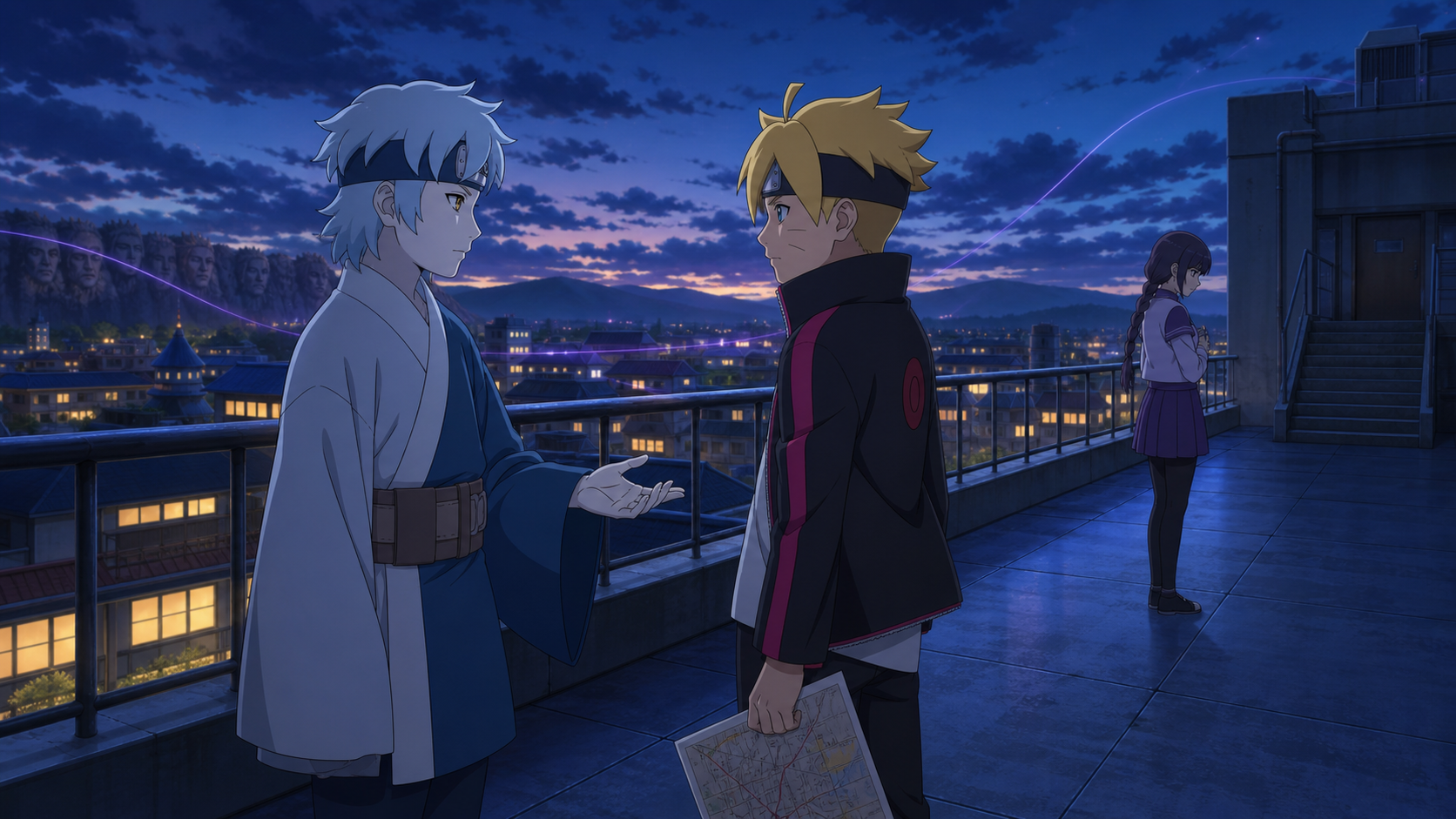
Boruto and Mitsuki
Mitsuki spends one quiet day learning why people follow Boruto, then risks their friendship by admitting he knows who caused the Ghost incidents.
Series: Boruto: Naruto Next Generations
Episode: 12 · Boruto and Mitsuki
Arc: Academy Entrance
Release: 2017-06-21
Previous: Episode 11 · The Shadow of the Mastermind
Directory: All 293 Boruto episodes
Bottom line
Boruto Episode 12 looks quiet because the Ghost incidents stop, but Mitsuki spends the entire episode circling a truth that could destroy Boruto's faith in one of their classmates. The obstacle-course lesson, Iwabee's arithmetic, Sumire's hospital room, and dinner at the Uzumaki house all answer the same question for him: why do people follow Boruto when nobody ordered them to? Boruto and Mitsuki sacrifice their course time to help Denki. Shikadai admits Boruto's influence changed him. Inojin says Boruto chooses his own direction and accepts people without sorting them through inherited prejudice. Sumire calls him fun, then gives Mitsuki careful answers while hiding the role she played in every attack. At dinner, Mitsuki finally sees the wound underneath Boruto's anger toward Naruto. Boruto believes the Hokage abandoned the people closest to him, so he has promised himself that he will never do the same. That stubborn promise tells Mitsuki what Boruto will do once Sumire's name enters the conversation. He will not quietly accept an order that treats Class Rep as disposable. Mitsuki still tells him. The confession is the episode's real act of friendship because Mitsuki chooses the difficult truth even though the truth may pull Boruto directly against his mission.
Mitsuki reports through a white snake
The episode opens with Mitsuki communicating at night through a white snake. He mentions a Root heirloom and a possible user, then remembers waking inside a tank.
That brief image tells us how differently Mitsuki approaches the Ghost investigation. Boruto stumbled into the mystery through empathy and a strange eye. Mitsuki arrived with outside information, a hidden contact, and a life that began under laboratory glass.
He has clues Boruto does not know exist. He also has no ordinary model for deciding when a secret becomes something a friend deserves to hear.
The Ghost incidents stop before anybody solves them
The sudden silence confuses Boruto, Shikadai, and the others. Nobody caught the Ghost. No final victim identified the source. The attacks simply end.
Boruto wants to keep investigating because unfinished danger irritates him. Some classmates wonder whether adult shinobi already have the matter under control. Mitsuki knows the pause may mean the culprit has gathered enough chakra.
The absence of another rampage creates the episode's tension. Everybody else gets a peaceful school day. Mitsuki watches the quiet like a countdown.
Shino turns teamwork into an obstacle course
The Academy students run a course in groups of three. Boruto, Mitsuki, and Denki work together while teachers observe how the students handle speed, difficulty, and one another.
Denki struggles midway. Boruto and Mitsuki could leave him and protect their finish time, but they go back. The delay costs the team a passing result.
That choice becomes Mitsuki's first live example. Boruto does not calculate whether Denki's score will improve his own. He sees a teammate falling behind and changes direction.
Shino fails everybody for opposite reasons
Some teams reach the finish by abandoning slower members. Boruto's team stays together but runs out of time. Shino fails the entire class.
The decision feels harsh until he explains the assignment. A shinobi team cannot celebrate one fast member while somebody else remains in danger. Finishing together matters, and managing time still matters.
Boruto made the humane choice without solving the whole exercise. That combination is important. Caring about people does not make every decision automatically successful. The class has to learn how to protect a teammate and complete the mission.
Konohamaru and Moegi are already scouting future teams
Konohamaru and Moegi tell the students that working shinobi will occasionally observe their exercises. The adults are beginning to imagine which students might serve under which leader after graduation.
The announcement turns a school drill into a glimpse of the future. These friendships will eventually carry missions, injuries, responsibility, and decisions far beyond an obstacle course.
Moegi notices Iwabee and Boruto. Shino calls Boruto the nucleus of the class and, in the same breath, the nucleus of trouble. Both descriptions are accurate.
Boruto has become the class's center without asking permission
Students argue with Boruto, compete against him, roll their eyes at him, and still move when he moves. He has no formal position like Sumire's Class Rep title. The influence comes from action.
Boruto ran toward Denki on the train, refused to abandon Shino, defended Magire from his own possessed choices, and keeps dragging classmates into investigations. His decisions are frequently reckless, but nobody wonders whether he will show up.
Mitsuki notices the pattern because Boruto's influence looks nothing like an assignment from a creator.
Shikadai admits Boruto changed his choice
Mitsuki asks Shikadai why he helped Denki. Shikadai suggests that Boruto got to him.
The answer sounds casual, which makes the influence more believable. Boruto did not deliver a lecture about teamwork. His refusal to leave people behind changed what Shikadai considered normal.
Shikadai is smart enough to identify manipulation, yet he does not resent this change. Friendship can alter judgment without becoming control, and Mitsuki is trying to understand that distinction.
Iwabee doing arithmetic is character development
Mitsuki sees Boruto helping Iwabee with math after class. The image is funny because Iwabee would rather break a wall than admit a worksheet can defeat him.
Boruto stays. Their friendship began through a fight over what strength means, and now strength looks like sitting beside somebody who has repeated a grade because written work keeps blocking him.
This is the version of Boruto Mitsuki studies most closely. Boruto is not performing heroism for a crowd. He is helping Iwabee with arithmetic because the problem is in front of him.
Mitsuki asks whether Boruto made Iwabee feel included
Mitsuki's questions can sound clinical because he is gathering data about belonging. Iwabee does not need that language. He knows Boruto treated him as a rival and classmate instead of a failure everyone should avoid.
Being included did not magically fix Iwabee's grades. Boruto gave him a reason to keep participating in a class he had already watched move on without him.
Mitsuki hears another version of the same answer. Boruto creates attachment by recognizing people before they become convenient.
Inojin notices Mitsuki watching Boruto
Inojin catches Mitsuki paying unusual attention to Boruto and explains why the class gravitates toward the Hokage's son. Boruto hates being reduced to that title, so he makes his own choices and tends to accept others without carrying the adults' old suspicions.
The observation comes from a boy whose parents belong to the previous generation's closest circle. Inojin could easily define Boruto through Naruto. Instead, he sees how hard Boruto works to become recognizable on his own terms.
Mitsuki is also trying to become more than somebody else's plan, even before he can say that openly.
Mitsuki visits Sumire alone
The hospital conversation is the episode's most uncomfortable scene on a rewatch. Mitsuki already suspects Sumire. He sits beside her bed and asks how she feels about Boruto.
Sumire says Boruto is fun. The answer matches what Inojin and the others described, but her calmness carries another meaning once we know she has been monitoring the investigation.
Mitsuki is not making small talk. He is testing whether the person behind the Ghost incidents formed a genuine attachment to the classmate getting closest to her secret.
Sumire turns the question toward Mitsuki's family
Sumire asks whether Mitsuki has family. He answers with the uncertainty of someone whose origin does not fit a normal household description.
She says her family is dead and recalls her mother combing her hair. The memory is gentle, which clashes with the revenge mission inherited from her father.
Both children are sitting inside identities constructed by adults. Mitsuki is studying how to choose. Sumire is approaching the moment when her father's choice will demand everything from her.
Class Rep explains why she seemed nervous
Sumire says her panicked behavior comes from feeling less capable than her father. She also says the class became fun.
The explanation hides more than Mitsuki can openly challenge inside the hospital. Her father did not merely set a high family standard. He trained her to complete the Gozu Tennō and avenge Root.
The second statement sounds true. Sumire expected the Academy role to function as cover, then the noisy class gave her a life that competed with the mission.
She wants the Ghost Incident to end quickly
When Mitsuki asks how she feels about whoever injured her, Sumire says she wants the situation over soon.
On first viewing, the answer resembles exhaustion from a victim. On rewatch, the sentence carries the pressure of a culprit nearing the final stage.
Mitsuki hears the ambiguity. Sumire does not express rage at the attacker or curiosity about the investigation. She wants an ending, and Mitsuki has to decide whether that desire confirms the conclusion he already suspects.
Boruto brings Mitsuki home for dinner
Boruto invites Mitsuki to the Uzumaki house, and Hinata and Himawari welcome him without interrogation. The domestic warmth is ordinary for Boruto and new information for Mitsuki.
Mitsuki has spent the episode asking why people choose Boruto. Inside the house, he can see the family Boruto loves, the space Naruto's job keeps interrupting, and the younger sister Boruto protects with a softness he rarely advertises at school.
The meal gives Mitsuki context no mission report could provide.
Mitsuki asks how Boruto really feels about Naruto
In Boruto's bedroom, Mitsuki asks about his relationship with his father. Boruto's public complaint is familiar: Naruto is always working, everybody compares them, and the Hokage title swallows the man who lives upstairs.
The private hurt is sharper. Boruto remembers what the household felt like before Naruto became Hokage. He does not resent a stranger. He resents losing daily access to somebody who is still close enough to come home.
Hinata calls them to dinner before Boruto can finish, because family conversations always have terrible timing.
Naruto actually makes the dinner, then the office calls
Naruto sits down with the family and meets Mitsuki. For a brief moment, the episode offers the evening Boruto wanted.
Shikamaru informs Naruto's shadow clone that chakra linked to the Ghost incidents has been detected and Sai has gone to investigate. The clone disperses, giving the real Naruto the information immediately. Naruto leaves the table.
The emergency is legitimate. Boruto's anger is legitimate too. One dangerous night lands on top of every previous dinner, birthday, and promise interrupted by the Hokage's work.
Boruto storms out because this argument is older than dinner
Boruto leaves the house before anybody can smooth over the moment. Mitsuki follows him and finally hears the full complaint.
Since becoming Hokage, Naruto has neglected the family in Boruto's eyes. The village gained constant access to his father, while Hinata, Himawari, and Boruto learned to expect an empty chair.
Boruto's anger can be unfair about the immediate emergency and completely accurate about the accumulated pattern. The episode allows both truths without making him a spoiled child for missing his father.
Boruto promises never to abandon the people closest to him
Boruto says he will do what Naruto could not: protect the people near him and refuse to leave them behind.
That promise explains the obstacle course, Iwabee's homework, Denki, Shino, and the investigation. Boruto's loyalty is partly love and partly rebellion. Every rescue lets him prove he is not becoming the version of Naruto he resents.
The promise will also explain why Sumire's identity cannot make him step away. Class Rep is close to him, so Boruto will chase the truth even when the truth becomes dangerous.
Mitsuki remembers a similar command from his parent
Boruto's words trigger a memory of Mitsuki's parent describing a path and a person who could become his sun. The parallel helps Mitsuki understand why Boruto's choices pull people toward him.
Mitsuki was sent to observe Boruto, but observation has already changed him. The boy he studies is becoming a reason to evaluate orders rather than simply receive them.
That change does not make Mitsuki free of Orochimaru's design. The episode shows the first muscles of judgment developing inside that design.
Mitsuki finally tells Boruto he knows the culprit
After spending the episode collecting answers, Mitsuki confesses that he knows who is behind the Ghost incidents. The episode ends before he says Sumire's name aloud, but Boruto's world has already begun shifting.
Mitsuki could follow his hidden instructions alone. He could protect Boruto from the information. Instead, he gives Boruto a place inside the decision.
The choice is risky because Mitsuki now understands exactly what Boruto will do. Boruto has just promised never to abandon someone close to him.
Sumire answers Mitsuki while hiding in plain sight
The hospital conversation deserves more attention than a quick mystery recap allows. Mitsuki asks Sumire what she thinks about Boruto, and she answers with the version of him the class knows: loud, impulsive, impossible to ignore, and strangely good at making the room feel less lonely. Nothing in her answer sounds fake. That is exactly why the scene hurts.
Sumire is not pretending to care about her classmates while privately feeling nothing. Her daily life at the Academy has become real enough to compete with the revenge planted inside her. She can appreciate Boruto's warmth and still move toward a plan that will hurt him. Trauma does not turn a person into a clean little riddle where every kind moment becomes a lie.
Mitsuki hears the emotional truth, but he also knows the evidence. He is speaking with a classmate and evaluating a target at the same time. The scene refuses to make either identity disappear for his convenience.
Friendship is not the opposite of investigation
Boruto keeps treating the Ghost case like friendship gives him a right to charge ahead. Mitsuki approaches the same case with secrecy, orders, and information Boruto lacks. Episode 12 puts those methods beside each other without pretending one boy already has the perfect answer.
Boruto notices pain quickly. He also rushes past danger signs when loyalty takes over. Mitsuki sees patterns and can carry an ugly conclusion without flinching. He also risks reducing people to mission variables because that language feels safer than attachment.
Together, they almost form one functional investigator. Boruto asks what happened to the person. Mitsuki asks what the person can do next. The story needs both questions. Compassion without judgment can walk straight into a trap, while judgment without compassion can decide a wounded child is only a weapon.
That tension is the real foundation of their partnership. They do not complete each other because one is sunshine and the other is moonlight. They challenge the weakness hiding inside the other's strongest instinct.
Naruto leaving dinner is not a cheap bad-father joke
The office call lands at the worst possible moment, but the episode gives Naruto a real emergency. Chakra connected to the attacks has appeared. Sai is in motion. The Hokage cannot ignore a threat to the village because his son finally has a friend over for dinner.
Boruto still has every reason to be furious. Children do not experience institutional responsibility as an abstract civic virtue. They experience the chair that goes empty again. Naruto may have a defensible reason each time, but repeated absence becomes its own family fact.
The writing works because nobody needs to be a cartoon villain. Naruto is serving the village he once begged to recognize him. Boruto is watching that achievement consume the father he wanted at home. Hinata and Himawari live inside the same compromise without getting the luxury of calling either side simple.
Mitsuki enters that dinner expecting information about Boruto and finds the emotional engine behind him. Boruto does not merely dislike authority. He fears becoming a person who chooses duty so often that the people nearby stop expecting care.
The obstacle course predicts the Sumire decision
Shino's lesson looks like a school exercise until the final confession rearranges the episode. Boruto goes back for Denki even though the clock says leaving him would be easier. The team fails because loyalty alone does not solve the mission, but Shino never tells them that abandoning Denki would have been correct.
Sumire is about to become the classmate standing behind everyone else while a far more serious clock runs down. Boruto will go back for her. The episode has already shown the beauty and danger of that instinct.
Mitsuki knows the mission may demand speed, secrecy, and force. He also knows Boruto will refuse a victory defined by leaving somebody behind. Telling him about the culprit is therefore not a neutral exchange of evidence. Mitsuki is choosing to let Boruto's moral stubbornness enter the operation.
The obstacle course does not hand the boys an easy lesson about teamwork. The exercise asks the harder question: how do you save the teammate and still stop the disaster? Episode 12 ends before they have an answer.
Mitsuki chooses a person over a clean chain of command
Mitsuki's private report and tank memory frame him as somebody built inside other people's plans. He has instructions, a watcher, and knowledge that did not come from ordinary childhood experience. Silence would keep those lines neat. He could investigate Sumire alone and present Boruto with the result after every meaningful choice had already been made.
Instead, he speaks. The confession gives Boruto agency, even though Mitsuki cannot predict how much chaos that agency will create. That decision matters more than any sentimental declaration that they are friends.
Mitsuki is learning that trust is not obedience with a warmer name. Trust means allowing another person to affect the path, including when their response may complicate the mission. For a child whose life has been arranged around somebody else's design, that is a quiet rebellion.
Why Boruto and Mitsuki works
Episode 12 is a character study disguised as the calm before Nue appears. Every conversation teaches Mitsuki something about Boruto: Denki shows who he helps, Shikadai shows how he influences people, Iwabee shows the patience behind the troublemaking, Inojin names Boruto's independence, Sumire reveals the reach of his warmth, and the Uzumaki dinner exposes the wound driving his loyalty.
Mitsuki does not finish the episode with a polished definition of friendship. He does something better. He tells Boruto the truth even though the truth will complicate his mission.
The Ghost has stopped attacking, but Mitsuki's final sentence tells us the quiet was never peace. Sumire is preparing the end, Naruto and Sai are moving toward the chakra signature, and Boruto is about to learn that the classmate he refuses to abandon is the person everyone else may be ordered to stop.
Sources and lawful viewing
Official episode reference: Naruto Official episode guide
Licensed episode route: Crunchyroll licensed series page