
The Shadow of the Mastermind
Boruto turns the mail routes into a village-wide trap, but Tayori’s refusal to abandon one parcel becomes the moment the Ghost cannot control.
Series: Boruto: Naruto Next Generations
Episode: 11 · The Shadow of the Mastermind
Arc: Academy Entrance
Release: 2017-06-14
Previous: Episode 10 · The Ghost Incident: The Investigation Begins!
Directory: All 293 Boruto episodes
The episode starts with guilt, not glory
Boruto walks into the hospital carrying the kind of apology that does not fit neatly inside a sentence. Sumire, Wasabi, and Namida were hurt at the water purification plant, and Boruto cannot stop tracing their injuries back to his bad mail deliveries. He had treated the postal assignment like a punishment, dragged his feet, and arrived too late. Now three classmates are in hospital beds while he stands there trying to make responsibility sound smaller than the fear sitting in his chest.
Sumire does not let him turn the visit into a ceremony of self-blame. Wasabi and Namida do not either. Their injuries came from the Ghost attack, not from one boy grumbling about packages. Still, Boruto has finally understood that the case can reach people he knows. The mystery is no longer a string of strange adults collapsing around town. The danger has entered his classroom.
Naruto shows Boruto the cost
Naruto finds his son at the hospital and takes him to see the newest victim. Sakura is treating a man whose chakra has been drained so severely that recovery is uncertain. No dramatic speech could make the danger clearer. The Ghost does not simply make people act out. Every possession feeds on somebody, and each new attack leaves a human body behind.
Naruto tells Boruto to step away from the investigation. That order makes perfect sense from a father and Hokage who sees the injured civilians after every incident. Boruto sees a problem adults have not solved, but Naruto sees how quickly one child can become another patient. Their argument works because neither side sounds foolish. Naruto is protecting his son. Boruto is protecting the classmates and neighbors already inside the Ghost's reach.
Shino understands what Naruto cannot dismiss
Shino interrupts with the most important adult judgment in the episode. Boruto, Mitsuki, and Shikadai have noticed patterns the official investigation missed. Their age does not make the observations meaningless. Shino does not pretend danger has vanished, and he does not hand them permission for reckless heroics. He argues that their unusual point of view has value.
Naruto leaves the final decision with their teacher. That small concession matters. The Hokage can command a village, yet fatherhood does not give him ownership over every truth Boruto finds. Shino accepts responsibility for his students while allowing them room to continue. This is trust with supervision, which feels much more honest than another speech about believing in children.
Back to the post office
Boruto, Mitsuki, and Shikadai return to the post office because ordinary work offers the best cover for watching Konoha. Komame has every reason to refuse them. Their first run ended in missing deliveries, complaints, and chaos. Tayori speaks for the boys anyway. He remembers their effort beneath the disaster and gives them another chance when his manager would rather protect the schedule.
Tayori is not a shinobi. He cannot sense chakra or chase a masked controller across rooftops. His power comes from taking every parcel seriously. A name and address mean somebody is waiting. The episode plants that belief early, then makes his stubborn decency the emotional weapon that saves Komame later.
Shadow clones meet basic geography
Boruto tries solving the workload with shadow clones. On paper, one boy becoming several boys sounds perfect for mail delivery. In practice, every clone looks at the distance between routes and complains. The joke lands because Boruto has finally found a problem brute-force multiplication cannot fix. More bodies do not create organization.
Shikadai watches the attempt with the exhausted patience of a child already acting like a field captain. Mitsuki watches Boruto. Their triangle has become one of the Academy arc's strongest rhythms: Boruto supplies motion, Shikadai supplies structure, and Mitsuki quietly studies why either choice matters.
Sumire watches her friends leave
At the hospital, Wasabi and Namida leave with their parents. Sumire remains behind and watches them go. The scene is brief, but the loneliness is brutal once the audience knows where the Ghost story is heading. Her classmates are surrounded by families who fuss, worry, and take them home. Sumire has an empty space where that safety should be.
No villain speech is needed. Her silence tells us that the class representative persona has been built around service because belonging never came automatically. Sumire remembers every name, smooths every disagreement, and keeps smiling because being useful feels safer than asking whether anyone would stay for her.
Sai finds the Root-shaped shadow
Mitsuki reports the latest attack while Sai examines the evidence. A trace of Wood Release points toward research connected to the Foundation, better known as Root. That discovery does not mean the children tour a secret laboratory. The episode stays in Konoha's streets and post office. Root exists here as a buried cause, a program whose methods survived long enough to poison another generation.
Sai recognizes that stain because Root wrote itself into his childhood. His presence turns the clue into more than lore. Konoha's peace sits above systems that trained children as tools, erased names, and treated emotion as weakness. The Ghost case is beginning to expose how old institutions keep hurting people after their leaders are gone.
Boruto realizes the Ghost may be watching
The breakthrough comes from embarrassment. Boruto thinks about their failed deliveries and asks why attacks keep happening near places the boys were assigned to visit. Maybe the Ghost is not merely appearing along their routes. Maybe the controller knows the routes because somebody is watching them.
That realization flips the postal assignment from punishment into bait. Boruto does not need to know the mastermind's name yet. He only needs to make the watcher believe the boys are spreading across Konoha again. For once, his impatience becomes useful because he refuses to wait for a perfect answer before testing a strong pattern.
Shikadai builds the village-wide trap
Shikadai turns Boruto's hunch into a plan. Their classmates divide the routes, cover more ground, and agree to signal the moment anything suspicious appears. Iwabee carries fireworks for the alarm. The Academy students become a loose surveillance network hiding inside an ordinary delivery day.
This is the first time the class feels like a generation instead of a collection of introductions. Denki, Inojin, Chōchō, Metal, Iwabee, and the others are not waiting for Boruto to win the episode alone. Each person holds one piece of the village map. Their cooperation is messy, unofficial, and exactly suited to an enemy who hides inside everyday frustration.
The empty post office was the opening
The plan seems clever until the weakness becomes obvious. Everyone is watching the routes, which leaves the post office itself nearly unguarded. Komame has spent the day swallowing irritation, deadlines, and the chaos created by his temporary workers. The Ghost finds a ready crack.
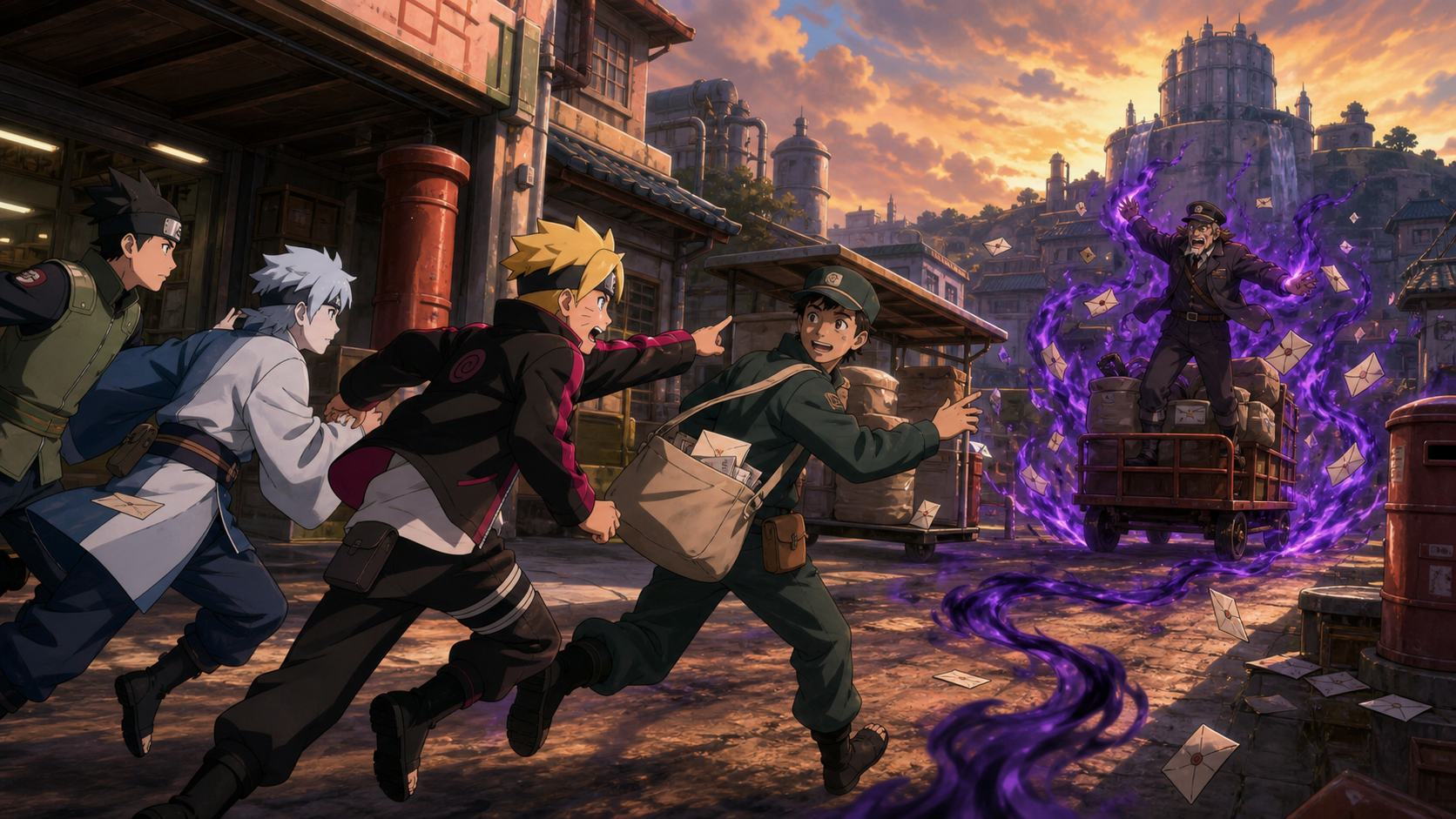
Possessed Komame tears through the office and turns stacked mail into a storm. The target is funny enough to lower our guard, then frightening enough to prove the Ghost can weaponize anybody. A strict postal manager becomes a remote attacker, hurling parcels through the streets while his body rides the delivery cart at the center of the destruction.
Mail becomes ammunition
The chase gives Boruto Episode 11 its best action. Packages and letters fly like projectiles while the students race through the postal district. Komame attacks from a distance, which keeps Boruto from ending the fight with one direct punch. Every parcel is both dangerous and precious. Destroying the barrage would mean destroying somebody's delivery.
Iwabee blocks the attack with Earth Release. His wall is not elegant, but elegance would be useless against a street full of airborne mail. The boy once framed as the class delinquent now plants himself between civilians and danger. That change deserves attention. Iwabee does not need a long confession about growth. He proves the change by showing up when the signal matters.
Tayori refuses to abandon one parcel
Tayori spots a package in the chaos and protects the parcel with his own body. To Boruto, one box among hundreds might look replaceable. To Tayori, a recipient is waiting. Somebody trusted the post office to carry a promise from one person to another, and he will not let Komame's attack break that promise.
His words reach the man beneath the possession. Komame has spent the episode acting like efficiency matters more than feeling, but Tayori reminds him why their work exists. Mail is not paperwork moving across a map. Every item carries anticipation, affection, worry, or news. The Ghost can amplify resentment, yet Tayori calls up a stronger part of Komame before the darkness can erase him.
The possession cracks from the inside
Komame hesitates. That moment gives Boruto and Iwabee the opening to knock him unconscious and force the Ghost from his body. The victory does not belong to strength alone. Tayori weakens the possession by speaking to the person still trapped inside.
That choice becomes a quiet thesis for the entire Ghost arc. Hurt people are not empty containers. Even under supernatural influence, their ordinary loyalties remain. A sincere connection can interrupt the worst impulse long enough for somebody else to help. The series has not abandoned action. The action simply works because empathy created the opening.
The class chases the masked controller
When the dark chakra flees, Mitsuki, Inojin, Chōchō, and Metal follow. Their pursuit finally brings the masked controller within reach. Mitsuki finds the suspect first, alone and away from the others. A fight seems inevitable.
Mitsuki lets the figure leave.
That decision is the sharpest mystery in the episode. Mitsuki has already shown that he can be ruthless when Boruto is threatened. He is not frightened, confused, or too slow. He chooses observation over capture. The question changes from whether Mitsuki can stop the culprit to what he already knows and why he wants the plan to continue.
Boruto wins a battle and misses the real move
Boruto believes the trap worked because Komame survived and the post office attack ended. From his point of view, the day proves that classmates working together can protect Konoha. He is right about the teamwork and wrong about the scale of the enemy's plan.
The masked controller was never risking everything on one postal worker. Each Ghost incident has harvested chakra. Every victim, chase, and public disturbance has contributed to something growing outside Boruto's sight. The heroes prevented another death, but the mastermind still gained what the larger operation needed.
The post office rebuild matters
After the fight, everyone helps reorganize the wrecked post office. This cleanup is not filler after the exciting part. Boruto's first encounter with postal work began with contempt for boring responsibility. Now he understands that protecting a place includes restoring what the battle damaged.
The students sort letters, stack parcels, and put the ordinary world back together. Tayori and Komame return to being people rather than plot devices. Konoha's peace is built through small acts like these, not only through Hokage monuments and famous jutsu. Somebody still has to make sure the package reaches the person waiting.
Mitsuki carries the episode's darkest secret
Mitsuki remains the unsettling center. He studies Boruto's choices, passes information to Sai, follows the fleeing chakra, and then allows the culprit to escape. His calm makes every decision harder to read. Boruto charges toward the visible problem. Mitsuki keeps one eye on the hidden experiment.
Their friendship is real, but honesty has not caught up. Mitsuki may admire Boruto precisely because Boruto makes choices from the heart without needing permission. At the same time, Mitsuki is still operating from knowledge Boruto does not possess. That imbalance cannot stay quiet forever.
Nue is the true destination
The final reveal confirms that the stolen chakra is being gathered to awaken Nue. The Ghost attacks were never isolated outbursts. They were feedings. Konoha has been watching symptoms while the real threat develops behind them.
That twist gives the postal story a darker aftertaste. The class coordinated, saved Komame, and protected civilians. Those victories are genuine. Yet every partial success has happened inside the mastermind's timetable. Boruto is learning how to investigate, while the enemy has already moved from testing victims to preparing a weapon.
The class trap works because everybody owns one piece
Boruto identifies the pattern, but the plan stops being his private adventure the moment the class joins. Shikadai turns suspicion into an organized response. Inojin uses the Super Beast Scroll to watch from above. Iwabee brings the physical force needed when the street becomes dangerous. Denki handles communication. The students cover more ground because nobody has to impersonate a complete shinobi team alone.
That matters for Boruto. His first instinct is usually to sprint toward the loudest problem and hope courage fills every missing skill. Episode 11 lets him lead without making everyone else an accessory to his greatness. He shares the information, accepts Shikadai's structure, and trusts classmates to act beyond his line of sight.
The trap still fails to catch the controller. Good teamwork does not magically erase the experience gap between Academy students and somebody operating through Root technology. The class protects civilians and learns how the enemy watches them. Those are meaningful wins even when the larger mystery stays open.
Komame becomes the consequence of treating people like routes
The postmaster spends much of the assignment worrying about schedules, complaints, and efficiency. He is not wrong to care. Lost parcels affect real people, and Boruto's original attitude created extra work for everybody. The Ghost exploits the weak point inside that reasonable concern and turns Komame's frustration into violence.
Possession exaggerates what already hurts. Komame feels responsible for a system that can never run perfectly, especially when inexperienced students treat his workplace like a joke. Once the Ghost takes hold, every delay becomes betrayal and every obstacle deserves punishment.
Tayori reaches him by restoring the person beneath the job title. One parcel, one promise, and one waiting recipient become more important than the possessed demand for perfect control. The scene refuses to mock ordinary work. Postal responsibility becomes the memory strong enough to fight back.
Tayori understands service better than the future Hokage's son
Boruto begins the post-office arc believing important work should look exciting. Tayori knows better. A package can carry medicine, a gift, paperwork, or the small proof that somebody remembered another person. The courier may never learn the whole story. Delivery still matters.
That attitude quietly challenges Boruto's obsession with visible heroics. Saving Konoha is not only the moment when a giant enemy appears beneath the Hokage monument. Service also means repeating an unglamorous task correctly when nobody applauds.
Tayori does not need chakra to affect the fight because his relationship with Komame already exists. He has shown up, taken the work seriously, and earned enough trust for his words to penetrate the possession. The episode makes emotional continuity a form of strength without turning the moment into sugary nonsense.
Sai knows Root can survive without Danzo
Sai's investigation gives the mystery political weight without dragging the episode away from the children. Root was officially dismantled, but an institution built around secrecy does not vanish because the office name disappears. Research survives. Operatives survive. Children shaped by its methods survive.
The Wood Release trace signals that somebody inherited more than a grudge. Root treated bodies, bloodlines, and emotions as material for village security. Nue belongs to that logic: take a wounded child, attach a weapon to her suffering, and call the result a mission.
Sai can recognize the pattern because he once lived inside the same machine. His role is not decorative nostalgia for older Naruto fans. He is evidence that survival does not erase what an institution trained into a child. The case forces him to confront another young person carrying Root beyond Danzo's grave.
Mitsuki protects Boruto by deceiving him, and that cannot last
Mitsuki keeps helping the investigation while controlling how much truth reaches Boruto. From his perspective, secrecy may feel protective. Boruto charges into danger as soon as a friend needs help, so withholding information can keep him away from a target Mitsuki considers lethal.
The problem is that protection without consent starts resembling control. Mitsuki decides what Boruto is allowed to know, watches his reactions, and lets the masked figure escape for reasons he never shares. Friendship becomes an experiment when only one person understands the conditions.
Episode 11 does not frame Mitsuki as secretly heartless. His fascination with Boruto has already become attachment. That attachment makes the deception more complicated, not less. He wants Boruto safe, wants to understand why Boruto chooses people, and still follows a private path shaped by his parent and mission.
The locked door cannot remain closed because Boruto's entire personality depends on entering rooms where someone else told him to wait. Episode 12 will force Mitsuki to decide whether friendship means observing Boruto or trusting him with the truth.
RaeRae's reaction
I love this episode because the post office joke grows teeth without losing the human reason behind the job. Tayori is not secretly a legendary shinobi. He is a postal worker who believes a waiting recipient matters, and that belief reaches Komame when fists cannot. Give me that kind of fandom storytelling every time. Let the side character's ordinary conviction change the battle.
Boruto also earns his leadership here. He does not command because of his surname. He notices a pattern, accepts help, and lets Shikadai make the plan smarter. The whole class becomes useful. Even the failed part of the trap teaches them something. The Ghost is watching their movements, and their enemy thinks several steps beyond one possession.
Mitsuki letting the masked figure walk away is the detail I keep circling. He had the chance. He made a choice. Every calm glance now feels like a locked door, and Boruto has no idea his closest new friend may already know what waits on the other side.
Bottom line
Boruto Episode 11 turns mail routes into a village-wide trap, possesses Komame, and lets Tayori's promise to one recipient crack the Ghost's control. Shino trusts the students, Shikadai organizes the class, Iwabee protects the street, and Boruto proves that his reckless attention can uncover patterns adults miss. Meanwhile, Sai finds Root's shadow in the evidence, Mitsuki lets the masked controller escape, and the stolen chakra moves closer to awakening Nue.
Sources and lawful viewing
Official episode reference: Naruto Official episode guide
Licensed episode route: Crunchyroll licensed series page