
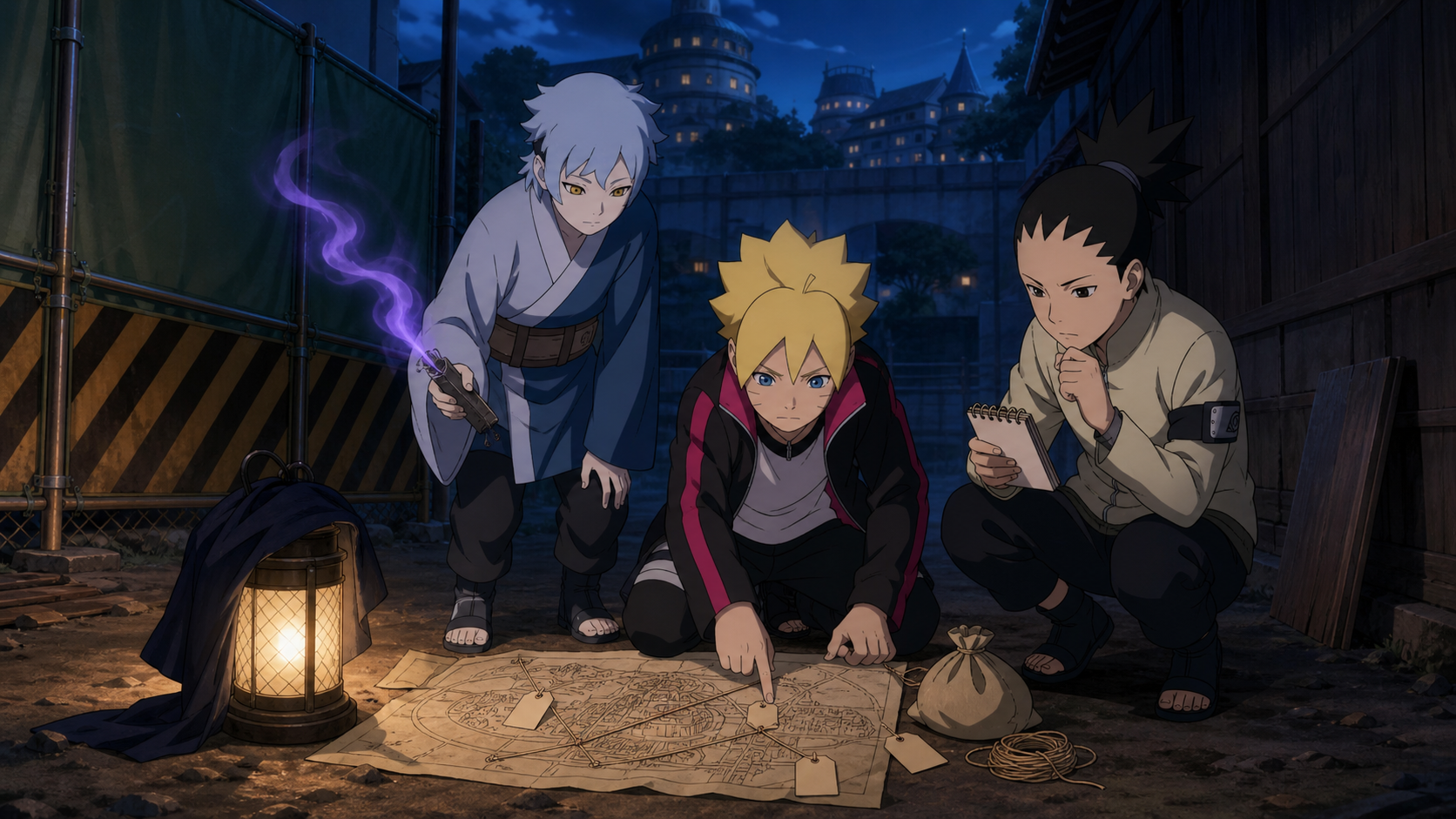
The Ghost Incident: The Investigation Begins!
Boruto turns workplace experience into a Ghost patrol, wrecks the mail route, and learns that saving Konoha still includes the people waiting on ordinary promises.
Series: Boruto: Naruto Next Generations
Episode: 10 · The Ghost Incident: The Investigation Begins!
Arc: Academy Entrance
Release: 2017-06-07
Previous: Episode 9 · Proof of Oneself
Directory: All 293 Boruto episodes
Boruto names the thing nobody else can see
Boruto has stopped arguing about whether his eye is a Byakugan. Episode 10 gives him a more useful question: what keeps wrapping dark chakra around frustrated people before they explode? He calls the shadow a Ghost because twelve-year-old mystery clubs deserve dramatic names, and because saying the word makes the pattern feel catchable.
Shikadai and Mitsuki join him in a crowded part of Konoha while he squints at strangers and tries to trigger his eye. Their method is terrible. Their confidence is enormous. I love them already. Boruto expects the Ghost to appear because he wants an answer badly enough, Shikadai keeps pointing out the holes, and Mitsuki watches both boys as if their friendship is another experiment worth following.
The boys skip class for detective work
The Ghost incidents have moved beyond the Academy. That expansion makes Boruto more determined, especially after Shikadai mentions that their fathers are investigating too. Solving the case before Naruto would prove that Boruto's sight matters and give him one victory that does not come from being the Hokage's son.
So the boys skip class.
Mitsuki files their absence as though three Academy students can simply declare an independent field assignment. Boruto and Shikadai accept this logic because the plan benefits them. Their first investigation produces no Ghost, no suspect, and no evidence beyond tired feet. The comedy works because their ambition is larger than their preparation. They are not a shinobi task force. They are three children wandering around town and hoping evil chakra respects office hours.
Hinata receives the Academy call
Hinata learns about Boruto's absence from the Academy, which means his secret investigation lasts approximately one day before reaching his mother. She does not laugh at him. She hears a son trying to explain an urgent duty and recognizes how much of that urgency is tangled around Naruto.
Boruto wants his father to believe him. He also wants to beat his father to the answer. Those desires sound contradictory only if we forget how much he misses Naruto. Competition creates a reason to stay connected when asking for attention feels too vulnerable. If Boruto solves the Ghost case first, Naruto will finally have to look at what his son can do.
Shino quietly gives Boruto a route
Shino understands more than Boruto realizes. His next lesson sends every student into Konoha for workplace experience, letting the class learn what ordinary village jobs require. On the surface, this is a practical assignment. Underneath, Shino has handed Boruto a legitimate reason to move through the village without skipping school again.
That is excellent teacher behavior. Shino does not announce that Boruto is right, because nobody has enough proof. He does not humiliate him for trying. He builds a lesson broad enough to serve the entire class while quietly giving one stubborn student room to test his idea.
Boruto, Shikadai, and Mitsuki choose the postal service immediately. Mail carriers travel everywhere. Every street, shop, office, and neighborhood becomes part of their route. For Ghost hunters, the job looks perfect. For boys who have never respected a delivery schedule, disaster is already waiting.
Tayori believes every parcel matters
Tayori Kuroyagi becomes their guide, and his earnest devotion to postal work is exactly the energy this trio needs. Boruto sees a village-wide patrol network. Tayori sees names, addresses, and people waiting. He treats delivery as a promise, not a pile of boxes.
The difference becomes the heart of Episodes 10 and 11. Boruto wants the exciting problem hiding behind the ordinary task. Tayori knows the ordinary task is already important. Somewhere in Konoha, a person is waiting for news, food, a gift, or something they cannot replace. A shinobi does not need to throw a kunai for their choices to affect somebody's day.
Tayori takes the boys across the village, showing them how much care lives inside a route that Boruto assumed would be boring.
Workplace day lets the whole class breathe
The class scatters into jobs that fit their interests and personalities. The assignment expands Konoha beyond training grounds and family compounds. These children may become shinobi, but they are growing up inside a village full of workers who keep water running, parcels moving, shops open, and public events organized.
Sumire, Wasabi, and Namida report to the Leaf Water Purification Plant. Chōchō has enough investment in snack deliveries to become a future postal-service accountability board all by herself. Everyone gets a small corner of adult life, which makes the later danger feel personal. The Ghost is no longer interrupting only ninja lessons. The attacks can reach the systems everybody depends on.
Naruto catches Boruto on the route
During the deliveries, Boruto sees Naruto at an opening ceremony. Of course the Hokage is standing in front of another crowd while his son is dragging packages through town. Naruto notices him too and approaches.
Their conversation is brief, awkward, and sweeter than either boy or father would admit. Boruto is doing real work while conducting his secret investigation. Naruto sees his son out in the village, contributing instead of demanding attention in the office. Neither one knows how to say that the encounter matters.
Boruto still wants to solve the case first. Naruto still has an official investigation running beyond his son's sight. For a moment, though, they occupy the same village as two people with responsibilities rather than a lonely child chasing a busy title.
Boruto destroys the delivery plan
The route moves too slowly for Boruto's Ghost hunt, so he splits the group up. Efficiency, according to Boruto, means finishing the boring work as quickly as possible and returning to the interesting mystery. Tayori's instructions become optional the second they interfere with his preferred timeline.
This choice is funny because the consequences are so ordinary. No forbidden jutsu backfires. No enemy ambushes them. People simply receive the wrong mail or no mail at all. Chōchō's missing special chips become a crisis worthy of national attention in her mind, and honestly, I respect the commitment.
Boruto wants credit for protecting the village while ignoring the village residents waiting on his route. Heroism sounds grand until somebody asks whether he delivered the package to the correct house.
Mitsuki brings news from Senju Park
When the boys regroup, Mitsuki reports another incident at Senju Park. The Ghost may have appeared while they were separated. Boruto abandons the route and races toward the scene, convinced that his eye can finally catch the shadow before adults close everything down.
They arrive too late. Sai has already gathered witness statements and processed the area. Boruto does not get the dramatic confrontation he imagined. He gets an empty scene and the knowledge that somebody else moved faster.
That frustration pushes him harder. Every missed attack feels like proof that the next patrol must be quicker. Boruto has not yet learned that speed without discipline creates blind spots, including the stack of undelivered mail waiting back at the office.
Sai finds Wood Release in the evidence
Sai's investigation gives the episode a darker spine. Trace evidence suggests Wood Release connected to research involving Hashirama's cells. Sai believes former Root members may be involved and that the attacks could be harvesting chakra for military purposes.
Root is not a random name from Konoha history for Sai. Root shaped his childhood, trained him to suppress feeling, and turned children into instruments for missions nobody wanted attached to the village's public face. When Sai recognizes the methods, he is looking at the possibility that Danzō's machinery kept moving after Danzō died.
Shikamaru and Sai decide to search Root records. Their work runs parallel to the children's Ghost club: one group follows classified history, while the other follows a chakra shadow only Boruto can see.
Naruto admits fatherhood scares him
Naruto returns home to change clothes and talks with Hinata about seeing Boruto during the postal assignment. The Hokage can coordinate investigators, attend ceremonies, and hold an entire village's expectations. Then one conversation about his son leaves him unsure.
Naruto admits that growing up without a father gave him no example for how to raise Boruto. That confession does not erase missed dinners or broken promises. The confession explains why he keeps reaching for public duty when private closeness feels unfamiliar. Naruto knows how to become indispensable to everyone. He is still learning how to be reliably present for four people at home.
Hinata understands both sides without turning Boruto's hurt into childish ingratitude. She sees a father who loves badly through absence and a son who acts loudly because silence never brings Naruto through the door.
The post office collects every mistake
Back at the postal service, complaints have arrived before the boys. Missing mail, wrong addresses, delayed parcels, and Chōchō's snack emergency prove that their clever shortcut failed. Komame does not care that Boruto was chasing a supernatural threat. The post office promised delivery, and customers received chaos.
Tayori takes responsibility for fixing the routes while Komame assigns Boruto, Mitsuki, and Shikadai to inventory duty. The punishment is perfect. They wanted freedom to run across Konoha, so now they must remain indoors and count the work they treated as disposable.
Boruto hates every second. Shikadai probably expected this result ten decisions ago. Mitsuki remains fascinated by the social ritual of consequences.
Inventory is Boruto's personal nightmare
Counting packages cannot compete with visible dark chakra, rival investigators, or the chance to prove Naruto wrong. Boruto's body may be in the storeroom, but his attention stays on the Ghost. Every box looks like time lost while the culprit finds another victim.
His impatience is not entirely selfish. Boruto has seen what the shadow does. He knows another attack may happen while adults debate evidence. Still, good intentions do not restore lost mail. Episode 10 lets both truths sit together. Boruto cares deeply, and Boruto created a mess because caring about one problem made him dismiss everyone outside that problem.
That flaw feels human. Fandom heroes become boring when every reckless choice is secretly perfect. Boruto needs consequences that cannot be punched away.
The television changes the whole day
News breaks about an incident at the Leaf Water Purification Plant. The workplace name lands before the boys even process the danger. Sumire, Wasabi, and Namida are assigned there.
Suddenly the Ghost is not an exciting mystery happening around strangers. Their classmates may be inside the attack. Boruto's frustration with inventory turns into fear, and all three boys rush from the post office.
The episode ends before giving them relief. That cutoff is cruel in the best weekly-anime way. We know Boruto already sacrificed the postal route to chase one scene too late. Now his careless deliveries may have cost the time he needed to reach people he knows.
Sumire's placement changes the mystery
Sumire working at the water plant looks innocent during a first watch. After the arc's reveal, every quiet shot carries another meaning. She stands beside Wasabi and Namida as the dependable class representative while the plan connected to her past keeps feeding.
The series has spent several episodes showing Sumire as the person who notices everybody else's feelings. She remembers names, calms arguments, and makes herself easy to trust. Episode 10 begins turning that kindness into a question without declaring the answer. Is she choosing these friendships, performing safety, or desperately trying to become the girl her classmates already believe she is?
That tension gives the cliffhanger more weight than a simple rescue alarm.
Shikadai is the investigation's necessary brake
Boruto supplies momentum, but momentum alone produced the delivery disaster. Shikadai keeps asking whether a plan makes sense, whether their assumptions hold, and whether Boruto's need to beat Naruto is steering the investigation.
He still follows Boruto to Senju Park and races toward the water plant. Skepticism does not make him passive. Shikadai challenges the method while believing the danger. That balance is why the trio works.
Mitsuki supplies the third angle. He accepts Boruto's unusual sight without demanding a family explanation, yet his calm suggests he knows more than he shares. Shikadai reads the board. Mitsuki reads Boruto. Boruto keeps running toward whatever neither friend has named aloud.
Shino's lesson succeeds through failure
From a workplace perspective, Boruto fails spectacularly. He ignores the route, causes complaints, and gets assigned to inventory. From a teacher's perspective, the lesson gives him exactly what he needed: movement through Konoha, direct contact with ordinary responsibility, and consequences that connect choices to neighbors.
Shino does not need a classroom lecture about discipline. Komame, Tayori, and Chōchō teach that lesson through lived annoyance. Boruto learns that a village is not an abstract crowd waiting for a hero. Konoha is made of people expecting their mail, workers covering mistakes, friends assigned to a water plant, and parents trying to talk after work.
The Ghost hunt becomes more urgent because the village becomes more specific.
The comedy keeps the mystery alive
Episode 10 could have turned into a dry bridge between Boruto's eye confirmation and the Ghost arc climax. Instead, postal chaos gives the investigation personality. The boys' scheme is clever enough to admire and irresponsible enough to laugh at. Tayori and Komame feel like people rather than information dispensers. Chōchō's chips become the perfect receipt for Boruto's shortcut.
That comedy also protects the darker material from becoming heavy-handed. Sai can uncover Root traces, Naruto can confess fear about fatherhood, and Sumire can walk into a dangerous workplace without the episode sounding like a lecture. Life in Konoha remains busy, silly, and ordinary while something predatory moves underneath.
Boruto wants Naruto's recognition more than Naruto's defeat
Boruto talks about solving the case before his father because competition feels safer than admitting he wants Naruto to believe him. If Naruto loses the race, he must acknowledge that Boruto saw something real. If Naruto wins, Boruto can complain about the Hokage again without naming the loneliness underneath.
That emotional dodge makes the investigation personal without reducing every victim to fuel for a father-son argument. Boruto genuinely wants the Ghost stopped. He also wants one answer that belongs to him before Naruto's office absorbs the mystery and sends the children home.
Hinata understands both motives. She does not dismiss the strange eye or pretend skipping school was acceptable. Her conversation with Naruto pushes him past the easy explanation that Boruto merely craves trouble. Their son is reaching for him through rivalry because direct requests have failed too often.
Naruto's admission matters because legendary heroes are not automatically skilled parents. He grew up without a father who modeled ordinary attention, boundaries, apologies, or repair. That history explains his uncertainty. Boruto still has to live with the consequences while Naruto learns.
The water plant turns a funny failure into real guilt
The postal detour stays hilarious until Boruto realizes their assigned route passed near the next attack. Suddenly every ignored parcel and shortcut feels connected to the time they lost. Boruto cannot know that perfect delivery would have prevented the possession, but guilt rarely waits for fair evidence.
Sumire, Wasabi, and Namida entered the purification plant as students completing an ordinary assignment. The Ghost turns that civic workplace into a hunting ground. The choice expands the threat beyond dramatic alleys and training spaces. Konoha's daily systems are vulnerable because the controller targets people, not scenery.
Boruto races toward the plant already prepared to blame himself. That instinct can create responsibility, but the series also shows the danger of a child believing every bad outcome proves he failed to move fast enough. Heroism becomes unhealthy when compassion turns into ownership of every wound.
Episode 11 opens inside that guilt. The cliffhanger earns the shift because Episode 10 spent enough time making the workday feel harmless before tearing through the assumption.
Sai's clue changes the scale of the investigation
Wood Release and Hashirama-cell research pull the Ghost case out of playground-mystery territory. Konoha has a long history of adults treating rare bodies and bloodlines like military resources. Root made that behavior systematic, secret, and easy to deny.
Sai does not leap from one trace to a complete solution. He recognizes a family resemblance between the current evidence and the institution that shaped him. That restraint keeps the clue useful. The audience understands that the Academy incidents belong to an older wound, while the investigators still have to find the person carrying the plan.
The discovery also explains why Boruto's eye alone cannot solve the case. He can see the dark chakra attached to a victim, but he cannot see the history that created the technique. Sai brings institutional memory. Naruto brings authority and resources. The students bring proximity to the targets. Each group holds a different part of the truth.
RaeRae's reaction
Boruto naming the Ghost and forming a tiny detective club is exactly the kind of Academy nonsense I want. Give me Shikadai complaining while following anyway. Give me Mitsuki filing an absence notice like he has found a legal loophole. Give me Chōchō ready to prosecute somebody over missing chips. The episode remembers that these children are funny before the danger demands they become brave.
My favorite choice is Naruto's conversation with Hinata. Naruto saved the world, became Hokage, and still has no idea how to be the father Boruto needs. That does not excuse him. That makes the failure hurt more. He loves his son and keeps reaching for the wrong tool because duty is the language he practiced his entire life.
Tayori also wins me immediately. His belief in one waiting recipient sounds small beside Root conspiracies and chakra harvesting. Episode 11 will prove that his ordinary devotion can reach a possessed man when shinobi force cannot. The setup earns that payoff.
Bottom line
Boruto Episode 10 turns the Ghost hunt into a charming disaster. Boruto, Shikadai, and Mitsuki skip class, use workplace experience as a village-wide patrol, wreck their postal route, arrive too late at Senju Park, and end inventory duty by racing toward their classmates at the attacked water purification plant. Sai discovers Wood Release evidence tied to Hashirama-cell research and possible Root survivors, while Naruto admits that growing up without a father left him unsure how to reach his own son.
The episode moves the mystery forward without forgetting the fandom fun. Boruto's instincts are good. His execution is a mess. Shino quietly trusts him, Tayori gives ordinary work dignity, and the cliffhanger makes every missed delivery feel heavier because Sumire, Wasabi, and Namida are now inside the danger.
Sources and lawful viewing
Official episode reference: Naruto Official episode guide
Licensed episode route: Crunchyroll licensed series page