
Proof of Oneself
Hanabi proves Boruto’s eye is not an awakened Byakugan, but one ridiculous Kagemasa fight proves the shadow he keeps seeing is real.
Series: Boruto: Naruto Next Generations
Episode: 9 · Proof of Oneself
Arc: Academy Entrance
Release: 2017-05-31
Previous: Episode 8 · The Dream's Revelation
Directory: All 293 Boruto episodes
Boruto walks into the Hyūga house needing an answer
Boruto arrives at the Hyūga home carrying more than a claim about his eye. He needs proof that the dark chakra was real, proof that Toneri's dream meant something, and proof that Naruto was wrong to doubt him. Calling the power a Byakugan gave every confusing sight a famous family name. Now the family who knows that name better than anyone gets to test him.
Hiashi does not dismiss his grandson. He explains that an awakened Byakugan should appear under the pressure of combat even if Boruto cannot activate the eye on command. Both Hiashi and Hanabi would recognize the signs. That response gives Boruto exactly what he demanded: a fair chance to show them.
The problem is that Boruto wants a verdict before the fight begins.
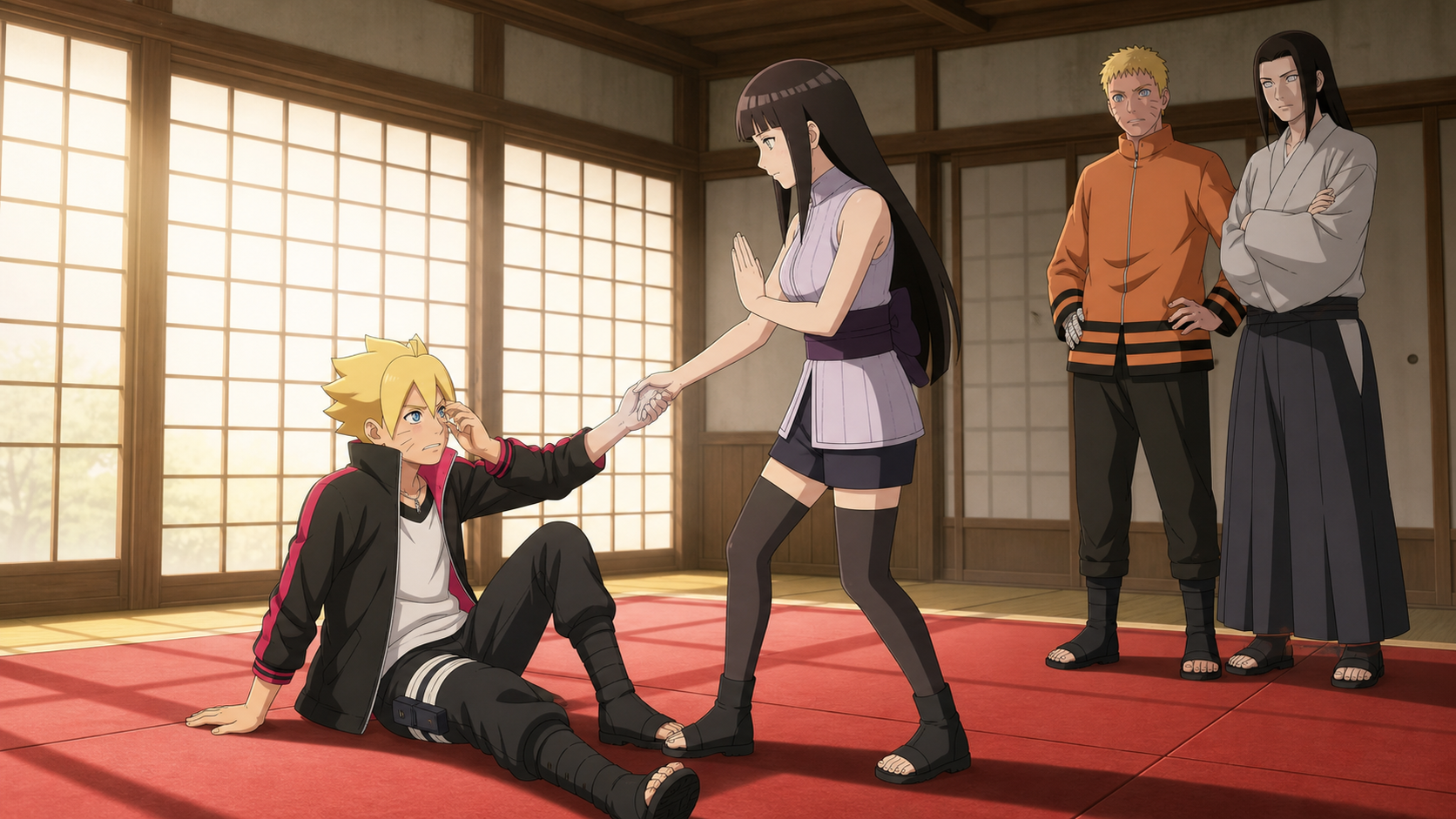
Hanabi saves Hiashi's back and takes the match
Hiashi prepares to test Boruto himself, but Hanabi steps in before her father turns a family visit into an orthopedic emergency. Her joke about Hiashi throwing out his back is affectionate, ruthless, and completely earned. Grandpa may be a legendary Hyūga, but Grandpa also needs to sit down.
Hanabi is the better opponent for this moment. She knows Gentle Fist and the Byakugan intimately, she can control the match, and she loves Boruto enough to push him without treating his failure as entertainment. Auntie mode and elite-kunoichi mode occupy the same body. Boruto has no idea how dangerous that combination is.
Himawari worries about her brother. Naruto assures her that Boruto will be fine. Then Hanabi begins teaching her nephew what fine looks like when every attack gets read before he finishes moving.
Boruto brings every trick he knows
Boruto does not enter the spar helpless. He uses shadow clones, misdirection, movement through the trees, and a flash bomb. One clone even carries the Kagemasa look because apparently Boruto cannot face a serious family trial without bringing his favorite movie into the strategy.
The sequence shows how talented he already is. Boruto combines techniques instead of repeating one attack until somebody falls. He creates distractions, changes angles, and tries to make Hanabi commit to the wrong target. This child thinks quickly in motion.
Hanabi sees through him anyway.
That difference matters. Boruto is not exposed as a fraud because he loses. He is a gifted Academy student fighting a woman whose entire style is built around seeing what opponents try to hide.
Hanabi turns the Byakugan lesson into action
When Boruto uses concealment and clones, Hanabi demonstrates why those tricks cannot fool an active Byakugan. She reads through obstacles, tracks the real body, and shuts down his openings. Her lesson arrives through palms and footwork rather than a classroom diagram.
Boruto tries surrounding her with shadow clones. Hanabi answers with Eight Trigrams Palms Revolving Heaven, sweeping the circle away. The move looks spectacular, but the emotional point is simple: if Boruto's eye had awakened as a Byakugan, Hanabi and Hiashi would know.
No veins rise around his eye. No Hyūga field of vision appears. Boruto keeps fighting because effort has always been his answer to doubt, yet effort cannot force one bloodline ability to become another.
The eye does not awaken
Hanabi gives Boruto the result plainly. She saw no sign that his Byakugan awakened. She also tells him that future awakening remains possible. The door is not locked forever, but this match did not prove his claim.
Boruto tries wearing disappointment like a shrug. Nobody in that courtyard believes the performance. He wanted Naruto to watch the eye appear. He wanted Hiashi to recognize the family power. He wanted everybody who laughed at the announcement to regret doubting him.
Instead, Hanabi wins and the mystery stays nameless.
The failure hurts because Boruto was not lying about what he saw. He guessed the wrong explanation and now fears everyone will treat the wrong guess as proof that the experience never happened.
Naruto is proud for the reason Boruto cannot hear yet
Naruto tells Hiashi that he is not disappointed. Boruto fought with everything he had because he genuinely believed his claim. The effort convinced Naruto that his son was not inventing a story for attention.
That is the emotional answer Boruto wanted, but he does not receive the answer in the triumphant language he imagined. Naruto cannot say, “Yes, you have the Byakugan.” He can say, “I believe that you believe something happened.” For a child desperate to be proven right, that distinction feels painfully small.
For a father who started the episode skeptical, the change is enormous. Naruto watched Boruto keep getting up against Hanabi. He saw conviction after the flashy theory failed to appear. Belief begins there, quietly, without the eye giving either of them an easy victory.
Hiashi has become somebody's soft grandfather
Watching Hiashi with Boruto and Himawari remains one of the wildest emotional rewards in the entire Naruto family story. This is the man who once treated clan duty like a blade hanging over his daughters. Now he invites everyone to stay the night, pours another drink, and tells Naruto not to scold the children because the visit is special.
Time did not erase the Hyūga family's harm. Hiashi's warmth does show that people can choose differently after causing harm. Boruto and Himawari know him as Grandpa, not as the cold clan head who measured Hinata against Hanabi.
That transformation gives the dinner scenes a tenderness bigger than the food. The next generation gets affection the previous generation had to fight to imagine.
Hanabi's stew starts another family battle
Hanabi plays with Boruto and Himawari during dinner. She proudly serves her special stew, waits for Boruto's judgment, and receives the worst possible review: his mother's tastes better.
The audacity.
Hanabi chases him. Himawari joins her. Boruto complains that two against one is unfair after spending the afternoon multiplying himself with shadow clones. Family justice has never moved faster.
This comedy is not filler around the important eye plot. The dinner proves that Boruto's place in the Hyūga family does not depend on manifesting their dōjutsu. He can fail the test, insult the stew, get chased through the house, and remain loved. Nobody withdraws kinship because his eye stayed ordinary.
Himawari's Byakugan stays part of the conversation
Hiashi asks Naruto about Himawari. Her Byakugan has not appeared again since the unforgettable day she knocked Naruto and Kurama unconscious with one furious strike. Hiashi wants updates and asks Naruto to bring her back if anything changes.
The contrast quietly complicates Boruto's disappointment. Himawari activated the family eye without chasing proof, while Boruto demanded the label and could not produce the signs. Siblings do not inherit identity in matching packages.
Boruto's path is not lesser because Himawari may carry a recognizable Hyūga power. His eye is doing something else, and Episode 9 refuses to reward his impatience with a convenient name.
Hanabi believes something happened
Later, Hanabi talks to Boruto alone. She knows him well enough to recognize that empty boasting would not have carried him through such a serious spar. He experienced something. She cannot confirm the Byakugan, but she does not call him a liar.
That conversation gives Boruto a place between certainty and ridicule. Hanabi offers no grand prophecy and no false diagnosis. She sees how badly he wanted to prove the claim and trusts that the urgency came from somewhere real.
Sometimes the best adult answer is not solving the child's mystery. Sometimes the answer is refusing to abandon them while the mystery remains unsolved.
Sarada finds Boruto at his lowest
Boruto meets Sarada outside at night, still bruised by the failed test and trying to pretend he does not care. Their conversation turns toward Kagemasa, the movie hero Boruto adores. Sarada can tease him and understand him in the same breath.
Boruto wants to be the person who sees hidden danger when everybody else misses the threat. Kagemasa gives that fantasy a costume and catchphrases. After Hanabi's verdict, the fantasy feels embarrassing. Then Boruto's eye catches the dark chakra again.
The timing could not be better. He has stopped expecting a Byakugan performance, and the actual ability returns when another person is in danger.
Kagemasa is having the worst celebrity night
Boruto follows the possessed figure to the Academy and discovers the actor who plays Kagemasa. The once-sleek movie hero has gained weight, and Boruto reacts with the complete lack of tact only Boruto can bring to a supernatural emergency.
The Ghost grabs the actor's insecurity and turns humiliation into violence. Kagemasa attacks because Boruto comments on his body, but the scene never loses its absurdity. Boruto is being pummeled by his favorite fictional hero while trying to understand why the costume no longer fits the poster.
The actor insists that he is a professional and can lose the weight. The Ghost makes that defensiveness dangerous. Fame has reduced him to an image, and one child's blunt surprise hits the exact wound the dark chakra wants.
Sarada believes Boruto before seeing the proof
Kagemasa pins Boruto down, and Sarada intervenes. Boruto tells her that a shadow only he can see is controlling the actor. Sarada cannot verify the chakra with her own eyes, but she has enough trust to fight beside him.
That trust matters after the Hyūga test. Boruto does not need Sarada to declare his eye a Byakugan. He needs somebody to respond to the immediate danger. She watches the possessed man's behavior, listens to Boruto's warning, and acts.
Sarada also brings the plan Boruto's panic lacks. Their bickering never disappears, yet the teamwork is already waiting underneath. Long before Team 7 receives a number, these two know how to turn irritation into coordination.
The Kagemasa lines become battle strategy
Boruto and Sarada fight the actor using lines from the Kagemasa movie. The scene commits fully to fandom nonsense, which makes the victory delightful. Boruto is not merely copying a hero. He and Sarada use the shared movie language to coordinate without telling Kagemasa their next move.
The final trick echoes Naruto and Sasuke's famous maneuver against Zabuza. Boruto transforms into a Fūma shuriken, Sarada throws him, and the hidden attack reaches the target after the obvious weapon fails.
Parents repeat through their children in strange ways. Boruto takes Naruto's role inside the transformation while Sarada handles the throw associated with Sasuke. Neither child knows they are remixing an old Team 7 memory. The fandom does, and the parallel lands beautifully.
Boruto watches the Ghost leave
Once Kagemasa is defeated, the dark shadow dissipates from his body. Boruto sees the separation clearly. The eye did not awaken for Hanabi because the eye was never responding to ordinary combat. The power appears around the Ghost.
That realization changes the question. Boruto no longer needs to prove a Byakugan. He needs to prove that the strange eye exists and that the chakra he sees connects the attacks around Konoha.
The actor's recovery gives Boruto evidence he can trust even if nobody else saw the shadow itself. Kagemasa changed under the influence, attacked, then returned after the chakra dispersed. The pattern has moved beyond one dream and one family theory.
The wrong name no longer owns the truth
The next day, Boruto tells Mitsuki and Shikadai that he no longer cares whether the power is a Byakugan. He will prove that the eye and the shadow are real.
That is growth. Small, stubborn, extremely Boruto growth, but growth all the same. He separates the experience from the label. Hanabi's test disproved one explanation without disproving every sighting.
Shikadai remains skeptical enough to keep the investigation grounded. Mitsuki remains interested enough to follow wherever Boruto leads. The three boys now have the beginning of a Ghost club, even if Boruto has not invented the name yet.
Proof belongs to more than the eye
The title “Proof of Oneself” sounds like Boruto must make a special organ perform on command. The episode gives him a different proof. He shows Naruto that his conviction is sincere. He shows Hanabi that the claim came from a real experience. He shows Sarada that following the shadow can save somebody. Most importantly, he shows himself that being wrong about the Byakugan does not make every observation worthless.
Boruto also proves his fighting talent. His clone combinations force Hanabi to respond seriously, and his transformed-shuriken trick helps free Kagemasa. The dōjutsu does not carry him through either fight. Creativity, trust, and refusal to stay down do.
That answer fits the Uzumaki-Hyūga child better than a simple bloodline reveal ever could.
Hanabi gives Boruto a test instead of a verdict
Hanabi could have dismissed Boruto as a child chasing attention. She could also have protected his feelings with a vague promise that every Hyūga gift develops differently. She chooses the honest middle: fight hard enough to make the Byakugan reveal itself, then accept the result the evidence gives.
The training match respects Boruto because Hanabi refuses to lower the standard. His clones, angles, and feints force her to work, but no visible Byakugan appears. Losing does not make him ridiculous. The loss answers the exact claim he brought to the compound.
Afterward, Hanabi separates the failed diagnosis from Boruto's character. She does not believe he lied. She believes he experienced something they cannot yet name. Adults often crush children by treating an incorrect explanation as proof that the original observation was fake. Hanabi never makes that mistake.
Her response becomes the episode's best model for skepticism: test the claim, state what the test established, and leave room for what the test could not establish.
The Hyūga house shows how much one generation changed
Hiashi welcomes Boruto and Himawari with a softness that would have felt impossible during Hinata and Neji's childhood. The same clan once enforced a branch-family seal, measured children through combat, and allowed hierarchy to poison close relationships. Now the clan head fusses over grandchildren and lets the house feel like family.
That warmth does not erase the old system. The contrast matters because change becomes visible in ordinary behavior. Hiashi cannot rewrite Neji's childhood, but he can refuse to make Boruto and Himawari approach him through fear.
Boruto also receives something Naruto never had at the same age: an extended family willing to take his strange claim seriously. He may complain constantly about the Hokage household, yet several adults are ready to listen, test, feed, and shelter him.
The episode lets that privilege exist beside his genuine loneliness. Having loving relatives does not cancel the empty chair Naruto leaves at home, and Naruto's absence does not mean Boruto stands completely alone.
Sarada joins before she has every answer
Sarada sees Boruto pursue the shadow around Kagemasa and chooses to help. She does not share his vision, but she can see the actor's behavior, the danger, and Boruto's certainty. Her decision is practical trust rather than blind agreement.
Their transformed-shuriken move works because both children commit to the same timing. Sarada must throw what appears to be a weapon while trusting Boruto to hold the transformation and choose the opening. Boruto must trust her aim. The maneuver belongs to both of them.
The Team 7 echo carries more than nostalgia. Naruto and Sasuke once used deception to reach Zabuza because neither could win through direct force. Their children independently reach the same tactical idea against a completely different threat. Inherited history appears through problem-solving, not a speech about legacy.
Sarada's presence also gives Boruto a witness to the aftermath. She may not see the Ghost leave, but she sees the possessed actor recover after their attack. Boruto's case is still incomplete, yet the mystery no longer lives entirely inside his private testimony.
Kagemasa makes Boruto confront fandom without fantasy
Boruto loves the movie hero because Kagemasa turns impossible danger into style. Meeting the actor should have been a perfect fan moment. Instead, the Ghost takes hold of the insecurity behind a public image and turns Boruto's favorite figure into the threat.
The weight jokes are broad, but the underlying pressure is recognizable. Kagemasa's body changed, production treated that change as a problem, and shame gave the dark chakra somewhere to fasten. The episode does not need the actor to be morally pure for the possession to feel cruel.
Boruto helps him without receiving a glamorous introduction or autograph. He has to protect the human being after the fantasy collapses. That distinction belongs at the center of fandom writing. Loving a performance does not mean the performer exists only as the version sold on screen.
When Kagemasa recovers, Boruto gains a better kind of proof than celebrity validation. The person beneath the role survives, and the Ghost pattern becomes clearer.
RaeRae's reaction
I came for Hanabi folding Boruto across the training yard and stayed for Hiashi becoming the grandpa who pours drinks while his grandchildren run through the house. Naruto fans earned this softness. We remember what the Hyūga home meant for Hinata. Seeing Boruto fail a clan test and still receive dinner, teasing, concern, and a bed for the night hits harder than the episode announces.
Hanabi is the star. She tests Boruto honestly, destroys every trick, gives him the disappointing answer, then makes sure he understands that she believes something happened. No fake reassurance. No cruelty. Just an aunt who can knock him flat and hold space for the mystery afterward.
The Kagemasa fight is wonderfully ridiculous. Boruto insults his favorite actor's weight, gets attacked at the Academy, quotes the movie during combat, and recreates a classic Naruto-Sasuke trick with Sarada. Fandom joy and plot movement share the same scene. More of that, please.
Bottom line
Boruto Episode 9 lets Hanabi disprove the Byakugan theory without treating Boruto like a liar. He fights creatively, loses cleanly, spends the night surrounded by Hyūga family affection, and receives quiet belief from Naruto and Hanabi. Then the actual eye activates around the possessed Kagemasa actor, Sarada joins the fight, and their transformed Fūma-shuriken trick frees him from the Ghost.
Boruto leaves with no famous name for his power. He also leaves with something better: a new question grounded in what he actually saw. The Byakugan test failed. Boruto's honesty did not. His next job is finding the shadow again and proving that Konoha's strange attacks belong to one mystery.
Sources and lawful viewing
Official episode reference: Naruto Official episode guide
Licensed episode route: Crunchyroll licensed series page