
RaeRae Reacts · One Piece Episode 156
Skypiea Manufactures Class Two Criminals
One Piece Episode 156 turns an immigration toll into escalating criminal classes before Nami and Luffy scatter McKinley’s White Berets.
McKinley begins with a photograph and a verdict
Episode 156 opens with Captain McKinley presenting Amazon’s Vision Dial image as proof that the Straw Hats entered Skypiea illegally. The photograph proves presence, not informed refusal.
Pagaya tries to reason with the White Berets while the crew asks what crime they supposedly committed. Nobody from the gate appears to explain the conversation.
A fair investigation would preserve Amazon’s exact words, the toll notice, the crew’s response, and the Express Lobster’s role in carrying them upward.
McKinley treats the report as complete because the process was designed to create the offense. Evidence selected by the same system needs independent review.
Class Eleven sounds minor until the fine arrives
McKinley calls unpaid entry a Class Eleven offense and offers a path back to ordinary tourist status. The crew can erase the charge by paying ten times the original fee.
The remedy confirms that immediate danger was never necessary. Skypiea could have stated the amount before admission and collected ordinary payment.
Instead, the government multiplies the toll after creating noncompliance through ambiguity. Penalty revenue becomes part of the border design.
The crew should request a written charge, itemized calculation, deadline, appeal, and receipt. Verbal numbers spoken by armed officers are not transparent administration.
Robin converts extol and exposes the actual demand
Robin establishes that ten thousand extol equal one berry. The total fine for seven people becomes seven million berries.
Translation turns an impossible-sounding local number into a recognizable fortune. Shared units are essential before anyone can evaluate or negotiate payment.
The original toll would have totaled seven hundred thousand berries, still substantial but far below the punishment. Amazon never offered a conversion or payment method.
A border authority serving visitors should display exchange rates, accepted currency, and assistance for people without local money. Skypiea provides confusion, then bills the confusion.
Nami’s absence remains more urgent than McKinley’s paperwork
The crew keeps discussing how to recover Nami while the White Berets demand attention. A missing navigator inside a lethal sacred forest outranks an administrative dispute.
Usopp tries to lower tension and asks McKinley to wait until Nami returns. He even suggests payment can be discussed once the person who handles money is present.
That request is reasonable and time-limited. McKinley could secure the Merry, record identities, and allow a supervised search without waiving the alleged charge.
Refusing any pause shows that enforcement values compliance theater more than immediate safety.
The recovered Waver becomes another presumed crime
McKinley notices the old Waver the crew salvaged from the St. Briss. Because Blue Sea people do not normally possess Wavers, he treats ownership as suspicious.
The crew has a provenance explanation: the craft fell with a two-hundred-year-old ship and remained aboard the Merry. Suspicion should trigger questions, not automatic theft allegations.
Usopp and Robin should document recovery location, condition, repairs, and witnesses. Pagaya can verify that the machine arrived damaged and required local work.
Property law needs a process for abandoned artifacts, salvage, historic ownership, and return. McKinley substitutes stereotype for investigation.
Saving Conis from a fish somehow enters the charge sheet
McKinley criticizes the crew for striking a rare sky fish even though the animal threatened Conis. Protection of a person should matter when evaluating harm to protected wildlife.
Environmental law can restrict killing, capture, or injury without demanding that residents become prey. Emergency-defense exceptions belong in any legitimate system.
Conis witnessed the event and should be allowed to speak without intimidation. Her safety should not disappear because the species carries official value.
The officer keeps collecting accusations faster than evidence. Quantity creates the appearance of guilt while preventing any claim from receiving proper review.
Zoro’s irritation becomes attempted violence on command
Zoro reacts to McKinley’s escalating list with a threat to cut through the conversation. Usopp immediately reframes the statement as a joke.
Threatening an officer can escalate a dangerous scene even when no blade moves. Zoro should conserve force for an actual attack and let Robin challenge the procedure.
McKinley also needs to distinguish speech, intent, preparation, and action. Treating every angry sentence as completed violence eliminates proportional response.
The crew cannot control a dishonest charge sheet, but they can avoid providing easy new facts for the officer to weaponize.
Chopper identifies the pattern before the adults stop arguing
Chopper says McKinley is trying to make them guilty by any available method. The youngest crew member summarizes the enforcement strategy with brutal accuracy.
Each response generates another accusation. Explanation becomes obstruction, rescue becomes wildlife crime, possession becomes theft, and frustration becomes threatened assault.
Usopp tries to keep everyone still and quiet because ordinary participation feeds the loop. His instinct resembles legal advice under hostile questioning.
The crew should designate one speaker, stop volunteering facts, request charges in writing, and preserve witness names. Chaos benefits the party controlling the labels.
Sleeping becomes environmental pollution because the list needs another line
Usopp proposes that everyone wait by sleeping. McKinley then treats their presence on the cloud beach as environmental pollution.
The accusation makes the system’s bad faith impossible to ignore. Inaction becomes criminal because the objective is submission, not safe conduct.
Real environmental enforcement identifies protected zones, prohibited impacts, measurable harm, and corrective steps. McKinley offers none of those elements.
Luffy and Zoro become ready to fight, which may satisfy emotionally while moving the crew toward the harsher classification McKinley can impose.
Nami returns with urgency and drives directly into the fine
Nami races back from Upper Yard and sees authorities surrounding the crew. She first warns Luffy not to provoke anyone, a request arriving seconds before her own restraint collapses.
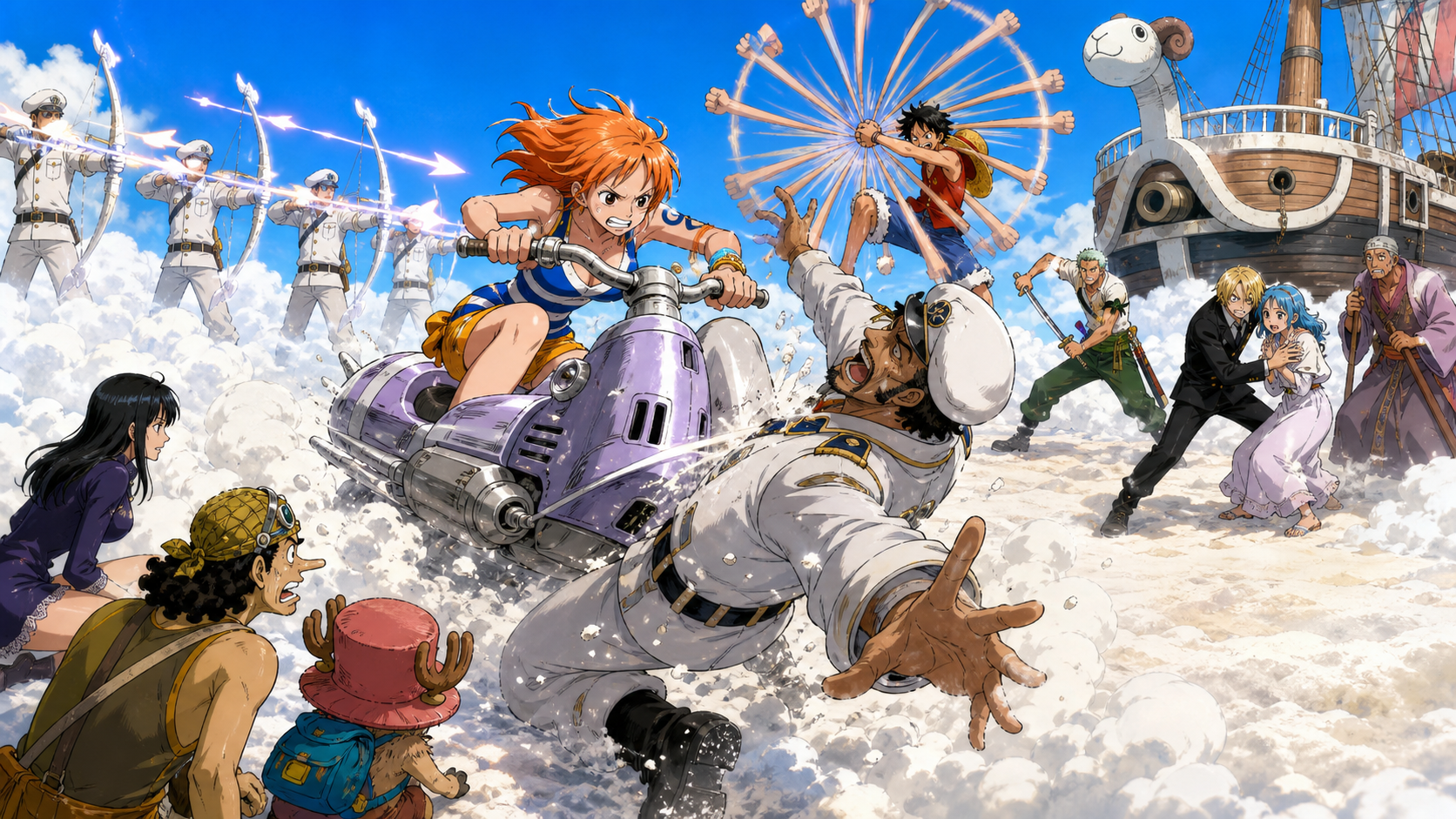
Usopp tells her the fine equals seven million berries. Nami responds by slamming the Waver into McKinley and ordering everyone to run.
The impact is satisfying because McKinley earned contempt, but physical assault gives the officer a clear event that does not depend on Amazon’s trap.
A safer return would deliver evidence first, extract Conis and Pagaya from the scene, and create distance before confrontation. Nami chooses speed under pressure.
Class Five reveals that cloud drifting is a death sentence
McKinley raises the crew’s status to Class Five and sentences them to cloud drifting. Officials place convicted people on a small island cloud with no way to escape.
Luffy initially imagines a pleasant ride. Robin recognizes the punishment as abandonment and connects the falling St. Briss to the same practice.
Exile without food, navigation, shelter, or rescue is execution performed slowly enough to avoid naming the killing.
The government also discards evidence and bodies into lower seas, transferring danger to people who never participated in the judgment.
Nami finally delivers the Upper Yard intelligence
Nami tells the crew about the recorded voices, armed priests, fleeing victim, lightning strike, and illegal-entry language. The missing half of the threat picture reaches Angel Beach.
Her report confirms that Upper Yard already expects the Straw Hats. Retreat from Skypiea now has stronger logic than curiosity.
Robin should record the report immediately while details remain fresh. Chopper needs to prepare for blast and electrical injuries before any rescue attempt.
The Tone Dial should be recovered only if doing so does not expose another person. Evidence has value, but living witnesses come first.
Luffy refuses to leave because the island still holds answers
The crew agrees that departure makes sense, but Luffy refuses. He came to find Sky Island, and one corrupt patrol will not make him abandon the destination.
His decision protects the adventure’s purpose while increasing risk for every host and crew member. Captains need to state objectives and accept the burden those choices create.
Remaining does not require attacking civilians or ignoring local claims. The crew can investigate Enel, Upper Yard, and Noland’s history while setting limits on harm.
Nami deserves a full hearing before the route is chosen. She personally witnessed the danger Luffy is volunteering everyone to face.
Conis tells them to flee while McKinley threatens her family
Conis urges the Straw Hats to hurry away. McKinley warns that continued assistance will make her and Pagaya subject to punishment.
The threat converts ordinary hospitality into coerced isolation. Enel’s government protects itself by making contact with accused people dangerous.
The crew should move the conflict away from the house and state clearly that Conis did not control their entry, Nami’s scouting, or Luffy’s decisions.
McKinley may ignore the distinction, but witnesses should preserve the coercion. Retaliation against hosts belongs in any later account of the incident.
The White Berets attack with cloud arrows and dial technology
McKinley orders his unit forward, and officers fire pale cloud arrows. The same shell technology Conis introduced as household infrastructure now powers enforcement.
Technology does not carry one moral identity. Dials can store music, move Wavers, cook food, build homes, or support weapons.
The crew needs to observe range, reload time, trajectory, stored force, and failure points. Usopp should collect only disabled equipment after the scene is secure.
Conis and Pagaya need cover behind solid structures rather than soft cloud decorations whose protective strength remains unknown.
Luffy’s Fireworks scatters the patrol without extending the beating
Luffy spins stretched limbs through the attacking formation in a fireworks-like barrage. Zoro and Sanji help disable the White Berets quickly.
The response stops an active armed attack, protects the hosts, and opens an escape route. Force remains tied to immediate defense rather than punishment for earlier insults.
The crew should disarm officers, check injuries, and avoid striking anyone already unable to fight. Defeating abusive enforcement does not remove basic care duties.
McKinley’s unit lacks the strength to carry out its threat, but losing the fight gives him another classification to announce.
Class Two is the destination McKinley’s process kept building toward
After the White Berets fall, McKinley declares the Straw Hats Class Two criminals. Upper Yard’s priests will now judge them.
His laughter reveals that escalation serves the system. Failed enforcement does not trigger review; failure transfers the accused to a more lethal authority.
The crew needs immediate movement, a destination, a headcount, medical checks, and a decision about the Merry. Remaining on Angel Beach invites capture or retaliation against residents.
Gan Fall’s whistle now meets the definition of emergency equipment. The question is whether to use the one free rescue before or after the priests engage.
Episode 156 shows how a rigged process manufactures violent proof
Episode 156 starts with a toll dispute created at Heaven’s Gate and ends with armed combat. Every official step narrows the crew’s choices until resistance becomes evidence supporting harsher punishment.
The practical checklist is no longer optional. Robin must preserve the photo, amounts, exchange rate, charges, witness accounts, and Amazon’s wording. Nami must map Upper Yard and record the priest encounter. Chopper must assess injuries on both sides. Usopp must inspect recovered dial weapons and the repaired Waver. Sanji and Zoro must protect Conis and Pagaya while avoiding unnecessary escalation. Luffy must decide whether the mission is escape, rescue, investigation, or confrontation.
The crew also needs a deployment plan for the Merry. A ship left beside the host’s home can become leverage against Pagaya, evidence for McKinley, or a target for Upper Yard forces.
McKinley’s wounded officers should receive basic care without being allowed to regroup around loaded dial weapons. Their names, injuries, ranks, and issued equipment belong in the incident record. Conis should be offered a choice about leaving rather than ordered aboard by either side. Pagaya needs time to secure his home, tools, and repair work. Any immediate departure should preserve a rendezvous point in case the family becomes separated. The crew also needs to decide who carries Gan Fall’s whistle, who can activate the repaired Waver, and who remains responsible for navigation if Nami becomes injured during another patrol encounter.
RaeRae’s verdict: keep this one. Nami driving seven million berries of outrage into McKinley’s face is funny, but the episode never lets the punchline erase the death machinery behind the fine.
Skypiea calls them Class Two criminals. The evidence says the classification system was waiting for a reason.