
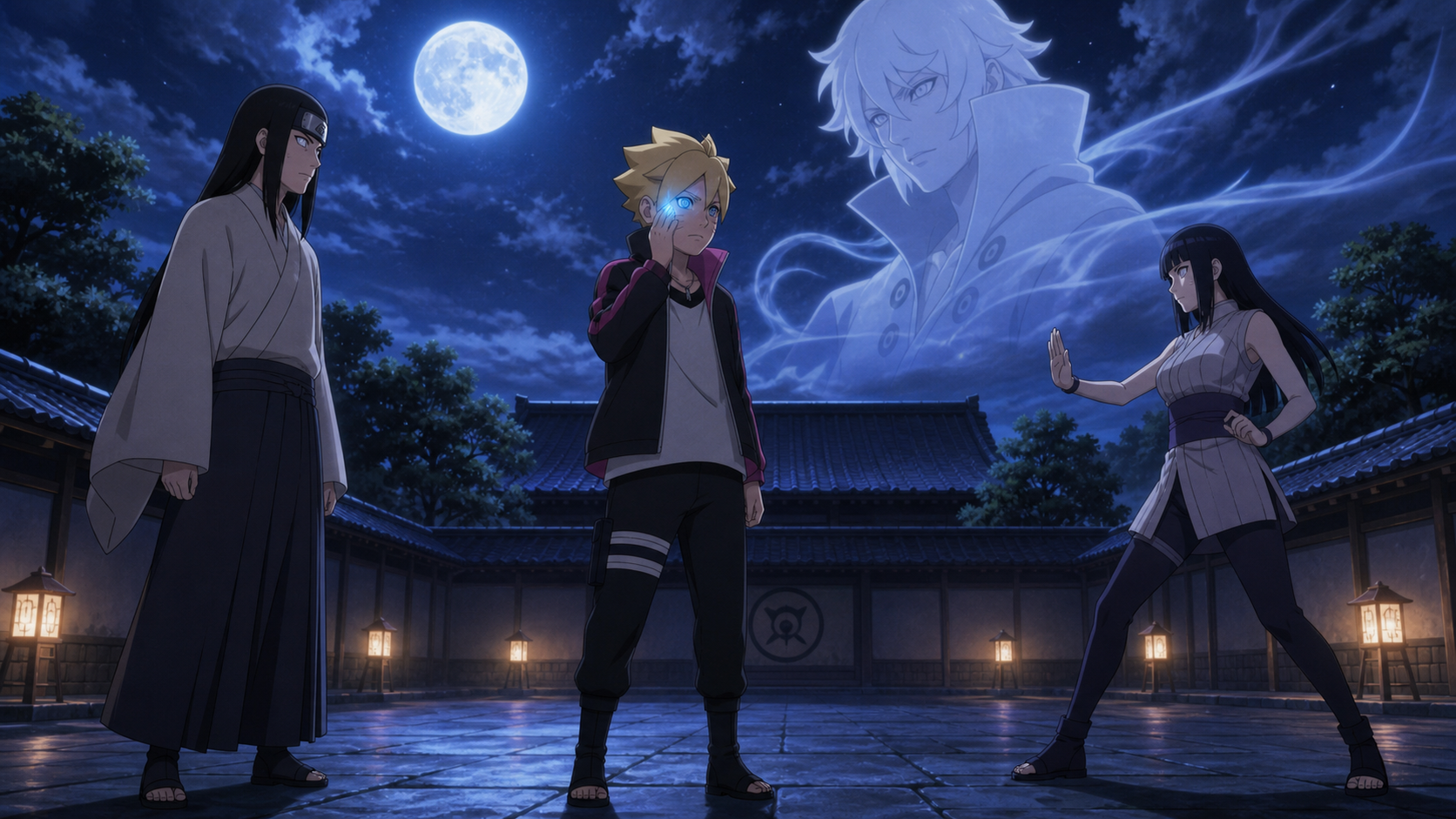
The Dream's Revelation
One Toneri prophecy and one Kagemasa movie convince Boruto that his superhero origin has arrived, but the Hyūga family still wants proof.
Series: Boruto: Naruto Next Generations
Episode: 8 · The Dream's Revelation
Arc: Academy Entrance
Release: 2017-05-24
Previous: Episode 7 · Love and Potato Chips!
Directory: All 293 Boruto episodes
Toneri watches the stars move
Episode 8 opens far beyond Boruto's bedroom, with Toneri studying the stars from the moon. A comet enters a constellation, and Toneri reads the movement as a sign that the coming harvest has begun. The Academy's Ghost incidents suddenly belong to a sky much larger than Konoha.
Boruto knows none of this. He has seen strange chakra around frightened and angry people, but every sighting feels local. Toneri already understands that the eye connects to an approaching threat. That gap between what Boruto knows and what the audience suspects gives every silly moment in “The Dream's Revelation” an ominous little shadow.
Then the episode cuts from moon prophecy to a ninja movie, because Boruto contains multitudes.
Kagemasa gives Boruto a hero he can imitate
Boruto, Denki, Shikadai, and Iwabee watch a movie about Kagemasa, a dramatic masked shinobi whose special eye detects evil. Kagemasa poses, announces destiny, and turns ocular pain into a full performance. Boruto is enchanted.
Of course he is. Kagemasa looks like the answer to every frustration Boruto has carried. The movie hero owns a mysterious eye, protects people nobody else can save, and receives recognition without standing beneath a famous father's monument. Boruto has been seeing danger nobody else can see. Kagemasa makes that isolation look cool.
The boys debate movie heroics against real shinobi life over food. Shikadai knows cinema is not a mission report. Iwabee respects strength. Denki leans toward the excitement. Boruto is already halfway into the costume.
The train conversation refuses to solve the shadow
While riding the train, Boruto tells Shikadai about the strange chakra. The shadow has appeared around several people before their emotions turn violent. Boruto can see the pattern, but he cannot summon the eye whenever he wants or explain why the sight belongs only to him.
Shikadai does not offer easy belief. He also does not abandon Boruto. That is their friendship in one train ride. Boruto brings an impossible claim, Shikadai complains, and both boys keep thinking.
The Ghost has not yet received its name. At this stage, the problem is a collection of moments Boruto cannot connect for anyone else. A special eye sounds more believable to him than a series of unexplained accidents because bloodline powers already exist in his family.
Shadow clones become a bedroom investigation board
At home, Boruto creates shadow clones so several versions of himself can review the incidents. This is such a Boruto solution. He needs more perspectives, so he manufactures more Borutos.
The clones argue through Denki's fear, Metal's panic, Shino's despair, and the other eruptions. Each victim carried a different frustration, but the dark chakra appeared before the behavior changed. Boruto knows the connection matters. He still refuses to tell Naruto.
Pride is part of the silence. Boruto wants evidence before his father dismisses another claim. Hurt is part of the silence too. Naruto is physically absent often enough that Boruto has learned to hold important things until they become impossible to ignore.
Shikadai says the obvious Hyūga word
Boruto meets Shikadai while eating, and Shikadai suggests that the eye could be a Byakugan awakening. The theory makes immediate sense. Hinata carries the Byakugan, Himawari has activated hers, and inherited dōjutsu do not always arrive on a convenient schedule.
Mitsuki appears as quietly as if he was summoned by gossip. He agrees that Boruto should learn more about the Byakugan. Mitsuki's support is never loud, but he takes Boruto's strange experiences seriously before most people do.
One casual possibility becomes Boruto's favorite answer. The Byakugan has a name, a clan, and visible proof. If Boruto can activate the famous eye, every previous sighting becomes real and every doubter loses at once.
Toneri turns uncertainty into destiny
That night, Toneri reaches Boruto through a dream. He tells him that the eye will become a star of hope against destruction and ties Boruto's power to a fate larger than his current life.
The message lands on the exact child most likely to turn one warning into a superhero origin story. Boruto wakes carrying moon-sized confidence. He remembers the Kagemasa movie, the Byakugan theory, and every dark shadow nobody else believed. The pieces feel as though they finally belong together.
Toneri does not give him a technique manual. He gives him a prophecy. Boruto supplies the pose, title, and sunglasses by breakfast.
Boruto catches the eye in the mirror
When Boruto wakes, his vision changes. He catches a glimpse of his right eye in the mirror and sees something unmistakably different. The moment is brief, which makes his certainty both understandable and premature.
He did not invent the change. The audience sees the eye. Boruto's mistake comes from naming the power before understanding the conditions. He assumes the Hyūga answer because that answer is waiting inside his family tree.
This distinction matters for the next two episodes. Boruto is wrong about the Byakugan and right that something awakened. The story lets him be both, even when his personality demands one clean victory.
Kagemasa cosplay enters the Uzumaki house
Boruto begins acting like Kagemasa, complete with the dramatic glasses and heroic declarations. Subtlety never stood a chance. He announces that the Byakugan has awakened and expects the family to respond as though the opening credits have started.
Himawari is curious. Hinata knows what an activated Byakugan looks like. Naruto arrives home exhausted and finds his son performing a destiny speech in the living room.
The family skepticism is not cruel. Boruto is making a very specific claim about a power Hinata has used her whole life, and his visible eye looks normal. Still, every doubtful expression lands on a sore place. Boruto wants Naruto to believe him before proof, not after.
Naruto's official case has already found Boruto
Elsewhere, Shikamaru gives Naruto a report on the strange incidents. Boruto has been present near every attack. The pattern raises an uncomfortable question: is the Hokage's son involved, or is somebody targeting him?
Naruto's tired entrance at home therefore carries more worry than Boruto understands. He is not hearing an isolated boast about a cool eye. He has just learned that his child keeps appearing around dangerous events under investigation.
Naruto needs facts because the case may be closing around Boruto. Boruto needs trust because his father always seems to arrive with official doubt. Their needs collide before either explains the missing half.
Hinata sends the question to Hiashi
Hinata offers the practical next step. If Boruto believes he has awakened the Byakugan, Hiashi can examine him. Grandpa knows the clan's dōjutsu, and the Hyūga family can distinguish a real activation from movie-inspired confidence.
That suggestion prevents the argument from ending in either ridicule or blind agreement. Boruto gets a chance to prove the claim. Naruto gets expertise. Himawari gets a visit with Grandpa and Aunt Hanabi, which may be the true victory from her perspective.
The episode does not reach the spar. Episode 8 is the road toward the test, ending when Hiashi calls Boruto into the courtyard.
The Academy rumor machine moves faster than truth
Shikadai, Denki, and Mitsuki discuss Boruto's supposed Byakugan. News travels quickly because Boruto announced the awakening with enough volume to reach another district.
Denki is willing to imagine the possibility. Shikadai remains doubtful. Mitsuki keeps the question open. Their reactions mirror the audience: we saw the eye change, but we know the Hyūga label does not quite fit.
Boruto's mistake is not talking about the power. His mistake is treating the most exciting theory as the final answer. That habit will become a recurring part of his growth. He sees something important, leaps three conclusions ahead, and then has to walk back without losing the original insight.
Naruto takes both children to the Hyūga compound
Naruto brings Boruto and Himawari to the Hyūga home. The visit turns an argument into a family scene, which is exactly what the story needs. Boruto's eye connects him to Hinata's lineage, but the relationship exists before any power appears.
Hiashi and Hanabi are delighted to see the children. Their warmth matters for anyone who remembers the compound from Hinata's childhood. The old Hyūga household measured daughters through combat and succession. The new generation arrives to hugs, excitement, and a grandfather ready to listen to one dramatic claim.
History has not vanished. The atmosphere has changed.
Hiashi explains why wanting cannot activate the eye
Hiashi tells Boruto that the Byakugan requires training and has recognizable functions. An inherited possibility does not become mastery overnight because a dream promised greatness. Naruto had already tried telling him something similar, but Grandpa's clan authority makes the lesson harder to dismiss.
Boruto hears caution as another challenge. If the eye appears under pressure, then combat can prove everything. He is ready to fight before Hiashi finishes explaining.
This is where Episode 8 stops, right at the courtyard threshold. The actual test belongs to “Proof of Oneself.” Keeping that boundary matters. “The Dream's Revelation” is about Boruto building certainty. Episode 9 is where certainty meets Hanabi's palms.
Himawari quietly complicates the whole claim
Himawari stands beside Boruto as the sibling who has already awakened the Byakugan. Her activation happened from anger, without a prophecy or performance. Boruto wants the same recognizable power because the family can understand that answer.
The contrast never becomes a sibling rivalry here. Himawari worries about Boruto rather than guarding a special status. She carries no need to prove that her eye makes her more Hyūga than her brother.
That softness keeps the family story from becoming a competition. Boruto's power can be different. Himawari's power can remain dormant. Both children still belong to Naruto and Hinata before any eye opens.
The Kagemasa joke is also foreshadowing
Kagemasa's special eye detects danger and marks him as a protector outside ordinary systems. Boruto copies the surface because the fantasy feels good. The story uses the movie to hint at the real shape of his future.
Boruto will keep seeing threats other people cannot perceive. He will keep standing between Konoha and dangers tied to the Ōtsutsuki. He will also keep struggling with whether destiny belongs to him or traps him.
For now, the foreshadowing wears sunglasses and annoys his family. That is why the scene works. The series plants a huge idea inside a joke Boruto would absolutely repeat in public.
Mitsuki watches Boruto choose a story
Mitsuki's interest in the Byakugan question carries another layer. He is a child created through another person's plan, searching for a sun to guide his own choices. Boruto receives a dream about destiny and immediately embraces the role.
Mitsuki watches how naturally Boruto turns uncertainty into movement. He does not need complete proof before encouraging Boruto to investigate. That trust feels generous, but Mitsuki also knows more about unusual bodies and hidden origins than his classmates suspect.
The friendship begins with Boruto believing he is chosen and Mitsuki quietly deciding that Boruto is worth following. Neither boy understands the cost yet.
Naruto and Boruto keep missing each other's language
Naruto takes the claim seriously enough to visit Hiashi, yet Boruto experiences every question as disbelief. Boruto wants his father to say, “I know you are special.” Naruto wants a result he can use to keep his son safe.
Both love each other. Neither speaks the language the other needs.
Naruto grew up proving himself through impossible victories because nobody offered inherited trust. Boruto grew up with a famous father whose trust feels unavailable behind work. Naruto believes action shows care. Boruto believes attention shows care. A trip to the Hyūga house becomes their compromise.
The episode earns its cliffhanger
Hiashi calls Boruto into the courtyard and proposes a fight to see whether the Byakugan emerges. Boruto accepts instantly. Himawari watches. Naruto watches. Hanabi is close enough to prevent her father from doing anything foolish.
The cliffhanger works because Boruto has spent the entire episode enlarging the claim. A train conversation became a Byakugan theory. A dream became a prophecy. A mirror glimpse became public certainty. Now one family spar threatens to confirm or collapse the whole story.
We know the eye is real. We also know Boruto has named the eye wrong. The fun comes from watching him discover that truth without losing faith in what he saw.
Toneri hands Boruto a burden disguised as praise
Toneri's dream message tells Boruto that his eye will shoulder the fate of the world. A grown shinobi might hear a warning and start asking about the threat, the source, and the cost. Boruto hears confirmation that he is spectacular. Of course he does. The messenger gives a twelve-year-old cosmic importance with no usable instructions.
That gap makes the prophecy less comforting than Boruto believes. Toneri knows danger approaches, but Boruto wakes with symbolism instead of preparation. He receives responsibility before context and attention before consent.
The scene also separates Boruto's eye from the ordinary Byakugan question before the family debate begins. Viewers know the dream belongs to something larger, while the characters reach for the bloodline explanation closest to home. Their mistake is reasonable because nobody has access to Toneri's side of the conversation.
Boruto's excitement protects him from fear for now. Calling himself chosen sounds ridiculous, but bravado lets him approach a phenomenon that could otherwise make him feel invaded by his own body.
Himawari quietly becomes the strongest witness in the room
Himawari saw Boruto's eye change. She does not know what the eye means, and she cannot reproduce the moment for the adults, but her testimony changes how the family responds. Hinata knows Himawari has no reason to invent the detail.
That support matters because Boruto has already wrapped the experience in movie poses and prophecy talk. His performance makes skepticism easy. Himawari separates the observation from her brother's theatrical interpretation: something happened, even if Boruto has built the wrong story around the event.
Naruto listens because both children are involved. He may doubt the Byakugan label, yet ignoring Himawari would mean deciding that two children misunderstood the same visible change. The trip to Hiashi becomes responsible investigation rather than indulgence.
Himawari never demands credit for moving the adults. She simply tells the truth and watches the family test the claim. That quiet reliability balances Boruto's need to announce every discovery at maximum volume.
Kagemasa gives Boruto a costume for uncertainty
The movie hero is not random comedy. Kagemasa hides one eye, enters danger with confidence, and turns mysterious power into a recognizable persona. Boruto borrows the glasses because pretending to understand the role feels easier than admitting his body did something he cannot control.
Fandom often works that way. A character gives people language, posture, or imagery for feelings that arrived before an explanation. Boruto does not merely imitate a cool actor. He uses Kagemasa to rehearse being the person a prophecy claims he must become.
The pose becomes funny because everybody around him can see the gap between cinematic menace and a child stumbling through breakfast. The joke never makes his experience fake. The audience can laugh at the performance while taking the underlying fear seriously.
Episode 9 will complicate the fantasy by putting Boruto face-to-face with the human actor beneath Kagemasa. For now, the screen hero gives him enough nerve to name the mystery aloud.
Hiashi chooses family before clan judgment
Boruto enters the Hyūga compound expecting an examination from a legendary clan head. Hiashi greets his grandchildren with open delight. That welcome changes the emotional terms before any spar begins.
The old Hyūga system measured children according to bloodline hierarchy and utility. Hinata grew up under that pressure. Boruto arrives with a possible dōjutsu and does not get treated like a resource the clan can claim. Hiashi explains the Byakugan, listens to the story, and proposes a practical test.
The transformation is not a magical erasure of the clan's history. Neji still lived and died under the consequences of that structure. The gentler household shows that people can change how power operates around the next generation.
Boruto can fail the test without losing access to the family. That safety is the real difference. His worth at dinner does not depend on awakening the correct eye in the courtyard.
Himawari receives the same welcome without bringing any claim to prove. Her presence keeps the visit from becoming a clan audition disguised as family time. Hiashi wants both grandchildren near him. Hanabi wants to spar, tease, and listen. The dōjutsu question matters, but nobody makes inherited power the price of belonging. Naruto knows how rare that distinction is because nearly every institution in his childhood demanded a performance before offering respect.
RaeRae's reaction
Boruto wearing Kagemasa glasses and declaring himself chosen after one moon dream is peak twelve-year-old behavior. I cannot even be mad. If Toneri appeared in my sleep, told me my eye would save the world, and vanished before answering questions, I would also wake up unbearable.
The family material is what makes the episode land. Hinata does not shame him. Naruto may doubt the Byakugan label, but he takes both children to Hiashi. Hiashi and Hanabi light up when their grandchildren arrive. The Hyūga compound once represented pressure and pain. Boruto walks in expecting a test and finds a family eager to see him.
I also love that the episode ends before the spar. The drama here belongs to the belief growing too large for the evidence. Hanabi gets the pleasure of knocking that certainty around next time.
Bottom line
Boruto Episode 8 begins with Toneri reading danger in the stars, introduces Kagemasa as Boruto's one-eyed movie hero, and lets a dream turn Boruto's unexplained sight into a grand Byakugan announcement. Shikadai suggests the clan theory, Mitsuki encourages investigation, Shikamaru's report places Boruto near every incident, and Naruto brings Boruto and Himawari to the Hyūga compound for an answer.
No Byakugan test happens yet. Hiashi explains the power, calls Boruto into the courtyard, and sets up the spar that belongs to Episode 9. “The Dream's Revelation” is the wonderfully dramatic moment when Boruto sees a real mystery, gives the mystery the wrong famous name, and decides the whole village is about to witness his superhero origin.
Sources and lawful viewing
Official episode reference: Naruto Official episode guide
Licensed episode route: Crunchyroll licensed series page