
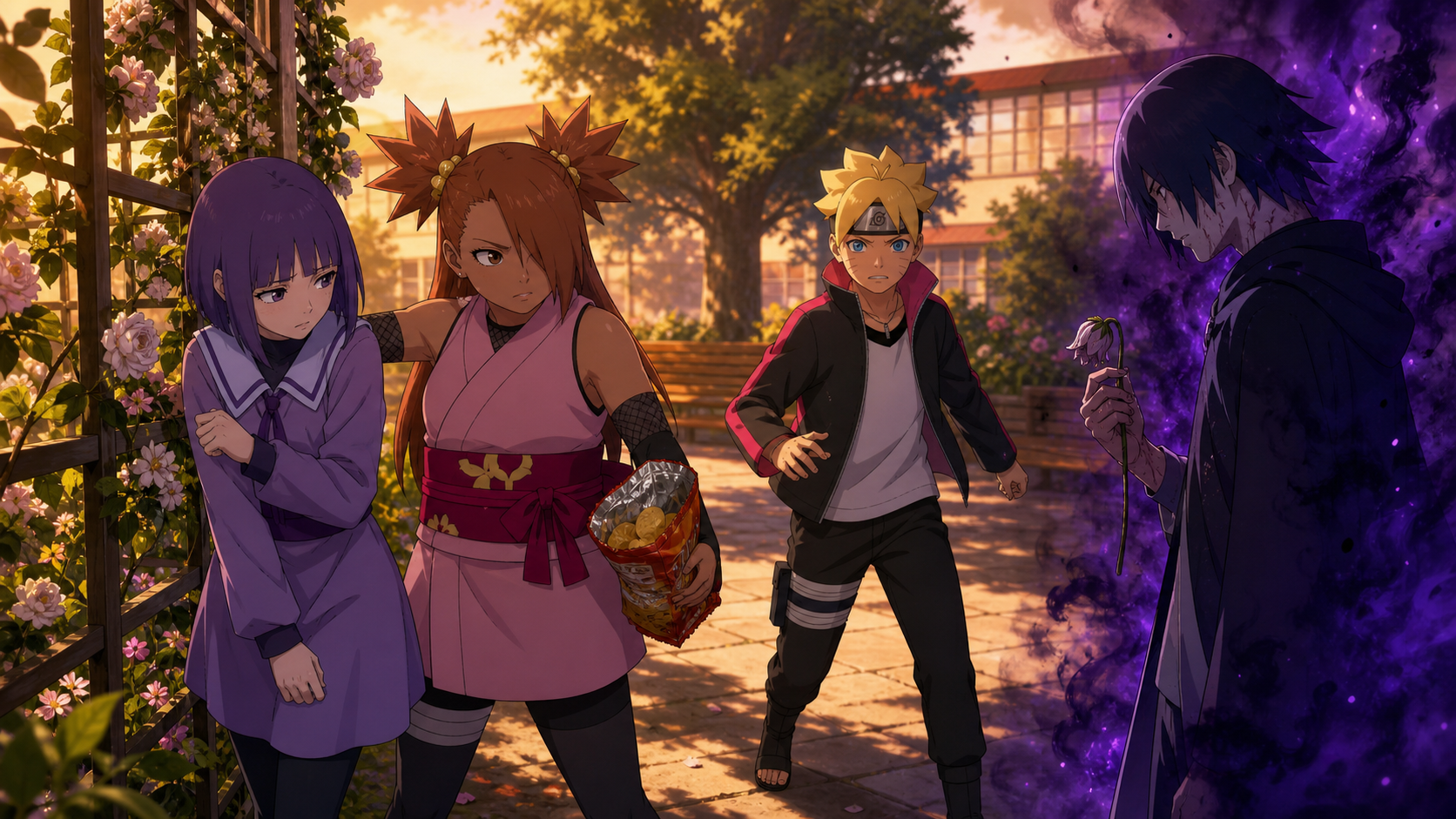
Love and Potato Chips!
Chōchō catches Sumire’s hidden admirer, coaches the confession, then uses one bag of chips to do what the whole rooftop fight cannot.
Series: Boruto: Naruto Next Generations
Episode: 7 · Love and Potato Chips!
Arc: Academy Entrance
Release: 2017-05-17
Previous: Episode 6 · The Final Lesson!
Directory: All 293 Boruto episodes
Boruto finally starts drawing the shadow
Boruto sits with Shikadai and sketches the thing only his right eye can see. The dark chakra has appeared around several people before their emotions turn violent, and the boys are finally treating the sightings like one mystery instead of a collection of terrible afternoons.
The drawing is not elegant. Boruto's explanation is not organized. Shikadai still asks the right questions: Why can only Boruto see the shadow? Why does the shadow choose certain people? What does the attacker gain after each incident?
No answer arrives. The conversation matters because Boruto has stopped reacting to each crisis and started looking for the pattern between them. His eye sees the Ghost first. Shikadai helps him think beyond the first sight.
Chōchō knows somebody is watching
Sarada complains about the boys while Chōchō and Sumire walk with her, and Chōchō becomes convinced that somebody is staring at them. Her first assumption is naturally that a secret admirer has been overwhelmed by her magnificence. Fear and confidence share one bag of chips.
The joke works because Chōchō refuses to make herself small. She notices the gaze, announces the problem, and decides the watcher is about to get caught. Sarada takes the threat more seriously. Sumire remains gentle and uneasy. Together, the girls compare what they noticed and decide to act rather than waiting for the mysterious eyes to disappear.
Somewhere nearby, Magire Kakuremino is learning that invisibility does not protect a boy from Chōchō's instincts.
The alley trap catches the wrong love story
After Chōchō buys chips, the girls use an alley to draw their watcher closer. The trap works. Magire appears, and the boys rush over when they hear the commotion.
Chōchō recognizes him as a student from another class. Boruto checks for the dark chakra and sees none. At this moment, Magire is nervous, embarrassed, and entirely himself.
Everyone assumes he has been following Chōchō. Magire corrects them with enough panic to bruise her ego: Sumire is the person he likes. Chōchō recovers quickly because romance is still romance, even when somebody foolishly chose another girl.
The reveal gives the episode its title. Love belongs to Magire. Potato chips belong to Chōchō. By the end, the chips will do more useful work.
Chōchō turns into a confession coach
Once Magire admits his crush, Chōchō encourages him to tell Sumire directly. Her advice carries the confidence he lacks. Stop hiding, stop following, and say what you mean.
Magire hesitates. Sumire is the class representative who once spoke kindly to him when other students overlooked him. One small kindness grew enormous in his imagination because he had so little connection elsewhere. He turned gratitude, loneliness, and attraction into a complete relationship before Sumire knew the story existed.
Chōchō sees a shy boy who needs one brave moment. She does not yet understand how much hidden attention has already accumulated behind that moment.
Sumire says no without cruelty
Magire confesses. Sumire rejects him.
She does not mock him, humiliate him, or punish him for speaking. She simply does not share the feeling. Magire leaves hurt because rejection hurts even when everybody behaves decently.
This is where the episode becomes more interesting than a cute Academy crush. Magire has built Sumire into the answer to his isolation. Her refusal does not merely close one romantic possibility in his mind. The answer seems to confirm that he is still unseen, weak, and alone.
The Ghost has been choosing exactly those cracks. Magire walks away carrying the kind of pain the shadow knows how to enlarge.
The blackboard message changes the mood
The next day, a message for Sumire appears on the Academy blackboard. Magire is absent from his class. What looked like an awkward confession now feels unfinished and threatening.
Mitsuki asks questions and confirms the absence. He observes the situation with that quiet attention that makes every glance suspicious. Boruto remembers the earlier attacks. Shikadai starts connecting the timing.
Then messages rain around Sumire. The Academy itself becomes part of Magire's hidden performance. Notes can come from anywhere because his Concealment Technique lets him disappear against the environment.
Chōchō's romantic coaching has become a rescue mission, and she does not run from the responsibility.
A metal wall divides the class
Magire creates a metal barrier that separates the boys and girls inside the Academy. The division turns hallways they know into a maze. Boruto cannot simply sprint straight toward Sumire, and the students lose sight of one another at the worst possible moment.
The girls retreat into a storage room. Smoke bombs fall and fill the space. Sumire opens the door to clear the air, which separates her from Chōchō and Sarada.
Every step pushes Sumire toward isolation. Magire does not need overwhelming strength when he can control where people look and who stands beside her. His technique matches his emotional problem perfectly: he hides, watches, and attacks from places nobody can name.
Denki tries to help and gets dropped
Denki finds Sumire and asks whether she is all right. Magire knocks him unconscious before he can do more.
The moment is quick, but Denki deserves credit. He is not the strongest student in the Academy. He still approaches a frightened classmate inside a dangerous building. Courage does not always arrive with a jutsu ready.
Magire removing Denki shows how far the Ghost has pushed him beyond confession. This is no longer one lonely boy asking for a date. The shadow has turned his desperation into a demand that nobody interfere between him and the person who already said no.
Boruto sees the pattern before the adults ever hear about the attack.
The rooftop reveals the Ghost
The students reach the Academy roof, where Magire holds the confrontation with Sumire. Boruto finally sees dark chakra wrapped around him. The earlier rejection was real. The violent escalation belongs to the same shadow that possessed Denki's father, Metal, and Shino.
Recognizing the Ghost does not erase Magire's choices or Sumire's fear. Recognition tells Boruto how urgent the danger has become. Magire's chakra is being drained while his worst thoughts become stronger.
The rooftop also strips away the romantic framing. Magire had one honest chance to speak. Sumire answered. Everything after that answer is the Ghost feeding on his refusal to accept the loss.
Concealment makes every direction dangerous
Magire blends into the surroundings and attacks while hidden. Boruto, Sarada, Shikadai, and the others cannot strike what they cannot find. The Concealment Technique is one of the best character-jutsu matches in the Academy arc. Magire spent his school life avoiding notice, and now invisibility gives his pain teeth.
Boruto's eye can see the dark chakra, but the moving target still keeps everyone off balance. The class reacts to sounds, impacts, and flickers. Magire controls the roof because everybody else is searching for a body he has trained to erase.
Then Chōchō stops looking for a hidden opponent and starts speaking to the boy inside the technique.
Chōchō puts the chips down
Chōchō sets aside her potato chips. That small movement means the situation has crossed from dramatic gossip into something she refuses to joke away.
She tells Magire that hiding will never make people notice the person he wants to become. Following Sumire, leaving secret messages, and attacking classmates will not turn fear into love. If he wants connection, he has to change how he shows up.
Her speech works because Chōchō is the opposite of concealment. She enters every room as though the room should be grateful. She likes food, romance, fashion, and herself with no whispered apology. Magire believes visibility requires Sumire's approval. Chōchō tells him to build enough self-worth to stand where everybody can see him.
Potato chips become a peace offering
After the lecture, Chōchō offers Magire chips. The gesture is funny, generous, and perfectly hers. She does not promise that Sumire will change her mind. She offers one ordinary act of connection after telling him the truth.
Magire accepts.
The dark chakra leaves him before Boruto needs a finishing blow. Magire cries because the Ghost's hold breaks and the feelings underneath have nowhere else to go. Chōchō's chips do not cure loneliness. They interrupt the belief that rejection left him with nobody.
That is a much better ending than beating him unconscious and pretending the emotional wound disappeared with the shadow.
The Ghost leaves Magire hollow
As the chakra departs, Magire becomes visibly gaunt and collapses. The transformation finally reveals what each possession has been taking. The victims are not only emotionally exhausted after their rampages. Their chakra has been drained.
Boruto and his friends had focused on the behavior because behavior was what they could see. Magire's body gives them a new clue. The Ghost is collecting something from every incident.
The cost also explains why ordinary recovery looks insufficient. A person can calm down, apologize, and still remain physically endangered because the shadow fed while everyone watched the spectacle.
This mystery is no longer about random anger. Somebody is harvesting power.
Food-table detectives compare the clues
Later, Boruto and the boys discuss Magire over food. Shikadai suggests chakra exhaustion. Boruto thinks back through the earlier victims. Mitsuki listens with an unsettling amount of calm.
The series keeps placing investigation beside meals, which feels right for this generation. They do not have an official office or mission room. They have restaurant booths, snacks, train rides, and whatever paper Boruto can draw on.
Their theory is still incomplete, but the group has crossed an important line. Boruto sees the shadow. Shikadai can compare effects. Mitsuki knows enough to recognize that their findings matter to someone beyond the table.
Shikamaru gives Naruto the adult version
Shikamaru delivers a report to Naruto that reaches the same conclusion: the victims appear to suffer severe chakra depletion after the incidents. The children and the Hokage's office are investigating the same pattern from opposite sides.
Naruto does not yet know that Boruto's eye sees the possession before each attack. Boruto does not know how much official evidence has accumulated. Father and son are circling the same threat without sharing the map.
That separation keeps the case dangerous. Boruto can identify the next victim, but he lacks authority and protection. Naruto has resources, but he lacks the one perception that reveals the shadow at work.
Sooner or later, their information has to meet.
Mitsuki reports to somebody in the dark
At night, Mitsuki communicates with an unseen person about Boruto's findings. The scene adds a second watcher to an episode already built around hidden attention.
Magire watched Sumire because he wanted closeness without knowing how to ask. Mitsuki watches Boruto because somebody outside the Academy wants information. The motives differ, but the parallel is hard to ignore.
Mitsuki genuinely likes Boruto. He also arrived with a purpose he has not explained. His calm support can be friendship and observation at the same time. Every Ghost clue makes that double role more important.
Boruto believes he has gained a loyal classmate. The audience knows their bond is already being reported elsewhere.
Sumire's role gains a darker edge
Sumire spends most of the episode as Magire's target, and her discomfort is real. Later knowledge about the Ghost incidents changes the rewatch without canceling that experience. She can be connected to the larger plan and still fear what possessed Magire does on the roof.
The class representative persona keeps everyone focused on her kindness. She is the girl who spoke to Magire when others ignored him. That kindness becomes the reason he built a crush and the reason Chōchō believes a direct confession might work.
Sumire's gentleness is not fake. The tragedy of her arc comes from genuine affection growing inside a mission built from somebody else's hate.
Chōchō owns the episode
Boruto identifies the Ghost. Shikadai helps interpret the chakra loss. Sarada stays close to Sumire. Yet Chōchō ends the possession.
She does not need a secret eye or a stronger punch. She understands that Magire is hiding from himself as much as he hides from the class. Her bluntness cuts through the fantasy that Sumire can rescue him from loneliness. Her chips offer a way back toward ordinary human contact.
The episode never asks Chōchō to become quieter, thinner, or less ridiculous before giving her emotional authority. Her appetite, confidence, and romantic imagination are exactly what make the intervention hers.
That is why “Love and Potato Chips!” works when the title sounds like pure comedy.
Rejection is not an injury Sumire has to repair
Sumire responds to Magire with care and clarity. She appreciates his feelings, but she does not return them. The answer should end the romantic question. Magire's pain may be real, yet pain does not create a debt that Sumire must pay with access, affection, or another explanation.
The Ghost turns his humiliation into aggression, but the dark chakra does not invent the belief that her rejection wronged him. Possession enlarges resentment already waiting for permission. That distinction matters because blaming every choice on supernatural influence would erase the entitlement Chōchō confronts.
Sumire spends the rooftop sequence trapped inside somebody else's emotional demand. She stays composed because that is how she survives most situations, not because the threat feels harmless. Sarada's presence gives her an ally who understands that protecting Sumire matters more than soothing Magire.
The episode never asks Sumire to reward him after the danger ends. Chōchō offers friendship on different terms, and Magire has to return to ordinary social life without converting rejection into punishment.
Concealment is Magire's defense and his accusation
Magire's technique makes him invisible, which fits a boy convinced nobody notices him. The sad part is that people cannot respond to needs he refuses to express. He hides, watches, and turns Sumire's small kindnesses into evidence of a relationship she never agreed to enter.
After rejection, invisibility changes from protection into control. Messages appear without a visible author. Traps force the class to respond. Sumire has to think about him constantly because he has made ignoring him dangerous.
That is why Chōchō's demand that he show himself cuts so deep. She does not merely counter a jutsu. She rejects the whole arrangement where Magire controls the room while avoiding accountability for what he does inside the room.
Visibility requires risk. He may be awkward, embarrassed, or told no. Chōchō offers a chip because returning to human contact begins with accepting those risks rather than making everyone else carry them.
Chōchō's confidence is emotional intelligence, not a running gag
Chōchō assumes the admirer might want her because she does not organize her life around the possibility that she is undesirable. The joke depends on her certainty, but that certainty also frees her to handle rejection without treating romance like a referendum on human worth.
She can encourage Magire to confess because a no does not seem catastrophic to her. When he cannot accept Sumire's answer, Chōchō recognizes the real problem immediately. Love is not proved through surveillance, intimidation, or refusal to leave.
Her blunt style reaches him because she never wraps the message in pity. Magire does not need another person treating him like a fragile mystery. He needs somebody to state that hiding has become harmful and that friendship remains possible after he stops.
The potato chip is perfect because Chōchō shares something she values without pretending the crisis created romance between them. Food becomes an invitation back to the group, not a prize for frightening Sumire.
The Ghost keeps choosing wounds already present
The earlier incidents involved anger, insecurity, and exhaustion. Magire adds loneliness and shame. The pattern tells Boruto that the shadow does not select victims at random. Dark chakra finds an emotional opening and pushes until a private hurt becomes public danger.
That rule complicates the students' response. They cannot solve every attack by punching harder, because the possessed person's original pain still matters. They also cannot excuse violence simply because pain came first.
Boruto's eye identifies the supernatural layer. Chōchō identifies the human layer. Both forms of sight are necessary on the roof. Boruto can track an invisible attacker, while Chōchō understands what words might make Magire choose visibility again.
The chakra loss afterward proves that the Ghost benefits even when the victim survives. Somebody is harvesting the cost of these emotional explosions, which makes every apparently self-contained incident part of a larger operation.
RaeRae's reaction
Chōchō putting down the chips is the Academy equivalent of an elite shinobi removing training weights. Everybody should have known the roof was about to become her stage.
I love how she moves from assuming the secret admirer wants her, to coaching Magire through a confession, to reading him for filth when he turns rejection into an invisible hostage situation. Chōchō can believe love is wonderful and still understand that Sumire's answer ended that possibility. Her final offer is not romance. Her offer is a chip and one chance to stop hiding.
Magire's Concealment Technique also deserves credit. The jutsu tells us who he is before he can. He wants Sumire to notice him while building his entire life around not being seen. That contradiction is more interesting than another villain who simply hits harder.
Bottom line
Boruto Episode 7 starts with Chōchō catching a supposed admirer and ends with her talking a Ghost-possessed Magire out of his concealment. Magire confesses to Sumire, receives a rejection, fills the Academy with hidden messages and traps, knocks out Denki, and attacks from invisibility on the roof. Boruto sees the dark chakra, but Chōchō's blunt truth and offered potato chips create the opening that makes the shadow leave.
Magire collapses gaunt from chakra loss, giving both the students and Naruto's investigators their strongest shared clue so far. Meanwhile, Mitsuki secretly reports Boruto's discoveries to an unseen contact. Love creates the misunderstanding, potato chips end the fight, and the Ghost mystery grows much bigger than one painful crush.
Sources and lawful viewing
Official episode reference: Naruto Official episode guide
Licensed episode route: Crunchyroll licensed series page