
RaeRae Reacts · S3E6 · 1992 Animated Series
The Beast Within
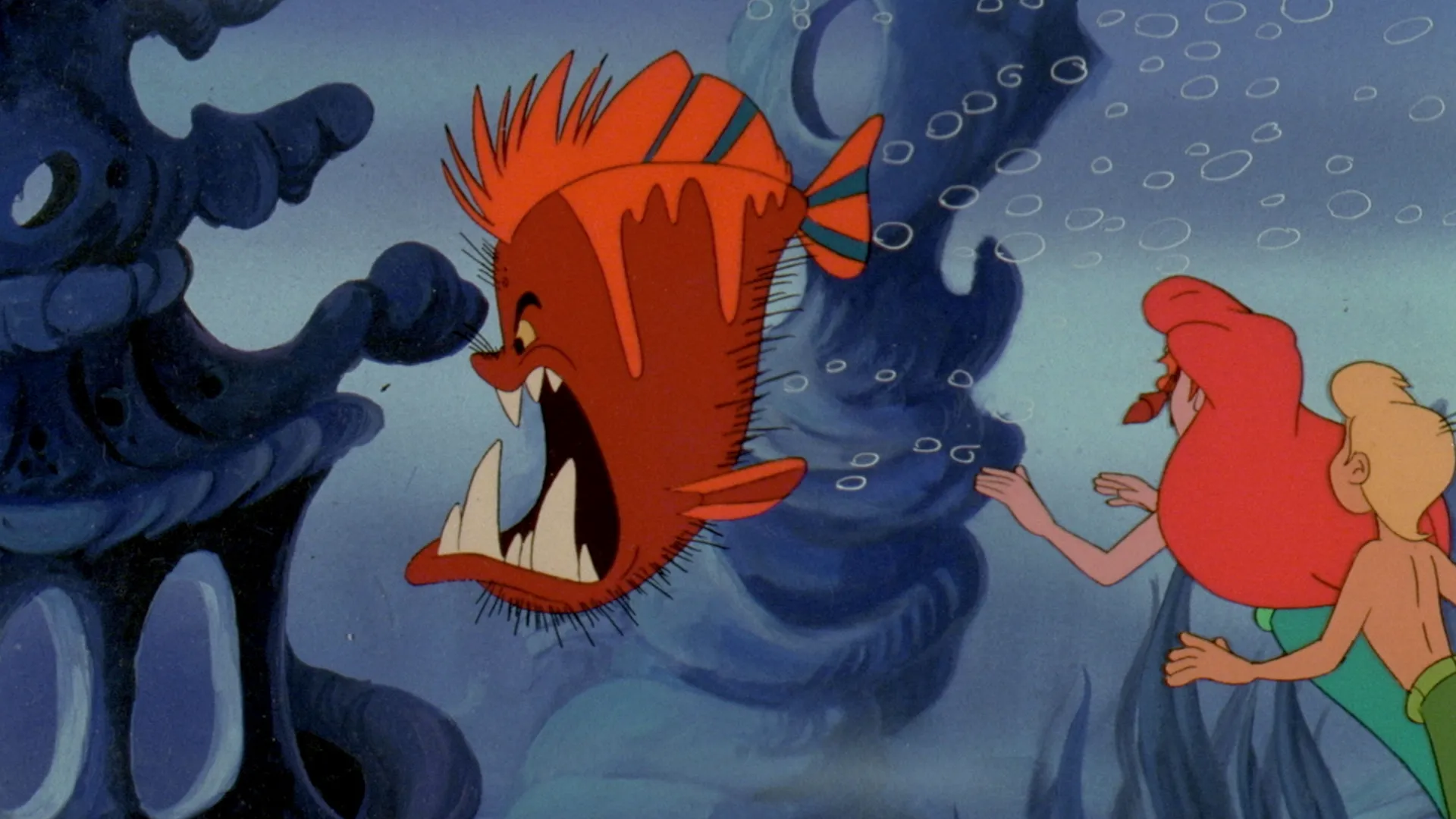
Flounder is bitten by a howling hairfish, and fear of transformation tests whether friendship survives when the familiar body stops behaving safely.
The episode receipt
Series: The Little Mermaid (1992). Episode: S3E6 “The Beast Within.” Broadcast-order position: 29 of 31.
What happened
Flounder is bitten by a howling hairfish, and fear of transformation tests whether friendship survives when the familiar body stops behaving safely.
What the episode is really testing
Where to watch
Disney+ currently lists this episode. Regional catalogs and numbering can differ because the pilot is omitted from the service.
First reaction: Flounder changes, but the village reveals the beast it already carried
Flounder is bitten by a howling hairfish while Ariel, Urchin, and Sebastian search Quaking Canyon for gemstones. His body begins changing without his consent, his fear becomes visible as aggression, and nearby villagers answer uncertainty with a hunt. The child who needs treatment becomes the threat everyone feels entitled to punish.
“The Beast Within” uses a Saturday morning monster plot to ask an ugly question: when a frightened community sees illness alter somebody’s appearance and behavior, does it still recognize a person? Atlantica’s answer is not comforting. Ariel must protect Flounder from the curse and from neighbors who decide fear is evidence.
The bite is an injury before it is a moral symbol
Flounder does not seek power, ignore a warning for glory, or choose transformation. A dangerous creature bites his tail during an accident. The curse enters through a wound, which makes his condition something that happens to him rather than a secret expression of bad character.
That distinction matters because stories about monsters often pretend bodily difference exposes an evil self. This episode gives us no reason to believe the red hairfish is Flounder’s hidden truth. It is an infection overwhelming his ordinary control.
Ariel brings Flounder into danger again
Flounder is apprehensive about Quaking Canyon, and Ariel treats the expedition as another adventure worth taking. Her optimism is part of what makes her lovable, but it repeatedly asks more cautious friends to absorb risks she finds exciting.
The episode cannot place every consequence on a random beast. Ariel is not responsible for the bite, yet friendship should require her to notice how often Flounder’s loyalty becomes the safety net beneath her curiosity.
Fear is not a character defect in Flounder
The show frequently names Flounder as timid while also sending him into caves, shipwrecks, storms, and political crises beside Ariel. He is afraid because danger is present, not because courage is absent.
His anxiety in Quaking Canyon is accurate risk perception. A stronger reading of his character recognizes that bravery is what he does while his body is already warning him to leave.
The cave-in removes the illusion of an easy exit
Once the entrance is blocked, the adventure becomes confinement. The group must find another way through unfamiliar territory while a predator moves nearby. That pressure helps explain why decisions become improvised and expensive.
The physical trap also previews Flounder’s condition. Soon he will be trapped inside a form other people read as dangerous, searching for an exit while panic closes routes around him.
The hairfish is frightening because its rules are unknown
Nobody enters the canyon with clear information about transmission, symptoms, duration, or treatment. The bite is followed by delayed transformation, which means apparent safety cannot be trusted. Uncertainty does much of the horror’s work.
Communities are especially vulnerable to cruelty when knowledge is incomplete. The ethical answer is careful containment, urgent research, and support. The villagers choose certainty theater instead.
Flounder’s body becomes public property
As he grows large, red, hairy, and powerful, strangers discuss what should be done to him as if the changed body cancels his right to speak. His identity becomes secondary to what everybody can see.
This is the logic behind too many moral panics about illness and disability. Once a body is classified as abnormal, spectators begin treating intervention as automatically justified, even when they have not asked what the person experiences or needs.
The transformation does not erase recognition completely
Flounder is not presented as an empty beast wearing his shape. He can speak, respond, and remain connected to Ariel even while the curse distorts his impulses. Pieces of the child remain reachable.
That makes the mob’s refusal to see him more damning. The evidence of personhood is present. Fear simply gives the villagers permission to ignore it.
Behavioral symptoms complicate responsibility without ending it
The hairfish form terrorizes a village and creates real danger. Harm does not become imaginary because Flounder lacks full control, and frightened residents deserve protection from immediate attack.
But protection is not the same as revenge. A humane response can restrain dangerous behavior while still treating the afflicted person as somebody worth curing and returning to community.
The villagers convert fear into a mob because a mob feels decisive
Individual uncertainty is uncomfortable. Collective anger provides rhythm, targets, and the relief of believing action itself proves righteousness. Nobody must sit with doubt once everyone agrees to hunt.
The episode catches how quickly public safety language can become punishment theater. The crowd wants the emotional satisfaction of eliminating a visible threat more than the slower work of understanding it.
The lone villager seeking a cure protects the possibility of community
One resident suggests consulting the Fortune Teller rather than simply destroying the hairfish. That small dissent is morally enormous because it preserves another category for Flounder: patient.
A community is not redeemed because one person behaves well, but one person can interrupt the lie that cruelty was unanimous or inevitable.
The Fortune Teller has already been exiled by the people who need her
She lives apart in a large secluded shell and initially refuses the villager who comes for help. The community drove her away, then expects her knowledge to remain available when its own certainty fails.
Expertise is often treated this way. A society mocks, excludes, or underfunds inconvenient knowledge until crisis arrives, then acts offended when trust and infrastructure are missing.
Her refusal is understandable and still dangerous
The Fortune Teller’s resentment has a history. She does not owe instant emotional warmth to people who harmed her, and the episode should not flatten exile into a quirky personality detail.
At the same time, withholding a cure leaves Flounder exposed to a mob. Justice has to distinguish between refusing reconciliation and allowing a child to pay for a community’s abuse.
Ariel asks for help without pretending the exile never happened
The strongest appeal is not that the villagers deserve rescue. Flounder does. Ariel’s loyalty reframes the request around an afflicted friend rather than the comfort of people who rejected the healer.
That shift allows aid without false forgiveness. The Fortune Teller can save a life and still demand that the village answer for how it treated her.
Silverfish make the cure collective
The remedy is not a sword, a royal decree, or a single magical hero. A school of silverfish must surround and restore the cursed fish. The cure depends on many small bodies moving together.
That visual quietly opposes the mob. Both are collectives, but one gathers to destroy what it fears while the other gathers with knowledge and purpose to return a person to himself.
Treatment requires correct identification
The cure only works because somebody understands that a howling hairfish is not simply born evil. The condition has a history, a mechanism, and a reversal. Naming it accurately changes the available action.
Bad labels close doors. If the village calls Flounder only a monster, destruction appears logical. If it recognizes a cursed child, care becomes possible.
The mob captures Flounder after he looks familiar again
Episode accounts note that the villagers seize him in his normal form and prepare to bring down a sunken ship on him. The body they claim to fear is gone, yet punishment continues.
That is the episode’s sharpest indictment. Once stigma attaches to a person, visible recovery may not restore innocence. The crowd is no longer responding to present danger. It is enforcing a story about who Flounder permanently is.
Recovery does not automatically restore social safety
Flounder can be cured biologically and remain endangered politically. The silverfish address the curse, but they cannot erase witnesses’ anger, humiliation, or appetite for blame.
Real recovery therefore needs more than symptom removal. It needs protection, truthful public explanation, repair for harm, and a boundary against retaliating at the person who survived the illness.
The village deserves answers, not a scapegoat
Homes may be damaged and residents may have been terrified during the attack. Those effects should be documented and repaired. Pretending nothing happened would abandon people who experienced real danger.
Accountability must follow causation. Flounder did not choose the bite or control the transformation. Atlantica can compensate victims without converting an infected child into the author of the entire disaster.
King Triton’s government should have an emergency plan
A kingdom containing sea witches, curses, giant creatures, magical artifacts, and unstable environments should not improvise every biological emergency through a teenager’s friendships. This is foreseeable governance work.
Atlantica needs healers, protected transport, quarantine rules that preserve dignity, public communication, and a registry of magical conditions and known remedies. Adventure cannot be the health system.
Quarantine is not the same as exile
Temporary separation may be necessary when transformation produces uncontrolled attacks. The purpose should be treatment and protection, with the least restrictive conditions possible and continuous contact with trusted people.
Exile treats the person as contamination. Careful quarantine treats the condition as a shared problem the community has a duty to solve.
Ariel’s loyalty is the episode’s ethical anchor
She never accepts the villagers’ description of Flounder as disposable. Even when his body becomes frightening, she continues searching for the friend inside the crisis.
Loyalty here is not denial. Ariel recognizes danger and still refuses the false choice between public safety and Flounder’s humanity.
Urchin understands what it means to be judged by category
As an orphan who previously lived outside palace protection, Urchin knows how quickly respectable Atlantica can classify a child as suspicious. His presence beside Flounder gives the rescue a social dimension beyond friendship.
He has experienced the difference between being managed as a problem and welcomed as a person. That history should make him especially resistant to the mob’s certainty.
Sebastian’s trophy becomes a test of value
King Triton gives Sebastian a trophy for the twenty-fifth anniversary of becoming royal advisor. During the cave escape, Urchin throws it to distract the hairfish and help save the group.
The object represents honor, memory, and recognition. The crisis asks whether those symbols matter more than the lives and choices that supposedly made the honor meaningful.
Sebastian has a right to mourn the trophy
The award arrives after Triton initially forgets Sebastian’s anniversary. Losing it may feel like losing proof that decades of labor were finally seen. His hurt is not silly simply because the object can be replaced.
Good analysis should not demand that overworked caregivers remain endlessly gracious. Sebastian’s anger has emotional logic, even when he directs it unfairly.
Urchin makes the correct emergency choice
A trophy can distract a predator. A trapped group needs an opening. Urchin chooses living bodies over ceremonial property in a moment that does not offer gentle options.
That does not prevent an apology for the loss. It does mean Sebastian should recognize the act as crisis judgment rather than careless disrespect.
Their silence turns grief into another emergency
Sebastian and Urchin refuse to talk after the trophy is broken. Each protects pride while Flounder’s condition worsens and the group needs coordination.
Conflict avoidance can look calmer than argument, but it often consumes attention and weakens trust at exactly the wrong time.
The anniversary also exposes invisible labor
Sebastian has served Triton for twenty-five years, yet the king needs prompting to remember. The trophy is generous only after neglect has already framed the occasion.
Institutions frequently celebrate loyal workers with objects after normalizing the labor that kept everything functioning. Recognition should not require a crisis or an anniversary reminder.
Triton should replace the trophy and revise the ritual
A replacement can acknowledge that the original was sacrificed during a rescue rather than merely lost. Better still, the palace can document Sebastian’s work, redistribute his responsibilities, and provide rest.
Honor should improve the conditions of the honored person. Otherwise it is decoration placed over continued extraction.
The werewolf structure is unmistakable
A bite transmits a curse, delayed symptoms alter the body, the victim becomes large and violent, villagers organize a hunt, and a specialized remedy restores him. The howling hairfish is an underwater werewolf story built for Flounder.
The adaptation uses familiar folklore without needing a moon. “Howling,” hair growth, loss of control, and the mob supply the genre signals.
The title points inward, but not where the mob thinks
“The Beast Within” appears to name the creature emerging from Flounder. Yet his monstrous state is imposed from outside through a bite. The villagers’ cruelty, by contrast, grows from choices they make together.
The more unsettling beast within belongs to ordinary people who believe fear makes violence clean.
The title also echoes a larger Disney vocabulary
Beauty and the Beast had become a defining Disney film only a few years earlier, making the language of inner beasts culturally immediate in 1994. This episode does not require a literal crossover to participate in that vocabulary.
The useful Easter egg is thematic: appearance, transformation, mob judgment, and the question of where monstrosity actually lives.
The Fortune Teller’s shell resembles forbidden knowledge spaces
Her secluded home visually recalls the kind of place Atlantica teaches children to approach with suspicion, including the shadowed environments associated with sea witches. Design tells us the kingdom has pushed useful knowledge to its margins.
The resemblance should not be inflated into a secret identity theory. It works as visual language about exile, fear, and expertise outside official power.
Jim Cummings makes the threat and the crowd share a voice
Cast records credit Jim Cummings with the howling hairfish, villagers, and the cure-seeking villager. One performer therefore moves between monster noise, mob energy, and dissent within the crowd.
Whether or not intended as symbolism, the casting creates a neat auditory argument: danger and the response to danger come from the same social soundscape.
Edan Gross has to preserve Flounder through distortion
Flounder’s performance must remain recognizable enough that Ariel’s loyalty feels grounded while selling physical and behavioral change. The voice keeps a child inside the monster mechanism.
That continuity prevents the transformed body from becoming an unrelated villain conveniently defeated before the regular cast returns.
Linda Gary gives the Fortune Teller moral abrasion
The healer is not introduced as a soft dispenser of exposition. Her resentment interrupts the assumption that knowledgeable outsiders exist to rescue institutions that mistreated them.
The performance lets help arrive with history attached. Care does not erase grievance.
The episode needs Flounder’s perspective after the cure
What does he remember? Did he understand his actions while unable to stop them? Is he frightened of his own body, ashamed of damage, angry at Ariel, or terrified the curse might return? The ending has limited room for those questions.
A deeper follow-up would center his recovery rather than treating the restored character model as proof that everything emotional is finished.
Ariel owes Flounder a different kind of adventure conversation
After the immediate danger passes, she should ask what he needs before their next expedition and make refusal genuinely possible. Friendship cannot rely on Flounder always following because he fears disappointing her more than the cave.
Consent between friends includes the right to say this danger is not fun for me.
The village needs a public reckoning
Residents should learn what the curse was, why the attack happened, how the cure worked, and why punishing Flounder afterward was wrong. The Fortune Teller’s exile should be investigated openly.
Without that process, the next unfamiliar condition will produce the same mob with a different target.
Atlantica should record the cure without exploiting the healer
The Fortune Teller’s knowledge can become part of emergency preparation only with her consent, credit, protection, and material support. Taking the remedy while preserving her exclusion would repeat the original abuse.
Knowledge sharing is a relationship, not extraction dressed as public need.
Where this sits in broadcast order
“The Beast Within” is season three, episode six and the twenty-ninth episode in the thirty-one-episode series. It aired October 22, 1994, with Tedd Anasti and Patsy Cameron credited as writers and Jamie Mitchell as director.
Placed after “Heroes,” it continues the season’s suspicion of public stories. Apollo is trapped inside a flattering myth. Flounder is trapped inside a condemning one. Both episodes ask whether a community can correct the identity it imposed.
Final reaction
This episode looks like a playful underwater werewolf riff and lands as one of the series’ clearest stories about stigma. Flounder’s altered body creates real risk, but the greater moral failure comes from people who confuse fear with permission and continue punishment after the visible threat is gone.
Ariel, Urchin, the dissenting villager, the Fortune Teller, and the silverfish prove another collective response is possible. Episode grade: A-, with the village required to apologize publicly, the Fortune Teller offered restitution on her terms, Sebastian given a replacement trophy that names Urchin’s rescue, and Flounder allowed to decide when he is ready for another adventure.