
RaeRae Reacts · S3E4 · 1992 Animated Series
Land of the Dinosaurs
Ariel finds a lost world of dinosaurs, giving the series a pulp-adventure detour where wonder and ecological interference arrive together.
The episode receipt
Series: The Little Mermaid (1992). Episode: S3E4 “Land of the Dinosaurs.” Broadcast-order position: 27 of 31.
What happened
Ariel finds a lost world of dinosaurs, giving the series a pulp-adventure detour where wonder and ecological interference arrive together.
What the episode is really testing
Where to watch
Disney+ currently lists this episode. Regional catalogs and numbering can differ because the pilot is omitted from the service.
First reaction: Ariel finds a frozen ecosystem and treats the trident like a defrost button
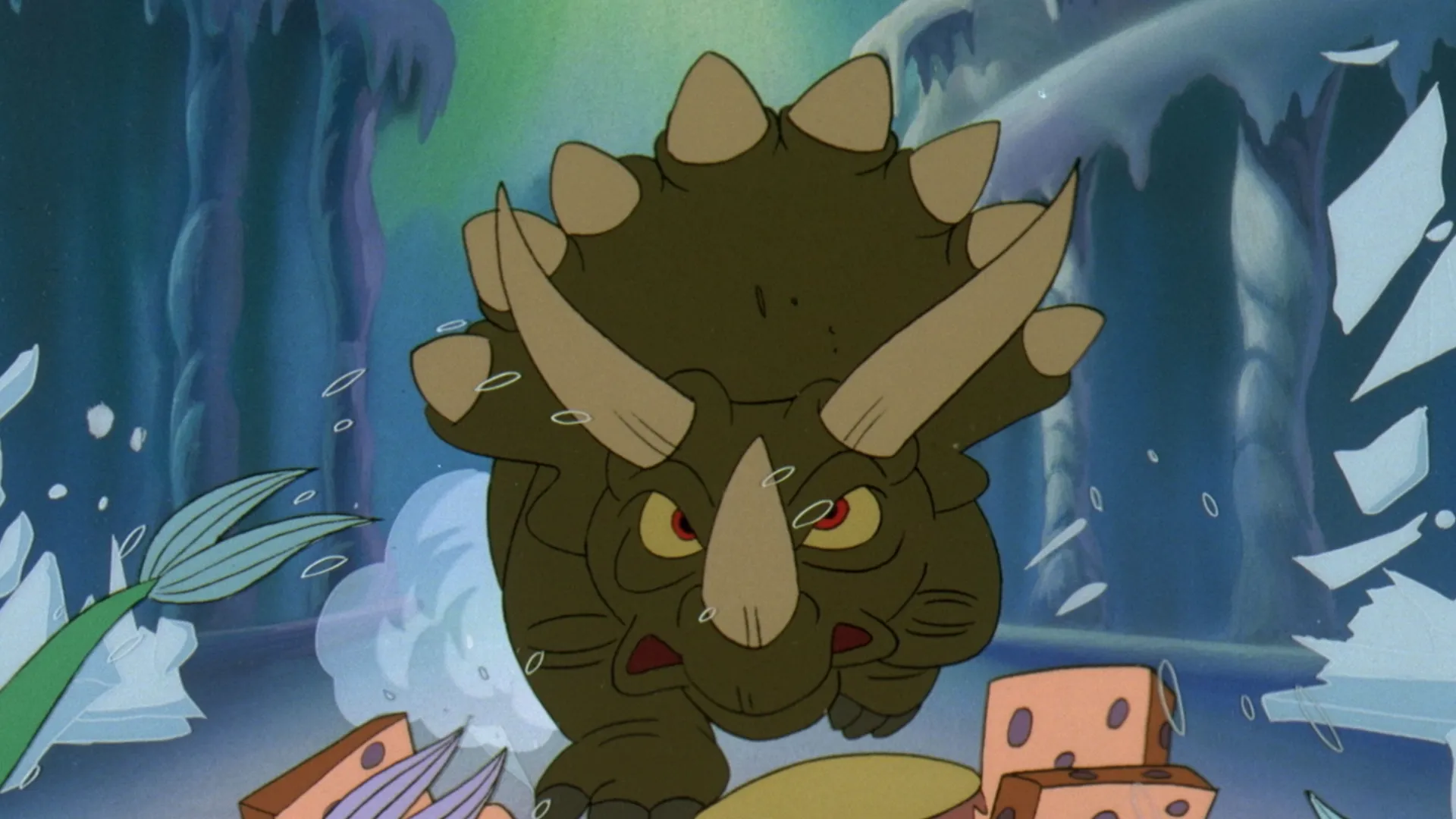
During a family trip to the frozen north, Ariel discovers dinosaurs trapped beneath ice. She uses Triton’s trident to release them because they look extraordinary and adorable. The revived animals cause havoc before Triton opens or restores a land refuge where they can live.
“Land of the Dinosaurs” is twenty-three minutes of de-extinction ethics disguised as a very cute warning not to borrow Dad’s weapon of mass habitat modification.
Discovery does not create ownership
Ariel finds the animals, but she does not gain authority over whether they wake, where they live, or how their bodies become part of Atlantican knowledge. Curiosity identifies responsibility before it grants any right to intervene.
The first person to open the tomb is not automatically the caretaker, scientist, or sovereign of what is inside.
Frozen is not the same thing as safely preserved
The episode uses magical cartoon cryopreservation. In reality, ice crystals, tissue damage, decomposition, oxygen loss, and enormous timescales would make revival far more complicated than warming a body.
The fantasy is allowed. The React should label it fantasy instead of treating the trident as plausible paleontology.
Ariel does not know whether the dinosaurs are alive, dormant, or magical replicas
Before casting, she lacks evidence about consciousness, injury, species, age, health, or what mechanism preserved them. Each possibility changes what ethical care requires.
Uncertainty should slow the intervention when the outcome cannot be reversed easily.
The trident is a sovereign tool, not family vacation equipment
Triton’s weapon can alter weather, bodies, ice, and geography. Ariel’s access remains astonishingly casual after earlier episodes involving theft and misuse.
A kingdom that lets a teenager discharge the trident at unknown frozen megafauna has not learned from its own incident history.
Waking one animal can wake an ecological relationship
Dinosaurs require food, water, temperature ranges, social groups, territory, nesting conditions, and interactions with plants and prey. A body cannot be restored apart from the system that sustained it.
De-extinction is habitat work before it is spectacle.
The revived animals are not invaders by moral choice
They emerge into a world radically changed from the one they knew. Their movement, feeding, and defense create danger, but none of them chose the release or destination.
Calling their behavior havoc should not shift blame away from the person who thawed them without a plan.
Aquatic dinosaurs are franchise fantasy, not a clean scientific category
Episode summaries note the strange convenience that the animals can function underwater. Popular culture often calls ancient marine reptiles dinosaurs even when taxonomy distinguishes them.
The story prioritizes an underwater adventure. A guide should identify what appears on screen before assigning precise species the animation does not support.
The Tyrannosaurus and the trident create a scale joke with real risk
A Tyrannosaurus knocks the trident away with its tail, sending the device into a trench. The animal does not understand royal symbolism. It responds to an unfamiliar object and nearby bodies.
Critical technology should not be carried into wildlife contact without retention and recovery plans.
Losing the trident removes the only tool Ariel assumes can control the result
She begins with power and no plan, then loses power while the dinosaurs remain active. The sequence exposes how fragile command feels once the intervention outlasts the button that started it.
Responsible care cannot depend on uninterrupted possession of one magical object.
Ariel’s “adorable” response is a dangerous classification
Cuteness lowers perceived risk and increases the urge to touch, release, feed, or claim. Large ancient animals do not become safe because their animation invites affection.
Wildlife ethics begins where aesthetic reaction stops making decisions.
Fear would not make the dinosaurs evil either
Once they move, size, teeth, and unfamiliar behavior trigger alarm. The same animals shift from adorable to menace because the humans and merpeople misread both appearances as total truth.
Observation should replace projection in both directions.
The family trip becomes an unauthorized field expedition
A vacation does not include quarantine equipment, veterinary expertise, paleontologists, containment plans, or habitat surveys. Ariel transforms leisure into research and emergency response without giving the family informed choice.
Adventure is not a substitute for preparation.
Ariel’s sisters are exposed to a risk she initiated
Cast records place several sisters in the episode. They join a family outing and encounter consequences from trident use they did not approve.
The youngest princess’s curiosity repeatedly becomes collective labor for everyone nearby.
Family status makes it harder for the sisters to refuse the adventure
Ariel’s enthusiasm can dominate a group because everyone knows she may act with or without agreement. A sister who objects risks becoming the boring one who ruined the trip, while Triton’s presence may make the outing feel officially safe even when no plan exists.
Real consent inside families requires more than nobody saying no loudly enough. Each sister should receive the location, known hazards, expected activities, and permission to remain behind without ridicule. Discovery should not become compulsory bonding.
Triton’s eventual refuge is better than destruction
He does not solve the problem by killing animals whose revival was not their fault. Opening a land sanctuary recognizes their right to continue living after the kingdom interrupted dormancy.
That restraint is one of his better uses of power.
A refuge is not automatically the original habitat
Destroying or removing ice reveals a place where dinosaurs can roam. The episode calls it their home, but millennia of geological and climatic change make that conclusion uncertain within any realistic framework.
Sanctuary should be evaluated by present needs, not romantic assumptions about origin.
The refuge must be large enough for behavior, not display
Animals need migration, hunting or foraging, privacy, reproduction, social choice, and escape from constant observation. A fenced tourist island would repeat captivity under conservation branding.
Living freely means more than having enough room to stand.
Predator and prey welfare cannot be separated
A refuge containing carnivores needs a food system. Supplying meat through captive feeding may alter hunting behavior, while releasing living prey creates danger for species that never evolved alongside these predators. Letting the dinosaurs hunt one another can also collapse a tiny founding population.
There is no painless answer created by the word sanctuary. Managers must study nutritional need, behavioral health, population size, and whether intervention reduces more suffering than it creates.
Food supply could devastate the new environment
Large herbivores may strip vegetation. Predators may hunt unfamiliar species. Existing prey may lack defenses against restored animals, while dinosaurs may be unable to digest modern resources.
Habitat carrying capacity should be studied before the population is celebrated.
Disease can travel in both directions
Ancient organisms may carry microbes, parasites, or immune vulnerabilities unfamiliar to present ecosystems. Modern pathogens may be lethal to them.
Quarantine protects revived animals as much as everyone else.
Reproduction changes a rescue into a permanent population decision
If multiple animals can breed, Triton is not caring for a few survivors. He is establishing species whose numbers, genetics, territories, and future conflicts require long-term governance.
The first generation’s welfare and the ecosystem’s capacity must be planned together.
Genetic diversity may be too narrow
A small frozen group could descend from too few individuals to support a healthy population. Inbreeding, inherited disease, and low resilience would emerge after the episode’s happy ending.
Revival without reproductive viability can prolong suffering rather than restore a species.
Nobody knows whether the animals want continued life in this world
They cannot consent before waking, and once conscious their behavior may communicate stress, attachment, exploration, or refusal only indirectly. Re-freezing would introduce another ethical problem rather than resetting a mistake.
The rescuers owe them the best possible life because they removed the earlier state without permission.
Observation should minimize human and merfolk imprinting
If revived animals associate Ariel with food, safety, or social contact, dependence may reduce their ability to live within the refuge. Young animals would be especially vulnerable.
Care can be real while keeping distance that protects wild behavior.
The dinosaurs are evidence, not collectibles
Ariel’s artifact habit could tempt her to keep eggs, bones, scales, or objects from the refuge as treasures. Scientific and cultural importance does not make removal harmless.
Documentation should preserve context and avoid turning living discovery into a private grotto display.
Fossils and living animals tell different kinds of history
A frozen body preserves anatomy and perhaps tissue. A living animal reveals movement, social behavior, sound, feeding, and adaptation under present conditions. Neither one offers a perfect recording of an entire species across millions of years.
Researchers should resist turning a few survivors into universal representatives. Age, sex, health, stress, and captivity history shape every observation. Extraordinary access does not eliminate sampling limits.
Atlantica needs knowledge it does not have
Triton can reshape ice but cannot infer nutrition, veterinary care, reproduction, or prehistoric ecology from royal authority. He needs specialists and honest uncertainty.
Magic can create space. It cannot replace expertise.
Archimedes could help document without claiming mastery
A scholar of humans and exploration may have relevant field methods, maps, and artifact practices. He would still need to collaborate with naturalists rather than treating one expertise as universal.
The best team knows the edges of each member’s knowledge.
Scuttle should not name the species from a surface rumor
His confidence around human things makes him an unreliable taxonomist. He can scout land and report visible behavior without deciding every animal’s history.
Domain-specific contribution remains the safest use of his talents.
The refuge should be protected from hunters and spectacle
News of living dinosaurs would attract collectors, armies, scientists, performers, and rulers seeking prestige. Secrecy may protect the animals temporarily while also reducing oversight.
Protection needs controlled access, enforceable boundaries, and accountability that does not advertise coordinates.
Scientific access needs rules that prevent a second Dr. Vile
The previous episode showed what happens when one researcher controls bodies, waste, and records without review. Dinosaur study could attract equally ambitious investigators who describe invasive procedures as necessary because the animals are unique.
No rarity justifies unlimited experimentation. Noninvasive observation should come first, any intervention should have independent review, and the welfare of each animal must outweigh publication prestige. The refuge cannot become a prettier laboratory with better public relations.
Ariel’s curiosity creates knowledge and moral debt
Without her, the animals remain frozen and perhaps unconscious forever. Because of her, they receive life and face an alien world. The result is neither simple rescue nor simple harm.
Discovery becomes ethical through long-term responsibility, not a heroic first action.
Triton should not punish curiosity by banning exploration
The failure was unauthorized intervention with sovereign magic, not noticing something under the ice. A blanket ban would discourage future reporting and drive expeditions into secrecy.
Separate observation, sampling, and activation into different permission levels.
Ariel needs field-research rules
Do not touch unknown organisms. Do not alter temperature or habitat. Record location. Notify specialists. Establish a perimeter. Prepare emergency communication. Never use the trident without explicit authorization.
The rules preserve wonder by preventing wonder from becoming disaster.
The incident should change how Atlantica teaches curiosity
Children should learn that discovery has stages: notice, record, protect the site, consult knowledge, assess risk, seek permission, and intervene only when evidence supports action. Hero stories usually skip from noticing to touching because waiting looks less exciting.
Teaching method does not flatten wonder. It gives young explorers a way to stay near the unknown without making themselves, their families, or the unknown creature pay for the first burst of excitement.
Triton needs actual trident security
This is not the first episode where young characters take or use the weapon. Repeated access means the problem is systemic, not one rebellious daughter.
Authentication, storage, physical retention, and delegated emergency tools would reduce the kingdom’s dependence on perfect behavior.
The episode participates in early-1990s dinosaur fever
It aired in October 1994, after Jurassic Park had made revived dinosaurs a dominant popular image. The plot shares the era’s fascination with bringing extinct animals into a present world that immediately loses control.
The connection is cultural context, not a documented production citation unless creators state it.
Unlike Jurassic Park, the episode avoids commercial motive
Ariel releases the animals from wonder and affection rather than building a theme park. The lack of profit makes her motives gentler while leaving the ecological risk intact.
Good intentions change accountability, not physical consequence.
The title promises a place and the story has to create one
“Land of the Dinosaurs” initially sounds like a lost world already waiting under ice. By the ending, Triton’s action makes a refuge where the revived animals can roam.
The title therefore names both discovery and a political decision about who receives territory.
Territory allocation affects unseen residents
Creating or opening dinosaur land may displace current species, alter currents and ice, change shorelines, or claim space another community uses. Triton cannot treat empty-looking land as unowned.
Sanctuary planning must include every existing inhabitant, not only the spectacular newcomers.
What Ariel should do after the crisis
Document exactly what she changed, help fund and staff long-term care, accept limits on access, and listen when experts say observation is more responsible than interaction.
Accountability continues after the dinosaurs stop chasing anyone.
What Triton should establish
A protected research refuge, quarantine, ecological monitoring, noninvasive medical care, genetic review, access control, emergency planning, and transparent oversight that keeps exact coordinates secure.
The animals need a future, not a magical parking place.
Where this sits in broadcast order
“Land of the Dinosaurs” is S3E4 and episode twenty-seven in the complete thirty-one-episode inventory. It aired October 8, 1994. Tedd Anasti and Patsy Cameron are credited as writers, with Jamie Mitchell credited as director.
It follows an episode about a scientist who modifies crabs without consent with a story where Ariel changes the state of ancient animals without consent. Motive differs. The need for ethical restraint remains.
Final reaction
“Land of the Dinosaurs” gives Ariel the most seductive mistake imaginable: she finds impossible life, has the power to wake it, and cannot imagine that waiting might be the loving choice. The dinosaurs become dangerous because they enter a world nobody prepared them to inhabit.
Triton’s refuge is merciful and only the beginning of the work. Episode grade: B plus, with the trident returned to secure storage, the refuge closed to tourists, and Ariel assigned enough ecological monitoring paperwork to last through the next ice age.