
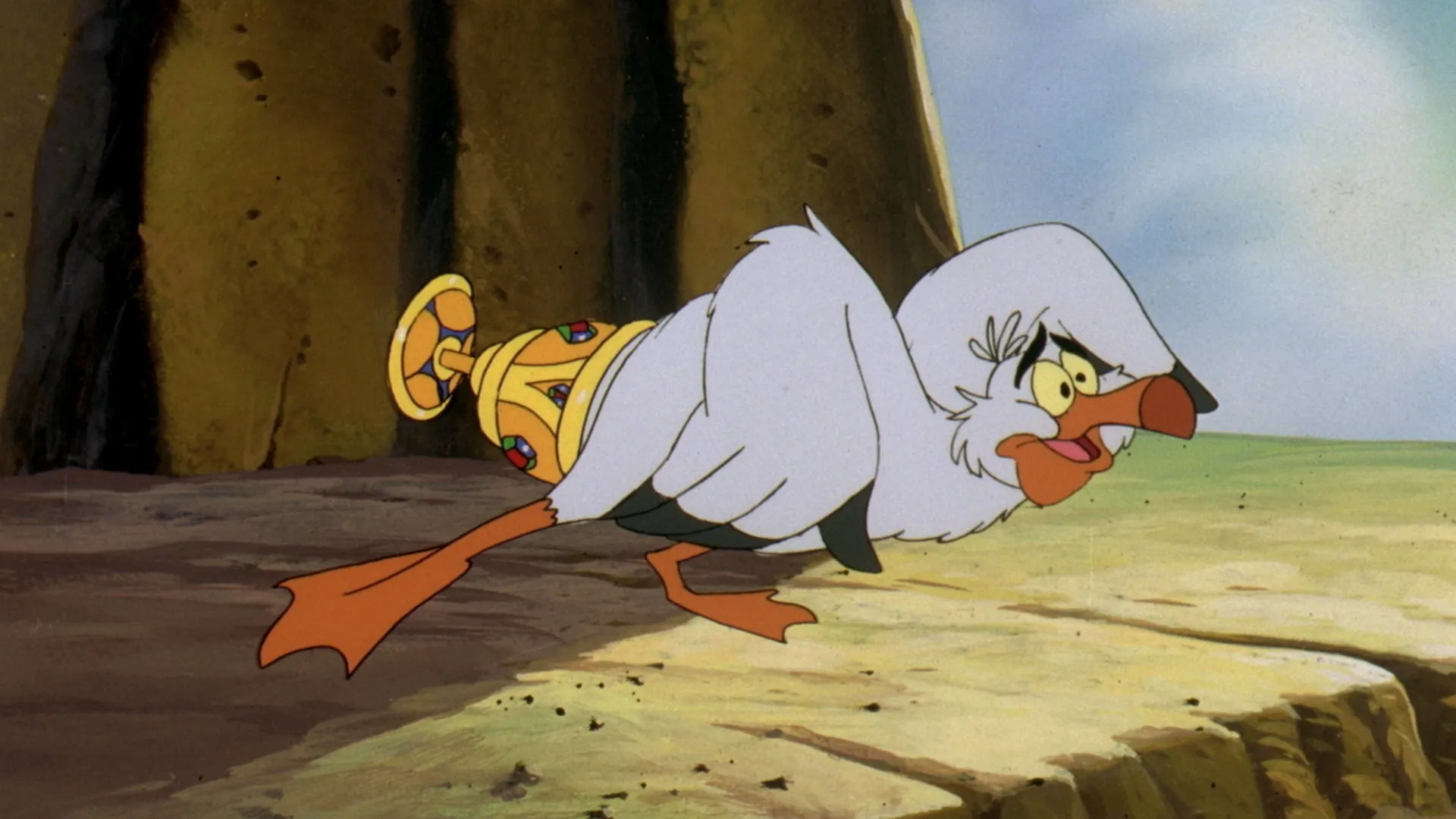
RaeRae Reacts · S3E1 · 1992 Animated Series
Scuttle
Ariel meets Scuttle before the film and discovers that inaccurate information can still arrive through a loyal friend who risks himself when the theory becomes real danger.
The episode receipt
Series: The Little Mermaid (1992). Episode: S3E1 “Scuttle.” Broadcast-order position: 24 of 31.
What happened
Ariel meets Scuttle before the film and discovers that inaccurate information can still arrive through a loyal friend who risks himself when the theory becomes real danger.
What the episode is really testing
Where to watch
Disney+ currently lists this episode. Regional catalogs and numbering can differ because the pilot is omitted from the service.
First reaction: Scuttle is wrong about almost everything and exactly right about showing up
Ariel meets the seagull who will become her favorite human-stuff expert. He is theatrical, confident, improvisational, and not remotely reliable enough to carry that job title. Then pirates capture Sebastian, threaten Prince Eric, and Scuttle helps turn chaotic knowledge into a successful rescue.
“Scuttle” is an origin story about trust earned through action and misapplied through expertise. Saving your friends can make you indispensable. It does not make your guesses about forks accurate.
Scuttle’s original name is Scuttlebutt and the edit is character design
Episode lore identifies his longer name before he adopts Scuttle. “Scuttlebutt” also carries associations with gossip and rumor, which suit a bird who gathers fragments from the human world and delivers them with tremendous certainty.
Shortening the name does not change the method. He remains a walking headline without a corrections desk.
Ariel needs a bridge to the surface and mistakes confidence for credentials
She has questions nobody in Triton’s court wants to answer. Scuttle lives above water, handles human debris, and speaks without fear. That access makes him feel authoritative before accuracy has been tested.
Information deserts create experts out of whoever is willing to talk.
Scuttle’s bad anthropology begins with genuine observation
He sees objects, behaviors, ships, clothing, and tools. His errors do not come from total invention. They come from missing context filled with storytelling.
That mix is dangerous because visible evidence makes the unsupported explanation feel researched.
A confident explanation is emotionally easier than an honest unknown
Ariel brings Scuttle objects because uncertainty frustrates her and the palace refuses the subject. “I do not know” would leave the gap open. His elaborate stories close it immediately and make a mysterious world feel available.
The comfort of completion is part of the misinformation. Verification takes time, may produce partial answers, and can reveal that a beloved theory was nonsense. Scuttle’s method rewards curiosity instantly, which makes better method feel less satisfying even when it is more reliable.
Archimedes already proves a better method exists
Season 2 introduced a serious humanologist whose knowledge exceeded Scuttle’s guesses. Ariel now meets the accessible, entertaining source she will keep consulting in the film.
The continuity invites an uncomfortable question: why does charisma replace the more accurate scholar? Convenience, proximity, and friendship often beat expertise in everyday information habits.
Expertise and friendship should remain separate roles
Scuttle can be a brave friend, surface scout, messenger, and creative problem-solver without being treated as the final authority on human culture. Respect does not require pretending every skill transfers.
A healthy group can say “we trust you with us” and “we need to verify that claim” at the same time.
Sebastian’s capture turns surface curiosity into immediate stakes
Pirates seize someone Ariel loves. Human danger stops being Triton’s abstract warning and becomes a specific criminal system with weapons, ransom plans, and a ship capable of carrying violence across boundaries.
Ariel’s curiosity survives because she learns to distinguish humans from humanity as one moral category.
Piracy is not proof Triton is right about every human
The captors choose exploitation. Eric and Grimsby occupy the same surface world without sharing that choice. Treating both groups as interchangeable would reproduce the kind of species-level prejudice Ariel challenges throughout the series.
Evidence should refine a belief, not harden it into total fear.
Ransom converts a person into leverage
The pirates target status and relationships. Eric’s value to them is not his interior life but what somebody else will pay to recover him. Sebastian becomes useful because he hears or enters the plot and can be contained.
Kidnapping makes attachment profitable by weaponizing care.
The ransom plot depends on information about Eric’s identity
The pirates must know who the prince is, what route he travels, and who controls resources on his behalf. That implies observation or local intelligence beyond a random encounter at sea.
Eric’s security problem is therefore larger than one pirate vessel. His court should examine leaked schedules, predictable routes, port relationships, crew screening, and the political conditions that made a royal kidnapping appear achievable.
Eric’s class position creates both privilege and danger
A prince has ships, an aide, protection, and political importance. Those resources make ransom plausible because wealth and authority signal payment capacity.
Privilege does not prevent victimization. It shapes the form the threat takes and the institutions available afterward.
Ariel helps someone she barely knows because rescue is not romance yet
Eric appears at a distance in this pre-film episode. Ariel’s intervention can be read as ethical courage before the movie organizes their relationship around love.
That distinction matters. She risks herself for strangers and friends throughout the franchise. Her heroism did not begin when she found a handsome prince.
Scuttle’s flight creates intelligence Ariel cannot gather underwater
He can track ships, observe decks, move between air and sea, and relay positions quickly. His ecological access is operationally valuable even when his object interpretations are nonsense.
Competence is specific. The rescue succeeds when the team uses what Scuttle can actually do.
Ariel’s underwater perspective reveals weaknesses in the pirate plan
Ships depend on hull integrity, direction, weapons, crew coordination, and assumptions that threats come from the visible surface. Ariel, Flounder, and Sebastian can approach from an environment the pirates do not control.
The group wins through complementary access rather than one superior hero.
Sabotage is justified by the immediate threat and still risky
The rescuers interfere with the pirate ship until the pirates accidentally bomb their own vessel. The plan prevents kidnapping but could injure captives, crew, marine life, and nearby ships.
Emergency ethics does not require passivity. It requires choosing the least harmful effective disruption available under time pressure.
The pirates’ own weapons rebound on them
Causing attackers to destroy their vessel gives the climax comic justice. The harm originates from tools they brought to threaten others.
The reversal is satisfying because it exposes how violent systems remain dangerous to the people operating them.
Sebastian contributes information after capture
He is not merely cargo waiting for rescue. He learns the plan and communicates it, allowing Ariel, Flounder, and Scuttle to act with purpose.
Captivity limits agency without erasing it.
Scuttle earns trust through courage, not accuracy
He stays involved when the stakes become real. The rescue requires risk, improvisation, and loyalty beyond his desire to impress Ariel with knowledge.
This is the correct foundation for friendship and the wrong foundation for calling him a historian.
Heroism can create a halo around unrelated claims
After someone helps during a crisis, people naturally generalize competence. The rescuer seems wiser, more trustworthy, and more correct across subjects that had nothing to do with the emergency. Gratitude makes skepticism feel rude.
Scuttle benefits from that halo. Ariel is right to remember who showed up for Sebastian. She is wrong if the rescue becomes evidence that every utensil story deserves archival status. Emotional debt should never become epistemic immunity.
Just Give Me a Chance states Scuttle’s emotional argument
The episode gives him a musical number asking others to look beyond his awkwardness and let him contribute. The song makes belonging the issue rather than factual expertise alone.
A chance should include room to demonstrate actual strengths and receive correction where he is wrong.
Maurice LaMarche inherits a character built by Buddy Hackett
LaMarche voices Scuttle for the series, preserving the frantic confidence and comic rhythm while fitting a weekly animated production. The performance makes nonsense sound like urgent public service.
That vocal certainty is part of why Ariel believes him and why viewers forgive him.
The episode explains how future misinformation becomes relational
By the film, Ariel consults Scuttle about a fork and pipe because he is not just a random bird. He helped save Sebastian and Eric. Trust formed in danger migrates into a domain where it is less deserved.
This is how real misinformation often travels: through relationships that were earned for other reasons.
Corrections can feel like betrayal when expertise is tied to belonging
If Scuttle’s place in the group depends on being the human-stuff expert, admitting uncertainty threatens identity. Friends may avoid correcting him because they do not want to reopen the question of whether he belongs.
The healthier relationship makes belonging unconditional enough that accuracy can improve.
Ariel also gets something emotionally useful from his wrong answers
Scuttle validates her fascination. Even a false explanation treats the object as worthy of attention rather than forbidden garbage. He gives curiosity social permission.
The task is preserving that permission while replacing invention with honest uncertainty.
Triton’s prohibition creates the market for Scuttle’s certainty
If the palace offered safe, accurate education about human history and tools, Ariel would not need one bird to explain an entire civilization. Censorship does not remove demand for knowledge.
It pushes demand toward unverified sources who feel welcoming.
Banning a topic also prevents adults from correcting dangerous misunderstandings
If Ariel expects punishment for mentioning human artifacts, she cannot ask court scholars whether a pipe carries heat, whether a blade can cut, or whether a vessel signals danger. Errors remain private until they create an emergency.
Open education would let adults challenge Scuttle without humiliating Ariel for caring. A safe question is a preventative tool, especially when the objects come from wrecks and may retain sharp edges, pressure, chemicals, or mechanisms nobody underwater recognizes.
Scuttle’s island is close enough to complicate the film’s geography
Episode notes observe that his home looks near swampy land, while the film makes the island feel isolated. Visual geography shifts because television episodes reuse and simplify space according to story needs.
The difference is a continuity detail, not a hidden migration event requiring invented lore.
Eric appears before Ariel supposedly first sees him
The episode closes with Eric and Grimsby aboard their ship. Eric thinks he sees a beautiful mermaid leap from the water. The series has already used him earlier, and now Ariel participates in another indirect encounter before the movie’s birthday ship scene.
The emotional first sight in the film cannot remain literal under this continuity.
The glimpse works as dramatic irony even when canon bends
Viewers know the couple’s future while the characters remain separated by water, timing, and uncertainty. Eric sees enough to wonder but not enough to identify Ariel later.
The moment is designed as affectionate foreshadowing, not a continuity lawyer’s affidavit.
Eric believing he saw a mermaid should affect later skepticism
In the film, his memory of the singing rescuer is already fragile and contested. This earlier glimpse could make him more open to the possibility, even if he never saw Ariel clearly.
The series does not fully carry that psychological history forward because the movie predates it.
Sebastian has already helped save Eric before whispering Ariel’s name
The film later places Sebastian close to Eric during the three-day courtship. Under series continuity, he is not dealing with a completely unknown prince.
That adds a quiet layer of prior assessment even if the feature never acknowledges it.
Grimsby’s presence grounds Eric in an institution
The prince is not an isolated romantic object. He travels with an older aide, crew, and the expectations of a kingdom. A kidnapping would create political consequences beyond one young man’s safety.
Ariel’s future relationship will cross not only species but systems of government and class.
The pirates should not remain generic forever
The episode needs readable villains quickly, so it gives us a gang and a ransom scheme rather than deep political economy. An adult React can still ask where piracy comes from, who funds it, and why maritime enforcement failed.
Individual greed exists inside routes, ports, markets, and weak oversight.
Ariel should tell Triton about the pirate threat
Keeping the entire event secret protects her from punishment while leaving Atlantica unprepared for vessels willing to capture residents or attack nearby royalty.
She needs a reporting channel that does not require surrendering all autonomy.
Triton should respond without using the incident to ban curiosity
A pirate plot is evidence for security, not proof that every human object or person is corrupt. If he turns rescue disclosure into punishment, Ariel will hide the next threat.
Trustworthy governance separates safety review from moral panic.
Scuttle should receive a domain-specific title
Surface scout, aerial observer, object finder, or emergency messenger would honor his real value. Human cultural scholar would remain inaccurate until he adopts better methods.
Clear roles protect both Scuttle’s dignity and Ariel’s information quality.
Ariel should cross-check every object explanation
Ask Archimedes, observe humans using similar objects, compare multiple examples, and label unknowns as unknown. Scuttle can propose hypotheses without presenting them as fact.
Friendship plus verification is stronger than either blind trust or ridicule.
The episode creates the origin of the dinglehopper problem
Once Scuttle becomes the trusted surface contact, future claims about hair-styling forks and musical pipes carry emotional authority. The film’s joke now has a relational backstory.
The Easter egg is structural rather than hidden: this is how misinformation enters Ariel’s archive.
Scuttle’s courage explains why he later attacks Vanessa
During the film’s wedding crisis, he recognizes Ursula’s disguise and mobilizes animals against the ceremony. This episode establishes the pattern of rushing into a dangerous human situation when Ariel’s people are threatened.
His methods are chaotic, but loyalty is consistent.
The rescue team succeeds because nobody is complete alone
Ariel understands water, Scuttle understands air and ships, Sebastian provides intelligence, and Flounder supports movement and coordination. The episode’s friendship argument is practical, not sentimental.
Difference becomes capacity when the group stops demanding one member master every environment.
Where this sits in broadcast order
“Scuttle” is S3E1 and episode twenty-four in the complete thirty-one-episode inventory. It aired September 17, 1994. Tedd Anasti and Patsy Cameron are credited as writers, and Maurice LaMarche voices Scuttle in the series.
Season 3 begins by adding the final major member of Ariel’s film friendship trio while complicating what “first meeting” can still mean for Eric.
Final reaction
“Scuttle” gives the loudest bird in the franchise exactly the origin he needs. He is brave before he is accurate, useful before he is qualified, and loyal enough that Ariel will later believe almost anything he says about human stuff. The pirates prove he belongs in the group. They do not prove a fork is a comb.
The episode becomes smarter when trust is treated as portable and therefore dangerous outside the domain where it was earned. Episode grade: A minus, with Scuttle officially appointed aerial rescue coordinator and every anthropology claim sent to Archimedes for review.