
RaeRae Reacts · S2E3 · 1992 Animated Series
Save the Whale
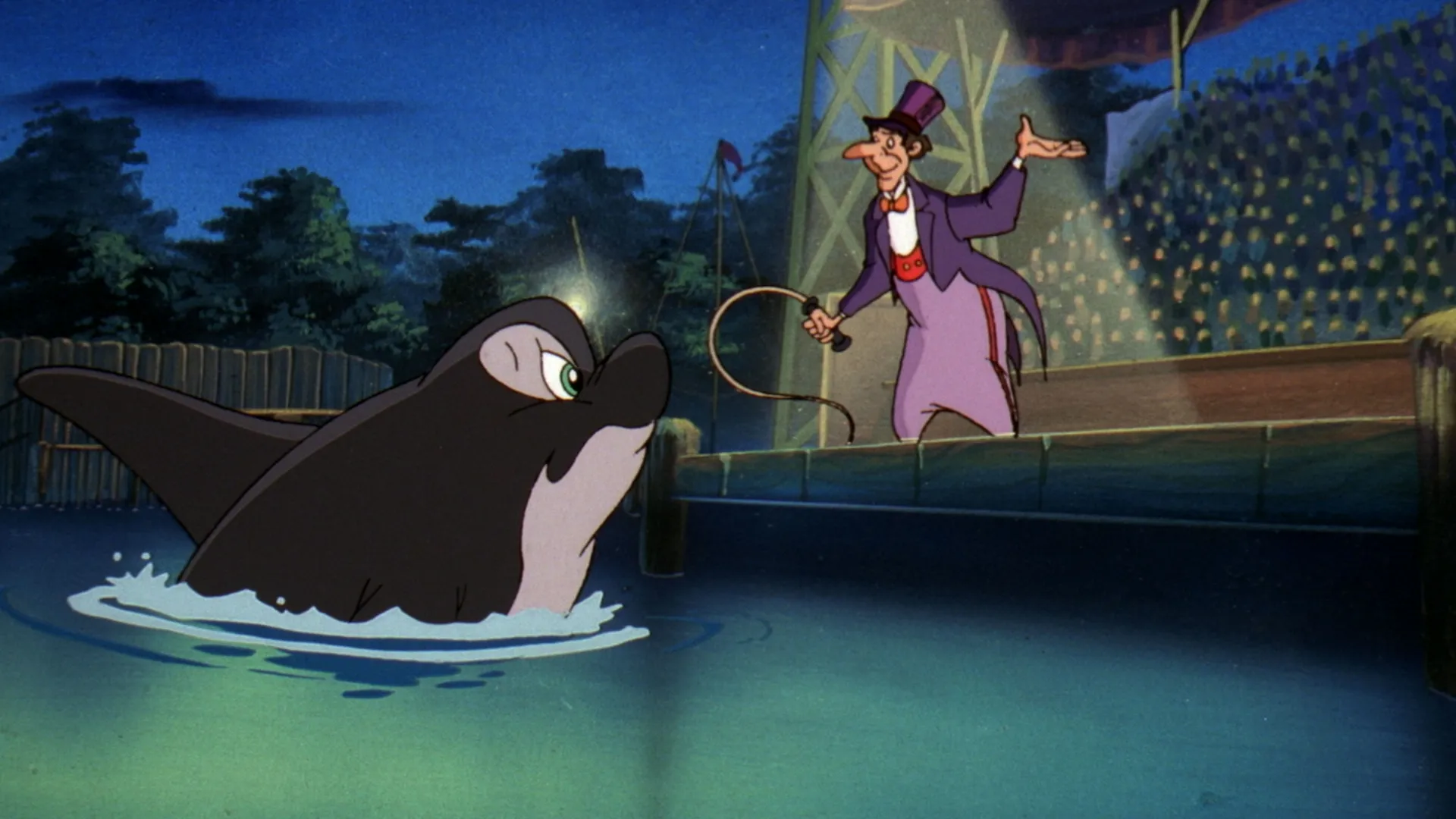
Spot and Sebastian are captured by a circus owner, forcing the series to connect human curiosity with captivity, spectacle, and profit.
The episode receipt
Series: The Little Mermaid (1992). Episode: S2E3 “Save the Whale.” Broadcast-order position: 17 of 31.
What happened
Spot and Sebastian are captured by a circus owner, forcing the series to connect human curiosity with captivity, spectacle, and profit.
What the episode is really testing
Where to watch
Disney+ currently lists this episode. Regional catalogs and numbering can differ because the pilot is omitted from the service.
First reaction: Spot came home grown and the world immediately put a price on him
Spot returns to Atlantica as a full-grown killer whale, eager to see Ariel and perform for the community that remembers him as a frightened baby. The reunion should be uncomplicated joy. Instead, a human circus owner sees a living animal and calculates a spectacle.
“Save the Whale” is funny in the bright Saturday-morning way this series knows how to be, but the engine underneath it is ugly. Somebody recognizes Spot’s intelligence, social nature, and trust, then decides those qualities make him easier to exploit.
The title arrives carrying an entire environmental movement
By 1993, “save the whales” was already a familiar conservation slogan, not a neutral phrase invented for this episode. The title lets a child audience recognize the moral emergency before the plot explains captivity, hunting, or commercial display.
That familiarity helps the episode move quickly. It also risks flattening conservation into a rescue catchphrase unless we ask what happens after Ariel opens the cage.
Spot is not the baby Ariel remembers
The pilot introduced a young orca who needed protection and courage. Here he returns larger, capable, social, and eager to show what he can do. Ariel’s affection remains real, but memory can freeze another person or animal at the age when we felt most necessary to them.
Seeing Spot clearly means recognizing development. He is her friend with his own life, not Ariel’s former pet returning to validate how well she cared for him.
Calling Spot a pet was always the first warning
Ariel loved Spot, yet the earlier relationship was organized through ownership language. A princess found a vulnerable animal, named him, tried to keep him, and eventually learned that belonging with his own kind mattered more than possession.
The circus owner takes that same ownership assumption to its cruel commercial conclusion. Ariel’s version was affectionate. His is profitable. The difference matters, but neither one should erase Spot’s agency.
A reunion performance can be voluntary before capture changes everything
Spot enjoys displaying his strength and skill for Atlantica. Performance itself is not automatically abuse. Animals play, communicate, repeat learned behaviors, and sometimes seek social response without a human coercing them.
The ethical line changes when movement is confined, food or safety becomes leverage, and refusal is no longer possible. The episode gives us that line in the transition from community celebration to circus captivity.
Sebastian becomes collateral because exploitation rarely stays tidy
The owner captures Sebastian along with Spot. A crab may look like a novelty beside an orca, but the logic is identical: unusual body, entertaining behavior, potential ticket sales. Once life is inventory, the category keeps expanding.
Sebastian’s fear also prevents the story from treating captivity as an abstract issue that only affects a large charismatic whale. Smaller creatures are still subjects, even when the poster puts somebody bigger in the center.
The circus owner understands value without understanding personhood
He recognizes that Spot can draw a crowd. He sees intelligence only as trainability and social attachment only as a weakness that can be manipulated. This is a precise form of dehumanization, even when the victim is not human: perceive capacity, then convert it into utility.
The villain is not ignorant of Spot’s gifts. He is attentive in the worst possible way. He notices everything except the fact that none of it belongs to him.
A cage is not made humane by applause
An audience can laugh, clap, and believe it loves the animal while participating in a system built on confinement. Warm public emotion does not tell us what happened during capture, transport, training, housing, or the hours when the show is over.
The episode’s circus imagery asks a useful question for every attraction involving animals: are spectators responding to the creature, or to a controlled display that removed its ability to leave?
Entertainment teaches people what kinds of control look normal
Children learn categories through repetition. If every extraordinary animal appears behind bars, performing on command for a human owner, captivity begins to look like the natural relationship between wonder and access.
“Save the Whale” pushes back by making the cage an interruption of Spot’s real social world. He already has community, history, movement, and relationships before humans turn him into an exhibit.
The human surface is not freedom just because Ariel romanticizes it
Ariel often sees human objects as portals into a larger life. This episode forces her to confront a human institution that converts ocean life into property. The surface contains art and cruelty, curiosity and extraction, sometimes in the same tent.
Her fascination grows more credible when it survives evidence. Loving another culture does not require pretending its violence is a misunderstanding.
Ariel has to rescue without making herself the center
Spot is captured because humans target him, not because Ariel failed to love him enough. Her role is to use access, courage, and knowledge to restore his freedom. The rescue should not become proof that she is his permanent guardian.
Good intervention returns choice. It does not create a new debt in which the rescued must remain emotionally available to the rescuer forever.
Sebastian knows what it means to perform for power
Sebastian serves a king, conducts public concerts, and constantly manages the expectations of a royal household. His labor is not the same as forced animal captivity, but it gives his imprisonment an extra sting. He knows performance can be work negotiated within a community, and now he experiences display without consent.
The difference between musician and exhibit is not talent. It is whether the performer can shape the work, refuse the stage, and go home afterward.
Spot’s trust makes capture easier
A social animal who approaches familiar figures and enjoys interaction may not read every human vessel as a threat. Trust is a survival risk when an exploiter treats openness as access.
That is not Spot’s moral failure. Safety education should increase his options without teaching that warmth itself was foolish.
The episode refuses the myth that intelligence protects victims
Spot is capable, perceptive, and physically powerful. Sebastian is clever and verbally assertive. Neither quality prevents capture when the owner controls equipment, environment, and surprise.
Stories often reassure audiences that a smart victim will escape. This plot is better when it admits intelligence cannot cancel structural power.
Orca size makes the enclosure absurd on purpose
A full-grown killer whale is built for distance, depth, speed, and complex social life. Confinement reduces an enormous sensory world to whatever space an owner can transport and monetize.
Even without turning the React into a biology lecture, the visual mismatch tells the truth. A body that fits inside a tank is not therefore suited to living there.
Charismatic animals receive sympathy that ecosystems do not
Spot has a name, expressive eyes, history with Ariel, and recognizable affection. Viewers immediately care. Countless less adorable creatures can be captured, displaced, or killed without receiving a title card that orders us to save them.
Conservation has to grow beyond charisma. Protecting whales while destroying food chains, migration routes, water quality, and quieter species is rescue theater rather than ecological care.
The rescue must include the route home
Opening a cage is only the first step. Spot needs safe passage away from human hunters, recovery from transport and stress, and reconnection with the social world he chose after the pilot.
Sebastian needs the same respect at his scale. Freedom is not merely absence of bars. It is restored access to the conditions that make a life possible.
Atlantica cannot rely on Ariel as its entire wildlife policy
Ariel recognizes Spot and acts because the victim is personal. A functioning kingdom should already have surveillance, rescue protocols, surface-risk education, and diplomatic rules for responding when marine life is taken.
Heroism feels good on television. Institutions matter on the day the captured whale is somebody Ariel has never met.
Triton’s border rules have a real danger underneath them
The king’s hostility toward humans is frequently overbroad and controlling. Here the episode supplies evidence for the fear beneath it. Human technology can enter the sea, seize residents, and disappear before Atlantica organizes a response.
Understanding Triton’s evidence does not excuse isolation. It makes the need for a smarter policy more urgent than either total prohibition or Ariel’s optimism.
Ariel’s curiosity can become intelligence work
Her knowledge of ships, tools, human habits, and surface geography is not frivolous when a rescue crosses the boundary between worlds. What Triton calls obsession can become cultural literacy with direct public value.
The lesson is not that every forbidden hobby must save the kingdom before adults respect it. Ariel’s curiosity deserved room before the emergency.
The owner’s circus is a business model, not one bad mood
The villain benefits from buyers, transport, advertising, labor, and an audience willing to pay. Removing him solves the immediate plot without dissolving the demand that made Spot valuable to capture.
A serious reading follows the money. Who profits, who looks away, who buys a ticket, and who absorbs the cost in fear and confinement?
Spectators can love Spot and still fund his captivity
A child at the show may be delighted by the whale and sincerely wish him well. The ticket still rewards the owner. Ethical harm does not require every participant to feel cruel.
That is why consumer innocence cannot be the final standard. We have to examine what our pleasure purchases.
Rescue stories can accidentally promise the system is fixed
Ariel saves the friend we know, the villain loses control, and the episode closes with relief. The format needs closure. Real extraction networks replace one animal, rename the attraction, and continue.
The useful emotional ending is a beginning for policy: prevent recapture, monitor routes, and teach Atlanticans how to report danger.
Spot’s return gives the series genuine continuity
This is not a disposable guest animal created for one moral lesson. Spot comes back from “Whale of a Tale,” visibly changed by time. The return rewards viewers who remember the pilot and lets the series examine the relationship after separation.
Continuity makes the capture hurt because Spot is not merely a symbol called Whale. He is somebody whose earlier fear, growth, and departure already mattered.
The pilot connection is the episode’s most important Easter egg
Spot’s appearance reaches back to the animated series premiere, where Ariel found him as a baby and eventually accepted that he needed to rejoin his pod. His adult return confirms that leaving Ariel was growth, not abandonment.
That history sharpens every cage in this episode. Spot already completed one story about escaping affectionate possession. Now he faces commercial possession.
The title is blunt because the moral should not hide
“Save the Whale” does not offer a mysterious poetic label. It names the task in language audiences already know. Sometimes subtlety gives viewers too much room to admire a spectacle while missing the captive body inside it.
The React can still complicate the slogan after accepting its basic demand. Yes, save Spot. Then build a world where rescue is not the only thing standing between wildlife and sale.
Jodi Benson gives reunion joy enough room to become alarm
Ariel’s delight at seeing Spot is open and youthful. When danger enters, that warmth becomes urgency rather than a generic princess rescue voice. The relationship is audible before the script has to explain it.
Benson also keeps Ariel from sounding like she owns the whale’s story. Her best moments come from recognition and concern, not command.
Samuel E. Wright makes Sebastian’s indignation political
Sebastian is funny when frightened, but his outrage at being treated as an object carries more than comic energy. Wright gives him the certainty of someone who knows he is a professional, advisor, and person even when the captor sees merchandise.
The performance lets children laugh without asking them to agree that a talking crab’s humiliation is harmless.
The episode aired when whale captivity was already publicly contested
The early 1990s did not invent concern about marine mammals in entertainment. Public arguments about whaling, aquariums, performance, conservation, and animal welfare were already available to the writers and audience.
The episode belongs to that climate without functioning as a documentary. Its contribution is emotional architecture: friendship outside the cage, capture as rupture, and freedom as the only acceptable ending.
What the episode understands about nostalgia
Spot’s return invites viewers to enjoy recognition. The story then refuses to leave nostalgia untouched. Remembering the cute baby whale is not enough if the adult whale’s needs and autonomy disappear beneath the memory.
Fandom has the same responsibility. Loving an old character means allowing that character to become more complicated than the version first encountered.
What the episode misses about the captor’s wider network
The circus owner carries most of the blame in one visible body. We see less of the workers, officials, customers, suppliers, and enforcement failures that allow a captured orca to reach a show.
That simplification keeps a twenty-two-minute plot moving, but an adult React should restore the missing system rather than praising one villain’s defeat as comprehensive reform.
What Ariel should learn before the next reunion
Ask Spot how he lives now. Learn the routes and communities important to him. Make contact plans that do not depend on spectacle. Share information about human risks without demanding he avoid every surface forever.
Friendship after caregiving requires a new shape. Ariel can love him without returning him to the role of dependent baby.
What Triton should build after this incident
Atlantica needs a marine rescue team, reporting network, safe recovery locations, and rules governing encounters with human vessels. It also needs people trained to distinguish genuine human research from capture and commerce.
Fear alone cannot protect the kingdom. Preparation can.
Where this sits in broadcast order
“Save the Whale” is S2E3 and episode seventeen in the complete thirty-one-episode inventory. It originally aired October 2, 1993. The official current catalog synopsis identifies Spot and Sebastian as the captured pair.
Coming after “Calliope Dreams,” the season moves from a creature harmed by accidental sound to an animal deliberately seized for entertainment. Both stories ask whether wonder gives anybody the right to control another living being.
Final reaction
“Save the Whale” earns its direct title. Spot’s grown body proves Ariel once did the right thing by letting him leave, and the circus cage shows how quickly another person can reinterpret freedom as available inventory. Sebastian’s capture makes the logic impossible to dismiss as something that only happens to wildlife.
The rescue works because it restores a relationship that existed before the showman sold one. Episode grade: A minus, with every ticket buyer asked to look past the applause and Spot permanently removed from anybody’s list of available attractions.