
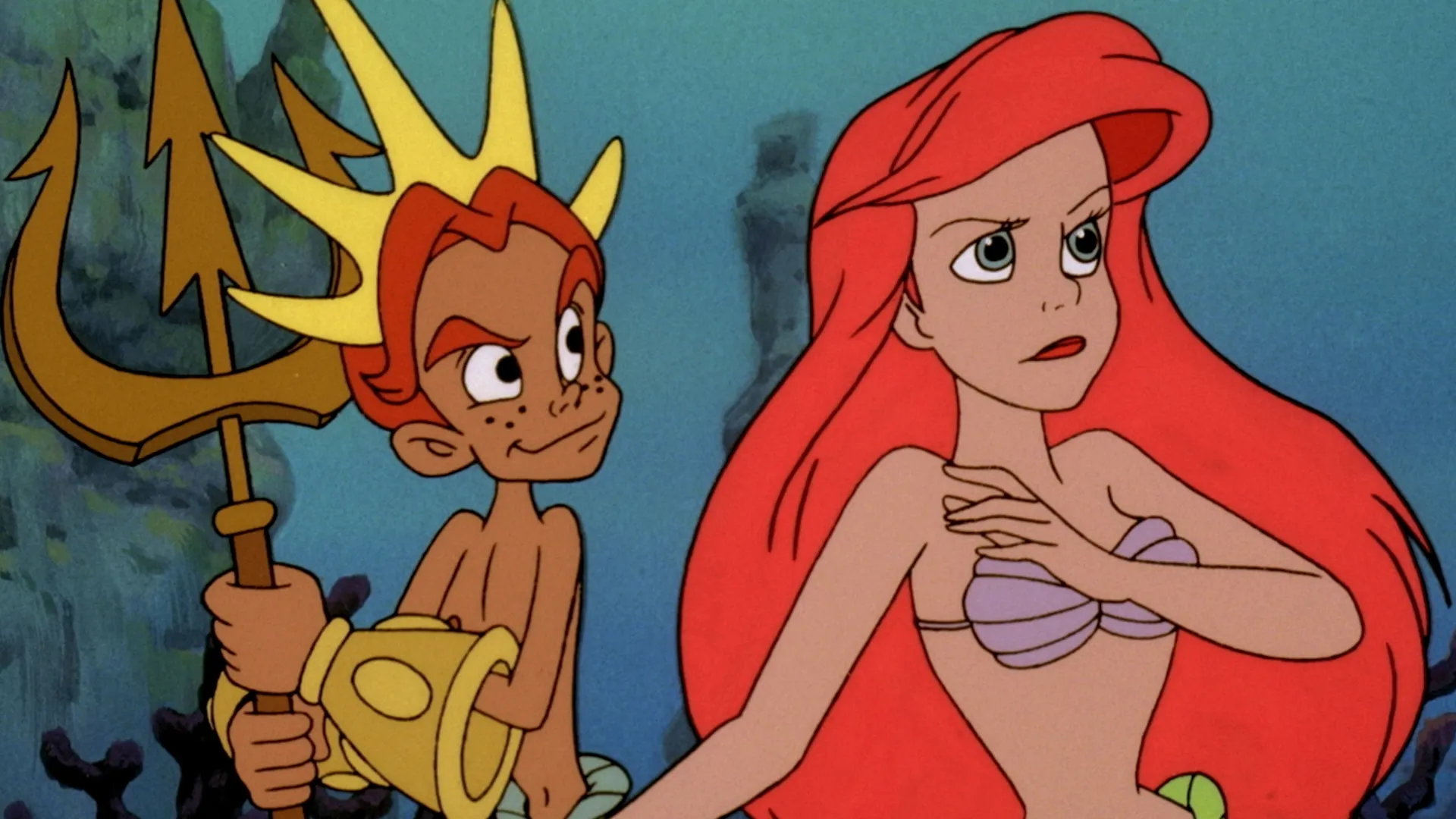
RaeRae Reacts · S1E11 · 1992 Animated Series
Red
An accident leaves Triton physically diminished and emotionally exposed, forcing Ariel to care for the father whose authority usually fills the room.
The episode receipt
Series: The Little Mermaid (1992). Episode: S1E11 “Red.” Broadcast-order position: 11 of 31.
What happened
An accident leaves Triton physically diminished and emotionally exposed, forcing Ariel to care for the father whose authority usually fills the room.
What the episode is really testing
Where to watch
Disney+ currently lists this episode. Regional catalogs and numbering can differ because the pilot is omitted from the service.
First reaction: Triton hurts his back and immediately treats aging like a political failure
The king’s pain occurs at Ariel’s party, where youth, movement, and social energy make physical limitation especially visible. One injury becomes evidence that he is old, out of touch, and losing the body his authority has always seemed to inhabit.
That leap gives the villain an opening. Triton is not merely seeking relief. He is defending an identity built around appearing powerful enough that nobody imagines the throne without him.
Age shame makes an ordinary injury feel like exposure
Back pain can happen to people across ages, but Triton interprets it through fear of decline. The surrounding culture likely rewards kings for strength and continuity, so vulnerability feels public even inside the family.
Shame narrows judgment. Instead of seeking a careful diagnosis or rest, the household becomes receptive to a magical solution promising the old body was the problem.
Ageism traps Triton between invulnerable elder and irrelevant old man
The culture appears to offer him two identities: a powerful king whose body never limits him, or an old ruler falling behind. Neither leaves room for a competent adult who sometimes hurts, rests, delegates, and remains valuable. The Youth Stone sells escape from a false binary.
Ageism does not only insult older people. It also denies younger people authority and treats dependence as humiliation. Red experiences the reverse side when his smaller body causes others to discount the adult history inside him.
Masculinity makes care feel like defeat
Triton’s public identity depends on strength, command, and the ability to protect everybody else. Receiving help reverses that flow. A culture that defines manhood through provision can make ordinary care feel like evidence that the man has failed.
That belief isolates leaders precisely when honest support would protect them. Triton needs a model of masculinity where accepting treatment, delegating power, and naming fear are forms of responsibility rather than surrender.
Ariel wants to help and authorizes a treatment she does not understand
Apple TV’s official synopsis makes the key choice explicit: Ariel allows Glo-Fish to give Triton the Youth Stone. Her care is sincere. Her consent is not informed because she lacks reliable knowledge of the stone, flute, source, risks, and ulterior motive.
Good intention cannot substitute for medical evidence. When another person’s body will change, the standard must become higher than “this might make him feel better.”
Triton’s consent is compromised by insecurity and incomplete disclosure
A person can agree to treatment and still be manipulated when critical facts are hidden. Triton wants relief from the emotional meaning of age, while Glo-Fish presents youth as a solution without revealing the planned theft.
Consent requires more than a yes. It requires capacity, material information, freedom from coercion, and a realistic account of alternatives.
Glo-Fish turns wellness language into access
The greedy fish approaches the palace through a need that sounds caring. Restore vitality. Help the king feel like himself. The offer lowers defenses because it resembles service rather than intrusion.
Scams often target shame instead of ignorance. The victim may know many things and still be vulnerable where a promise touches the identity he fears losing.
The Youth Stone is a treatment and a weapon
Its advertised function is rejuvenation. Its strategic function is removing adult Triton’s power, judgment, and control of the trident. The same transformation that appears to solve age anxiety creates a security breach.
Dual-use magic demands governance. A kingdom with sea witches, enchanted stones, and a trident should not accept unverified remedies through informal palace contacts.
Red is not adult Triton in a conveniently smaller body
The spell turns him into a ten-year-old merboy who insists on a new name. His cognition, impulses, and sense of identity shift with the body. Treating him as an adult official would ignore the actual dependency the transformation creates.
The episode uses magical age regression rather than disability, but both scenarios warn against assuming the familiar person retains every previous capacity simply because others need continuity.
Capacity must be evaluated for the specific decision
Red may remember facts, recognize family, and express preferences while lacking the judgment required to control the trident or assess a magical threat. Capacity is not a single switch labeled competent or incompetent. It depends on the choice, information, consequences, and support available.
Ariel should involve him as much as possible without pretending every decision remains safe. Respecting autonomy includes providing explanation and choices at the level the person can use.
Support can increase capacity instead of replacing it
Clear language, limited options, familiar routines, and time can help Red participate in decisions. The family does not have to choose between complete control and complete independence. Supported decision-making preserves more personhood during crisis.
That approach also challenges Triton’s usual parenting style. Ariel may make better choices when given information and structured freedom, just as Red does. Control is not the only available form of safety.
The new name creates distance from the king he cannot perform
Calling himself Red allows the child to exist outside the expectations attached to Triton. The name can feel playful and protective. If he cannot be the commanding father and ruler, he can become somebody whose wants are immediate and whose mistakes do not carry a crown.
Identity under transformation is not only loss. It can reveal parts of the person authority forced underground.
Ariel becomes caregiver to the father who usually controls her
The reversal gives Ariel responsibility for safety, boundaries, reassurance, and the exhausting unpredictability of a child. She has to make decisions Red may dislike because his capacity and the external danger have changed.
That experience can produce empathy for Triton’s parental fear without proving his authoritarian methods correct. Caregiving explains why limits exist and does not excuse every limit a parent chooses.
Parentification is funny here and dangerous as a family norm
Ariel temporarily manages a dependent version of her father because magic creates an emergency. The comedy should not make it normal for a child to become the emotional or practical parent of an adult whenever the adult struggles.
Children can contribute during crisis. They should not become the system that keeps the household functioning while adults avoid help.
Red tests every rule Triton expects Ariel to follow
The child wants movement, excitement, and immediate experience. Warnings sound like obstacles created by somebody who does not understand him. Ariel hears her own arguments in a different voice.
Role reversal is most useful when it creates mutual recognition rather than a smug punishment. She can see the fear behind a caregiver’s no, and Triton can later understand how confinement feels from inside the smaller body.
Power disappears faster than the habits power created
Red may still expect obedience because adult Triton’s identity has been organized around command. His body and capacity change while the reflex to direct others remains. The mismatch produces comedy and conflict.
Authority is relational. Once guards, advisers, and family must protect rather than obey him, the crown’s daily performance becomes visible.
The trident proves the kingdom stores too much power in one object
The thieves target Triton’s vulnerability to reach the weapon that concentrates royal magic. If one transformation can separate ruler from trident, Atlantica has a succession and security problem beyond this episode.
Good systems assume leaders can become ill, injured, missing, or incapacitated. Continuity should not depend on one body remaining permanently invulnerable.
A palace without an incapacity protocol invites concealment
If admitting weakness could destabilize the kingdom, Triton has an incentive to hide pain and pursue secret cures. The absence of a legitimate temporary-transfer process makes magical rejuvenation feel safer than honest limitation.
A regency, trusted council, and secure trident custody would reduce the political stakes of one bad back.
The greedy fish understands insider access
He does not attack the palace wall. He becomes useful, finds the emotional opening, and introduces the tool that changes conditions from within. The threat succeeds because it travels through trust and service.
Security obsessed with visible enemies will miss the person carrying a solution leadership wants desperately to believe.
The anonymous sea witch supplies capability without accountability
Magic enters through an unregulated network where the practitioner, buyer, and target do not share transparent obligations. The stone and flute can transform a king, yet no institutional record, testing process, or counterspell appears before use.
Atlantica’s repeated vulnerability to witches is not only a villain problem. It is a governance failure around magical technology.
Ariel’s care work is skilled even when the episode calls it babysitting
She monitors Red, anticipates danger, regulates her own frustration, protects state secrets, and searches for a cure. The task combines childcare with crisis management and palace security.
Calling it practice for motherhood narrows the labor into gender destiny. Ariel is demonstrating leadership, not merely rehearsing a future domestic role.
The motherhood framing deserves resistance
Contemporary summaries sometimes describe Ariel as getting good practice for becoming a mother. A teenage girl caring for a transformed parent does not need to be interpreted primarily through future maternity. Boys and men also need caregiving competence.
The episode is stronger as a lesson in reciprocal responsibility, capacity, and emergency care. Motherhood may be one later application, not the meaning of every nurturing action.
Jodi Benson lets Ariel sound responsible without erasing the daughter
Ariel has to issue limits and solve problems while emotionally processing that the reckless child is her father. Benson keeps affection, exasperation, and fear in the same performance.
The voice prevents competence from becoming coldness. Ariel cares for Red as a person, not merely as a trident-delivery problem.
Red gives the series a glimpse of Triton before the crown
Child behavior cannot serve as a perfect biography of the adult because the spell changes him. It still suggests energy, pride, curiosity, and resistance to control existed before kingship magnified them into command.
Ariel and Triton resemble each other more than their arguments admit. Red makes the resemblance impossible to hide.
The body reversal exposes age as a relationship, not a number
Triton feels old because his body interrupts an activity and because he imagines how others see that interruption. Red feels young because desire meets few internal brakes and every adult-looking figure becomes a boundary.
Age has biology, social expectation, memory, and power attached. The spell changes all four unevenly.
Rest would have been less dramatic and more ethical
The original problem may have needed time, care, and acceptance of temporary limitation. Magical youth promises instant restoration because ordinary recovery feels incompatible with royal performance.
The episode participates in a culture that treats aging as something to defeat. Its plot also punishes the promise, showing how much can be lost when rejuvenation matters more than informed care.
The cure cannot be only return to productivity
Everyone needs adult Triton back to defend the kingdom and recover the trident. That urgency is real and can reduce the person to his function. He deserves restoration because his body and autonomy were altered through deception, not merely because the palace needs its strongest weapon user.
Ethical care keeps the patient’s interest visible even when public consequences are enormous.
The episode risks treating adulthood as the only acceptable body
Everyone understandably wants to reverse a nonconsensual transformation. The story can still imply that Red’s child body is merely defective while adult Triton’s body restores moral and political order. Bodies acquire value through the roles society permits them to hold.
The ethical reason to reverse the spell is continuity of identity and choice, not contempt for childhood or dependency. Red deserves safety and respect during the transformation even while the family seeks a cure.
Triton should remember what it felt like to be managed
After returning to adulthood, he has rare firsthand experience of dependence, limited authority, and adults deciding which risks he can take. That memory should change how he explains boundaries to Ariel.
If the episode resets him completely, the role reversal becomes entertainment instead of family development. Empathy should survive the restored body.
Ariel should remember that care does not create ownership
She protects Red and temporarily makes decisions because his capacity and the danger require it. That authority must remain proportional and end when adult Triton returns. Caregiving is not a permanent claim over another person’s choices.
This distinction will matter when Triton uses love to justify controlling Ariel. Both characters need the same rule.
The episode foreshadows later trident theft plots
The franchise repeatedly treats Triton’s trident as the shortcut to ruling the sea. Morgana later manipulates Melody into stealing it. “Red” demonstrates early that family vulnerability and magical deception can bypass direct force.
The repeated pattern makes security reform feel overdue rather than unlucky.
The opening song makes aging anxiety arrive through celebration
Contemporary episode records identify “Dis Is De Life” at the opening. Music frames the party as pleasure and social energy before Triton’s injury changes how he experiences his body.
The contrast helps explain the shame. He is surrounded by a rhythm he believes a king should still command, and pain makes him feel left outside it.
What the palace should change after this
Atlantica needs medical review for magical treatments, verified practitioners, incapacity procedures, secure custody of the trident, and a culture where the king can rest without suggesting the kingdom is collapsing.
Those changes would protect Triton better than another guard stationed at the door. The exploit entered through shame, so security must include emotional and institutional resilience.
What the family should say after this
Ariel and Triton need to discuss her authorization of the Youth Stone, his fear of aging, and what each learned while their roles reversed. Avoiding the conversation leaves the incident as a strange day nobody integrates.
A family can survive vulnerability more safely when naming it does not threaten love or authority.
Where this sits in broadcast order
“Red” is S1E11 in the complete thirty-one-episode inventory and originally aired November 14, 1992. Disney+ displays it one position earlier because “Whale of a Tale” is absent. CVM Sekai preserves broadcast order.
The story follows a run about misinformation and turns bad information directly onto Triton’s body. The cost is no longer a rumor or object chase. It is a king’s capacity and a daughter’s sudden care burden.
Final reaction
“Red” is a lively role-reversal episode with a serious argument about age shame and manipulated consent. Triton’s desire to escape limitation creates the opening, Glo-Fish and a sea witch exploit it, and Ariel has to perform the care and leadership the palace never planned for.
The funniest punishment is making Triton experience his own rules from the child’s side. The most important lesson is that aging does not make him less worthy and invulnerability should never be a kingdom’s continuity plan. Episode grade: A minus, with the Youth Stone confiscated and Atlantica ordered to establish an actual medical board.