
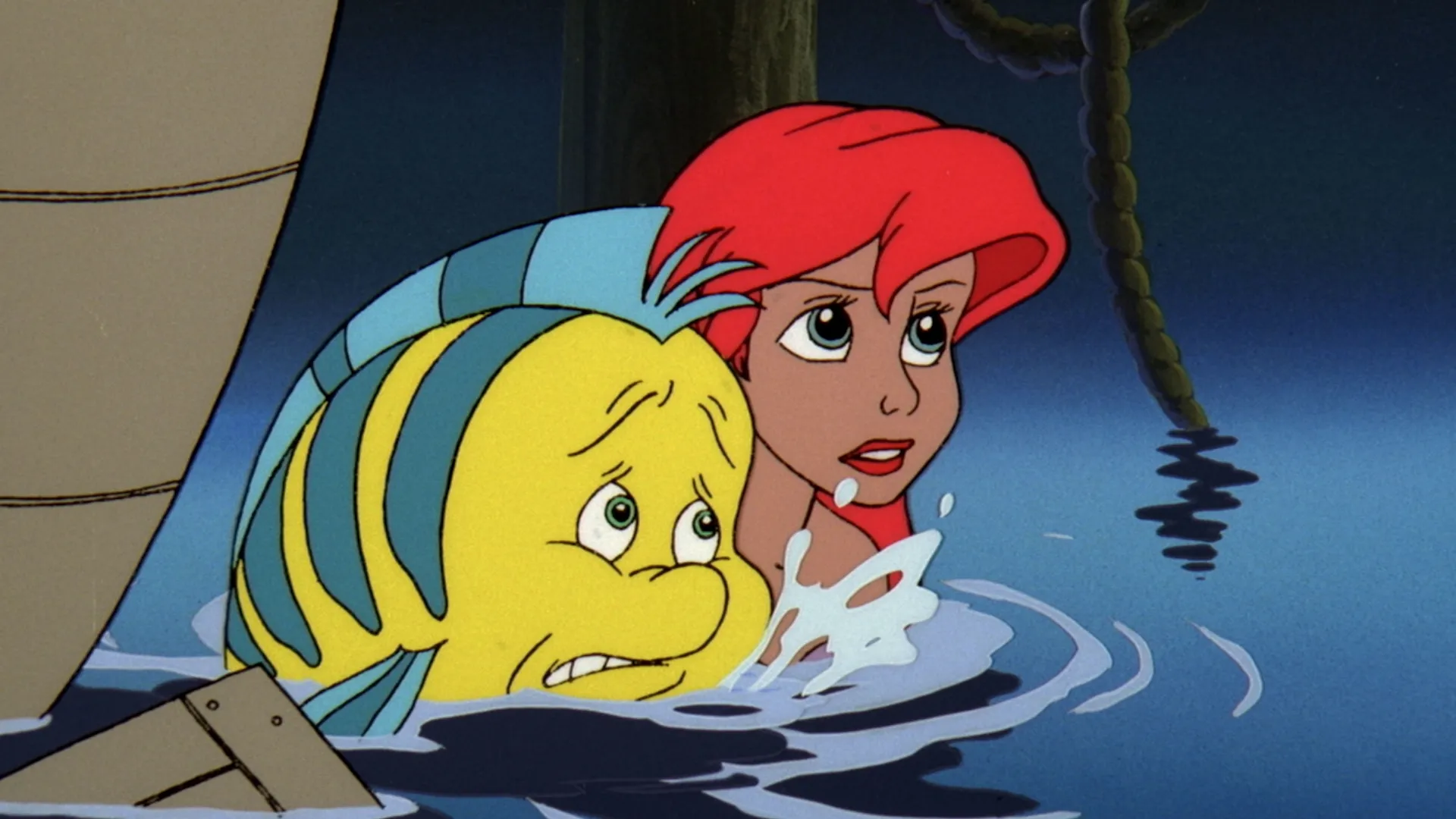
RaeRae Reacts · S1E10 · 1992 Animated Series
Thinga-Ma-Jigger
A human boot becomes Ariel’s latest object lesson in how curiosity, misinformation, and imagination can all occupy the same artifact.
The episode receipt
Series: The Little Mermaid (1992). Episode: S1E10 “Thinga-Ma-Jigger.” Broadcast-order position: 10 of 31.
What happened
A human boot becomes Ariel’s latest object lesson in how curiosity, misinformation, and imagination can all occupy the same artifact.
What the episode is really testing
Where to watch
Disney+ currently lists this episode. Regional catalogs and numbering can differ because the pilot is omitted from the service.
First reaction: a boot becomes a weapon because fear needs certainty faster than evidence can provide it
A pirate’s boot falls into the sea, and nobody in Atlantica has the cultural context to identify it reliably. The object is ordinary on land and destabilizing underwater because every observer fills the knowledge gap with a different need.
Ariel sees human possibility. Scuttle sees another stage for confident invention. Lobster Mobster and the Evil Manta see power. The boot does not change. Interpretation keeps arming it.
The thinga-ma-jigger is an honest name by accident
Calling the object a thinga-ma-jigger admits that the speaker does not know what it is. The placeholder could support inquiry if everyone treated it as temporary. Instead, the catchy name begins to feel like understanding.
Humans do this constantly. Naming a mystery reduces anxiety and can hide how little the label explains. Vocabulary becomes a lid placed over uncertainty.
Scuttle turns ignorance into entertainment again
He performs human expertise because Ariel wants a story and his social role depends on providing one. Saying “I do not know” would be more accurate and less rewarding. The boot becomes whatever function produces the best performance.
His misinformation is funny until characters make consequential decisions from it. Charm does not remain harmless when somebody treats the guess as technical intelligence.
Ariel has observation skills and no research infrastructure
She can examine material, shape, wear, and construction. She lacks comparative examples, human testimony, written records, and a safe institution where uncertain finds can be studied. Curiosity is doing work the kingdom refuses to organize.
Triton’s ban turns every artifact into private speculation. The result is not safety. It is an unregulated knowledge market dominated by the most confident bird.
The pirate origin complicates Ariel’s romantic human archive
The boot does not fall from an idealized peaceful household. It comes from a pirate ship, linking the human world to danger, theft, and violence as well as craft and beauty. Ariel’s interest survives because a culture cannot be reduced to its worst members.
Triton’s fear also gains evidence. Humans can be dangerous. The ethical error is turning that fact into a claim about every human and every object.
Pirate provenance warns against treating “human” as one culture
A pirate crew has its own hierarchy, economy, tools, and relationship to violence. The boot can tell Ariel something about a particular wearer without representing every person on land. Atlantica’s category of humans is too broad to explain the object responsibly.
Both idealization and prejudice flatten difference. Triton takes evidence of dangerous sailors as proof humanity is dangerous. Ariel can take one fascinating artifact as proof the human world is wonderful. Each uses a fragment to finish an entire civilization.
The boot is dual-use only because characters invent the second use
Many technologies can support ordinary life and violence depending on context. A boot protects a foot and could also strike, conceal, or signal. Calling something dual-use should require plausible function, not unlimited imagination.
Manta and Lobster Mobster skip that distinction. Any unknown object becomes potentially military because they cannot prove it is not. That standard makes every tool a weapon and gives fear permanent authority over classification.
A boot records a body that is absent
Its shape implies a foot, movement, labor, and a life above the water. Wear can suggest where pressure fell and how often somebody used it. Ariel encounters human embodiment through an empty container.
That makes the object an especially good prelude to her later transformation. She is fascinated by a tool made for the kind of limb she does not possess.
Prince Eric enters the series through what he loses
This episode marks Eric and Max’s first appearance in the television series. Ariel does not yet meet the prince as a romantic subject. His boot reaches her world first, detached from the person and available for fantasy.
The continuity is delicious because the feature film will make Ariel build an image of Eric from a brief rescue and incomplete contact. Here she begins with even less: the footprint of a stranger.
Eric’s appearance changes the prequel from parallel story to near encounter
Until this episode, the television series can feel contained inside Ariel’s underwater adolescence. Eric and Max place the future love story physically above the same water at the same time. Their lives have already crossed through an object even though neither person knows it.
That proximity strengthens the later shipwreck without claiming destiny forced every step. The ocean has carried traces between their worlds long before Ariel hears Eric’s voice. The Easter egg works because it deepens chronology, not merely because fans can point at a familiar face.
The missing boot is a tiny human-side consequence
Eric or a pirate loses footwear while Atlantica reorganizes itself around the object. The original owner may experience inconvenience and never know an underwater conflict followed. Cause and awareness separate completely across the border.
That asymmetry is useful. Human actions affect the sea without humans seeing the downstream meaning, while merpeople build stories about a surface population that does not know those stories exist.
Max offers a second trace of the future relationship
Eric’s sheepdog belongs to the human domestic world Ariel has not experienced. Max will later recognize Ariel’s scent and respond to her before Eric understands who she is. His early presence makes the series connection more than a name check.
Animals repeatedly cross borders more easily than governments. Max does not need Atlantica’s theory of humans to respond to an individual.
Lobster Mobster sees a weapon because crime organizes objects through use
He evaluates the boot according to what it might help him control, threaten, or sell. Unknown technology becomes attractive not for truth but for advantage. If rivals believe it is powerful, that belief may be enough to make it useful.
A fake weapon can still produce real compliance. Power often depends on perception before it depends on mechanism.
The Evil Manta sees the same object through strategic paranoia
After manipulating Atlantica through fear, Manta understands that a mysterious artifact can become another tool for instability. He does not need to identify it correctly if he can control the story around it.
His interest shows how misinformation and militarization cooperate. A threat narrative makes acquisition urgent, and urgent acquisition discourages verification.
The villains create an arms race around nothing
Each actor fears what the other could do with the supposed weapon. Nobody wants to wait for evidence because delay might allow a rival to gain advantage. The safest individual choice appears to be immediate possession.
Collectively, those choices increase danger. Arms races can grow from uncertainty when mistrust makes restraint look naive.
Threat inflation increases the authority of whoever claims expertise
Once the boot is described as a powerful weapon, the person promising to secure it can demand resources, obedience, and secrecy. The threat does not need to be real for the response apparatus to become real. Panic expands somebody’s power.
Manta benefits from instability, while Lobster Mobster benefits from possession and reputation. Both have incentives to exaggerate. Risk assessment fails when the loudest beneficiaries also define the danger.
Verification needs an agreed test before the result appears
Characters could decide what evidence would support the weapon claim, inspect the material, test safe hypotheses, and revise the conclusion. Instead, they interpret every unexpected event after the fact as proof of hidden power.
A test designed after seeing the result can protect any belief. Reliable inquiry states what would count against the claim before excitement and rivalry take over.
A harmless object can cause harm through social belief
The boot does not need magical or mechanical power. Characters chase it, threaten one another, and reorganize plans around what they think it can do. Belief supplies the causal force.
Calling the object harmless would miss the episode’s point. Physical properties are one kind of power. Shared interpretation is another.
Uncertainty should slow action and instead accelerates it
The less the villains know, the more dangerous they imagine the boot might be. Worst-case thinking creates a demand to act before the worst case can be ruled out. Evidence arrives too slowly for panic’s preferred timeline.
Risk management requires proportionality, reversible steps, and active testing. Grabbing the unknown object while fighting rivals satisfies none of those conditions.
Sebastian understands consequences and lacks cultural data
He can correctly predict that Ariel’s find will attract danger, violate Triton’s rules, and expand beyond a private experiment. He cannot identify the boot more reliably than the others. Institutional caution and technical knowledge are different competencies.
Sebastian becomes most useful when he names what he knows and what he does not instead of allowing authority to fill the gap.
Flounder is watching adults manufacture danger
He approaches the boot through Ariel’s curiosity and then sees larger figures project violence onto it. The object lesson is not only about human artifacts. It is about how power interprets uncertainty as property to control.
His fear becomes rational as soon as the chase begins, even though the original boot never posed the imagined threat.
The episode follows “The Evil Manta” with another information war
The previous story showed Manta weaponizing lies about people. This one shows characters weaponizing a mistaken story about an object. The sequence gives the season a sharper intellectual continuity than the premise suggests.
Atlantica keeps treating misinformation as an episode-specific accident instead of a recurring vulnerability.
Human trash becomes underwater treasure and hazard
The boot’s descent turns a discarded or lost object into a cultural event. Surface activity continually deposits material into the sea, where ecological impact and archaeological fascination can coexist.
Ariel’s collection preserves some debris while also normalizing a flow humans may not understand. Wonder should not erase pollution.
The object’s value is almost entirely contextual
On a human foot, the boot is clothing. In Ariel’s hands, it is evidence and aspiration. In Lobster Mobster’s plan, it is leverage. In Manta’s imagination, it is strategic power. Value moves with the user and the story.
That flexibility explains why provenance matters. Removing an artifact from context does not reveal its pure meaning. It multiplies possible meanings.
The boot foreshadows Ariel’s desire for legs without announcing it
Footwear is designed for the anatomy Ariel lacks and will later acquire through Ursula’s bargain. Her fascination can operate as material curiosity and as a quiet attraction to another form of movement.
The episode does not need Ariel to articulate that desire yet. The object lets the body question exist before romance intensifies it.
Ariel’s grotto needs catalog cards, not another confident nickname
She should record where the boot appeared, what was directly observed, what Scuttle claimed, and which questions remain open. Separating data from interpretation would preserve wonder while preventing guesses from hardening into fact.
An archive becomes knowledge through method. A room full of objects can still be a room full of beautiful misinformation.
Jodi Benson makes the artifact feel emotionally alive
Ariel’s excitement gives the boot more presence than its physical function deserves. Benson communicates the possibility that human objects offer, which explains why caution can sound like an attack on hope.
The performance keeps curiosity sympathetic even as the episode exposes the weakness of Ariel’s research process.
Samuel E. Wright makes the boot an administrative nightmare
Sebastian can see the coming chain of possession, villain interest, royal anger, and rescue labor. Wright’s accelerating panic turns one object into a list of tasks nobody assigned resources to handle.
He is funny because the artifact is mundane to viewers and catastrophic inside his job description.
The production gets enormous mileage from one prop
A boot is visually readable, easy to pass between characters, and absurd enough to support escalating misinterpretation. The episode can move through comedy, chase, and threat without building a new magical system.
Limited television resources become a thematic advantage. The smaller the actual object, the clearer it becomes that imagination is producing most of the danger.
The episode teaches epistemic humility without using the phrase
Good judgment includes confidence proportional to evidence. Ariel, Scuttle, Lobster Mobster, and Manta all move beyond what they can support. Their motives differ, but the shared error is certainty.
Saying “we do not know yet” is not failure. It is a protective fact that keeps an unknown boot from becoming a public weapon.
Triton should create a human-artifact protocol
Surface objects will continue reaching Atlantica. The kingdom needs safe storage, inspection, provenance records, and people trained to distinguish ordinary debris from actual hazards. Blanket prohibition guarantees secret handling.
A protocol would also give Ariel a lawful route for curiosity, reducing the incentive to hide discoveries until villains hear about them first.
Ariel should revise without surrendering wonder
The correct lesson is not that human artifacts are foolish or dangerous by nature. It is that admiration does not identify function. She needs evidence, multiple sources, and comfort with unanswered questions.
Wonder grows more durable when it can survive correction. A boot remains interesting after it stops being a weapon.
The villains should not be allowed to call panic strategy
Lobster Mobster and Manta act as though seizing the object is prudent because the rival might seize it first. Their plan creates the confrontation they cite as justification. Fear becomes self-licensing.
Strategic thinking would test the object, gather intelligence, and consider whether the opponent is also guessing. Paranoia prefers motion because motion feels like control.
What I wanted the ending to preserve
I wanted Ariel to learn the boot’s actual function or at least record the strongest evidence honestly. Returning every mystery to comic uncertainty protects the running joke but weakens the archive she is building.
The Eric connection could remain unknown to her while the audience enjoys the dramatic irony. Provenance does not require premature romance.
Where this sits in broadcast order
“Thinga-Ma-Jigger” is S1E10 in the full thirty-one-episode inventory and originally aired November 7, 1992. Disney+ displays it one position earlier because “Whale of a Tale” is absent. CVM Sekai preserves broadcast order.
Its placement extends the season’s concern with misinformation from people to diplomacy to objects. It also plants Eric and Max inside Ariel’s timeline before the feature-film meeting.
Final reaction
“Thinga-Ma-Jigger” is a clever comedy about an ordinary object becoming dangerous through interpretation. Ariel’s curiosity gives the boot cultural value, Scuttle’s confidence supplies false expertise, and the villains convert uncertainty into an arms race.
The boot is not a weapon. The stories attached to it become weapons quickly enough. Episode grade: B plus, with Eric’s first series footprint noted and Scuttle’s museum accreditation denied one more time.