
RaeRae Reacts · S1E7 · 1992 Animated Series
Charmed
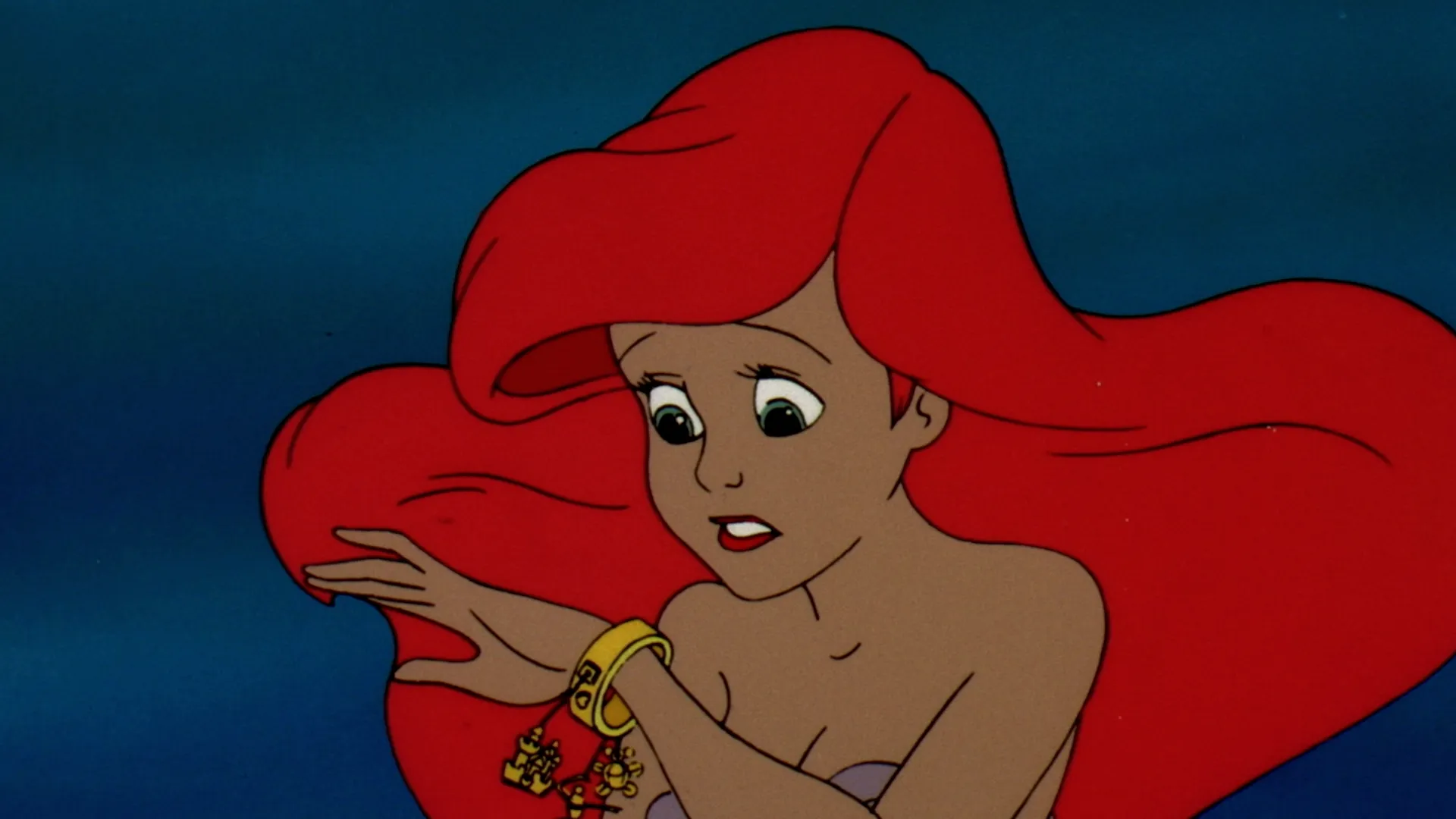
Ariel finds a human charm bracelet and discovers that an object can offer connection, status, and danger at the same time.
The episode receipt
Series: The Little Mermaid (1992). Episode: S1E7 “Charmed.” Broadcast-order position: 7 of 31.
What happened
Ariel finds a human charm bracelet and discovers that an object can offer connection, status, and danger at the same time.
What the episode is really testing
Where to watch
Disney+ currently lists this episode. Regional catalogs and numbering can differ because the pilot is omitted from the service.
First reaction: Ariel does not find jewelry, she finds portable evidence that the forbidden world is real
The charm bracelet matters before anybody knows its monetary value or practical danger. It came from humans. Ariel can hold proof of a culture Triton has reduced to threat, and every tiny charm suggests a story the palace refuses to tell her.
That is why asking her to discard it feels larger than losing an accessory. The object validates a curiosity Atlantica keeps treating as disobedience. Ariel is wearing an argument around her wrist.
A charm compresses a whole world into one tiny symbol
Charm bracelets work by turning memories, identities, relationships, and aspirations into collectible objects. A miniature shape can stand for a trip, person, place, or private joke. Ariel encounters the symbols without the owners who could explain them.
Her interpretation becomes imaginative archaeology. She can notice care and craft while still getting the meaning completely wrong. Fascination is the beginning of knowledge, not knowledge itself.
Scuttle’s explanations make uncertainty entertaining and dangerous
Scuttle gives Ariel a confident human story whenever evidence runs out. His inventions protect wonder from silence, which is emotionally useful and intellectually unreliable. The bracelet becomes whatever his performance needs it to be.
Ariel’s larger problem is not that she trusts a friend. It is that Triton’s ban leaves Scuttle as one of the only available sources. When institutions refuse honest education, misinformation does not disappear. It becomes charismatic.
The bracelet offers status because rarity creates an audience
Once others notice the object, Ariel’s private interest can become social distinction. She has something nobody else possesses and knowledge nobody else can verify. Curiosity begins to mingle with the pleasure of being special.
That does not make her shallow. It shows how objects move between identity and status. A meaningful artifact can become a performance the moment other people react to it.
Human culture becomes fashionable before it becomes understood
Atlantica may reject humans in official language while still finding their objects novel, beautiful, or prestigious. That contradiction resembles cultures that stigmatize a people while consuming selected pieces of their art, fashion, food, or music.
The bracelet can cross the border more easily than the human who owned it. Appreciation of an object does not automatically produce respect for the people who made it.
Cultural appreciation needs more than affection for the object
Ariel’s admiration is sincere, and sincerity does not settle the ethical question. Appreciation becomes responsible when it seeks context, credits makers, accepts correction, and remembers that a culture contains living people rather than only beautiful material available for collection.
Appropriation begins when the collector’s fantasy becomes more important than the source community’s meaning. Ariel lacks direct access to human testimony, but she can still practice humility by labeling her interpretation as uncertain instead of converting Scuttle’s guesses into fact.
The bracelet becomes valuable because access is unequal
Rarity does not live entirely inside the metal or charms. Triton’s prohibition, the physical border between surface and sea, and the absence of reliable trade make human objects scarce. Policy helps produce the prestige that policy then condemns.
Forbidden markets often work this way. Restriction can reduce supply while increasing symbolic value. Ariel’s bracelet signals daring and access precisely because most Atlanticans are denied both. The king may be unintentionally manufacturing the status economy around the artifacts he wants forgotten.
Ariel’s collecting is part archive and part possession
She rescues human artifacts from decay and preserves evidence Atlantica would rather ignore. Her grotto is a counterarchive built by somebody excluded from official knowledge. It is also a collection taken without provenance, consent, or reliable interpretation.
Both truths matter. Ariel protects material culture and turns unknown lives into objects arranged around her desire. The franchise becomes richer when her curiosity is allowed that contradiction.
Preserving an artifact does not grant ownership of its meaning
Ariel can keep the bracelet physically safe and still misunderstand almost everything it represented to its original owner. Material preservation protects the possibility of future knowledge. It does not make the current custodian the final authority on the story.
That distinction should guide the grotto. The objects need records of where they were found, which claims come from observation, which come from Scuttle, and which remain unknown. A label admitting uncertainty would be more respectful than a confident invented use.
A museum can challenge power and still need ethics
Ariel’s hidden collection resists a king who has decided an entire culture should be excluded from knowledge. In that sense, the grotto is politically brave. It preserves counterevidence until Atlantica is capable of facing it.
Secrecy also means there is no peer review, public access, conservation standard, or route for returning an object if its owner appears. The counterarchive should not be romanticized into perfect scholarship merely because the official archive is worse.
The object is not guilty for the danger built around it
When the bracelet creates trouble, adults can treat the artifact itself as corrupting. The deeper cause may be secrecy, misinformation, greed, envy, or a physical property nobody understood. Destroying the object would avoid examining those systems.
Material things carry risks and meanings through the relationships people build around them. A bracelet cannot force Ariel to conceal information, and it cannot teach her what nobody was willing to explain.
Triton’s ban turns a manageable question into a secret emergency
If Ariel could bring human finds to a knowledgeable adult, the kingdom might identify hazards, origins, and appropriate handling. Instead, possession threatens punishment, so she has an incentive to hide the bracelet until the consequences grow.
Prohibition can reduce exposure, but it can also remove the reporting pathway needed when exposure occurs anyway. Triton governs as though obedience will eliminate contact in an ocean full of shipwrecks.
Sebastian knows the rule and not the object
His first expertise is institutional: Triton disapproves, human things cause trouble, and Ariel must be protected. He may lack the cultural or technical knowledge needed to assess this particular bracelet. Authority fills the gap where evidence should be.
Sebastian’s caution remains useful. The problem is treating policy as complete analysis. A rule can point toward risk without explaining what the risk actually is.
Flounder gets pulled between loyalty and social excitement
Flounder wants Ariel safe and wants to share the discovery that makes her happy. If the bracelet attracts attention, he may also feel the pressure of being close to the person with the rare object. Friendship and status begin to overlap.
His hesitation gives the episode an honest middle position. He does not need to hate the artifact or endorse every choice Ariel makes around it.
Possession changes the way Ariel tells the story
Before finding the bracelet, she can ask what humans make and why. After claiming it, questions about origin can feel like threats to ownership. The object becomes “mine” before its history becomes known.
That shift is common in collecting. Emotional attachment can arrive faster than ethical inquiry. The deeper the attachment, the harder it becomes to hear evidence that the object should be returned, shared, or handled differently.
The lost owner exists even when the episode cannot show her
Some human wore, received, or carried the bracelet before it entered the sea. Each charm may record a life Ariel cannot reconstruct. Calling it treasure can erase the possibility that it is also somebody’s loss.
The ocean setting makes return practically difficult, but provenance still matters. An artifact does not begin its story when the collector discovers it.
Ariel experiences cultural connection without reciprocal contact
The bracelet lets her imagine closeness to humans while humans remain absent. She can admire a version of their world that never challenges her interpretation, rejects her, or reveals ordinary contradictions.
That one-sided intimacy prepares both the beauty and danger of her later obsession. She feels emotionally informed before she has participated in an actual human relationship.
The title “Charmed” points to attraction and loss of judgment
Ariel is charmed by the object even if no literal spell controls her. Beauty, rarity, and forbidden origin can narrow attention until warning sounds like ignorance and possession sounds like understanding.
The episode does not need magic to explain enchantment. Desire can organize evidence all by itself, especially when the desired thing confirms an identity Ariel is fighting to protect.
A status object creates competition even among friends
Once an item marks the wearer as unusual, other characters may want access, imitation, or control. The social meaning grows beyond Ariel’s original curiosity. She now has to manage reactions she did not choose but may enjoy.
The episode exposes how quickly personal expression becomes hierarchy. Rarity can make one person visible by making everyone else feel ordinary.
Attention can reward risk before consequences appear
If the bracelet brings admiration, Ariel receives immediate evidence that keeping it was worthwhile. Warnings describe a future possibility while status is happening now. The timing makes risky choices feel rational in the moment.
Good judgment requires weighting delayed harm against immediate reward. Teenagers are not uniquely bad at this. Entire markets depend on adults making the same trade.
The danger of the bracelet should produce knowledge, not xenophobia
A harmful outcome can confirm Triton’s broad claim that human things are dangerous. One object cannot support that conclusion. Atlantican objects could also injure somebody who did not know their function.
The lesson should be about context, research, and safe handling. Turning it into “humans were bad after all” would confuse unfamiliarity with inherent corruption.
Ariel’s mistake is not caring too much about another culture
The palace may frame the episode as proof that fascination itself is the problem. Ariel’s actual errors are incomplete research, secrecy, and letting emotional investment outrun evidence. Curiosity remains necessary for the peace she will later build.
Correcting the method without killing the interest is the educational challenge Triton keeps missing.
Scuttle represents the confidence economy
He gains authority by answering quickly, entertainingly, and without visible doubt. Ariel rewards a coherent story because uncertainty is emotionally unsatisfying. Accuracy has no advocate in the exchange.
The dynamic feels painfully current. People often choose the source that removes uncertainty fastest, especially when the source already validates what they hoped to hear.
Jodi Benson makes desire sound like a form of self-defense
Ariel’s excitement is not merely acquisitive. Benson lets the object carry her defense of the person she believes herself to be: curious, connected to something larger, and capable of seeing value her society misses.
That emotional weight explains why practical warnings can feel like attacks on identity. She is not only being asked to reconsider a bracelet. She hears a demand to distrust her own way of knowing.
Samuel E. Wright turns risk management into comic exhaustion
Sebastian can see the chain from forbidden object to discovery, royal anger, and physical danger before Ariel finishes admiring the charms. Wright makes that anticipatory labor audible through speed and panic.
His problem is that correct concern arrives wrapped in the same absolute language Triton uses. Ariel hears the institution before she hears the evidence.
The bracelet visually suits episodic television
A compact, reflective object can stay readable in close-up and move between characters without demanding enormous new environments. Individual charms create quick visual hooks while the social reaction carries most of the drama.
The production limitation becomes thematic. A tiny object occupies an enormous amount of emotional space because characters keep adding meaning to it.
Collecting can preserve what power excludes
Official Atlantica has decided human culture is unworthy or dangerous. Ariel’s grotto protects counterevidence from that policy. Collections built outside institutions can preserve histories dominant systems neglect.
They can also reproduce power when the collector controls access and interpretation. Preservation becomes ethical through provenance, context, and willingness to revise, not merely through affection.
Ariel needs media literacy before she needs another lecture
She is interpreting an object through Scuttle, rumor, desire, and social reaction. Nobody has taught her how to compare sources, identify uncertainty, or separate observation from inference. Punishment will not supply those tools.
The kingdom could teach surface history honestly while naming real conflicts. Information is not surrender to human influence. It is protection against fantasy and propaganda from either side.
The episode foreshadows the fork and the grotto
The charm bracelet belongs to the same emotional system as the fork Scuttle calls a dinglehopper and the artifacts filling Ariel’s hidden collection. Human objects become bridges, but the bridges are built from guessed meanings.
By the feature film, the quantity of objects can look like knowledge. “Charmed” reminds us that accumulation and understanding are different practices.
What Triton should learn from the incident
Shipwreck debris and human artifacts will keep entering the sea regardless of royal preference. Triton needs safe collection procedures, scholars, and a way for citizens to report finds without immediate punishment. Contact is an environmental fact.
A ban that produces secret handling makes the kingdom less safe. Governance should respond to the world that exists, not the world authority wishes obedience could create.
What Ariel should learn from the incident
She can value an artifact without claiming certainty about it. She can ask who made it, what evidence supports an explanation, what risks attach to it, and whether possession is the most respectful relationship available.
Those questions do not make wonder colder. They make wonder accountable to the lives and histories that produced the object.
What I wanted the ending to preserve
I wanted Ariel to keep some form of connection after the danger was resolved, perhaps through documentation, a drawing, or a safely stored object with an honest label admitting what remains unknown. Growth should not require burning the archive.
The best ending would let her relinquish careless possession without accepting Triton’s claim that human culture deserves only fear.
Where this sits in broadcast order
“Charmed” is S1E7 in the complete thirty-one-episode inventory. Disney+ presents it one number earlier because the service omits “Whale of a Tale.” CVM Sekai preserves broadcast order so every React, image, and directory entry remains stable.
After answering an excluded creature’s message, Ariel now has to ask whether objects can communicate clearly without their makers. The season keeps testing how she interprets lives beyond Atlantica’s approved story.
Final reaction
“Charmed” is not a warning that girls become foolish around jewelry or that human things contaminate the sea. It is a story about how forbidden objects collect identity, status, misinformation, and risk faster than one curious teenager can separate them.
Ariel is right that the bracelet carries a world worth knowing. She is wrong to let desire stand in for provenance and safety. Triton is right that unknown objects can cause harm. He is wrong to believe ignorance is protection. Episode grade: B plus, with one charm added for media literacy and another removed from Scuttle’s research credentials.