
RaeRae Reacts · S1E5 · 1992 Animated Series
Double Bubble
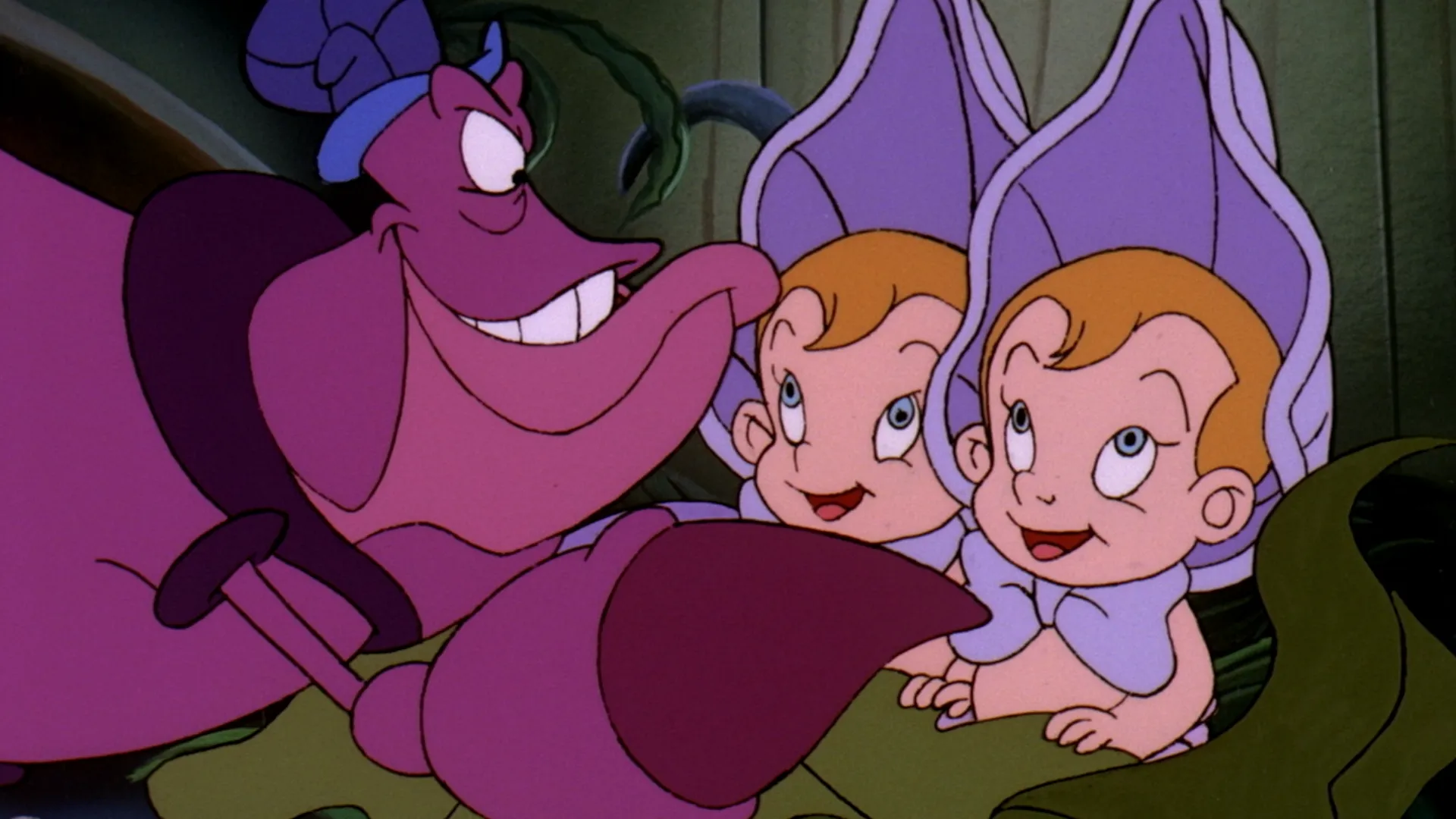
Ariel and her friends babysit royal twins while a supposedly simple care assignment exposes how quickly palace responsibility becomes everybody else’s labor.
The episode receipt
Series: The Little Mermaid (1992). Episode: S1E5 “Double Bubble.” Broadcast-order position: 5 of 31.
What happened
Ariel and her friends babysit royal twins while a supposedly simple care assignment exposes how quickly palace responsibility becomes everybody else’s labor.
What the episode is really testing
Where to watch
Disney+ currently lists this episode. Regional catalogs and numbering can differ because the pilot is omitted from the service.
First reaction: everybody calls childcare easy until the children become their responsibility
“Double Bubble” begins with the familiar lie that watching small children is simple work. The assignment sounds domestic, temporary, and therefore less serious than royal business. The twins destroy that assumption almost immediately because care is not passive supervision. It is constant attention, anticipation, emotional regulation, and physical safety performed at the same time.
The comedy works because Ariel and her friends believe good intentions will cover the missing skill. The frustration works because adults routinely make the same mistake and then act shocked when caregivers ask for preparation, pay, or support.
Royal children are still children, but their mistakes mobilize a kingdom
The twins have ordinary curiosity with extraordinary consequences. Their rank means disappearance, injury, or public embarrassment can activate guards, advisers, and diplomatic panic. Ariel is not only keeping two young people alive. She is protecting symbols of another royal household.
That pressure does not make the twins less deserving of play. It reveals how monarchy attaches public stakes to private childhood. Every tantrum can become somebody else’s employment crisis.
Ariel accepts responsibility before calculating the work
Ariel often says yes from confidence in her heart rather than evidence about the task. She cares about the twins and assumes affection will translate into control. The episode lets experience correct that shortcut without arguing she was wrong to care.
Responsibility begins before the crisis. It includes asking about routines, risks, food, communication, medical needs, and what each child does when frightened. Love is not a substitute for the handoff nobody completed.
The handoff is where the adults already failed
A competent childcare transfer should explain expectations, emergency contacts, boundaries, and the children’s habits. Instead, the assignment behaves like palace labor passed downhill: important enough to demand perfection, ordinary enough to require no visible planning.
When adults omit the information and young caregivers struggle, the failure gets personalized. Ariel appears irresponsible while the system that treated care as intuitive disappears from review.
Two children do not create twice the work
Twins can amplify each other’s energy, split attention, imitate dangerous behavior, and coordinate escape. Care does not increase in a neat straight line. One child’s need can become the exact opening the other uses to create a new emergency.
The title’s joke understands multiplication better than the adults do. “Double” is not merely a head count. It is interaction, unpredictability, and two developing minds testing the same boundary from different directions.
Sebastian becomes management because he is nearby again
Sebastian is repeatedly assigned whatever role the palace has failed to staff: musician, adviser, chaperone, diplomat, investigator, and now emergency childcare support. His competence makes him useful and therefore permanently available.
The episode turns that overload into comic panic. Underneath it sits a workplace pattern. If one reliable employee keeps rescuing every task, management learns to plan around rescue instead of building capacity.
Flounder is emotional support and another body to supervise
Flounder can help distract, comfort, or follow a child who swims away. He is also young, cautious, and vulnerable to the same chaos. Ariel may count him as support without recognizing that she is coordinating him too.
Friends volunteering does not create professional staffing. The group can distribute tasks, but none of them has been granted the knowledge or authority a trained caregiver would need.
The twins are not villains for behaving like children
Comedy often frames active children as tiny monsters whose purpose is to punish the babysitter. “Double Bubble” risks that framing whenever destruction becomes the punch line. The more useful reading remembers the adults created an environment where curiosity could reach danger.
Young children test limits because that is how they learn what limits are. Safety depends on designing spaces, routines, and supervision that assume the test will happen. Expecting perfect compliance is not a plan.
Ariel learns that being liked is not the same as keeping somebody safe
She wants a warm relationship with the twins and may hesitate to become the person who says no. That desire is understandable, especially for a teenager who experiences her own father’s boundaries as control. Yet care sometimes requires an unpopular limit.
The distinction is important for Ariel. She can reject Triton’s authoritarian method without rejecting every boundary. A rule explained, proportionate, and connected to actual risk is not the same thing as domination.
The episode turns invisible labor visible by letting it fail
Feeding, cleaning, watching, soothing, planning, and repeating instructions look like nothing when done well. The result is merely that disaster did not occur. Television notices the labor only when bubbles, chases, and escapes make it spectacular.
That mirrors how societies undervalue care. Prevention leaves no dramatic artifact, so the work is treated as natural affection rather than skilled production. The crisis finally reveals what quiet competence had been containing.
Palace hierarchy decides whose time is disposable
The assignment moves toward younger and lower-status helpers because royal adults have other obligations treated as more important. Somebody must absorb the hours, and the institution assumes availability rather than negotiating it.
Care work often lands on the person considered most naturally nurturing, least politically important, or easiest to pressure. Ariel’s princess status complicates that pattern, but Sebastian and Flounder still become unpaid extensions of her promise.
Care is treated as feminine instinct even when nobody has been taught how to do it
Ariel can be selected because a teenage princess is assumed to possess natural patience and nurturing skill. The assignment then disappears as labor because the culture frames care as something girls and women simply know. If she struggles, the failure appears personal rather than educational.
Affection may motivate caregiving, but it does not automatically teach safety, development, conflict management, or emergency response. Calling the work instinctive saves institutions from training and compensating the people expected to perform it. Ariel’s learning curve exposes the cost of that convenient myth.
Royal liability can crowd out the child’s emotional experience
Sebastian and Ariel have good reason to fear what the kings will do if the twins are lost or injured. That fear can make every interaction about avoiding punishment. The children become precious objects whose safety protects adult careers instead of young people who need connection and explanation.
Good care must hold both realities. The stakes are high, and the twins can still feel when adults are managing them primarily as liability. Safety built through terror of blame becomes brittle because it encourages concealment the moment something goes wrong.
The adults want accountability without shared responsibility
If the twins return safely, the system works and nobody discusses the strain. If anything goes wrong, the young caregivers can be blamed for failing a supposedly simple task. The standards remain high while resources remain informal.
Fair accountability asks what Ariel chose and what the adults provided. She can own overconfidence while the palace owns the unsupported handoff. Those truths do not cancel each other.
Care requires knowledge of the particular child
Generic affection cannot replace knowing which twin reaches for danger, how each responds to separation, what calms them, and how they communicate a need before it becomes a scream. Treating children as interchangeable “little ones” makes preventable surprises inevitable.
The episode’s twin premise underlines individuality. Similar appearance does not mean identical temperament. Good care notices difference instead of using the pair as one comic unit.
Ariel’s improvisation is both her strength and the reason the crisis expands
When a plan collapses, Ariel acts quickly, recruits help, and refuses to abandon the children. Those qualities matter. She also enters the assignment without enough structure because she trusts herself to improvise later.
Improvisation is most effective on top of preparation. Used as a replacement for preparation, it turns every ordinary need into a heroic emergency. Ariel often earns praise for solving the problem she might have reduced earlier.
Sebastian’s panic should not disqualify his correct observations
His voice rises because he can see several consequences at once: injured children, furious royals, Triton’s response, and the practical impossibility of watching two moving targets. Comedy makes him sound excessive while events keep validating the forecast.
The franchise sometimes rewards calm confidence even when confidence lacks information. Sebastian reminds us that anxiety can contain accurate risk data. The answer is not to mock the alarm. It is to turn the alarm into a plan.
The episode is a miniature lesson in ratios
Childcare safety changes with age, environment, caregiver experience, and the number of children. One capable adult may manage a situation that overwhelms several unprepared teenagers. Counting bodies alone says little about actual capacity.
Atlantica treats any group of friendly people as enough supervision. The resulting chase is a staffing audit disguised as slapstick.
The bubble imagery makes containment look playful
Bubbles suggest protection, separation, and fragility. They can hold something briefly while remaining one touch away from collapse. That is the episode’s model of control: beautiful, temporary, and dependent on conditions nobody fully controls.
The title also captures how adults imagine childhood as a protected bubble. The protection exists only because somebody is constantly maintaining it. When the caregiver’s attention divides, the bubble shows its seams.
Jodi Benson lets competence and embarrassment coexist
Ariel needs to sound sincerely capable at the beginning and increasingly aware that confidence has outrun experience. Benson does not turn the realization into self-pity. She keeps the focus on the children and the next action.
That makes the lesson feel earned rather than imposed. Ariel changes because the work supplies evidence, not because an adult delivers a speech about responsibility.
Samuel E. Wright makes labor audible
Sebastian narrates tasks, dangers, interruptions, and consequences at a speed that turns cognitive load into sound. The performance lets the audience hear how many decisions caregiving demands even when the animation focuses on one visible chase.
His frustration is funny because it has rhythm. It is also the closest the episode comes to an itemized invoice for everything the palace forgot to resource.
The television format depends on escalation
A quiet, competent afternoon would prove the value of childcare and produce little adventure. The script therefore stacks accidents until the assignment becomes an action sequence. Each new problem must arrive before the last one fully resolves.
That structure can make care look inherently chaotic. The deeper point is that a bad setup magnifies normal behavior. The twins do not generate every failure alone. The environment and staffing convert curiosity into escalation.
Why asking for help earlier would not make Ariel weak
Ariel tends to treat self-sufficiency as evidence she deserves freedom. Admitting the task exceeds her experience can feel like handing Triton proof that she is still a child. That family dynamic makes help psychologically expensive.
Maturity is not completing every responsibility alone. It is recognizing when the responsibility requires more people, different expertise, or a changed plan before somebody gets hurt.
The episode should change how the palace values caregivers
After witnessing the work, royal adults should understand that childcare is skilled labor deserving preparation, staffing, and respect. Gratitude without structural change merely sends the next assignment to another underprepared person.
The usual episodic reset makes that learning uncertain. Ariel grows. The institution can continue believing the outcome proves its original arrangement was acceptable.
Triton’s parenting shadows the entire assignment
Ariel copies and rejects pieces of her father’s method. She knows commands can damage trust, so she may avoid firm limits. She also inherits the royal assumption that confidence and authority can organize other people’s behavior.
Caring for the twins gives her a small view from Triton’s side: love can produce fear, limits, and an exhausting awareness of everything that might happen. The experience should increase empathy without proving every paternal restriction correct.
The twins deserve adults who do not make them carry the joke forever
If young children are remembered only as chaos, their needs disappear behind the story adults tell about surviving them. The twins need stimulation, routine, safety, and attention, not shame for being developmentally inconvenient.
A compassionate ending allows Ariel to name the work without blaming the children for requiring it. Care can be difficult because people matter, not because they are defective.
What Ariel should take into the feature film timeline
This experience teaches that wanting something and being ready for its daily demands are different questions. That insight will matter when Ariel imagines human life, marriage, and permanent transformation through the intensity of desire.
The series cannot erase the film’s impulsive bargain, but it can show earlier lessons she only partially carries forward. Growth is not a straight line. People can understand responsibility in one setting and lose the method when longing becomes larger.
What I wanted the final adult conversation to include
I wanted the royal parents to ask what support Ariel received, acknowledge the assignment was underspecified, and compensate the people whose labor made the safe return possible. Praise alone turns exhaustion into a charming story.
A genuine debrief would list what failed, what the twins needed, and how future care should be staffed. That scene would convert personal growth into institutional memory instead of waiting for another bubble to burst.
Where this sits in broadcast order
“Double Bubble” is S1E5 in the complete thirty-one-episode inventory. Disney+ labels it one position earlier because “Whale of a Tale” is absent from the service. CVM Sekai preserves the broadcast sequence so every episode image, React, and season link stays stable.
After “Urchin” asks who cares for a child outside the system, this episode asks who performs care inside royal systems. Together they expose two sides of Atlantica’s blind spot: neglected care and undervalued care.
Final reaction
“Double Bubble” is a childcare comedy with a labor argument hiding under every chase. Ariel’s affection matters, her overconfidence matters, and the adults’ unsupported handoff matters. The twins are not tiny villains. They are children revealing how little preparation existed around them.
The episode lets Ariel earn a more complicated idea of responsibility: keeping people safe may require limits, teamwork, specific knowledge, and asking for help before the emergency. Episode grade: B, plus an overdue demand that Atlantica stop treating childcare as a favor anybody nearby can perform.