
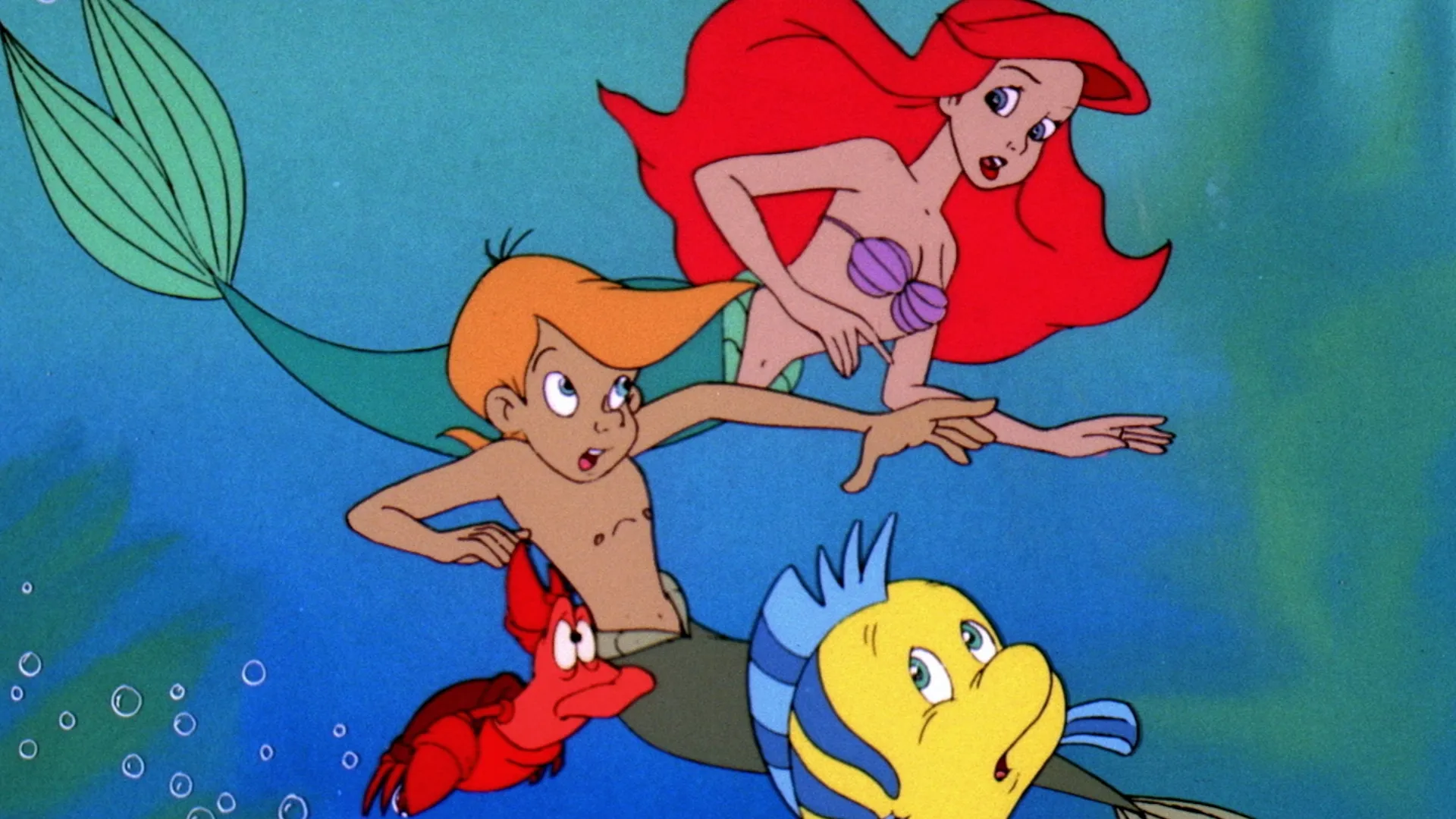
RaeRae Reacts · S1E4 · 1992 Animated Series
Urchin
Ariel befriends an orphaned merboy pulled toward Lobster Mobster and gives Atlantica a story about poverty, belonging, and who gets recruited when adults fail.
The episode receipt
Series: The Little Mermaid (1992). Episode: S1E4 “Urchin.” Broadcast-order position: 4 of 31.
What happened
Ariel befriends an orphaned merboy pulled toward Lobster Mobster and gives Atlantica a story about poverty, belonging, and who gets recruited when adults fail.
What the episode is really testing
Where to watch
Disney+ currently lists this episode. Regional catalogs and numbering can differ because the pilot is omitted from the service.
First reaction: Atlantica calls Urchin a problem after leaving him alone long enough to become useful to criminals
Urchin enters the story as an orphaned merboy surviving outside the protection that royal Atlantica appears to promise its subjects. Lobster Mobster does not invent the child’s vulnerability. He recognizes it, offers a role, and converts unmet needs into obedience. The criminal sees Urchin before the kingdom does.
That is what makes the episode uncomfortable beneath the jokes. Adults who ignored a hungry, unhoused child become alarmed when his survival reaches their property. Crime makes him visible. Poverty did not.
Urchin is not born dishonest
The episode gives him enough warmth, fear, and longing to make clear that theft is behavior inside a circumstance, not his natural identity. He has learned that quick hands and quick stories produce food, safety, or temporary approval. Those skills kept him moving when nobody offered dependable care.
Calling him a bad kid would let every adult avoid the question of how a child reached that position. The story is more honest when it treats dishonesty as adaptation that can become harmful without becoming destiny.
Lobster Mobster recruits through belonging before he recruits through greed
A child with no stable family does not need a villain to offer luxury. He needs the villain to offer recognition. Lobster Mobster supplies attention, a job, and the feeling that Urchin’s abilities have value. Exploitation becomes persuasive because it arrives dressed as inclusion.
The arrangement is unequal from the first moment. The adult keeps authority and profit while the child absorbs physical danger and legal blame. Urchin receives conditional belonging that disappears the second he stops being useful.
The criminal apprenticeship resembles employment because exploitation often does
Lobster Mobster gives instructions, expects performance, and rewards successful tasks. The structure imitates work without providing safety, development, or the right to refuse. Urchin is old enough to be used and young enough to be blamed as though he independently designed the enterprise.
That pattern matters outside fantasy. Children are often recruited into harmful systems because adults present risk as opportunity and obedience as maturity. The episode gives the process claws and a gangster voice, but the mechanism is recognizable.
Ariel notices the person before the offense finishes defining him
Ariel’s most important instinct is her refusal to let a category end curiosity. The palace can see thief, street child, or dangerous influence. She sees a boy capable of fear, humor, loyalty, and change. That attention interrupts Lobster Mobster’s monopoly on recognition.
She does not help because Urchin has already proved innocence. She helps because guilt does not erase childhood or the need for care. Accountability and human worth remain in the same frame.
Friendship is an intervention, not a social policy
Ariel can offer Urchin trust, food, companionship, and a model of belonging that does not demand crime. Those are real protections. They are also dependent on one princess continuing to notice him. A kingdom cannot outsource child welfare to the empathy of a royal teenager.
The episode resolves emotionally through relationship because television needs characters, not administrative systems. The political question remains: what happens to the next orphan who never meets Ariel?
Triton rules a kingdom that somehow has a street-child blind spot
Atlantica presents itself as orderly, prosperous, and governed by a king who cares deeply about family. Urchin’s existence complicates that image. Either the kingdom lacks systems for orphaned children, or those systems are inaccessible enough that he survives outside them.
Triton’s love for his daughters is sincere and narrow. A ruler’s moral record cannot stop at the palace nursery. The episode accidentally asks whether royal protection extends to children without royal blood.
Sebastian recognizes danger faster than need
Sebastian is trained by court life to protect Ariel, royal property, and institutional order. Urchin’s criminal association activates those alarms immediately. His suspicion contains evidence, but it can also trap the boy inside the only identity adults expect from him.
The crab needs Ariel’s relational reading just as Ariel needs his attention to consequence. Compassion without caution can be manipulated. Caution without compassion can guarantee the child returns to the person who at least pretends to want him.
Flounder shows what ordinary friendship could feel like
Ariel’s rank changes every relationship around her. Flounder offers Urchin something closer to peer contact, including uncertainty, jealousy, and eventual cooperation. He is not a rescuer with palace resources. He is another young person deciding whether this newcomer belongs.
That ordinary welcome matters because rehabilitation cannot feel like permanent probation. Urchin needs friends who can disagree with him without treating every mistake as proof Lobster Mobster was his true family.
Trusting Urchin is risky because trust always creates exposure
Ariel’s decision does not guarantee a clean outcome. Urchin may lie again, return to the Mobster, or make a choice shaped by habits that one kind conversation cannot erase. The possibility of harm is real. Otherwise trust would be sentiment, not risk.
The episode asks whether refusing that risk is safer. For the palace, perhaps. For Urchin, rejection would confirm that criminal belonging is the only belonging available after wrongdoing.
Accountability needs an exit route
A child cannot change if every adult response communicates that the label is permanent. Consequences should name harm, require repair where possible, and build a path toward different behavior. Punishment without reentry leaves Lobster Mobster waiting outside the gate.
Ariel’s faith functions as an exit route. The episode would be stronger if Atlantica turned that personal opening into stable housing, education, and an adult guardian instead of allowing friendship to carry the full burden.
Lobster Mobster understands precarity better than the palace
He knows a person who must solve tonight’s hunger cannot organize choices around a distant moral reward. Immediate safety defeats abstract law. That knowledge makes him effective and monstrous because he exploits the time horizon poverty imposes.
The palace can ask why Urchin did not choose honesty. Lobster Mobster has already arranged the conditions under which honesty offers nothing immediate. A fair response has to change those conditions, not merely repeat the rule louder.
The episode does not excuse theft when it explains it
Explanation is not acquittal. Property is taken, people are deceived, and dangerous adults gain access through Urchin’s actions. The harm matters. Understanding why he participated helps prevent repetition and assign responsibility proportionately.
The adult who organized the scheme and benefited from a child’s vulnerability holds more responsibility than the child he recruited. Treating both as equal partners would be legally tidy and morally lazy.
A princess can offer resources Urchin cannot
Ariel’s rebellion is protected by a home, family, status, and the near certainty that somebody will search for her. Urchin’s rule-breaking grows from the absence of those things. They may both resist authority, but they are not taking the same risk.
The friendship becomes meaningful when Ariel recognizes difference instead of imagining they are identical outsiders. Solidarity is not saying our lives are the same. It is using what protects you to widen protection for somebody else.
The palace is fascinated by reform because reform flatters the palace
When Urchin makes a better choice, adults can celebrate kindness and personal transformation. That ending feels good and quietly centers the institution that failed him. His improvement becomes proof Atlantica is generous rather than evidence it tolerated preventable abandonment.
A serious resolution would include institutional self-examination. Who knew children were living outside care? What happens when parents die? Which official is responsible? The episode leaves those questions beneath the celebration.
Urchin’s name reduces him before the story restores him
“Urchin” can mean a street child and evokes a sea creature, making the nickname efficient for the setting. It also replaces family history and individual identity with social condition. He is named by what adults see: roughness, homelessness, inconvenience.
The episode restores personhood through behavior and relationship but never fully escapes the label. That tension fits a story about how quickly society turns circumstance into identity.
The villain comedy keeps exploitation watchable
Lobster Mobster’s gangster parody, physical design, and theatrical delivery make the threat legible without making the episode unbearable for children. Humor creates distance from the reality of an adult using a homeless child to commit crimes.
The distance has a cost. Viewers may remember the funny mobster more easily than the recruitment mechanism. A deeper React has to put the mechanism back in focus without pretending the comedy failed.
Jodi Benson makes Ariel’s trust active rather than naive
Benson gives Ariel enough firmness that belief in Urchin sounds like a decision made against social pressure, not a princess floating through evidence. She hears risk and chooses to create another possibility anyway.
The performance also preserves Ariel’s tendency to move before building a complete plan. Her moral instinct is ahead of her infrastructure. She can open a door. She has not yet figured out who will keep the room safe afterward.
Danny Cooksey gives Urchin defense and hunger at the same time
Urchin needs to sound capable enough that Lobster Mobster would use him and young enough that the exploitation remains visible. The performance holds swagger beside the quick emotional shifts of a child watching for rejection.
That combination keeps his change from feeling like a switch. The need for belonging was present inside the criminal role. Ariel does not install a conscience. She gives an existing conscience somewhere safer to act.
The episode treats found family as rescue and leaves maintenance offscreen
Found family is not a single invitation. It is repetition: meals, boundaries, ordinary days, consequences that do not threaten abandonment, and adults who remain after the dramatic gratitude scene. Urchin needs that maintenance more than one heroic welcome.
Later appearances can make the initial promise credible by showing he has a continuing place. Without continuity, found family becomes a slogan that ends when the episode does.
Why children return to exploiters
Leaving Lobster Mobster means losing the person who provided work, identity, and a known set of rules. Even an abusive system can feel safer than a benevolent system whose acceptance appears temporary. Urchin’s hesitation is not evidence he prefers harm. It is evidence attachment forms under bad conditions too.
Adults often expect immediate gratitude from rescued children and interpret ambivalence as moral failure. The episode is better when Urchin’s divided loyalty is treated as a predictable consequence of recruitment.
Atlantica needs prevention, not better luck
A functioning response would identify children without caregivers before a crime boss does, provide stable placements, and ensure survival does not depend on theft. Prevention is less dramatic than a chase and more important than the chase.
The kingdom has musicians, soldiers, advisers, ceremonies, and enough administrative capacity to monitor a princess constantly. It can build a way to notice an orphan. Failure to do so is a political choice even when the script calls it background.
The episode’s morality improves when responsibility is distributed
Urchin is responsible for choices within his capacity. Lobster Mobster is responsible for manipulation and organized harm. Triton’s government is responsible for the conditions it failed to address. Ariel is responsible for helping without hiding risk from everyone else.
Distributing responsibility avoids two bad readings: the child is entirely guilty, or the child has no agency at all. He can need protection and still participate in repair.
Choice means less when every available door is controlled by somebody else
Adults can point to the moment Urchin agrees to help Lobster Mobster and call the arrangement voluntary. That description ignores who designed the options. The boy can accept dangerous work, remain alone without reliable food or protection, or approach an institution that has already failed to notice him. None of those doors was built by a child with equal power.
Coercion does not always arrive as a threat shouted in somebody’s face. Sometimes it arrives as scarcity. The exploiter controls access to the thing a vulnerable person needs and then calls compliance a free decision. Lobster Mobster can maintain a comic tone because the episode does not show every empty night that made his offer persuasive.
Repair should not require Urchin to perform gratitude forever
Once Ariel helps him, the palace may expect visible appreciation, perfect behavior, and loyalty to the people who opened the gate. That turns assistance into another conditional contract. A child should be able to have bad days, resent rules, and make ordinary mistakes without being reminded that rescue can be revoked.
Real belonging survives disappointment. It does not erase consequences, but it separates a harmful act from the person’s right to food, shelter, education, and care. Lobster Mobster’s approval depends on usefulness. Atlantica has to offer something fundamentally different or it has only changed the uniform of the person holding power.
This story predicts Ariel’s attraction to outsiders
Urchin joins a pattern that will include creatures and people Atlantica mistrusts. Ariel is drawn to the person behind the category because she knows how it feels to be described through disobedience before anyone asks what she sees.
That identification will help her challenge prejudice around humans. It can also tempt her to assume every dangerous association hides a misunderstood friend. Compassion needs evidence without becoming suspicion’s servant.
What I wanted the ending to show
I wanted a clear answer about where Urchin sleeps, who is responsible for him, and what support follows the emotional rescue. A palace meal and friendship are not a child-protection plan. Naming a guardian would have made Atlantica’s change material.
The omission reflects episodic television, where characters may return without administrative continuity. It still matters because the entire story began with an adult exploiting the vacuum around this child.
Where this sits in broadcast order
“Urchin” is S1E4 in the complete thirty-one-episode inventory. Disney+ presents it one number earlier because the service omits “Whale of a Tale.” CVM Sekai preserves broadcast order so episode images, Reacts, and season navigation do not shift around a missing pilot.
The placement expands the series beyond Ariel’s family conflict. After stories about animals, diplomacy, and royal disobedience, Atlantica finally has to look downward at a child its order did not protect.
Final reaction
“Urchin” works because the villain does not merely tempt a good child with shiny things. He occupies an empty role. Lobster Mobster offers conditional belonging where Atlantica offered invisibility, and Ariel becomes the first person to make a safer relationship feel possible.
The episode is compassionate but politically incomplete. One princess cannot serve as a kingdom’s housing program, guardian network, and rehabilitation policy. Urchin deserves accountability, stability, and a name bigger than the condition adults left him in. Episode grade: A minus for seeing the child, with points withheld because Atlantica still owes him an actual plan.