
RaeRae Reacts · S1E3 · 1992 Animated Series
Stormy
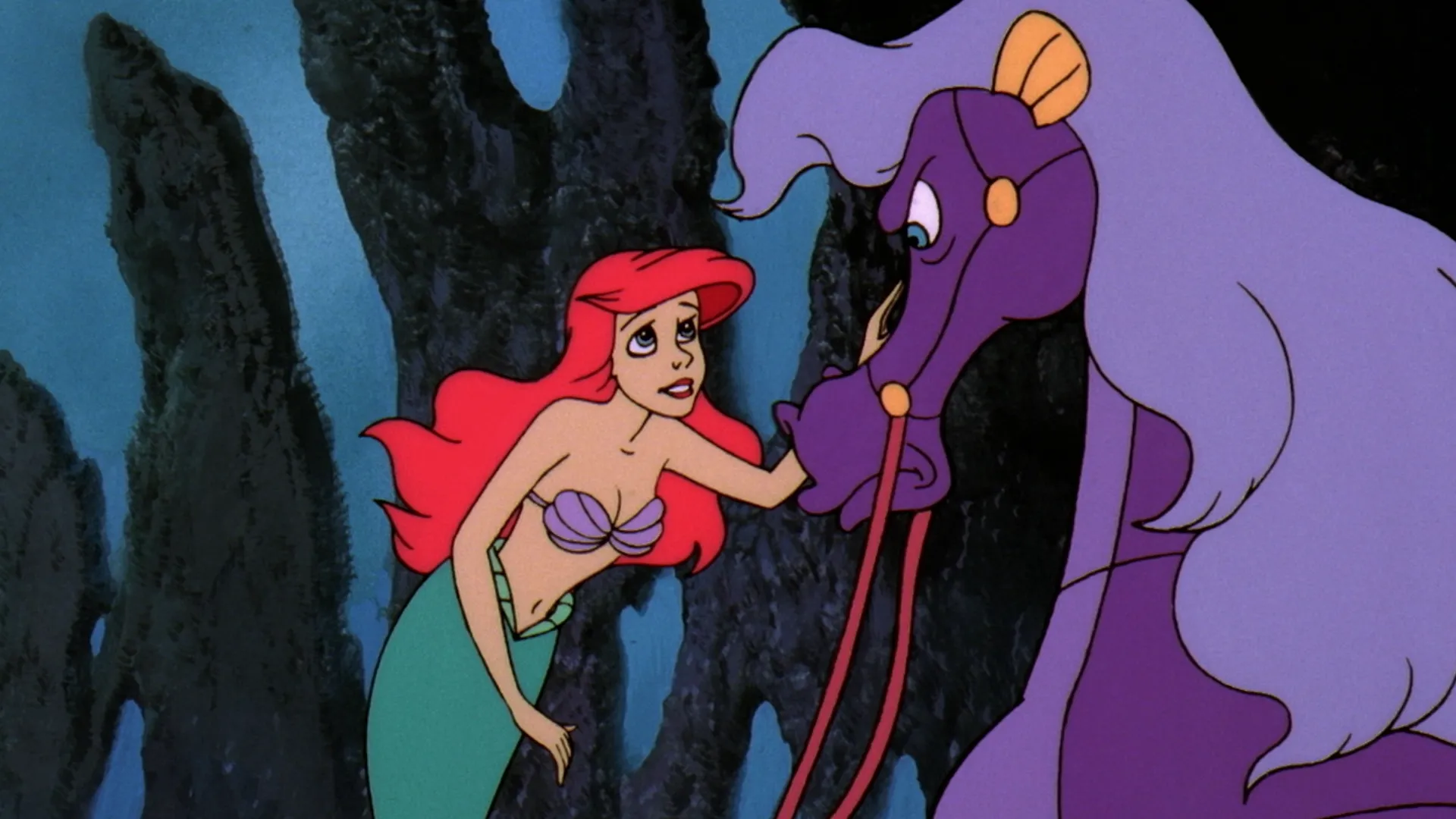
Ariel rides a wild seahorse against Triton’s orders and learns that freedom without preparation can become another creature’s danger.
The episode receipt
Series: The Little Mermaid (1992). Episode: S1E3 “Stormy.” Broadcast-order position: 3 of 31.
What happened
Ariel rides a wild seahorse against Triton’s orders and learns that freedom without preparation can become another creature’s danger.
What the episode is really testing
Where to watch
Disney+ currently lists this episode. Regional catalogs and numbering can differ because the pilot is omitted from the service.
First reaction: Ariel does not want a pet, she wants proof nobody can tell her no
Ariel sees Stormy and immediately turns riding him into a referendum on her freedom. Triton warns her that the seahorse is wild and dangerous. She hears the warning as another royal boundary drawn around a life she has not been permitted to test. The episode understands exactly why that restriction makes her want the animal more.
The problem is that Stormy is not a symbolic horse in Ariel’s private argument with her father. He is a living creature with fear, instinct, and limits of his own. Ariel wants autonomy so badly that she temporarily treats his autonomy as scenery. That contradiction gives the episode more bite than a simple disobedience story.
Stormy is not difficult because he has not met the right princess
Stories about wild animals often flatter the hero by making trust feel like conquest. The special child climbs on, the animal recognizes a pure heart, and everybody else discovers the rules never applied to greatness. “Stormy” flirts with that fantasy because Ariel believes connection can substitute for preparation.
The episode ultimately refuses to make the seahorse a trophy. Stormy can bond with Ariel and remain wild. Affection does not erase temperament. A relationship can be real without becoming ownership, permanent access, or evidence that every warning was cowardice.
Triton is right about the danger and wrong about how he communicates it
The king knows more about Stormy’s strength and unpredictability than Ariel does. He is not inventing danger because he enjoys control. Yet he delivers his knowledge as a command backed by rank. He gives Ariel a conclusion without enough of the reasoning, preparation, or alternative experience that might let her understand it.
Triton repeatedly mistakes authority for communication. When Ariel pushes back, he increases force instead of increasing information. The pattern creates a daughter who treats secrecy as the only route to firsthand knowledge. His warning is accurate. His method practically guarantees she will test it alone.
Ariel turns curiosity into entitlement before she notices
Curiosity is one of Ariel’s best qualities because it lets her see value where Atlantica sees danger or trash. It becomes entitlement when wanting to understand something turns into believing she deserves physical access to it. Stormy cannot consent to being a lesson in royal independence.
The distinction matters across the franchise. Ariel collects human objects, enters forbidden spaces, questions rules, and eventually builds peace through curiosity. The same impulse can also ignore boundaries. The series is useful when it lets her gift create a problem instead of treating curiosity as automatic moral innocence.
Freedom without skill is just risk wearing a prettier name
Ariel has courage, balance, and confidence in her ability to connect. She does not yet have the training to control a frightened, powerful animal in changing conditions. Her desire to ride is emotionally understandable and technically underprepared.
The episode does not argue that only experts deserve adventure. It argues that freedom carries material responsibilities. You can reject a rule and still owe the world a plan for what happens when your confidence is wrong. Ariel wants the choice before she has accepted the consequences attached to it.
The ride feels glorious because the episode needs temptation to make sense
If every second with Stormy were miserable, Ariel’s choice would be easy to condemn and boring to watch. The rush has to work. Speed, open water, and temporary cooperation give her the exact feeling the palace withholds: movement that is not scheduled, supervised, or useful to the crown.
That pleasure is not fake just because danger follows. The episode is strongest when it refuses the idea that bad outcomes prove no joy existed. Ariel is learning to judge a whole experience, not retroactively erase the part that felt alive.
Flounder sees the danger and still gets drafted into Ariel’s argument
Flounder knows Ariel’s plans tend to expand after he has already agreed to the first sentence. He worries because he recognizes the gap between her confidence and the conditions around them. His fear is not moral weakness. It is information the adventure badly needs.
Ariel often treats his presence as proof the plan is shared, even when friendship makes refusal difficult. The episode quietly asks how voluntary a sidekick’s participation feels when the person he loves is already moving. Loyalty can become unpaid risk management.
Sebastian understands rules better than the relationships beneath them
Sebastian is positioned to enforce Triton’s order because the court routinely turns him into Ariel’s portable boundary. He understands what the king said and what disobedience could cost. He does not always understand why Ariel experiences supervision as confinement.
That makes him both useful and limited. He can identify immediate danger faster than Ariel. She can identify emotional needs the rule ignores. Their best episodes let those forms of knowledge collide until each character has to revise something.
A wild animal is not a personality test for a human being
Ariel initially reads Stormy’s resistance as a challenge to her ability. If she is brave, patient, or special enough, the ride should work. This converts his behavior into feedback about her identity. The animal disappears inside the heroine’s self-evaluation.
Respect begins when she stops asking what mastering Stormy would prove and starts asking what Stormy needs. That shift is the emotional center. Care is not the technique that finally earns control. Care may require releasing the desire to control at all.
The episode separates trust from domestication
Stormy can choose moments of closeness without becoming permanently tame. That distinction is rare and valuable in children’s animal stories. Trust describes a relationship in a particular context. Domestication is not a medal awarded after one beautiful ride.
Ariel has to accept that connection does not guarantee possession. The lesson echoes “Whale of a Tale,” where loving Spot means recognizing the whale belongs with his own kind. The series keeps teaching Ariel that her enormous capacity for attachment cannot decide another creature’s future.
Triton’s protection carries the memory of losses Ariel cannot yet see
Later franchise material makes clear that Triton’s fear around his daughters is not abstract. Queen Athena’s death and the violence attached to the surface hardened protection into control. “Stormy” predates that backstory as produced television, but the later chronology changes how his warning lands.
He sees a powerful creature and imagines the moment strength becomes catastrophe. Ariel sees the same creature and imagines a world beyond the palace. Both perceptions come from real emotional histories. Neither character is equipped to explain that history to the other.
Ariel’s privilege gives her room to turn danger into development
A princess can disappear, violate an order, create a rescue problem, and return to a palace that remains hers. The episode focuses on her growth because the kingdom absorbs much of the cost. That safety net does not make her fear unreal, but it changes who can afford this kind of lesson.
Royal adventure often presents access as personality. Ariel reaches forbidden spaces because she is curious, yet rank also supplies protection, companions, and people obligated to search for her. A complete reading holds the bravery and the infrastructure together.
The rescue changes the moral equation
Once the ride puts lives at risk, the conflict is no longer Ariel versus an overprotective father. Other people and Stormy himself must respond to conditions created by her private test. Consequence expands beyond the person claiming freedom.
This is where the episode earns its lesson. Ariel cannot frame the outcome solely as her willingness to accept injury. Choosing risk for yourself is different from drafting everyone nearby into the rescue. Maturity begins when she counts the bodies outside her own intention.
Stormy does not become guilty for acting like Stormy
The seahorse’s wild behavior is not betrayal. Ariel knew, or was told, what he was. The danger comes from expecting affection to override instinct on demand. Blaming Stormy would preserve the fantasy that Ariel’s judgment was sound until the animal failed her.
The episode instead lets the mismatch matter. A creature can be magnificent and unsuitable for the role someone wants it to play. That is not a character flaw. It is the boundary that makes respect more than admiration.
The title belongs to the seahorse, but the storm is inside the family
Stormy names the animal and the emotional weather Ariel and Triton create around him. The seahorse becomes the object through which father and daughter repeat their basic disagreement: Triton sees danger requiring control, and Ariel sees life requiring contact.
Neither side begins with enough room for the other. Triton’s command does not acknowledge the need beneath Ariel’s defiance. Ariel’s rebellion does not acknowledge the experience beneath Triton’s fear. The animal gets caught inside a family argument he never volunteered to symbolize.
Jodi Benson keeps Ariel stubborn without making her careless in every register
Benson gives Ariel delight, impatience, defensive certainty, and eventual recognition as separate emotional beats. The character does not wake up intending harm. She follows a familiar confidence until evidence makes the confidence impossible to maintain.
That performance matters because the script could flatten Ariel into a child who needs punishment. Benson preserves intelligence while showing judgment fail. The lesson lands as revision rather than humiliation.
Samuel E. Wright makes Sebastian’s alarm useful
Sebastian’s panic often supplies comedy, but Wright also makes it function as a running risk assessment. He understands speed, royal consequence, and Ariel’s talent for converting one secret into several emergencies. His volume may be excessive. His forecast is not.
The best Sebastian comedy comes from being correct in a way nobody wants to hear. He can overstate every sentence and still identify the structural problem before the confident characters do.
The television animation sells speed better than fine detail
A wild ride gives the production a clear visual job: strong silhouettes, directional movement, rapid reaction shots, and enough environmental change to make loss of control visible. The sequence can feel larger than the limited television budget because momentum organizes every frame.
The quieter close-ups carry the moral work. Ariel’s face has to move from exhilaration to calculation without a feature-film level of nuance. Voice, timing, and pose complete what the drawing cannot always specify.
Why “but it worked for a while” is not a defense
Risky choices often produce a successful opening. That success can feel like proof the warning was wrong, especially to someone already primed to distrust authority. Ariel’s first moments with Stormy reward the decision and make the later correction harder.
A safe outcome during one interval does not establish a safe system. The episode teaches probabilistic judgment without using the phrase. You evaluate the range of likely consequences, not only the most flattering minute you happened to survive.
Why “because I said so” is not enough either
Triton’s eventual correctness cannot excuse the communication failure. Parents and rulers can possess real expertise and still teach badly. An order may stop a behavior while leaving the desire, confusion, and information gap untouched.
Ariel needs age-appropriate explanation, supervised experience where possible, and a relationship where admitting curiosity does not automatically trigger confinement. Safety built only on obedience collapses the moment supervision disappears.
The episode is about consent even when it never uses the word
Ariel wants Stormy’s cooperation and initially interprets moments of access as permanent permission. The story gradually distinguishes what she wants from what the animal chooses. That is a consent lesson grounded in attention rather than vocabulary.
Connection must remain revisable. Stormy can approach, retreat, cooperate, or resist without owing consistency to Ariel’s self-image. Respect means observing those signals after the exciting fantasy has already begun.
Letting go is not the same as failing
Ariel’s emotional victory arrives when she no longer needs ownership to validate the bond. Releasing Stormy does not erase what they shared. It gives that experience a boundary capable of preserving its truth.
The franchise returns to this idea whenever love and possession threaten to merge. Spot, Stormy, Melody, Eric, and even Ariel herself become people or creatures somebody loves enough to control. The healthier ending asks love to survive another being’s freedom.
What Triton should learn from this and probably will not
The king should recognize that prohibition without participation sends Ariel underground. He could create supervised ways for her to learn about wild animals, navigation, human artifacts, and the borders of the kingdom. Structured access would make curiosity safer without pretending it can be removed.
Triton usually reads the return home as proof stricter control was justified. That interpretation preserves the cycle. Ariel learns a specific lesson about Stormy. The family does not necessarily learn a general lesson about how they communicate before danger.
What Ariel should learn beyond “Dad was right”
The useful lesson is not that authority deserves automatic trust. Triton will be wrong about humans, Eric, and the value of Ariel’s questions. She needs a method for distinguishing protective knowledge from prejudice rather than replacing rebellion with obedience.
That method includes preparation, evidence, the perspectives of less powerful participants, and a willingness to revise desire. “Stormy” gives her an early version of that judgment. She does not lose curiosity. She learns curiosity owes something to its subject.
The prequel timeline makes this episode important
The series takes place before the 1989 film, so Ariel has not yet made the bargain that costs her voice. Episodes like this build the habits that will shape that choice: secret testing, confidence in personal connection, frustration with Triton, and a tendency to understand consequences only after crossing the line.
That does not make the film inevitable or reduce Ariel to a cautionary case. It shows repeated family patterns. Every smaller adventure is an opportunity to build trust, and every unresolved ending leaves the next forbidden world more attractive.
The episode avoids the ugliest version of the wild-animal fantasy
It could have ended with Ariel proving everyone wrong, taming Stormy, and receiving him as a royal reward. That ending would treat the animal as compensation for courage and make Triton’s concern simple cowardice.
Allowing Stormy to remain himself keeps the fantasy from becoming conquest. Ariel gets relationship without a certificate of ownership. The distinction is why the episode deserves more than a generic “listen to your parents” summary.
Where the episode still feels too neat
The consequences resolve within television rhythm. Ariel recognizes the problem, the immediate danger passes, and the family can move toward reconciliation without a long recovery. Real animal incidents can injure bodies, destroy trust, and change access permanently.
The compression is understandable for a children’s adventure. It also lets Triton and Ariel avoid the slower conversation their conflict needs. The episode changes behavior for a day more clearly than it changes the system producing the behavior.
Where this sits in broadcast order
“Stormy” is S1E3 in the complete thirty-one-episode inventory. Disney+ presents it as S1E2 because the service omits the pilot, “Whale of a Tale.” CVM Sekai keeps the full broadcast order so every React, image, and directory entry remains stable.
The order creates a clear early trilogy. Ariel releases Spot, Sebastian accepts help after overpromising, and Ariel learns that connection with Stormy cannot become possession. The series opens by testing three different forms of control.
Final reaction
“Stormy” looks like a familiar princess-disobeys-dad story until the seahorse refuses to remain a prop in their argument. Ariel’s desire is sympathetic, Triton’s warning is materially correct, and both characters communicate in ways that make the danger more likely. The episode works because nobody’s partial truth becomes the whole moral.
Ariel does not need less freedom. She needs the preparation and accountability that make freedom something other creatures can survive too. Stormy does not need to be tamed to prove their connection mattered. Episode grade: B plus, with extra credit for letting the wild animal keep his own ending.