
RaeRae Reacts · One Piece Episode 154
Nami Finds the Forbidden Horizon
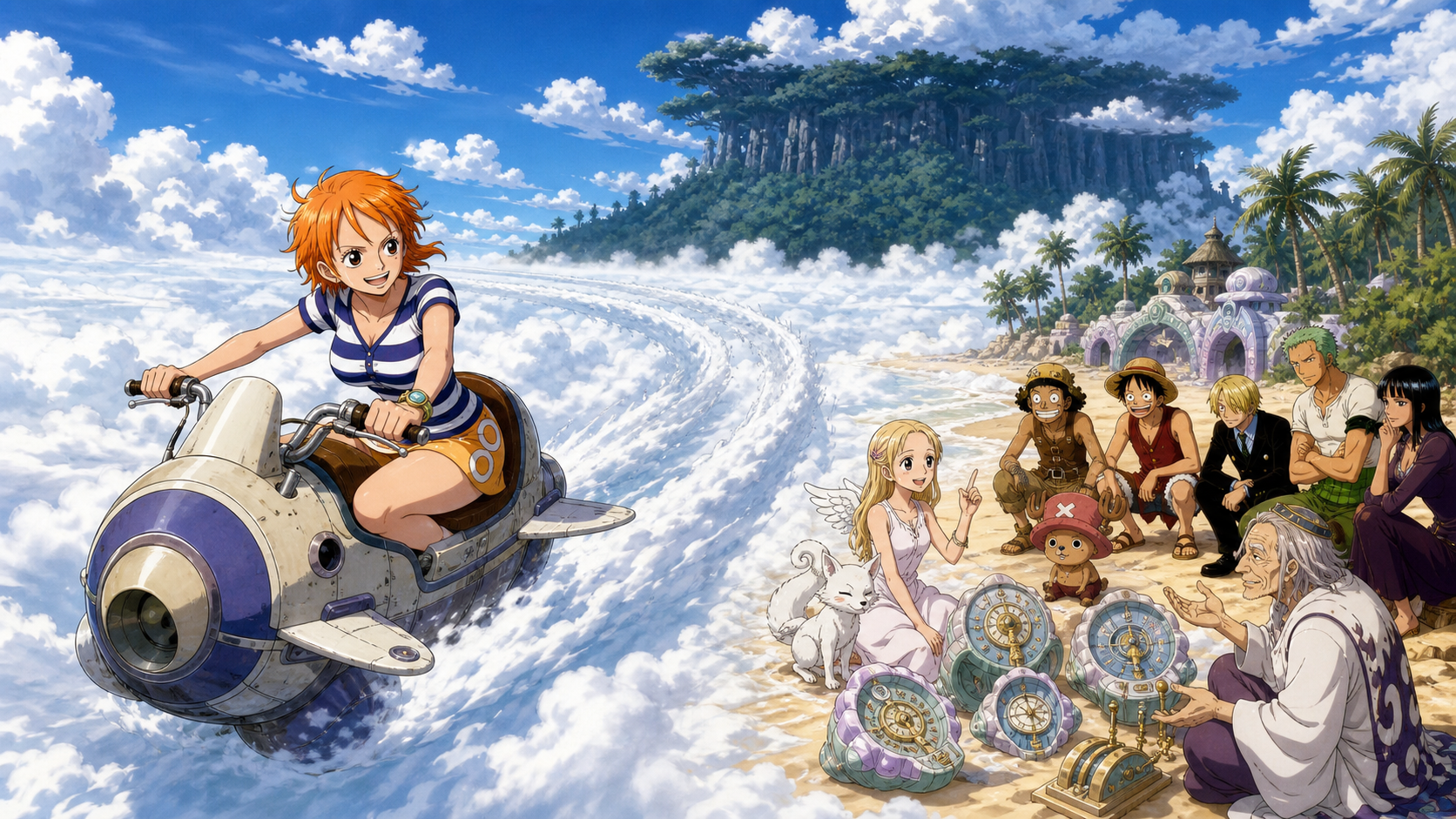
One Piece Episode 154 welcomes the Straw Hats to Angel Beach, introduces Conis, Pagaya, Wavers, and dials, then lets Nami find forbidden Upper Yard.
The Express Lobster deposits the Merry in a postcard
Episode 154 carries the Going Merry into Skypiea and leaves the crew at Angel Beach. The sign matches the name on the old map Luffy found aboard the falling wreck.
That connection matters because a dead navigator’s evidence survived long enough to guide another crew. The map was never a joke, even when Mock Town treated the destination as nonsense.
The Straw Hats should record the gate route, landing point, sign, and direction of the White Sea current before wandering. A beautiful beach can still become impossible to relocate from unfamiliar cloud channels.
Usopp also needs another hull inspection after the lobster used the broken wing mounts as handles. Arrival does not erase the structural stress from two vertical lifts.
Angel Beach gives everyone five minutes of earned nonsense
The crew tests the soft ground, cloud cushions, fruit, flowers, and every strange surface within reach. After Jaya, the Knock Up Stream, and a masked attack, a small resort break feels deserved.
Luffy, Usopp, and Chopper approach the environment through play. Robin and Nami watch patterns. Sanji notices food and women. Zoro remains alert for whoever may be nearby.
Exploration still needs limits. Unknown fruit can be toxic, cloud ground may conceal weak sections, and nobody knows whether local wildlife protects territory.
Chopper should approve food before Luffy bites through another shell. One captain with a steel-fruit dental emergency would be a ridiculous way to end the sky expedition.
The Conasshu fruit defeats Luffy before Conis says hello
Luffy tries to bite a Conasshu and discovers that the exterior is harder than expected. Conis calmly opens the fruit for him with local knowledge.
The tiny exchange establishes a useful rule for Skypiea: familiar categories do not guarantee familiar handling. Fruit, sea, land, vehicles, and currency all work differently here.
Conis shares rather than mocking the visitor. That choice immediately separates her from Mock Town, where lack of knowledge became an excuse for humiliation.
The crew should ask how the shell is opened, which parts are edible, and whether preparation affects safety. Hospitality works best when guests remain willing to learn.
Conis and Su make first contact look gentle
Conis introduces herself as a resident of the sky and welcomes the Blue Sea visitors. Her small cloud fox, Su, stays beside her on the beach.
Sanji reacts to Conis’s wings with predictable volume. Wings may be ordinary anatomy here, so treating a resident like a religious exhibit is not a strong opening move.
Nami and Robin should lead basic questions about place names, law, money, lodging, food, medical care, weather, and the gate toll. Those answers matter more than theories about angels.
Conis offers help without demanding a story first. The crew should return that respect by asking what information she is comfortable sharing and avoiding assumptions about her role.
Pagaya arrives on a machine Noland already described
Conis’s father Pagaya crosses the White Sea on a Waver, a compact craft that moves without sails or visible wind. Nami recognizes the vehicle from Noland’s travel journal.
The journal now proves useful beyond the City of Gold. Noland recorded local technology carefully enough for a navigator four centuries later to identify a machine on sight.
Robin should preserve exact terms and compare Pagaya’s explanation against the old text. Translation drift may hide changes in design, use, or ownership across generations.
Pagaya’s arrival also gives the crew an experienced technical contact. Usopp has found someone who may understand cloud materials, shell power, and the damaged Waver recovered from the sea.
Luffy demonstrates why borrowed vehicles need a safety briefing
Luffy tries the Waver and loses control almost immediately. Confidence does not provide steering knowledge, balance, braking distance, or emergency shutdown.
The craft is small enough to look like a toy and fast enough to injure the rider or anyone standing along the beach. Pagaya should establish a clear launch area before another attempt.
A beginner needs personal protective gear, a kill switch, a tethered practice zone, and instructions on throttle, steering, stopping, and cloud conditions. Nobody receives those protections here.
Luffy’s failure provides a baseline for Pagaya’s later surprise. Operating a Waver normally requires skill, not simply courage.
Nami rides the Waver like the machine finally found its person
Nami takes the controls and moves across the White Sea with immediate competence. Pagaya says riders may need ten years to master the craft.
Her success grows from navigation rather than magic. She reads current, balance, acceleration, surface resistance, and directional feedback faster than the others can name the parts.
The moment gives Nami a form of freedom the Merry cannot offer. She can scout alone, turn quickly, and follow narrow routes without waiting for the whole crew.
That freedom also increases exposure. Solo riding in unknown territory needs a return time, map, whistle, signaling method, fuel estimate, and agreed boundary.
The cloud construction site proves Skypiea is engineered
Usopp notices workers cutting cloud material for construction. Pagaya explains that sea clouds and island clouds have different densities and uses.
The landscape does not simply float by accident. Residents harvest, shape, and build with material whose properties Blue Sea visitors barely understand.
Workers need marked cutting zones, load limits, protective equipment, and controls that prevent weakened sections from collapsing beneath pedestrians or vessels.
Usopp should document tools and joining methods before touching anything. Repairing the Merry with cloud material may become possible only after testing compatibility with wood and metal.
Pyrobloin turns a fantasy cloud into a geological system
Pagaya explains that volcanic particles called pyrobloin reach the sky and interact with water vapor. Density differences help create sea clouds and island clouds.
The explanation links Skypiea to the Blue Sea rather than treating the island as a separate miracle. Material from below helps build life above.
Robin should record the local model without presenting one conversation as complete science. Sampling, measurement, and comparison would strengthen any conclusion.
The same particles connect to seastone, which raises practical concerns for Luffy, Chopper, and Robin. Devil Fruit users need warning before handling unfamiliar cloud products or tools.
Pagaya’s home becomes an orientation room
The crew accepts Pagaya and Conis’s invitation and moves from the beach into their home. Hospitality creates a calmer place to ask questions and recover from altitude.
Sanji enters the kitchen to learn sky cuisine while Robin requests a technical explanation of dials. Each person follows expertise instead of crowding around one mystery.
Hosts should know about allergies, dietary limits, injuries, and Blue Sea medical differences before serving unfamiliar food. Chopper can help translate health concerns.
The Straw Hats also need to avoid treating a private home like a supply depot. Permission should cover rooms, tools, food, and any device they handle.
The Tone Dial stores a voice inside a shell
Conis asks Luffy to speak into a dial and then activates the shell to repeat his recorded words. The Tone Dial turns sound storage into an everyday tool.
Luffy’s reaction is delight, while Robin and Usopp immediately gain reasons to think about records, communication, performance, and mechanisms.
A device that records voices also creates privacy concerns. Residents need consent rules for recording, storage limits, ownership, and disclosure when another person activates the shell.
The crew should label any dial they borrow. A pile of similar shells containing sound, heat, light, wind, or force can become dangerous through one wrong press.
Dials make shell technology feel ordinary before the danger arrives
Conis explains multiple dial types and the shell resources that power Wavers and household tools. Skypiean technology stores natural effects in compact forms.
That design changes labor, transport, cooking, communication, and construction. A culture does not need Blue Sea machinery to possess sophisticated engineering.
Usopp should ask about charge limits, failure modes, maintenance, safe temperature, water exposure, and disposal. Curiosity without specifications creates preventable accidents.
The crew has already seen a bazooka-like weapon in the White Sea. Household principles may also support combat equipment, so technical literacy becomes a safety requirement.
Sanji treats sky cuisine as evidence worth tasting
Sanji prepares food with local ingredients and techniques rather than waiting for somebody else to translate the culture through a lecture. Cooking becomes field research with better seasoning.
He should document ingredient names, preparation methods, storage needs, and any dial used for heat or aroma. Replication requires more than remembering flavor.
Shared meals can build trust faster than interrogation, but hosts should not feel pressured to reveal private recipes or scarce resources to armed visitors.
The meal also gives Chopper another opportunity to check altitude symptoms. Eating, hydration, and rest may restore the fighters more effectively than pretending their earlier defeat never happened.
Nami’s solo ride becomes a missing-person problem quietly
When Sanji brings out the food, nobody can see Nami on the nearby sea. Usopp assumes she continued exploring, while Conis and Pagaya become visibly uneasy.
The crew allowed a navigator to leave alone on an unfamiliar machine without a route, return time, radio, map, or local guide. Skill does not remove the need for coordination.
A search plan should begin with the last observed heading, Waver speed, fuel range, and nearby hazards. Blowing Gan Fall’s emergency whistle may become justified if Nami misses a clear threshold.
Luffy should assign one person to remain with the Merry and another to question the hosts. Sending everybody in different directions would multiply the problem.
Conis names the boundary only after Nami may have crossed
Conis explains that one nearby place must never be entered. The warning arrives after the visitor most likely to scout independently has already departed.
Critical restrictions belong in the first orientation, especially when the forbidden site sits within easy Waver range of a public beach.
Conis may assume every local child knows the boundary. Visitors need explicit maps, markers, reasons, penalties, and emergency instructions because shared knowledge does not travel automatically.
The crew should ask whether entry is physically dangerous, legally prohibited, religiously restricted, militarily controlled, or all four. Different hazards demand different rescue plans.
Upper Yard looks like land because Upper Yard is not cloud
Nami reaches a huge forested landmass beside the island-cloud settlement. The scale and soil distinguish Upper Yard from the soft engineered environment behind her.
For people raised on cloud, ordinary earth carries extraordinary value. Calling the site sacred may involve resources, history, political control, and faith at once.
Nami should stop outside any marked boundary, record coordinates, photograph landmarks if possible, and return for a guide. Solo entry would remove witnesses and recovery support.
The Log Pose, Noland’s journal, and Robin’s historical questions may all point toward the landmass, but evidence still needs a safe approach.
Paradise and prohibition occupy the same horizon
Angel Beach offers food, music, soft ground, open water, and people willing to teach. Upper Yard rises close enough to reach before a host finishes lunch.
The contrast exposes how tourism can hide governance. Visitors see paradise while residents understand surveillance, sacred borders, punishment, and the authority called God.
Amazon already reported the Straw Hats as criminals. Conis and Pagaya may not know that report, or they may fear what association with illegal entrants can cost them.
The crew should not assume hospitality means local safety. Protecting their hosts requires learning whether officials monitor homes, beaches, vehicles, and communication dials.
Episode 154 teaches before the law starts collecting bodies
Episode 154 slows the adventure down long enough to make Skypiea feel inhabited. Conis, Pagaya, Su, the Waver, cloud construction, food, and dials give daily life texture beyond the central mystery.
The episode also builds a practical warning list. The Merry needs a structural log. Waver use needs boundaries and check-in rules. Dials need labels and handling guidance. Unknown food needs medical screening. Cloud construction zones need respect. Recordings need consent. Upper Yard needs a map and a reasoned risk assessment.
Nami’s brilliance deserves celebration without turning solo scouting into good procedure. Pagaya’s ten-year estimate proves her ability, while her disappearance proves ability and coordination answer different questions.
Conis and Pagaya deserve protection from consequences created by the crew’s illegal-entry label. The Straw Hats should tell them exactly what happened at Heaven’s Gate before accepting more hospitality.
RaeRae’s verdict: keep this one. Episode 154 makes dials, cloud beaches, and a tiny Waver feel more revolutionary than a giant speech about worldbuilding ever could.
Skypiea opens with a welcome, a lesson, and one forbidden forest waiting for Nami to find the hard way.