
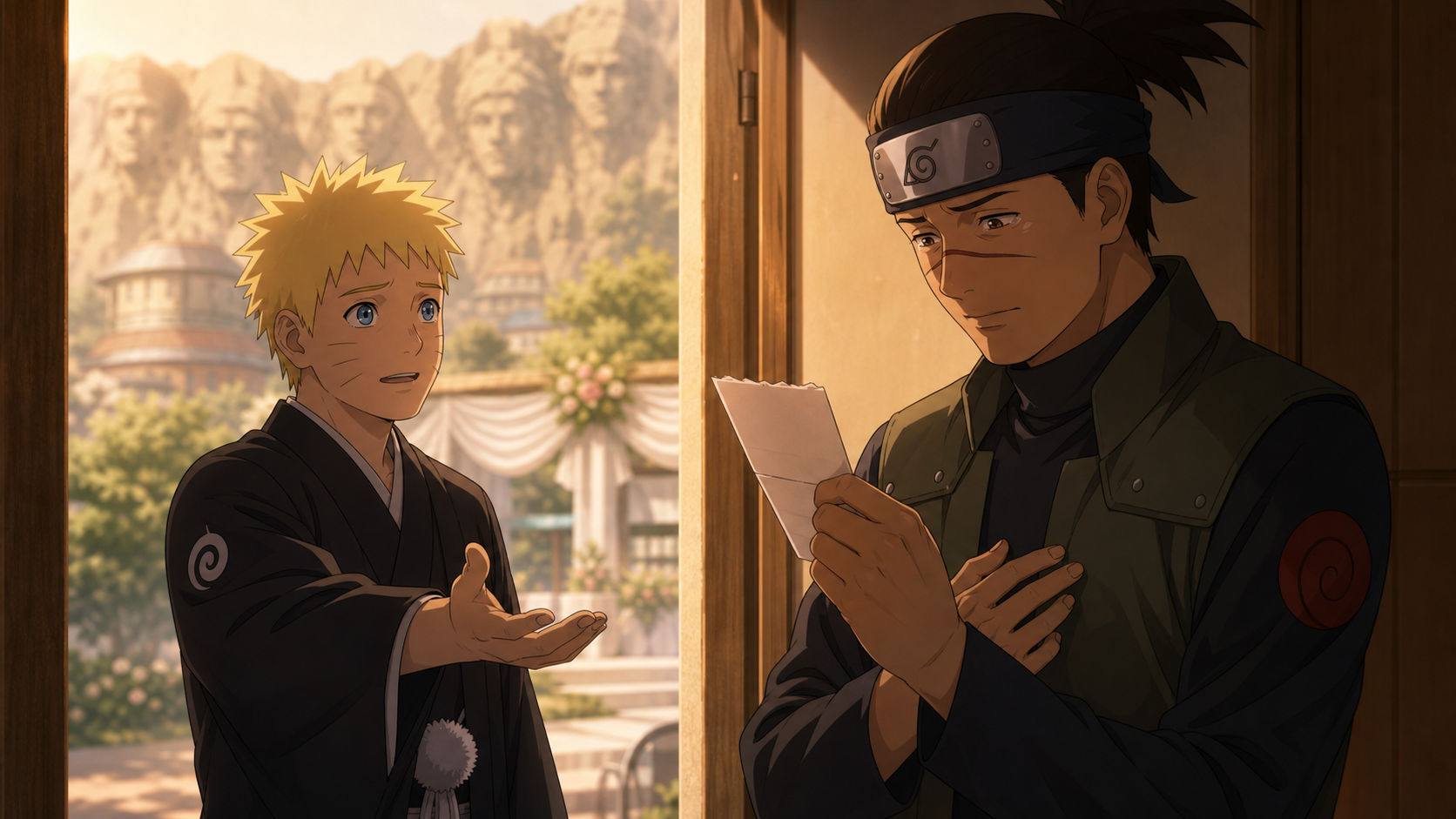
The Message
Naruto gives Iruka the language for a bond they have lived since the beginning, then steps toward marriage with chosen family beside inherited memory.
Episode at a glance
- Series
- Naruto Shippuden
- Episode
- 500
- Arc
- Konoha Hiden: The Perfect Day for a Wedding
- Japanese airdate
- March 23, 2017
- What matters
- Naruto asks Iruka to stand as his father, giving a practiced bond its name before he and Hinata enter marriage together.
Bottom line
“The Message” ends *Naruto: Shippuden* by returning to the relationship that made the entire story emotionally possible. Iruka still cannot record a satisfying wedding greeting because “teacher” no longer contains everything he is to Naruto, while “family” has never been formally spoken between them. Naruto resolves the question himself. He visits Iruka, asks him to attend the ceremony as his father, and gives both men language for a bond they have practiced since the night of the stolen Scroll of Seals. Iruka can finally record his message because he no longer needs to guess where he belongs. His words retain the teasing honesty of a parent: he warns Hinata about Naruto's immaturity and tells Naruto to make her happy. The wedding then gathers people from every part of the couple's lives without pretending that celebration cancels absence. Sakura receives Sasuke's distant congratulations. Hinata remembers Neji. Naruto looks toward Minato's face on the Hokage Rock. Hiashi struggles with emotion while Hanabi admires her sister. The series does not turn the ceremony into a victory lap for Naruto alone. Hinata reaches for his hand, Naruto asks whether she is ready, and they move forward together. The ending chooses a doorway rather than a completed domestic portrait. Marriage begins after a story about being seen, and chosen family stands beside inherited memory without replacing anyone who died.
Episode 500 concludes Naruto Shippuden
Episode 500 is titled “The Message.” The finale aired in Japan on March 23, 2017, completing the seven-part adaptation of *Konoha Hiden: The Perfect Day for a Wedding*.
The series closes on Naruto and Hinata's wedding day.
Iruka dreams about the Scroll of Seals
His memory returns to the night Naruto stole the forbidden scroll and learned the Multiple Shadow Clone Technique. The event began as manipulation by Mizuki and became the moment Naruto received genuine recognition.
The finale circles back to the beginning.
Naruto was still a lonely child
He sought acknowledgment through disruption because ordinary requests had brought rejection. Stealing the scroll promised both skill and the graduation he desperately wanted.
Misbehavior carried an unmet need.
Iruka chose Naruto over village fear
He protected the boy after hearing Mizuki expose the truth about Kurama. Iruka recognized Naruto as a child in danger rather than the beast that killed his parents.
Grief did not dictate his final choice.
The forehead protector confirmed belonging
Iruka gave Naruto his own protector after witnessing the clone technique. The gesture made institutional acceptance personal.
A teacher opened the first door.
Konohamaru wants another recording
Iruka's earlier congratulatory message sounds flat and generic. Konohamaru knows the relationship deserves more truthful language.
Technical completion is not emotional completion.
Iruka remains unable to speak naturally
The camera asks him to compress years of conflict, meals, grief, pride, and guidance into a brief statement. Every formal phrase feels smaller than the bond.
Writer's block becomes relationship uncertainty.
He has lost sight of his role
Naruto no longer needs an Academy instructor, yet their connection has never ended. Iruka cannot decide whether he should speak as teacher, friend, elder, or family.
Changing need does not mean reduced love.
The Academy continues around him
Students require attention while Iruka privately wrestles with Naruto's wedding. Daily responsibility prevents nostalgia from becoming his only identity.
Teaching remains present-tense work.
Tsukune and his friends vandalize again
The trio returns to the Third Hokage's statue after earlier discipline. Repetition tests whether adults will respond with patience and consequence.
Growth rarely follows one correction.
Iruka scolds them
He does not romanticize disruption simply because Naruto once behaved similarly. Current students deserve to be seen as themselves and held accountable for their own actions.
Comparison should not erase individuality.
The Third Hokage's image carries history
Hiruzen protected Naruto imperfectly, led Konoha through crisis, and died defending the village. Children still treat his monument as a surface for rebellion.
Public memory remains contested and ordinary.
Sadoru asks about a reception speech
He assumes Iruka will address the guests because everyone recognizes his importance to Naruto. The question intensifies the role Iruka cannot name.
Community sees a bond before language catches up.
Iruka says Kakashi will speak
The Hokage holds the formal responsibility, giving Iruka a procedural reason to retreat. Avoiding the podium does not resolve the private message.
Protocol becomes temporary shelter.
Ayame notices his absence
Iruka has not visited Ichiraku as often while struggling with the recording. A changed routine makes emotional pressure visible to someone who knows his habits.
Community notices quiet withdrawal.
Ichiraku links Iruka and Naruto
Ramen has supported countless conversations between them after the original promise of a celebratory bowl. The shop represents welcome without performance.
Food became a family ritual.
Iruka admits the message is unfinished
He does not pretend busyness or indifference. Naming the problem creates no immediate solution, but honesty removes one layer of isolation.
Uncertainty can be shared safely.
Naruto arrives at Iruka's home
The former student enters the teacher's adult life without ceremony. Their familiarity makes the visit feel domestic rather than official.
Closeness appears through access.
Iruka is attempting to cook dinner
His limited success contrasts with the ramen outings that usually structure their time. The scene lets Naruto encounter him as an ordinary man rather than a fixed mentor.
Family includes unpolished daily life.
Naruto asks him out for ramen
The invitation returns them to the language they both understand. A bowl can hold conversation that formal speeches cannot begin.
Ritual creates emotional safety.
Naruto mentions his last days as a single man
He frames the outing as an opportunity for fun before marriage. Iruka hears irresponsibility where Naruto intends nervous connection.
Familiar scolding returns immediately.
Iruka corrects him like a parent
He warns Naruto not to treat commitment casually. The reflexive response reveals the role Iruka has been trying to define.
Behavior answers before vocabulary.
Naruto wants to tell him something
The visit was never only about food. Naruto creates a private setting for a request carrying enormous emotional weight.
Vulnerability requires chosen timing.
Naruto asks Iruka to attend as his father
He does not ask for a symbolic teacher's seat or an official speech. He names Iruka as the person he wants representing parental family at the ceremony.
Chosen kinship becomes explicit.
The request honors practice over blood
Iruka did not replace Minato or Kushina. He became another father through recognition, protection, discipline, meals, and continued presence.
Love can expand family without rewriting loss.
Naruto makes the choice himself
No elder assigns Iruka the role and no custom automatically grants him the place. Naruto defines his own family through lived relationship.
Agency shapes the ceremony.
Iruka is overwhelmed
The invitation answers the question beneath every failed recording. He has worried about where he belongs while Naruto has already understood him as family.
Recognition travels both ways.
Iruka accepts
His answer does not need elaborate language. Presence at the wedding will communicate what the video could not.
Some messages are embodied.
The moment reinterprets the first episode
Iruka once gave Naruto proof that he belonged among Konoha's shinobi. Naruto now gives Iruka proof that he belongs within Naruto's family.
The original gift returns transformed.
Iruka speaks with Hinata
Their conversation acknowledges that the marriage joins relationships rather than isolating the couple. Hinata receives the person Naruto has chosen as family.
Partnership includes each other's history.
Hinata understands the request
She does not treat Iruka's role as competition with her own father or Naruto's deceased parents. The ceremony can hold several kinds of family at once.
Belonging is not a scarce resource.
Iruka records the message again
With his place clarified, he can address Naruto and Hinata without hiding behind generic congratulations. Emotional truth organizes the words.
Identity resolves the performance problem.
He warns Hinata about Naruto
Iruka names the immaturity, impulsiveness, and trouble he knows well. Affection does not require presenting an idealized son.
Honesty gives the blessing texture.
He tells Naruto to make Hinata happy
The statement carries parental expectation rather than ownership over either partner. Naruto is asked to practice care, not merely receive celebration.
Marriage creates responsibility.
Hinata's happiness is not Naruto's task alone
The conventional phrasing needs balance: both partners retain agency and share responsibility for the relationship. Iruka speaks from protective affection, not a complete philosophy of marriage.
Care should not become control.
Konohamaru finally captures the right message
His persistence pays off because he waited for sincerity rather than settling for footage. The video becomes a record of the community around the couple.
Patience protects emotional quality.
The wedding day arrives
Preparation gives way to presence. Missions, shopping, diplomatic planning, and private anxiety converge at the ceremony.
Anticipation becomes a shared day.
Guests bring packets of money
The custom exists alongside the personalized presents that drove the arc. Practical support and symbolic gifts can coexist without ranking one another.
Celebration has several economies.
The Five Kage attend
Leaders from formerly hostile villages gather for Naruto and Hinata rather than a crisis summit. Their attendance shows political change through ordinary joy.
Peace becomes visible in the guest list.
Allied shinobi cover Konoha's work
The staffing solution allows every close friend to attend. Cooperation Naruto helped build now safeguards his wedding.
Public achievement supports private happiness.
Shikamaru and Temari arrive together
Their presence follows the honeymoon misunderstanding without requiring a formal relationship announcement. Choosing to attend together speaks clearly enough.
Awkwardness has not prevented connection.
Ino and Sai arrive together
Their developing relationship places another postwar possibility inside the gathering. Both learned intimacy through very different forms of emotional distance.
Connection remains learned work.
Sakura receives Sasuke's message
His hawk delivers congratulations while he continues traveling. Distance remains real even when he chooses to acknowledge the wedding.
Presence has more than one form, though absence still matters.
Sakura thinks of Sasuke
The message opens a private emotional space amid the public celebration. Her response belongs to their unresolved and developing bond rather than Naruto's old childhood pursuit.
Time has changed the triangle.
Sasuke thinks of Team 7
Travel does not sever his connection with the people gathering in Konoha. His choice to remain away carries consequences alongside the sincerity of remembrance.
Repair remains incomplete but active.
Hinata looks toward the sky for Neji
Her cousin cannot stand beside her, and the wedding does not erase the violence that took him. Remembering him makes grief part of the day without allowing grief to consume the day.
Joy can include the dead.
Neji's sacrifice remains complicated
He chose to protect Naruto and Hinata, but his death should not exist only as fuel for their romance. Hinata remembers a cousin with his own pain, growth, and freedom.
Memory restores personhood beyond function.
Naruto looks at Minato's face
The Hokage Rock lets him address the father he cannot physically invite. Minato's public monument becomes private family memory.
The village and the son see different meanings.
Kushina remains part of the absence
Although the visual focus rests on Minato, Naruto carries both parents into the marriage. Kushina's hope that he find love and good people has shaped this destination.
One image cannot contain every inheritance.
Iruka does not replace Naruto's parents
His place beside Naruto adds living support to remembered family. The finale avoids forcing chosen and biological bonds into competition.
Love grows through addition.
Hanabi comes for Hinata
Her admiration gives the bride a sister's gaze before the public ceremony. Hinata is seen as beautiful by someone who knows the family pressures behind the moment.
Intimacy precedes spectacle.
Hiashi becomes emotional
The father who once judged Hinata as inadequate now struggles with feeling as she marries. His love does not erase past harm, but change remains visible.
Reconciliation carries history.
Hinata is not handed from one man to another
Family tradition surrounds her, yet the decisive final movement belongs to the couple. She reaches for Naruto and prepares to walk by choice.
Marriage should preserve agency.
Hinata takes Naruto's hand
Her action begins the final exchange. The girl who once watched from a distance now initiates contact at the threshold of their shared future.
Quiet courage becomes visible.
Naruto asks whether she is ready
He checks in rather than pulling her forward. The question gives consent a place inside ceremonial momentum.
Partnership begins with listening.
They move toward the ceremony together
The anime stops before turning marriage into a complete answer for every future problem. Naruto and Hinata cross into the next part of life side by side.
An ending becomes a beginning.
Boruto appears in the closing image
The next generation receives a visual handoff through Naruto's forehead protector. The symbol that once proved his belonging now points toward a child who will question the legacy he inherits.
Continuity includes future conflict.
The finale chooses family over combat
No last villain interrupts the day and no ultimate technique determines the ending. A conversation between Naruto and Iruka carries the greatest emotional force.
Recognition remains the series' decisive act.
Episode 500 completes the first promise
Iruka once told Naruto that he was not the Nine-Tails and gave him a place among shinobi. Naruto now tells Iruka that he is family and gives him a place beside the groom.
The final message is belonging spoken aloud.
Naruto does not replace his parents when he chooses Iruka
Iruka’s living care does not erase Minato or Kushina. Naruto’s family expands because every relationship is different, not because one person wins a title from another.
Naruto also makes the choice himself. Konoha spent his childhood defining him through a secret he could not control, assigning meaning to his body before he understood why adults recoiled. Here, no institution tells him which family counts. No clan elder arranges the role. He names the person whose care became parental and asks for that presence directly. The ceremony becomes a place where Naruto exercises authority over his own belonging.
Iruka’s acceptance completes a circle without making their bond perfectly sentimental. He still sees Naruto’s immaturity. He worries about Hinata. He knows affection includes correction, disappointment, pride, irritation, and continuing responsibility after the emotionally beautiful moment ends. The message works because Iruka does not deliver a polished speech about a flawless son. He speaks like somebody who has loved the whole difficult person for years.
Hinata enters marriage as a participant, not Naruto’s reward
The wedding arc can easily become a long celebration of what Naruto earned after saving the world. This episode resists that framing in its final movement. Hinata reaches for his hand. Naruto asks whether she is ready. They proceed together. It is a small exchange, but it gives consent and shared timing more weight than the idea of a bride being delivered to the hero at the end of his quest.
Hinata brings her own family, friendships, grief, courage, and history to the threshold. Her memory of Neji does not exist only to decorate Naruto’s happiness. Neji was her cousin, defender, critic, teammate in change, and another Hyuga child harmed by a clan system that assigned worth before either of them could choose. Remembering him allows joy to contain grief without reducing his death to romantic fuel.
Hiashi’s emotion needs the same honesty. His love in the present does not erase the years he judged Hinata inadequate or participated in a family structure that wounded both branches of the clan. Change matters, and so does history. A wedding should not demand instant absolution because someone cries beautifully. Reconciliation becomes trustworthy through what Hiashi does after the ceremony, when there is no audience rewarding him for tenderness.
The finale gathers absence without pretending absence is presence
Messages and monuments carry sincere connection without becoming presence. Sasuke’s distance, Minato’s silence, and Kushina’s unseen inheritance remain part of the day’s loss, and nobody pretends a symbol can fully close that distance.
That is why living presence matters so much. Iruka can answer. Hinata can take Naruto’s hand. Friends can gather because allied shinobi cover their assignments. Teuchi can keep a seat open. Chosen family does not compete with the dead; it gives grief somewhere to live among people who continue showing up. The wedding is not proof that every wound healed. It is evidence that isolation no longer controls the entire story.
Final verdict
“The Message” closes Naruto Shippuden with the act that always mattered most: one person seeing another clearly enough to make belonging possible. Iruka gave Naruto that recognition when the village saw a monster. Naruto returns it by naming Iruka as family and asking him to stand beside the groom. The wedding does not erase Kushina, Minato, Neji, Sasuke’s absence, Hyuga harm, or the labor required to keep peace functioning. It gathers those truths around a couple choosing to move forward together. Hinata is not a prize, Iruka is not a replacement, and marriage is not a magical cure. The series ends at a doorway because family remains a practice after the message is spoken.
Sources and watch notes
What I am carrying forward
Episode 500 closes Shippuden by naming Iruka as family and letting Naruto and Hinata cross the threshold together. The next work belongs to the full Naruto ecosystem: making sure every hub, post, taxonomy relationship, image card, and path into Boruto carries that same attention.