
Anime 101 · Production Craft · The Computer Did Not Make It by Itself
Yes, The Little Mermaid Remake Is Also Animation
Actors performed on rigs, but artists built the water, movement, creatures, hair, environments, transformations, and much of the world audiences were told was live action.
The category problem is cultural before it is technical
Studios market remakes as live action because the phrase implies prestige, novelty, and distance from the animated films being remade. The label becomes unstable when most of the visible world cannot exist in front of a camera. A photographed performer can occupy a frame whose environment, creatures, movement, and lighting logic are heavily constructed by animation and visual effects.
The 2023 Little Mermaid is a hybrid. Calling it animation does not erase Halle Bailey or the physical departments. Calling it only live action does erase the artists who create the impossible ocean around them. The accurate description should expand rather than force one team out of the sentence.
Dry-for-wet begins with bodies on land
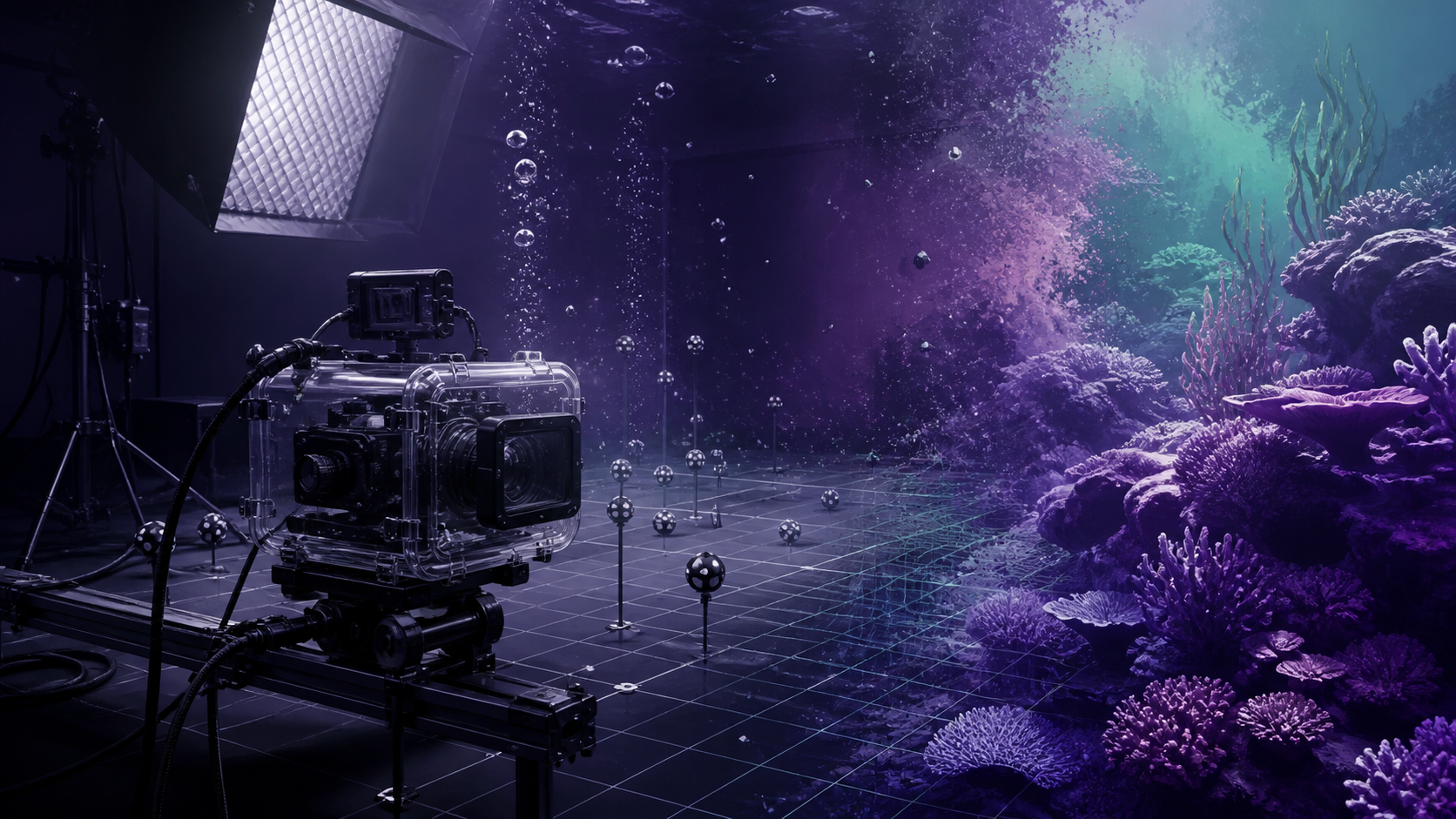
The production used blue-screen stages, harnesses, counterweights, tuning-fork rigs, seesaws, and stunt coordination to simulate buoyancy and directional movement. Performers had to act while technicians positioned bodies through choreography planned for later digital construction.
This method gives filmmakers human faces and controlled dialogue recording, but it creates a performance problem. The actor cannot feel the water, see the final environment, or always move with the resistance audiences associate with underwater life. The completed scene depends on collaboration across time.
Previsualization is animated planning
Official production material describes underwater sequences being mapped through previsualization before photography. Artists calculate camera paths, body movement, scene scale, and creature placement so departments know what must be filmed and what will be built later.
Previsualization is not a disposable computer sketch. It is animated staging that allows an expensive hybrid production to coordinate. The final shot may replace or refine nearly every element, but the storytelling decisions begin in moving images long before a finished background exists.
Digital creatures require performance choices
Sebastian, Flounder, Scuttle, and the undersea ensemble are not generated automatically by software. Artists model bodies, rig movement, animate performance, simulate surfaces, light forms, and integrate them with filmed material. Voice actors contribute timing and personality, while visual teams translate that performance through creatures constrained by the chosen realism.
The debate about whether the faces are expressive enough is therefore an aesthetic critique, not evidence that animation failed to happen. The work is everywhere. The production simply instructs much of it to hide behind plausibility.
Hair, fabric, water, and light are part of the acting environment
Underwater hair must move continuously without distracting from facial performance. Tails and fins must carry weight while suggesting buoyancy. Light must scatter and shift as if filtered through water. Clothing cannot behave as it would in air. Each layer affects whether the audience reads a gesture as floating, falling, swimming, or being mechanically suspended.
The film’s cinematography and effects teams designed complex lighting and postproduction systems around those problems. Even when a viewer dislikes the result, the image is a record of coordinated craft rather than a button labeled underwater.
Why CVM Sekai files the remake in the animation library
The animation library follows the labor and the worldbuilding, not a marketing hierarchy. If an adaptation relies on animated bodies, environments, creatures, simulations, and performance construction, it belongs in the same conversation as the hand-drawn work it remakes.
That filing also makes comparison more honest. The 1989 film uses drawn exaggeration openly. The 2023 film uses digital animation while trying to preserve photographic plausibility. Both make choices about line, shape, timing, expression, and impossible movement. One is not the absence of animation. It is a different industrial arrangement of it.
Sources
The Walt Disney Company’s production feature on the underwater world documents the dry-for-wet rigs, previsualization, lighting design, and effects planning. This guide also relies on credited production roles rather than the phrase computer generated, which too often turns thousands of human decisions into weather.
Hybrid is a more accurate starting word
The film contains photographed performers, physical sets, costumes, props, stunt work, location material, digital environments, animated creatures, simulated water, constructed hair and fabric movement, and extensive compositing. No single department explains the finished image. “Live action” is useful for marketing the presence of actors and inadequate as a description of the whole production method.
Calling the work hybrid does not reduce the physical performance or claim every pixel is synthetic. It recognizes that the undersea world depends on an organized exchange between photography and animation. The image is finished only when those forms agree about space, light, force, timing, and emotion.
Previsualization turns the screenplay into moving plans
Before expensive photography, teams use animated previsualization to block camera movement, character placement, action, scale, and timing. Official production material for the film describes undersea scenes being designed in advance so each shot could be evaluated for how it should be achieved.
Previsualization is not the final performance, but it is already animation doing story work. A moving plan lets the director, cinematographer, effects supervisors, stunt teams, designers, and actors share an imagined environment that does not yet exist. It reduces uncertainty while also influencing what later departments inherit as the intended scene.
Dry-for-wet means the water arrives later
Instead of filming the principal undersea performances in tanks, the production placed actors on land against controlled backgrounds and created the surrounding water digitally. The method avoids some limitations of underwater dialogue, breath, visibility, and camera operation. It introduces new problems because bodies still need to appear buoyant and continuously affected by a medium that is absent.
The phrase can sound simple, as if dryness is the only difference. In practice, every gesture becomes a negotiation with future animation. A hand cannot settle as though resting in air if the completed scene says current is moving through it. Hair, tail, costume, particles, and background life must later support the same physical intention.
Harnesses and counterweights create performance constraints
Actors were supported through wires, harnesses, counterweights, tuning-fork devices, seesaws, and coordinated stunt operation. The equipment helps position a body horizontally, lift it, rotate it, or let it travel through a planned path. It also creates pressure, fatigue, limited range, and timing demands that remain invisible in the finished fantasy.
A floating pose that looks effortless may require several technicians, a carefully balanced rig, costume accommodation, and later removal of hardware. Performance includes the actor’s face and intention plus the physical crew making the body available to the camera. The final shot should not erase that collaboration from how criticism understands the work.
Stunt labor continues even when nobody is falling
Stunt work is often imagined as explosions, crashes, or dangerous leaps. Undersea simulation needs specialists to guide movement, protect bodies, rehearse rotation, and coordinate equipment across repeated takes. The action can be gentle onscreen while remaining mechanically demanding behind it.
That labor shapes acting. A performer may need to hold emotional concentration while technicians reset position or move the rig on cues. The expression must look as if it originates freely inside water even when the body is following a highly controlled path. Naturalism is produced through discipline, not discovered automatically.
Lighting has to imply a medium that is not present
Cinematographer Dion Beebe and the production team designed complex lighting behavior to suggest underwater filtration, direction, movement, and depth. Light under water scatters, loses certain wavelengths, shifts contrast, and interacts with particles. A dry stage does none of that by itself.
Lighting therefore serves as both photography and instruction for later compositing. Highlights on a face must belong to the digital environment that will surround it. Moving patterns can imply water above the performer, but they must remain readable across skin, hair, costume, and the artificial background.
A blue screen is not an empty world
Actors working against blue backgrounds still respond to eyelines, storyboards, stand-ins, marks, sound cues, and direction. The environment is absent visually and present as a network of instructions. A palace entrance, creature, current, or distant danger may exist only as a position and timing relationship during the take.
The completed shot depends on whether every department honors that shared fiction. If Ariel looks toward Flounder, the animated fish must enter the gaze at the correct scale and emotional moment. A small mismatch can make two performances feel as though they occurred in different rooms.
Halle Bailey’s face remains a photographic anchor
Bailey provides a continuous human performance through expression, breath, gaze, vocal delivery, and physical intention. The production builds the environment around that anchor. Her acting gives effects teams emotional timing they can support, while the digital world influences how viewers interpret the acting.
This exchange is why hybrid work cannot be divided into real actor and unreal background. The photographed face may be heavily relit, integrated, surrounded, or accompanied by animated movement. The animation does not replace the performance. It constructs the conditions under which the performance can appear to belong beneath the sea.
Tails are character animation and body extension
A mermaid tail must continue the actor’s torso, carry weight and flexibility, respond to acceleration, and express swimming effort. It is not decorative costume below the frame. The animated tail changes how the audience reads the whole body, including whether a turn feels initiated from the shoulders, core, hips, or fin.
Different characters also need distinct movement. Ariel’s curiosity, Triton’s authority, and Ursula’s theatrical control should not produce identical swimming. Animation can extend acting by translating personality into propulsion, posture, and the amount of space a body claims.
Hair becomes a second performance
Underwater hair is always moving, but constant movement can obscure a face or become visual noise. Bailey’s locs carry cultural and character significance while also requiring a movement system compatible with the chosen ocean. Artists decide clumping, drift, collision, direction, speed, and how often the hair may cross the face.
Those decisions affect emotion. Hair can frame stillness, amplify a turn, reveal speed, or make a body look suspended. The simulation must feel physical without becoming random. A beautiful result records design judgment, not software behaving independently.
Fabric has to agree with both gravity and current
Costume material behaves differently in air and water. On a dry stage, gravity pulls fabric down. In the finished scene, buoyancy and current may lift or delay it. Digital alteration, replacement, or supplemental simulation can be required so clothing belongs to the same force system as hair and tail.
The challenge becomes more complex around seams where photographed and digital material meet. The audience should not notice which fold came from the physical costume and which was constructed later. Invisible integration is one of the production’s major achievements, even when marketing leaves the labor unnamed.
Sebastian, Flounder, and Scuttle are animated performances
Voice actors supply sound, timing, personality, and emotional intention. Animators translate that material into gaze, mouth movement, posture, locomotion, reaction, and interaction with the world. Modeling, rigging, surface, lighting, and simulation departments make the performance physically possible.
Calling the creatures computer generated can make the process sound automatic. A computer calculates within systems people design. It does not decide when Sebastian is offended, how Flounder gathers courage, or whether Scuttle interrupts with confidence. Those are acting choices distributed across voice and image.
Photoreal creature design narrows the available acting tools
The production asks the companions to resemble animals that could plausibly exist inside the photographic world. That choice limits eye shape, mouth flexibility, facial exaggeration, and body deformation compared with the 1989 designs. Animators must find expression inside a smaller range.
The limitation is aesthetic, not technical proof that the creatures lack animation. It also explains why voice performance sometimes carries more emotion than the face. Viewers can disagree about whether the realism works while still recognizing the human labor required to make a crab conduct, a fish worry, or a bird deliver gossip.
Water is an environment and a simulation problem
The ocean includes suspended particles, changing visibility, moving light, currents, bubbles, turbulence, surface transitions, and interaction with bodies. Not every element is simulated through one system. Artists combine procedural calculation, hand animation, compositing, matte work, and shot-specific adjustment.
The goal is not merely to add a blue layer. Depth must remain readable. Faces need clarity. Movement should feel resisted without becoming slow. Songs need visual energy. The environment has to obey enough physics to feel coherent and enough storytelling to remain legible.
Compositing makes separate labor appear simultaneous
A finished frame may combine photographed actors, digital tails, animated creatures, background environments, simulated hair or fabric, particles, light effects, and color treatment created at different times. Compositors integrate edges, depth, light, atmosphere, and motion so the pieces appear to share one moment.
Successful compositing becomes invisible, which creates an occupational paradox. The better the work, the easier it is for audiences to assume nothing happened. Guides should name the process precisely because seamlessness hides the number of judgments required.
Color grading unifies worlds and changes their emotional range
After photography and effects are assembled, color treatment helps the film maintain continuity across locations, shots, skin tones, and digital elements. Underwater sequences need a shared palette without making human faces unreadable. Surface scenes must feel connected while preserving a different atmosphere.
Grading is also expressive. A production can choose saturation, contrast, warmth, shadow detail, and separation to guide emotion. Criticism of a muted or naturalistic palette is criticism of an authored look, not a claim that postproduction failed to occur.
The transformation scenes require more than a body swap
Ariel’s movement between tail and legs, Ursula’s changes, Triton’s power, and the contract magic require animated transitions that communicate cause, force, pain, and identity. The effect must remain attached to performance instead of becoming light that conveniently hides every difficult seam.
Transformation is one of the franchise’s central metaphors. How the body changes affects whether the moment reads as liberation, violence, seduction, punishment, or repair. Visual-effects design is therefore participating in interpretation, not only continuity.
The surface world remains a hybrid too
Island environments, ship action, weather, extensions, animals, and magical climax material continue to rely on effects even after Ariel reaches land. The boundary between practical and digital does not match the boundary between sea and shore. Some of the most photographed-looking images contain extensive construction.
That continuity is another reason the live-action label misleads. Hybrid production is not a special technique used only when the camera goes underwater. It is the film’s general method for joining performers to a world larger and more dangerous than the available locations and sets.
Why credits and labor conditions belong in criticism
A film this dependent on animation and visual effects should be discussed with attention to the people, schedules, vendors, and working conditions behind the image. Celebrating technology without naming workers turns craft into corporate magic. Dismissing the image as fake does the same thing from the opposite direction.
Editorial criticism can evaluate aesthetics while recognizing labor. The design may be too restrained. The creature faces may be insufficiently expressive. The underwater movement may feel posed. Those judgments should remain connected to the reality that artists solved complex briefs rather than pressing a realism button.
Why CVM Sekai includes hybrid remakes in the animation library
The library follows animated labor and constructed worlds instead of accepting a marketing hierarchy where animation becomes source material and live action becomes the superior destination. If characters, environments, movement, transformation, and performance depend substantially on animation, the work belongs in the animation conversation.
This filing also keeps franchise history together. The 1989 hand-drawn film and 2023 hybrid use different systems to answer the same problems: how a mermaid moves, how a crab acts, how music changes bodies, and how an impossible kingdom becomes emotionally credible. Separation would hide the comparison that makes both crafts easier to understand.
Rendered realism still begins with design
Before a creature can look physically convincing, artists decide proportion, silhouette, anatomy, surface, age, color, and how closely the design should resemble a specific species. A realistic finish cannot rescue a design that does not support the role. Sebastian must remain readable beside Ariel, survive rapid kitchen action, conduct music, and fit inside a frame without becoming visual noise.
Those needs require choices that natural history never had to solve. The character is a storytelling instrument wearing an animal surface. Modeling and look-development teams balance recognition with plausibility, then hand animators a body whose possibilities were shaped long before the first completed shot.
Sound helps sell the water that performers could not feel
Movement feels underwater partly because sound design, dialogue treatment, music, and environmental audio tell the body what medium surrounds it. Bubbles, distance, current, creature movement, and changes in sonic space can support an image whose principal performance was recorded in air.
The musical score creates another challenge. Songs need clarity and rhythmic energy even when the setting suggests muffling and resistance. The film chooses intelligibility over literal acoustics, which proves realism was never total. Every department negotiates which physical rule serves the scene and which must yield to storytelling.
Digital does not mean infinitely changeable without cost
Because an element can be revised in software, outsiders may assume changes remain cheap until release. Every revision can affect animation, simulation, lighting, rendering, compositing, editorial timing, and quality control. Late decisions travel through dependent departments and consume human hours.
Understanding that chain matters when discussing remake scale. The image’s flexibility is real, but it is built on schedules and people. “Fix it in post” is not a neutral solution. It is a transfer of labor to teams whose work is easiest to hide once the frame looks seamless.
Source shelf
The Walt Disney Company’s production feature on creating the underwater world documents previsualization, the dry-for-wet approach, harnesses, counterweights, tuning-fork rigs, stunt coordination, lighting design, and the role of visual effects in constructing the sea.
The process analysis in this guide follows those documented methods and the credited crafts visible in the completed film. It does not claim every shot used the same technique. Hybrid productions solve sequences shot by shot, which is why broad labels are less useful than asking what each image required.
Keep exploring The Little Mermaid
Return to The Little Mermaid hub for films, the animated series, character files, reviews, rants, reactions, and lore guides.