
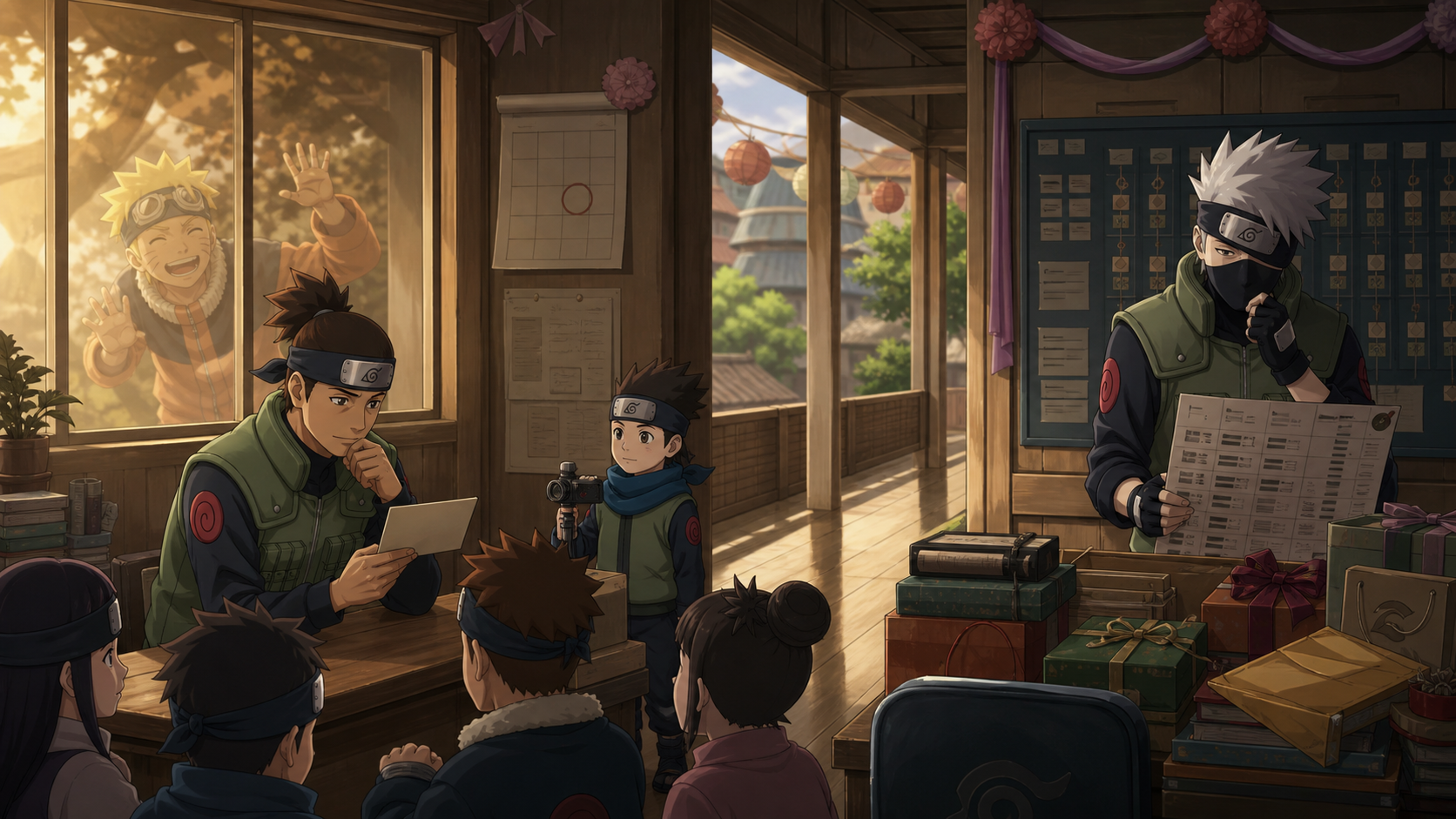
Naruto’s Wedding
Iruka must speak as the person Naruto made family, while Kakashi learns that a celebration cannot be organized by ranking whose friendship deserves attendance.
Episode at a glance
- Series
- Naruto Shippuden
- Episode
- 494
- Arc
- Konoha Hiden: The Perfect Day for a Wedding
- Japanese airdate
- February 16, 2017
- What matters
- Iruka chooses to see the students in front of him while Kakashi discovers that friendship cannot be ranked by wedding gifts.
Bottom line
“Naruto's Wedding” begins the final arc by asking how a village built for missions makes room for celebration. Naruto and Hinata's date is set, but their friends are now elite shinobi whose attendance would leave Konoha's defense and daily assignments understaffed. Kakashi inherits an old rule that ranks wedding gifts to decide who receives leave, then disguises gift shopping as a secret mission. The idea is funny because everyone treats affection like an operation. The rule is also unfair because wealth, taste, and performance become proxies for relationship. Iruka's story provides the necessary counterweight. He cannot compress his bond with Naruto into a camera message, receives an invitation to test for Academy vice-principal, and briefly chases promotion while comparing current students with the village's most famous former troublemaker. When Tsukune steals a decoy Scroll of Seals after hearing about Naruto's prank, Iruka realizes that nostalgia has made him overlook the child directly in front of him. He declines the exam and chooses classroom attention, not because advancement is wrong, but because leadership without seeing individual students would betray the work he values. The episode places a wedding beside a school lesson: love cannot be ranked through the most impressive gift, and teaching cannot be measured through the most famous graduate.
Episode 494 begins the Konoha Hiden adaptation
Episode 494 is titled “Naruto's Wedding.” The episode aired in Japan on February 16, 2017, and begins a seven-episode adaptation of Shō Hinata's novel *Konoha Hiden: The Perfect Day for a Wedding*.
The anime expands Iruka's Academy story and Konohamaru's congratulatory-video project.
Naruto and Hinata have set the date
The relationship developed through childhood admiration, war, and the events of *The Last: Naruto the Movie* now moves toward a public commitment. The village prepares to celebrate two people, not only its hero.
Marriage belongs to both partners.
The wedding follows years of collective crisis
Konoha has endured invasion, destruction, war, mass genjutsu, funerals, and reconstruction. A ceremony creates space for continuity beyond survival.
Peace gains an ordinary milestone.
Konohamaru begins recording messages
He collects congratulations from friends and mentors for a video gift. The project suits someone who admires Naruto while belonging to the next generation.
Memory becomes a collaborative artifact.
Sakura speaks first
Her message carries the history of Team 7 from Academy conflict through war and reunion. She addresses both Naruto and Hinata rather than making the wedding only about her teammate.
Congratulations recognize the couple together.
Recording changes natural speech
Friends who can face battle struggle when a camera asks them to summarize affection. Self-consciousness turns warmth into stiffness, argument, or comedy.
Performance is not the same as feeling.
Ino tries to control the group message
She wants the recording to look polished while Shikamaru and Choji appear uncomfortable behind her. Coordination becomes harder without a battle formation.
Friendship resists perfect staging.
Kiba interrupts the attempt
Akamaru's enthusiasm disrupts Ino's presentation and changes who holds the recording. The resulting chaos may communicate the group more honestly than a rehearsed speech.
Imperfection can preserve personality.
Konohamaru wants Iruka's message most
Iruka was the first adult to recognize Naruto as a child rather than Kurama's container. Any collection of family and friends feels incomplete without him.
The earliest bond carries special weight.
Iruka cannot find the right role
“Teacher” is accurate but smaller than the relationship has become. “Family” feels true while exceeding the formal language he has used for years.
Words lag behind lived attachment.
He asks for more time
Iruka does not want to produce a generic statement for the sake of finishing the video. Hesitation reflects care rather than avoidance alone.
Sincerity cannot always meet a recording schedule.
The Academy introduces Sadoru
A newer teacher struggles with students who test boundaries and exploit uncertainty. His distress shows how classroom authority must be built rather than granted by title.
Teaching begins before confidence arrives.
Students vandalize school property
The prank gives them visibility, shared excitement, and a chance to challenge adults. Damage still requires consequence even when motive is understandable.
Attention-seeking behavior communicates unmet need imperfectly.
Iruka identifies the culprits quickly
Experience lets him read avoidance, group dynamics, and inconsistent explanations. He does not need intimidation to establish what happened.
Knowledge of children supports accountability.
A hide-and-seek excuse collapses
Iruka asks questions that lead one student to reveal information only the vandals would know. The confession emerges through their own contradiction.
Good discipline can be investigative rather than humiliating.
Sadoru admires the technique
The rookie sees classroom management grounded in attention instead of raw authority. Iruka's expertise has grown through years of ordinary encounters.
Teaching skill is accumulated relational knowledge.
Iruka compares the prank with Naruto
He remembers vandalism across the Hokage Monument and larger disruptions from a child desperate to be acknowledged. The comparison initially makes current trouble look minor.
Nostalgia changes the scale of misconduct.
The students doubt the famous story
Naruto has become a celebrated hero, making his old behavior sound impossible or exaggerated. Public reputation has separated from the village's memory of the lonely prankster.
Hero narratives smooth inconvenient beginnings.
Iruka adds to their punishment
The children challenge his credibility and receive extra work. Comedy frames the moment, but fair discipline should remain tied to conduct rather than an adult's pride.
Authority needs proportion.
Naruto's transformation changes Iruka's status
People now recognize the teacher who once taught the world's hero. That reflected prestige can obscure Iruka's work with every less famous student afterward.
One graduate should not define an educator's worth.
The Academy offers a promotion path
Iruka is invited to take an examination for vice-principal. Administrative authority could expand his influence over curriculum, staffing, safety, and school culture.
Advancement can honor expertise.
Promotion also means distance from the classroom
More meetings and policy work would reduce individual time with children. Iruka must decide which form of service matches his present priorities.
Leadership changes proximity.
Ebisu reacts competitively
He wonders why Iruka received the opportunity while trying to conceal disappointment. Professional comparison turns a colleague's recognition into a measure of personal failure.
Status can strain shared purpose.
Konohamaru notices the reaction
His direct questions puncture Ebisu's attempt at indifference. Their old mentor-student familiarity makes pretense difficult.
Affection sometimes arrives through teasing honesty.
Iruka feels pressure to strive upward
Colleagues frame advancement as the obvious reward for good work and a fitting celebration beside Naruto's wedding. Remaining a classroom teacher risks being misread as lack of ambition.
Career value should not require hierarchy.
He begins preparing intensely
Iruka studies, takes on tasks, and performs the image of an exemplary candidate. Effort spreads across the village and becomes visible to former students.
Ambition reorganizes his attention.
Familiar shinobi observe his drive
People whose lives crossed his classroom recognize the teacher trying to become an administrator. Their presence makes Naruto one among many relationships shaped by his work.
Educational influence extends quietly.
Tsukune hears about Naruto's prank
The current student learns that vandalism and theft once preceded heroism. Without context about loneliness, consequence, and growth, the story sounds like a successful model.
Legend can detach behavior from meaning.
He steals the Scroll of Seals
Tsukune imitates Naruto's most dangerous early act to prove himself or gain recognition. Copying the action cannot reproduce the specific manipulation and crisis surrounding Mizuki.
Myth turns risk into a shortcut.
The scroll is a decoy
Kakashi has protected the real forbidden techniques and replaced the accessible object with an *Icha Icha* volume. Security has learned from the earlier breach.
Institutional memory prevents repetition.
The decoy is comic and questionable
An adult romance novel is safer than forbidden jutsu but still an odd object to place where a child may open the scroll. Kakashi's humor does not automatically equal sound school safeguarding.
Prevention needs age-appropriate design.
Iruka tracks Tsukune to the monument
The location deliberately echoes Naruto's opening story. Teacher and student meet beneath the public symbols of leadership.
History repeats visually without repeating exactly.
Iruka initially sees Naruto in the child
Comparison helps him understand attention-seeking but risks replacing Tsukune's individual reasons with a familiar script. The current student deserves questions about his own experience.
Empathy can become projection.
He apologizes for the comparison
Iruka recognizes that constant references to Naruto have made Tsukune feel unseen. The apology shifts responsibility toward the adult who controlled the classroom narrative.
Teachers can repair authority through accountability.
Tsukune is not a second Naruto
He lives in a different village, family context, and generation. Similar misbehavior does not produce identical need or destiny.
Every student requires a fresh reading.
Iruka recommits to present students
The incident reminds him why individual classroom contact matters. He wants to notice children before their pain needs a monument-sized performance.
Attention becomes preventive care.
The exam conflicts with the wedding date
Administrative scheduling places professional advancement against a family milestone. Kakashi considers moving the exam, showing that institutions can adapt.
The conflict is not necessarily permanent.
Iruka declines the exam anyway
He decides that his current classroom work needs him and that chasing the title distorted his attention. The choice reflects vocation rather than fear of competence.
Remaining close to students can be ambitious service.
Declining now does not forbid future leadership
Iruka can pursue administration later or influence policy without treating the current decision as a permanent identity. Careers do not need one irreversible ladder.
Timing belongs to the person doing the work.
Kakashi reviews wedding-day staffing
Naruto's closest friends are also some of Konoha's strongest active shinobi. Allowing everyone leave at once creates a legitimate readiness problem.
Celebration exists inside public duty.
The village depends too heavily on a small group
If one wedding destabilizes mission coverage, staffing and succession need examination. Heroes should not remain permanent single points of failure.
Peace requires broader capacity.
Kakashi dislikes the inherited rule
Tsunade established a method for deciding which shinobi could attend weddings during periods when operational demands made universal leave impossible. The rule ranks gifts to allocate attendance.
Administrative convenience enters intimate life.
Gift quality is an unfair attendance test
Money, access, cultural knowledge, and free time shape what someone can provide. A costly or dramatic object does not prove a deeper relationship.
Affection cannot be scored reliably through consumption.
The couple never requested a competition
Naruto and Hinata want friends present, not evaluated through secret criteria. The mission turns their wedding into an assessment without informed consent.
Surprise planning can still violate preference.
Kakashi disguises shopping as a mission
Official framing motivates shinobi who understand objectives, deadlines, and evaluation better than ordinary gift selection. The comedy grows from professional habits entering private care.
Familiar structure reduces emotional uncertainty.
Competition risks changing every gift
Once friends believe selection depends on quality, generosity becomes performance under surveillance. Thoughtfulness may be replaced by escalation.
Evaluation can corrupt the behavior being measured.
Konohamaru approaches Orochimaru
The former enemy appears during the video project, tempting Konohamaru to collect an unusually memorable message. Inclusion would ignore unresolved harm and the couple's possible preferences.
Novelty is not a reason for access.
Yamato shuts down the recording
He covertly signals that Orochimaru should not become part of the wedding gift. His intervention protects boundaries while highlighting the absurdity of permanent surveillance duty.
Safety still rests on one survivor watching an abuser.
Iruka's unfinished message remains central
Everyone else can produce congratulations, however awkwardly. Iruka cannot speak until he understands whether he stands before Naruto as teacher, mentor, parent, or family.
Relationship resists a single title.
A wedding exposes what Konoha still has not learned about care
I love that the final Naruto Shippuden arc does not begin with a villain kicking down a gate. It begins with adults trying to make a wedding happen, which sounds simple until Konoha brings every one of its habits into the room. There are assignments, rankings, secret criteria, surveillance, and a Hokage attempting to solve a human problem like it is a deployment chart. That is funny because these people truly do know how to organize a mission better than they know how to say, “I love you, and I want to be there.” It is also revealing. Peace does not automatically teach a military village how to care for people outside an emergency. Somebody has to build those practices on purpose.
Naruto and Hinata should be at the center of this celebration, yet nearly every decision is made around them. Their friends are secretly evaluated. Their gifts become evidence. Their guest list is shaped by a staffing system neither of them designed. Even Konohamaru’s sweet video project starts collecting people because they matter to Naruto, without first asking whether every person with history deserves access to this new family moment. The episode lets the awkwardness play as comedy, but consent does not become irrelevant because the surprise is affectionate. A gift can be loving and still place the giver’s idea of a perfect wedding above the couple’s actual wishes.
Kakashi must solve the staffing failure directly, because neither expensive gifts nor private sacrifice can substitute for village planning.
Iruka refuses to let Naruto’s legend erase another child
Iruka’s half of the episode lands harder for me because it understands how a beautiful memory can become a lazy lens. Naruto mattered. Iruka seeing him when other adults saw only the Nine-Tails changed both their lives. But Tsukune is not proof that Iruka gets to repeat that triumph forever. He is a child with his own reasons, his own household, his own need to be noticed, and his own consequences to face. Every time Iruka answers him with another Naruto story, the famous former student takes up space that the present student was asking an adult to hold.
The apology is therefore more important than the punishment. Iruka does not surrender his authority or pretend stealing a scroll was harmless. He admits that he was not listening closely enough. That is real teaching. An adult can set a boundary, require repair, and still acknowledge the part of the relationship that the adult mishandled. Konoha often imagines accountability as pain delivered downward. Iruka models something quieter and much more useful: authority becomes trustworthy when the person holding it can tell the truth about their own mistake.
His decision to decline the vice-principal exam works because it is not a rejection of leadership. The classroom is leadership. Knowing which child is bluffing, which child is lonely, which prank is ordinary testing, and which reckless act is a request for intervention requires attention that cannot be replaced by a title. Iruka realizes he was performing ambition according to somebody else’s ladder. He was studying how to move farther from the work before asking whether distance was what he wanted. Staying is not failure. It is a deliberate choice about where his care can be most honest right now.
Iruka’s unfinished message is the episode’s most truthful gift
Konohamaru’s camera asks everyone to make affection neat. Stand here, look forward, say the correct sentence, and finish before the recording becomes inconvenient. Of course Iruka freezes. “Teacher” cannot hold the meals, the discipline, the worry, the pride, and the moment he chose Naruto over the village’s hatred. “Father” may describe part of the emotional truth, but Iruka has never claimed the word casually. “Family” is right and enormous. His hesitation is not emotional emptiness. It is respect for a bond that deserves more than a polished line produced because somebody pressed record.
The episode’s messiness is its heart. Sakura speaks carefully. Ino tries to direct. Kiba and Akamaru blow through the staging. Ebisu gets jealous. Konohamaru reaches for a memorable guest without understanding the boundary. Yamato has to remain alert even during a celebration project because Orochimaru’s continued freedom still requires somebody else’s labor. None of this is perfect, and I do not want it polished into perfection. Family is visible in who pays attention, who repairs harm, who respects a no, who makes room, and who keeps showing up after the grand story ends.
Final verdict
“Naruto's Wedding” opens the final arc through two institutions struggling with human relationships. The Academy offers Iruka promotion because his teaching deserves recognition, yet the pursuit makes him overlook Tsukune as a person rather than another Naruto-shaped problem. His apology and decision to remain in the classroom protect the value of direct care without claiming administrators matter less. Kakashi faces a parallel mistake in village governance. A legitimate staffing problem leads him toward an inherited rule that judges wedding gifts to decide who attends. The policy confuses purchasing power and spectacle with affection, while Naruto and Hinata have no voice in the competition organized around them. Konohamaru's imperfect video provides the better model. Friends stumble, argue, freeze, and interrupt one another, but their messages remain recognizable because nobody can standardize love into a flawless performance. Iruka's silence matters most. The person closest to Naruto cannot speak on command because family is larger than the role he has officially named.
Sources and watch notes
What I am carrying forward
Episode 494 leaves Iruka searching for language large enough to hold family and Kakashi searching for a fair way to let that family gather. Episode 495 will test whether the gift mission can remain generous once competition, money, and performance take over.