
Dawn
Gengo’s isolation loses to relationships that can hold weakness without turning people into tools, and Shikamaru finally lets shared agency finish the mission.
Bottom line
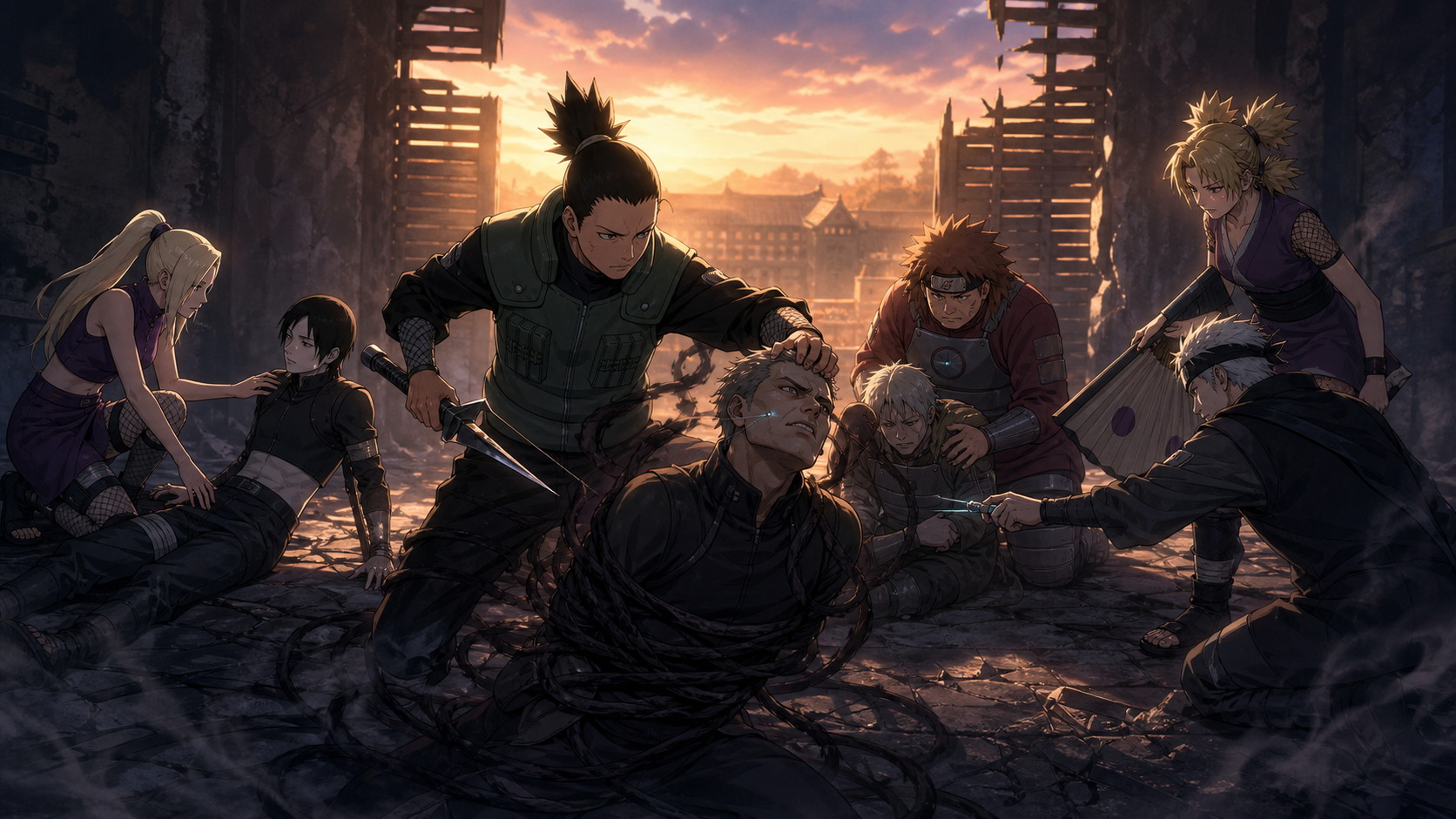
“Dawn” defeats Gengo by proving that pain does not make every bond false. Shikamaru pursues him into darkness while Ino, Choji, and Temari face Sai, Ro, and Soku without confusing coerced violence with willing betrayal. Ino reaches Sai through the emotional language Root denied him. Choji withstands Ro's attacks without punishing a survivor for manipulation built around old shame. Temari counters Soku's precision while insisting that recognition from Gengo is another form of use. Gengo darkens the room to weaken Shadow Possession and claims that he and Shikamaru are alike: intelligent men too perceptive to trust others. Shikamaru rejects the comparison because his weaknesses are held inside relationships, while Gengo killed or discarded anyone who could challenge him. Once the rescued team breaks through, Ro and Soku choose the mission again. Shikamaru captures Gengo, and Soku places a chakra needle through his tongue, ending the voice-based genjutsu without executing him. Afterward, Naruto confronts Shikamaru for hiding the danger, and Shikamaru promises greater honesty. He asks Temari on a date rather than deciding silently what their bond means. Dawn arrives through shared agency, not the lone strategist's perfect move.
Episode 493 concludes the Shikamaru Hiden adaptation
Episode 493 is titled “Dawn.” The episode aired in Japan on February 9, 2017, and completes the five-episode adaptation of Takashi Yano's *Shikamaru Hiden: A Cloud Drifting in Silent Darkness*.
The anime concludes Gengo's capture and brings Shikamaru's secrecy into direct conflict with Naruto, Temari, and Team 10.
Shikamaru follows Gengo deeper into Fushu Castle
The leader retreats away from followers and public speech toward corridors designed to control visibility. Shikamaru carries Asuma's chakra blades into unfamiliar darkness.
The final pursuit leaves the rally behind.
Gengo wants separation restored
Ino, Choji, and Temari disrupted a system that worked by isolating targets from trusted interpretations of their pain. Retreat gives him another chance to control a single listener.
Coercion depends on narrowing the audience.
Team 10 stays with the converted operatives
Shikamaru cannot pursue Gengo and safely neutralize Sai, Ro, and Soku alone. His friends accept the task he once tried to keep away from them.
Delegation becomes chosen responsibility.
Ino faces Sai
Their connection remains new compared with Team 10's lifelong formation, but Ino has already recognized his loneliness beneath awkward language. Her mind techniques give that recognition tactical reach.
Care and specialization meet in one opponent.
Sai describes backup as cowardice
Gengo's influence reframes friendship as evidence that Shikamaru cannot act independently. The insult repeats Root's belief that attachment weakens operatives.
Isolation is presented as superior discipline.
Temari rejects that framing
She came because she chose to investigate and because Gaara recognized Shikamaru's importance to the alliance. Nobody summoned her as a subordinate piece.
Support can preserve autonomy.
Gaara authorized Sand assistance
The Kazekage understands that the era of treating Konoha and Suna as separate interests has changed. A threat to a central union strategist concerns both villages.
Alliance becomes action beyond formal meetings.
Temari pushed through Konoha's silence
Kakashi protected the covert mission, while Ino and Choji knew Shikamaru's behavior had changed. Temari refused to let classification become an excuse for abandoning him.
Diplomatic trust challenges unilateral secrecy.
Ino enters Sai's mental space
Her technique risks placing her inside a mind shaped by Root, Team 7, Gengo, and fear of replacement. Rescue requires contact rather than external force alone.
The battlefield becomes relational memory.
Sai fears losing Team 7
Sasuke's return appears to restore an original formation where he has no secure role. Gengo turns that fear into proof that Konoha only used him temporarily.
Belonging feels vulnerable after institutional conditioning.
Ino refuses the replacement logic
Relationships do not operate through a fixed number of available positions. Sasuke can return without erasing the bonds Sai formed with Naruto, Sakura, Kakashi, and others.
Connection expands rather than swaps bodies.
She recognizes the person beneath control
Ino does not speak to Sai as a defective weapon or demand immediate emotional fluency. She addresses someone whose fear makes sense even when Gengo's conclusion does not.
Validation separates pain from manipulation.
Sai begins to cry
Emotion breaks through the expression Gengo imposed and the restraint Root trained. Tears mark recognition rather than weakness.
The body returns before every thought is clear.
Ino's rescue does not make Sai indebted romantically
Saving his mind creates trust and intimacy, but consent to future relationship remains separate. The episode can support attraction without turning care into a claim.
Gratitude is not romantic obligation.
Choji faces Ro
The larger fighter meets a veteran whose converted discipline remains formidable. Choji's role is to absorb pressure while leaving room for Ro to return.
Strength protects rather than punishes.
Ro's old guilt fuels the fight
Surviving beneath fallen comrades became proof, in his mind, that he failed the unit. Gengo used that shame to offer a new identity through obedience.
Unhealed memory continues directing the body.
Choji understands survivor judgment
He once feared his own limits and believed friends might outgrow or reject him. Team 10 gave him reasons to see survival and vulnerability without contempt.
Empathy informs physical restraint.
Their battle weakens Gengo's hold
Sustained contact with people who refuse the converted identity gives Ro competing evidence. Genjutsu loses certainty when relationship remains present.
Resistance can arrive through another person's patience.
Temari faces Soku
Wind Release gives her broad control against the younger operative's narrow, lethal precision. The matchup contrasts battlefield scale with exact targeting.
Different strengths create containment options.
Soku believes Gengo values her ability
The Land of Silence praises the chakra needles Konoha sometimes treated with suspicion or instrumental interest. Recognition feels like freedom after underestimation.
Praise can still reduce a person to usefulness.
Temari challenges the new ownership
Gengo values Soku because her technique serves his project, not because he supports her independent future. The relationship repeats the village logic under revolutionary language.
Changing employers does not guarantee autonomy.
Soku's resistance returns gradually
Combat, remembered trust, and the weakening voice loosen conversion rather than producing an instant switch. Recovery appears as a process under pressure.
Agency reenters through accumulated contradiction.
Shikamaru enters a darkened chamber
Gengo removes light to limit shadows that can be projected and controlled. The room turns Shikamaru's signature technique into a scarce resource.
Environment becomes ideological advantage.
Darkness also favors Gengo's voice
Without visual anchors or visible allies, language dominates perception. The leader can present himself as the only reliable interpreter of the room.
Isolation increases persuasive control.
Shikamaru carries Asuma's lighter
The familiar object connects him to mentorship, grief, Team 10, and promises made beside a dying teacher. Memory provides a source of light before flame appears.
Inheritance resists Gengo's closed account.
The chakra blades extend his reach
Asuma's weapons can hold shadow chakra and create anchors where the room offers few useful shapes. A teacher's tool becomes part of the student's independent strategy.
Legacy supports adaptation rather than imitation.
Gengo keeps pressing his weaknesses
He names exhaustion, guilt, distrust, and dissatisfaction with the shinobi order. Shikamaru does not deny having those vulnerabilities.
Resistance no longer depends on pretending strength is complete.
Shikamaru says he is made of weak points
The admission deprives Gengo of a revelation to weaponize. Friends already know parts of his fear, laziness, grief, and uncertainty.
Shame loses force when imperfection is allowed.
Gengo claims they are alike
Both men read systems, distrust easy answers, and operate from behind stronger public figures. Gengo treats intelligence as proof that genuine relationship is impossible.
Cynicism becomes his identity test.
Shikamaru refuses the comparison
He may doubt himself and withhold too much, but he remains connected to people who challenge his decisions. Gengo surrounds himself with converted agreement.
Accountable relationship separates strategist from autocrat.
Shikamaru notices Gengo has no companions
The leader speaks constantly about shinobi solidarity while no equal stands beside him. Followers are instruments, audiences, guards, or discarded bodies.
Hierarchy contradicts the liberation claim.
Gengo killed and concealed former allies
People who became inconvenient or resistant were removed rather than heard. The movement's promised belonging lasts only while obedience remains useful.
Disposal reveals the governing principle.
Use or be used defines Gengo's world
He believes every relationship is domination, so taking control first appears rational. That assumption recreates the shinobi system's worst logic while denying alternatives.
Cynicism protects him from mutual obligation.
Shikamaru sees through the loneliness
Gengo calls isolation insight, but the empty room reveals fear of anyone capable of independent judgment. Power has reduced his world rather than expanded freedom.
Control produced the solitude he expected.
The rescued team breaks through
Temari, Ino, Choji, Sai, Ro, and Soku appear together after overcoming the conversions. Their arrival physically refutes Gengo's claim that every bond is use.
People return through one another.
Shikamaru confirms everyone is alive
Relief matters before the tactical end. The comrades whose injuries haunted his nightmares have survived a mission he could not control alone.
Shared risk does not guarantee tragedy.
Ro and Soku resume their assignment
They choose to help capture Gengo after regaining agency. Their participation should be understood as renewed consent, not automatic duty after coercion.
The mission belongs to them again.
Shikamaru catches Gengo's movement
The team creates enough light, distraction, and positional pressure for Shadow Possession to connect. Strategy succeeds through conditions everyone helped build.
The final move has many authors.
Gengo's voice remains dangerous while restrained
Physical capture does not end a genjutsu delivered through speech. Guards, prisoners, and allies remain vulnerable if he can continue talking.
Containment must address mechanism.
Soku targets his tongue
Her chakra needle disables speech precisely rather than killing him. The ability Gengo coveted becomes the tool that ends his coercive authority.
Recognition returns through self-directed use.
Silencing the technique permits custody
Gengo can now face interrogation and political review without converting everyone nearby. Nonlethal neutralization preserves evidence and accountability.
Capture avoids martyrdom and execution.
His followers begin recovering
Once the voice loses influence, people can reassess convictions shaped through genjutsu. Recovery will still require accountability for freely chosen acts and care for coerced ones.
Deconversion is not instant social repair.
Gaara supports the stabilization effort
Sand reinforcements help secure the Land of Silence and demonstrate that the alliance can respond beyond Konoha's unilateral covert action. Multinational presence improves legitimacy only with local participation.
Intervention still needs transparent limits.
Gengo enters custody rather than disappearing
Formal detention makes future review possible and denies Konoha a secret assassination presented as the only solution. The country must also rebuild beyond one leader's removal.
Political repair cannot end at capture.
Naruto confronts Shikamaru afterward
The future Hokage is angry that a friend took a lethal mission in secret while claiming to prepare his administration. Protection performed without his knowledge limits his responsibility.
Leadership cannot inherit hidden machinery blindly.
Shikamaru promises greater honesty
He recognizes that carrying every shadow alone would repeat the secrecy that damaged earlier Hokage systems. Naruto needs truth if their partnership is meant to change governance.
Trust becomes an administrative principle.
Kakashi orders rest
The Hokage gives Shikamaru time away after captivity and psychological attack. Recovery is treated as part of service rather than an obstacle to productivity.
Rest receives institutional permission.
Shikamaru changes how he values time
Work and leisure no longer feel like opposing categories when relationships give both meaning. Efficiency stops being the only measure of a worthwhile day.
Life expands beyond duty.
He asks Temari to stay
Instead of assuming her feelings or hiding his own, Shikamaru creates an opening for direct conversation. The request respects her choice to accept or leave.
Vulnerability replaces strategic concealment.
Shikamaru asks her on a date
The invitation is awkward because emotional clarity is harder for him than military analysis. Directness matters more than polish.
Mutual relationship begins through explicit choice.
Temari calls the request troublesome
Her response mirrors his familiar language while signaling acceptance rather than contempt. Shared humor marks a relationship built through years of challenge.
Rivalry becomes companionship without losing friction.
Sai asks Ino out too
He attempts to thank the person who reached him and explore a connection beyond the mission. The invitation should remain a question, not repayment for rescue.
Affection gains dignity through consent.
Dawn changes the title's cloud imagery
The arc moved through silence, darkness, cloud, and suspicion before reaching morning. Light does not mean every grievance has disappeared.
The new day makes continued work visible.
The rescue works because nobody must become disposable
Ino, Choji, and Temari fight controlled allies with enough force to survive and enough restraint to preserve a route back. Sai, Ro, and Soku are dangerous in the moment. They are also people whose choices have been narrowed by genjutsu built around real wounds. Correct attribution changes the battle.
That approach protects impact and personhood together. Nobody has to pretend coerced attacks caused no harm. Nobody has to call a controlled operative a willing traitor. Recovery can hold medical care, apology, testimony, and institutional reform without inventing guilt where consent was stolen.
Ino restores possibility instead of assigning allegiance
She reaches Sai by refusing the Root logic that relationships occupy replaceable slots. Sasuke’s return does not cancel what Sai built. Ino’s care gives him another interpretation of fear; it does not command romance or demand gratitude. The next choice remains his.
That distinction makes their later invitation sweeter. Affection can grow from rescue while still requiring consent outside crisis. Saving someone never creates ownership over the future they recovered.
Soku ends the voice through her own technique
Gengo values Soku because her precision can serve him. When she regains agency, the same precision disables his tongue without execution. Her ability stops being proof of value granted by a leader and becomes a tool she directs toward the mission she chooses again.
Capture matters. Killing Gengo could turn him into a martyr and erase records about followers, victims, recruitment, and foreign operations. Nonlethal restraint preserves evidence and the possibility of public accountability.
Gengo’s defeat does not answer his recruits
People came to the Land of Silence because hidden villages and feudal systems left them without belonging, work, safe exit, or political voice. Some were coerced. Some agreed before genjutsu deepened loyalty. Removing Gengo cannot sort those histories automatically.
Stabilization needs local participation, individual review, trauma care, civilian options, and safeguards against the great villages treating Tobari as conquered territory. Dawn is legitimate only if residents gain more agency than they had under either regime.
Naruto’s anger is governance feedback
Shikamaru hid a lethal mission while claiming to prepare Naruto for office. Naruto cannot be responsible for a future administration if every morally difficult action is performed beyond his knowledge. Their friendship has to include disagreement, records, and truths that make leadership uncomfortable.
Shikamaru promising greater honesty is therefore political reform in miniature. An adviser should illuminate the machinery of power, not become another unseen person absorbing stains so the Hokage can remain symbolically clean.
Temari’s presence also changes what the alliance looks like after the mission. She did not arrive as Konoha backup under Shikamaru’s command. She came with Sand authority, personal concern, and the refusal to let classification exclude a partner from shared risk. That difference matters when outside forces stabilize the Land of Silence. Cooperation should not become several powerful villages agreeing among themselves while local residents watch another government form over their heads. Temari and Gaara can model alliance as mutual responsibility only if Tobari’s people gain information, representation, and a voice in what happens next. Shikamaru’s date invitation belongs to the same lesson at a smaller scale. He stops predicting her answer privately and asks. The moment is awkward because direct consent offers less control than strategy. That vulnerability is healthy. Temari gets to accept, refuse, joke, challenge, or set terms. Their relationship becomes possible when neither person treats care as authority over the other. The arc has spent five episodes showing how dangerous it is when one voice decides what everybody’s pain means. Ending with questions instead of commands feels right. Dawn is not certainty. It is enough light for people to see one another, name what happened, and choose the next move together with care.
Final verdict
“Dawn” completes Shikamaru's arc by disproving Gengo through relationships that retain disagreement. Ino does not restore Sai by commanding loyalty; she validates the fear underneath his conversion and shows that Sasuke's return cannot erase him. Choji and Temari resist Ro and Soku without treating coerced attacks as chosen betrayal. Shikamaru defeats the claim that intelligence requires isolation by admitting he has more weak points than strengths and recognizing that Gengo's followers are never allowed to become equals. The final capture belongs to everyone. Team 10 creates the opening, converted operatives reclaim agency, and Soku disables the dangerous voice without killing its owner. Naruto's anger afterward matters as much as the battle. A future Hokage cannot reform secret violence he is never allowed to see. Shikamaru's promise of honesty and his direct invitation to Temari move the same lesson into politics and intimacy: trust means letting another person know enough to choose beside you.
Sources and watch notes
- Naruto Official episode guide for the official series record.
- Crunchyroll for the licensed episode route where available.
What I am carrying forward
Episode 494 begins the wedding arc. I am carrying forward the need for Sai, Ro, and Soku’s recovery, transparent review of Gengo’s movement, local agency in the Land of Silence, Shikamaru’s promise to Naruto, and his direct invitation to Temari. Dawn must become ordinary accountability.