
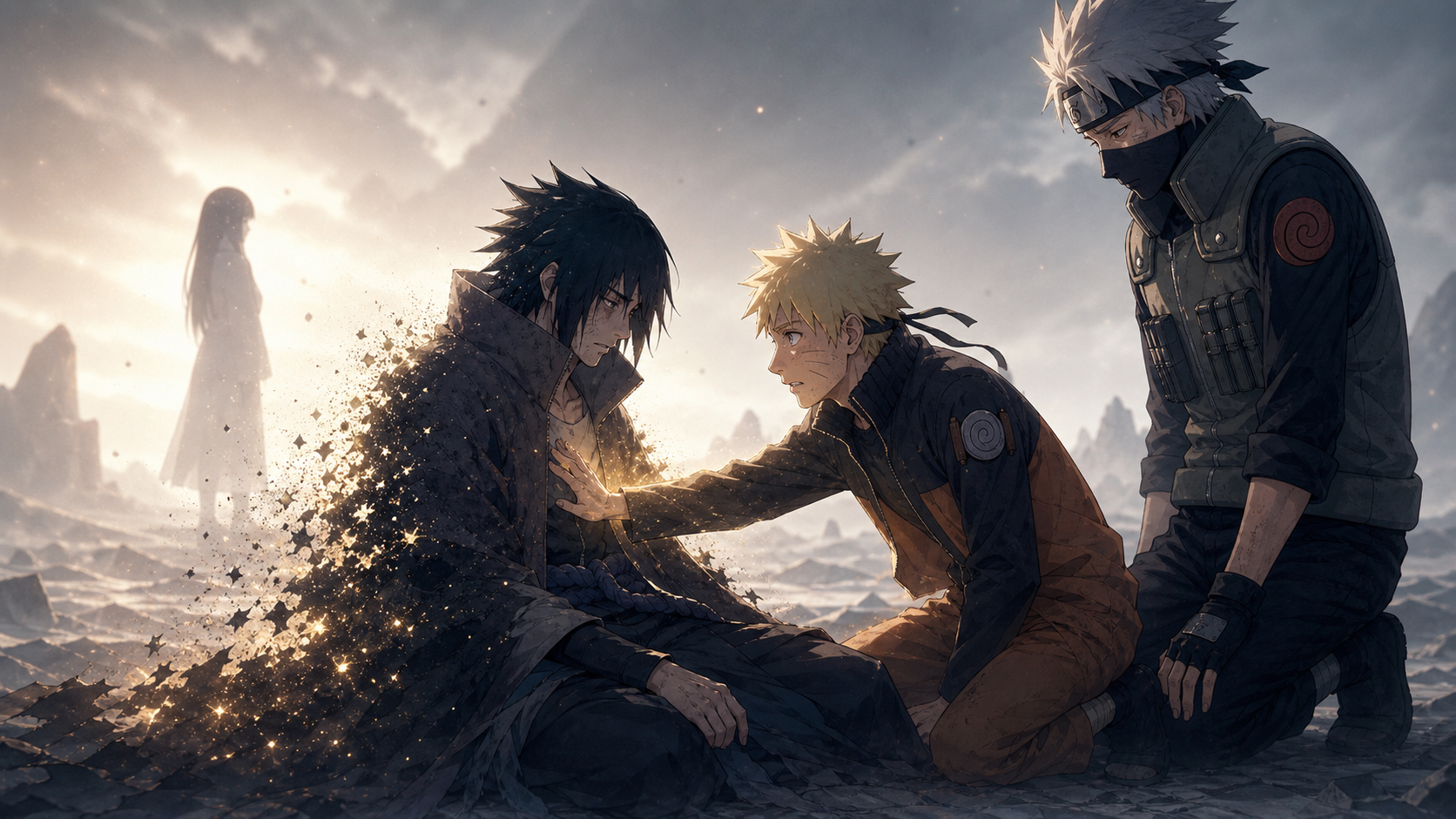
You Better…
Obito’s last instruction deserves to shape Naruto’s future without turning personal forgiveness into a verdict for every person harmed.
Bottom line
“You Better…” gives Obito the farewell Naruto wants for him, not the reckoning every victim would choose. As All-Killing Ash Bones reduce his body to ash, Obito tells Kakashi to support the next generation and tells Naruto to become Hokage. Naruto tries to heal him, but no Six Paths gift can reverse Kaguya's technique. Black Zetsu mocks Obito as a failed insect whose life produced nothing. Naruto answers with fury, defends the child who once shared his dream, and tears Kaguya's arm from her body. That defense is emotionally legible and morally incomplete. Obito did recover the part of himself capable of protecting others. He also helped kill Naruto's parents, controlled Yagura, enabled Akatsuki, launched a world war, and trapped humanity inside Infinite Tsukuyomi. Rin welcomes him in the afterlife because she loved him and watched his final struggle. Her welcome is personal, not a verdict delivered on behalf of the dead. Obito's last command carries truth: Naruto must become the kind of Hokage Obito abandoned. The future can honor his final choice without calling his whole life awesome.
Episode 472 adapts manga chapter 687
Episode 472 is titled “You Better…” The Japanese title is “Omae wa Kanarazu.” The episode aired in Japan on August 18, 2016.
The canonical chapter is expanded with a long Obito retrospective and his reunion with Rin.
Obito is already dying
Kaguya's bone has pierced him, and disintegration spreads through his body. Healing time is measured in seconds rather than medical possibility.
The farewell begins before anyone can deny the outcome.
Kakashi asks why
He questions Obito's decision to save him when Kamui remains useful against Kaguya. Tactical logic becomes a shield against immediate grief.
Kakashi wants the mission to explain why his friend must stay.
Obito redirects him toward the enemy
He refuses to let Kakashi spend their remaining time arguing over value. Kaguya still threatens Naruto, Sasuke, Sakura, and the trapped world.
Duty gives grief a direction.
Kakashi is needed after the battle
Obito sees his old rival as a teacher capable of guiding whoever survives. Kakashi's contribution cannot be reduced to current attack power.
The next generation needs witnesses as well as warriors.
Team 7 represents the future
Naruto, Sasuke, and Sakura carry different capacities, wounds, and political possibilities. Their reunion creates a future Obito once tried to replace with illusion.
He now protects reality's unfinished children.
Kaguya needs chakra recovery
Dimensional changes and high-level techniques have consumed enormous energy. She retreats toward her core world to replenish reserves.
Even godlike power requires pacing.
Retreat creates a farewell window
The temporary break lets Obito speak while Sasuke prepares to keep Kaguya occupied. Time for grief exists only because another fighter maintains pressure.
Emotional closure depends on battlefield labor.
Naruto attempts Six Paths healing
He places his hand near Obito and tries the power that restored Kakashi's eye and stabilized Might Guy. Past miracles make refusal emotionally impossible.
Naruto must test the limit himself.
All-Killing Ash Bones cannot be reversed
The technique destroys tissue completely rather than causing an ordinary wound. Naruto's chakra does not stop the crumbling.
Power meets a death outside repair.
Failure is not lack of effort
Naruto cannot save every person because he wants fiercely enough. The series occasionally protects him from that truth, but Obito's death does not.
Care remains real when rescue fails.
Black Zetsu weaponizes the moment
He mocks Naruto's attempt and treats Obito's dying body as entertainment. Cruelty aims to destabilize the only fighter still pressing Kaguya.
Grief becomes another battlefield surface.
Obito agrees that his life was wasted
He recognizes years devoted to Madara's lie, Infinite Tsukuyomi, and manufactured despair. Self-condemnation fits the scale of his choices.
Recognition arrives after victims paid the cost.
Agreement does not satisfy Black Zetsu
The mockery is not an invitation to accountability. Black Zetsu wants humiliation, dehumanization, and emotional collapse.
He reduces a person to usefulness for Kaguya's plan.
Naruto rejects the dehumanization
He refuses to let Black Zetsu define Obito as an insect. Defending human dignity does not require denying guilt.
Naruto's anger is strongest when contempt replaces judgment.
The word awesome goes too far
Naruto praises Obito because the child who dreamed of becoming Hokage resurfaced. The statement honors recovered aspiration while sounding like a verdict on the adult's full record.
Victims deserve more precise language.
Naruto sees a possible version of himself
Both boys were lonely, late, mocked, devoted to teammates, and desperate for recognition. Obito embodies what Naruto might have become after surrendering hope.
Identification drives mercy.
Similar beginnings do not equal similar choices
Naruto endured rejection without building a system of mass coercion. Obito's pain explains vulnerability to Madara, not every decision afterward.
Parallel childhoods sharpen responsibility rather than erase accountability.
Minato and Kushina remain inside the judgment
Obito released Kurama during Naruto's birth and helped cause both parents' deaths. Naruto's defense therefore includes forgiveness of intimate harm.
He can offer his own forgiveness, not everybody else's.
Yagura's suffering remains absent
Obito controlled the Fourth Mizukage and contributed to the Bloody Mist's terror. That history receives no voice during his farewell.
Personal reconciliation cannot represent an entire nation.
Akatsuki's victims remain absent too
Jinchuriki were hunted, extracted, and killed through the organization Obito helped direct. Countless shinobi died after his declaration of war.
The episode narrows memory to people who loved him.
Sasuke regains ocular power
His Rinnegan's tomoe return after the dimensional strain. Recovery gives Team 7 an attacker capable of forcing Kaguya to react.
He recognizes the opening immediately.
Sasuke becomes the distraction
He tells Naruto to remain with Obito while he occupies Kaguya. The usually isolated fighter deliberately carries the combat burden for someone else's goodbye.
Support roles shift without argument.
Complete Body Susanoo takes flight
Sasuke surrounds himself with the enormous armored avatar and drives toward Kaguya. The attack threatens enough force to prevent her from resting.
Pressure protects Obito's final words.
Kaguya changes dimensions again
She narrowly avoids Sasuke and abandons a stable recovery position. His assault achieves delay even without landing a decisive blow.
Distraction becomes successful combat.
Obito thanks Kakashi
Their relationship contains rivalry, rescue, betrayal, borrowed eyes, combat, and reconciliation. Gratitude does not summarize everything, but gives the ending a human sentence.
He leaves without demanding praise.
He thanks Naruto for recognition
Naruto addressed him as Obito rather than Madara and kept calling him toward the abandoned Hokage dream. That insistence helped dismantle the mask.
Being named correctly reopened responsibility.
Remembering himself is not recovering innocence
The young dreamer never entirely disappeared, but the adult cannot return to a point before harm. Recovery means choosing differently with the time left.
Identity carries the record forward.
The title becomes a command
Obito tells Naruto that he absolutely must become Hokage. The unfinished phrase contains demand, faith, and warning.
Naruto inherits a dream from somebody who betrayed the office's meaning.
Hokage now means resisting escapism
Obito pursued Infinite Tsukuyomi because reality could wound and disappoint. Naruto must lead without promising a painless dream or forcing happiness onto others.
The office becomes stewardship of an imperfect world.
Naruto accepts the charge
He does not pause for a formal promise. His reaction carries commitment through grief and battle.
Becoming Hokage remains future work, not a title awarded by one dying endorsement.
Obito turns completely to ash
Kaguya's technique finishes its work, leaving no body for burial or healing. The visual repeats the impermanence of everything he tried to preserve inside illusion.
Only memory remains on the battlefield.
Black Zetsu compares him to a cockroach
The insult praises endurance only by making survival disgusting. Black Zetsu cannot imagine persistence as repentance.
He understands bodies as instruments and waste.
Naruto's rage becomes speed
The taunt pushes him into a direct assault on Kaguya. Emotion sharpens rather than paralyzes his movement.
Grief turns immediately toward protecting the living.
A chakra arm severs Kaguya's limb
Naruto crosses the distance and cuts off the arm carrying Black Zetsu. The strike wounds Kaguya and physically removes her commentator from immediate control.
Anger produces tactical value.
Black Zetsu loses his platform
Attached to Kaguya's severed sleeve and arm, he is displaced from the body whose choices he has narrated throughout the fight. Naruto's response interrupts both voice and weapon.
The manipulator is briefly isolated.
Violence does not answer the moral argument
Severing Kaguya's arm stops a threat but cannot prove Naruto's broad praise of Obito correct. Combat success and ethical precision are different tests.
The episode treats fury as emotional resolution too quickly.
Obito enters the afterlife as a child
His younger appearance separates the self Rin first knew from the scarred adult who died. The image offers emotional return.
Visual innocence risks softening adult responsibility.
Rin has been waiting
She tells Obito that she watched his path and recognizes the effort he made near the end. Her presence fulfills the reunion he distorted the world trying to manufacture.
Reality gives what illusion could only counterfeit.
Rin's forgiveness belongs to Rin
She can welcome the teammate she loved and still cannot pardon crimes committed against strangers. Forgiveness is not transferable authority.
Her embrace closes their relationship, not history's case.
Watching does not mean approving
Rin's statement that she saw him should include knowledge of both atrocities and change. The anime emphasizes comfort rather than confrontation.
Reconciliation arrives with fewer questions than his record warrants.
Obito apologizes for the delay
He frames his long path as time taken before joining her. The line is tender and troubling because those years contained deliberate mass harm.
Delay was catastrophic for people outside their reunion.
The afterlife rewards recovered identity
Obito reaches the person connected to his original dream after rejecting Madara's worldview. The spiritual logic values who he chose to become at death.
Earthly accountability remains unfinished because death ends its possibility.
Flashbacks dominate the adaptation
Chapter 687 supplies a brief death scene, while the anime revisits childhood, Rin's death, Akatsuki, war, and Obito's ideological collapse. The expansion aims for closure.
Repetition can exhaust viewers who remember those scenes clearly.
Memory still clarifies the final contrast
Placed together, the images show the distance between boy, masked leader, jinchuriki, defeated enemy, and ally. Obito's identity was never one clean category.
The montage works when used as evidence, not absolution.
Kakashi receives no private closure yet
He watches his friend disappear and must immediately remain useful. Grief cannot fully unfold while Kaguya attacks.
Obito's instruction to stay becomes an emotional burden.
Sakura witnesses another teammate loss
She helped keep Obito alive through the dimensional search and now watches healing become impossible. Her response receives less focus than Naruto and Kakashi's.
The episode again prioritizes male reconciliation.
Sasuke expresses care through action
He does not join the farewell dialogue, but his decision to hold Kaguya away grants others those seconds. Emotional distance does not equal absence of care.
Protection can be quiet and tactical.
The farewell prepares Kakashi's next role
Obito wants him alive for Team 7, and the next stage will return their shared eye power in an unexpected form. Death does not finish the partnership immediately.
The title's ellipsis remains open.
Naruto's best response is future conduct
Words spoken in grief will never resolve Obito's legacy. Becoming a Hokage who rejects coercive peace and remembers victims would answer the command more honestly.
Leadership must make the distinction visible.
Naruto’s failed healing keeps care honest
He has restored Kakashi’s eye and pulled Guy back from death, so trying Obito is not denial detached from experience. Naruto has seen impossible interventions work through his hands.
All-Killing Ash Bones establishes a limit no commitment can negotiate. Care remains real because he attempts rescue, stays present, and listens after the body cannot be saved.
Black Zetsu offers contempt instead of accountability
Calling Obito an insect does not honor victims or examine responsibility. The insult reduces a human life to whether it efficiently served Kaguya’s return.
Accountability names choices, consequences, and people harmed. Contempt declares the person beneath judgment, which repeats the same ownership logic Obito used against others.
Naruto can defend dignity without defending the record
He recognizes the lonely child, abandoned Hokage dream, and final capacity to protect. Those parts of Obito deserve language more precise than Black Zetsu’s mockery.
Naruto does not need to call the whole adult life awesome to refuse dehumanization. Dignity belongs even to somebody guilty of devastating harm.
Personal forgiveness has a jurisdiction
Naruto may forgive the person who released Kurama during his birth and helped cause Minato and Kushina’s deaths. Rin may welcome the teammate she loved. Kakashi may mourn a friend who betrayed him.
None can pardon crimes committed against Yagura, jinchūriki, villages, soldiers, or civilians. Forgiveness cannot be transferred from one relationship to unrelated victims.
Rin’s welcome cannot become a universal verdict
Her reunion answers the private bond Obito distorted the world trying to recover. She watched his final struggle and chooses tenderness in the afterlife.
That choice belongs to Rin. The scene becomes dishonest only when viewers are asked to treat her embrace as proof that history’s account has closed.
Sasuke makes the goodbye possible
He restores his ocular power, recognizes that Naruto needs time, and takes responsibility for pressuring Kaguya alone. The quiet tactical choice gives Obito room for final words.
Care does not always enter the conversation. Sometimes it keeps the danger away from people who need to speak.
The Hokage command is warning as much as faith
Obito tells Naruto to become the leader he once wanted to be. The request carries hope because Naruto refused the despair that captured him.
It also carries a warning. Hokage cannot mean imposing comfort, erasing grief, or deciding that a painless illusion is better than other people’s unfinished freedom.
Future conduct is the only durable memorial
Naruto’s grief-fueled attack removes Kaguya’s arm and interrupts Black Zetsu, but violence cannot settle Obito’s meaning. The better answer unfolds after the battle.
Leading without coercive peace, remembering victims beside changed perpetrators, and protecting reality even when reality hurts would honor the final instruction without falsifying the life behind it.
An afterlife reunion does not replace earthly repair
Obito dies before restitution, testimony, rebuilding, or judgment can continue. Death ends his capacity to repair more than one immediate crisis.
The living inherit those obligations. Kakashi, Naruto, the villages, and survivors must address what remains rather than treating spiritual closure as social repair.
The obituary needs every tense
Obito was a child who valued comrades. He became an adult who engineered mass harm. He changed, helped end the war he created, saved Kakashi, and died asking Naruto to protect a real future.
A truthful account refuses to let the final verb erase the earlier ones or the earlier verbs make the final choice meaningless.
Grief should widen memory, not narrow it
The people closest to Obito dominate his final moments. Kakashi remembers childhood rivalry and rescue. Naruto sees a damaged version of his own dream. Rin receives the boy she loved. Those perspectives explain the tenderness, but they cannot become the only archive.
A responsible farewell keeps absent victims present without demanding that every intimate goodbye become a courtroom. The episode can let Kakashi grieve, let Rin welcome, and let Naruto defend human dignity while the editorial record still names the bodies, villages, and futures Obito harmed. Compassion does not require silence. Accountability does not require denying that a person changed before death. The memory refuses both shortcuts and lets survivors hold different truths without forcing one relationship to govern them all.
RaeRae’s verdict
“You Better…” is strongest when Naruto cannot save Obito and must receive the dream instead. The failed healing prevents another miracle from avoiding loss, while Sasuke’s combat support gives the farewell room.
The episode becomes too broad when personal love sounds like collective acquittal. Obito’s final act is brave, his instruction is worthy, and his reunion with Rin can be tender. His victims remain inside the truth. Holding all four facts is not cruelty. It is memory.
Final verdict
“You Better…” is moving because Obito dies asking for a future he once tried to erase. He thanks Kakashi, recognizes Naruto, and places the Hokage dream in hands that did not surrender to despair. Sasuke's decision to distract Kaguya gives the farewell room, while Naruto's failed healing attempt forces him to accept a death beyond miraculous repair. The episode becomes weaker when Naruto calls Obito broadly awesome and when Rin's welcome feels like a universal acquittal. Naruto may forgive the man who helped kill his parents. Rin may forgive the teammate she loved. Neither speaks for Yagura, the jinchuriki, the Allied dead, or every person trapped by Infinite Tsukuyomi. Obito's last act was brave. His final instruction was worthy. His reunion can be tender. A truthful obituary must hold those facts beside the devastation he chose.
RaeRae’s call
Naruto and Rin can forgive what Obito did to them; they cannot speak for every other victim. His last act is brave, his Hokage command is worthy, and his return to Rin is personal tenderness. None turns the Nine-Tails attack, Yagura’s control, Akatsuki, the war, or Infinite Tsukuyomi into a detour toward redemption. The honest farewell lets change matter while keeping the people harmed before that change visible.
Episode details and viewing routes
- Official episode reference: Naruto Official episode guide
- Licensed episode route: Crunchyroll licensed episode page
What I am carrying forward
Obito died after saving Kakashi from Kaguya’s All-Killing Ash Bones. Naruto could not reverse the disintegration, and Sasuke held Kaguya away long enough for final words.
Obito asked Kakashi to support Team 7 and told Naruto to become Hokage. Naruto severed Kaguya’s arm after Black Zetsu mocked the death, while Obito reunited with Rin. Episode 473 returns his chakra and both Mangekyo Sharingan to Kakashi for one last shared intervention.