
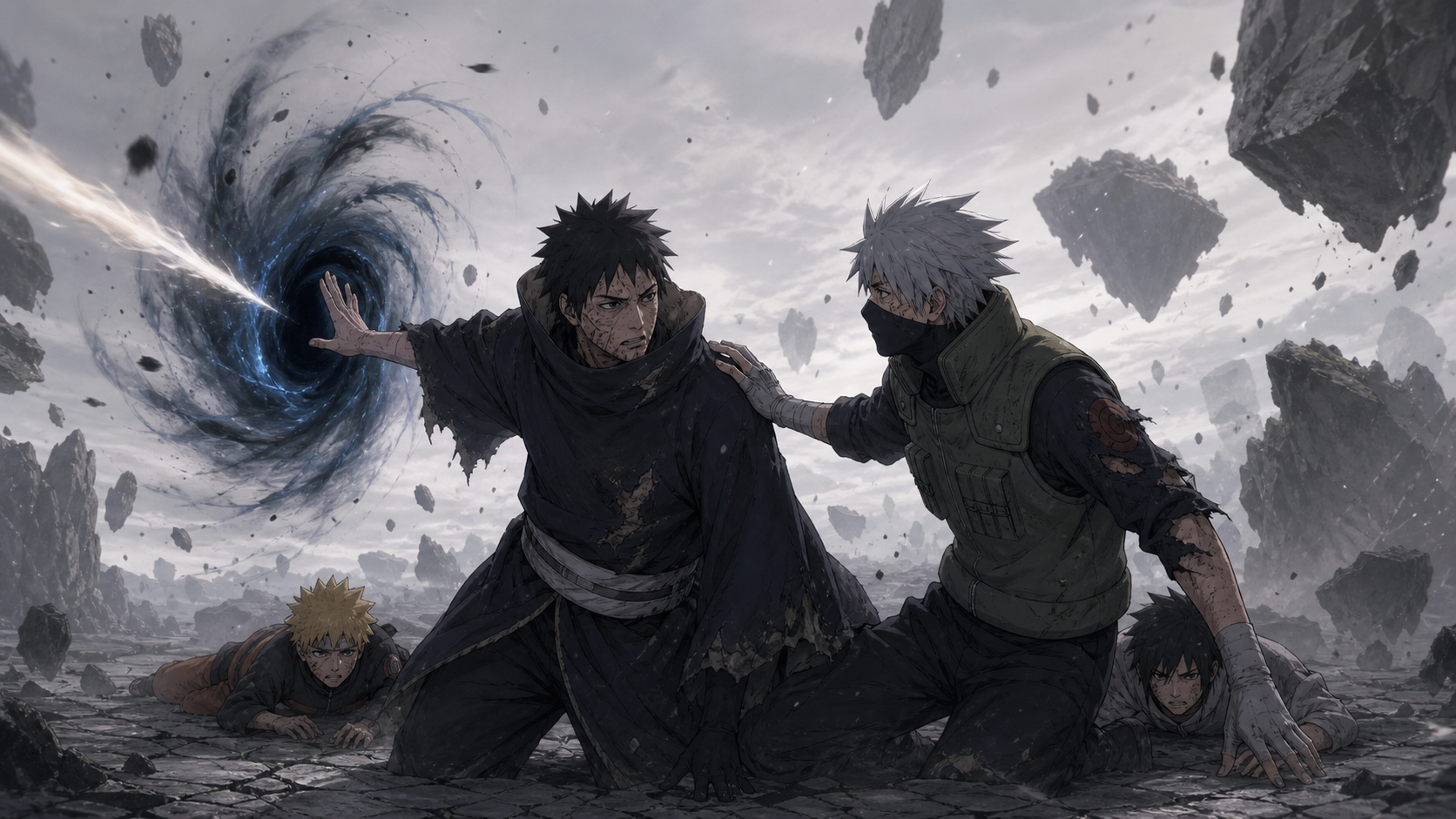
The Two of Them…Always
Obito makes one necessary final choice without receiving a moral refund for the war, deaths and dream prison he built before it.
Bottom line
“The Two of Them… Always” gives Obito a meaningful final choice without granting him a moral refund. He has enough strength left to return Sasuke and Sakura, then Kaguya shifts Team 7 into a dimension where gravity pins even Naruto and Sasuke to the ground. All-Killing Ash Bones fly toward the two people capable of sealing her. Kakashi and Obito force their bodies upright and move as shields, each remembering Rin. Obito uses Kamui one last time to erase the projectile aimed at Kakashi while accepting the fatal strike meant for himself. The symmetry is deliberate: he once saved Kakashi beneath falling rock, later built a war from grief and resentment, and now saves him again while asking his old rival to remain alive. The sacrifice protects the world. The sacrifice does not resurrect the dead, undo Infinite Tsukuyomi, or transform mass violence into a detour toward heroism. Obito dies doing the necessary thing after years of choosing the catastrophic one. Both truths belong in the same frame.
Episode 471 adapts manga chapter 686
Episode 471 is titled “The Two of Them… Always.” The Japanese title is “Futari o Chanto.” The episode aired in Japan on August 11, 2016.
The chapter continues the canonical Kaguya battle while expanding Obito's memories for television.
Hagoromo briefs the four Hokage
Away from Kaguya's dimensions, Hagoromo explains Team 7's situation to Hashirama, Tobirama, Hiruzen, and Minato. The dead leaders need a role in ending a battle they cannot enter directly.
Information begins their preparation.
Madara's severed body enabled manifestation
Hagoromo's chakra emerged through the remains left on the battlefield. Ancient power returns through the body Black Zetsu used and discarded.
Madara's defeat keeps producing unintended openings.
Hagoromo has already divided his power
Much of his chakra now belongs to Naruto and Sasuke through the sun and moon seals. He cannot simply perform every needed technique himself.
Empowerment has made the next generation necessary.
One unavailable jutsu shapes the plan
Hagoromo mentions a technique he can no longer execute alone. The four Hokage will have to contribute chakra and positions when Team 7 returns.
Rescue depends on people outside the visible battle.
Obito is failing physically
Repeated dimensional searches pushed Kamui beyond his remaining reserves. His eyes bleed, his body weakens, and Kaguya's worlds offer no recovery time.
Naruto's earlier restoration postponed death rather than erasing damage.
He remembers the Hokage dream
Young Obito wanted public recognition and imagined his face carved above Konoha. The memory returns after he spent years hiding behind Madara's name and an orange mask.
Identity becomes the episode's quiet battlefield.
Kakashi was always inside that dream
Their childhood rivalry gave Obito someone to chase, resent, admire, and protect. Becoming Hokage was never detached from being seen beside Kakashi and Rin.
Ambition began relationally before grief turned inward.
Rin remains the emotional center
Obito remembers the teammate who believed in both boys and asked them to care for one another. Her death shaped his despair, but her wishes never endorsed the world he created afterward.
Love cannot be used as an alibi.
He focuses on the immediate task
Obito cannot repair history while stranded between dimensions. He must return Sasuke and Sakura to Naruto before Kaguya discovers the rescue.
Responsibility narrows to the next necessary action.
Sasuke's return completes the sealing condition
Naruto and Sasuke each carry one half of Hagoromo's power. Reuniting them restores the only known path to stop Kaguya permanently.
The rescue changes the battle's possible ending.
Sakura returns depleted
She has supplied enormous chakra, survived corrosive dimensions, and physically supported Obito through repeated portals. Arrival does not reset her body.
Success carries the cost into the next stage.
Kaguya hunts the apparent original
Among Naruto's copies, she targets the figure carrying Truth-Seeking Balls. The visual marker appears to identify the real body.
Naruto has anticipated that assumption.
Clones protect the marked decoy
Several copies defend the Naruto with the orbs, reinforcing Kaguya's conclusion. Their behavior sells the false priority.
Deception depends on coordinated performance.
Kakashi feels useless
Without the Sharingan, he cannot match the dimensional techniques or Six Paths power around him. A man defined by copied jutsu suddenly lacks a clear combat function.
Helplessness threatens his sense of identity.
Utility is not the measure of belonging
Kakashi remains Team 7's teacher and Obito's oldest living bond even when he cannot damage Kaguya. Relationship does not expire when ability changes.
The episode will make his life worth saving beyond tactical value.
Kaguya catches the decoy
Her hair restrains the marked Naruto, and she strikes him down. The protected target appears to have been the correct one.
The trap closes on her confidence.
The Truth-Seeking Balls were transferred
Naruto gave the orbs to a clone so the original could move without the obvious signature. Power becomes camouflage when separated from identity.
Kaguya kills another copy.
The real Naruto remains active
The sealing half survives because he treated his strongest visual symbol as disposable. Strategy beats the assumption that power always announces the true body.
Humility becomes concealment.
Kaguya changes the environment
With Sasuke restored, she abandons ordinary pursuit and moves everyone into a high-gravity dimension. The world itself becomes restraint.
Terrain replaces direct binding.
Gravity affects Kaguya too
She drops alongside her enemies and must adjust to the force she selected. Dimensional ownership does not grant total immunity.
Her advantage comes from preparation and ranged lethality.
Naruto and Sasuke cannot rise
Even Six Paths-enhanced bodies are pressed against the ground. Their sealing marks mean nothing if neither can reach the target.
Overwhelming power becomes useless without movement.
Sakura is pinned after exhausting herself
Her chakra reserve is nearly empty before gravity adds another burden. She cannot simply heal or strike through the condition.
The prior rescue shapes present vulnerability.
Kakashi and Obito struggle upright
The two older shinobi force movement despite the same environment holding stronger fighters down. Emotion and timing drive the scene, though the physical logic is strained.
Drama outruns consistent power scaling.
The gravity inconsistency is visible
Viewers reasonably question how depleted Kakashi and Obito move when Naruto, Sasuke, Sakura, and Kaguya cannot. The episode offers determination rather than a mechanical explanation.
Emotional coherence does not erase physical convenience.
Kaguya fires All-Killing Ash Bones
The projectiles disintegrate any body they pierce. Healing cannot reverse the technique once contact begins.
The attack targets Naruto and Sasuke simultaneously.
Her first aim is disrupted
High gravity alters the trajectory, causing the initial shots to miss. Kaguya learns from the error rather than abandoning the method.
The environment buys Team 7 one warning.
The second volley compensates
Kaguya adjusts her aim for gravity and fires again. The bones now travel toward the immobilized sealing pair.
No clone exchange or Rinnegan swap appears available in time.
Kakashi moves toward Naruto
He places his body between a student and certain death. The teacher who felt useless finds a role no special eye requires.
Protection becomes his remaining technique.
Obito moves toward Sasuke
He shields the other half of the seal. Their parallel paths initially suggest both old teammates will die together.
Rin's memory pulls them into the same choice.
Both remember the childhood promise
Rin asked Obito and Kakashi to look after one another. The memory survives betrayal, war, and decades of silence.
Her care becomes a demand for life rather than revenge.
Rin should not be reduced to moral equipment
The series repeatedly uses her image to motivate male rivalry, despair, and reconciliation. Her own choices matter, especially the decision to die preventing the Three-Tails attack.
Memory should preserve her agency.
Obito sees the old pattern repeating
He once pushed Kakashi away from falling rock and lost half his body. Now both men are stepping into fatal projectiles.
The first rescue never stopped binding their lives.
Kamui removes Kakashi's bone
Obito uses his left eye to warp away the projectile aimed at his friend. Precision saves Kakashi without moving his body through the gravity field.
His final technique creates one surviving path.
He accepts the other strike
The bone pierces Obito, and disintegration begins. He spends his last usable intervention on Kakashi rather than himself.
Sacrifice becomes deliberate and informed.
Obito cannot phase through the attack
His restored eyes and exhausted chakra do not provide an easy escape after using Kamui for Kakashi. The lethal technique closes what Naruto's healing briefly reopened.
His time has ended.
Kakashi is ordered to stay longer
Obito tells his friend not to follow him yet. The line rejects their shared impulse toward self-sacrifice.
One of them must remain with Team 7.
Saving Kakashi is not repayment
Obito cannot exchange one life for the thousands lost through Akatsuki, the Ten-Tails, and the war. Moral arithmetic does not work that way.
The choice still prevents another death.
A good death does not create a good life
Final courage can reveal capacity for change without rewriting years of domination. Obito dies acting against the worldview he enforced.
Contradiction is the honest verdict.
Naruto's influence reaches the decision
Naruto refused Obito's false identity and insisted that the boy who wanted to be Hokage still carried responsibility. That recognition helped reopen a future-directed choice.
Accountability gave him somewhere to move.
Kakashi receives survival as an assignment
Living now means carrying grief without repeating Obito's escape into fantasy. He must help Naruto, Sasuke, and Sakura finish the battle.
Survival becomes labor rather than reward.
Team 7 witnesses the cost
Obito's body crumbles before people he endangered and later helped. Their urgency leaves little room for a complete moral reckoning.
The battle keeps grief unfinished.
Kaguya treats bodies as obstacles
She does not understand why Kakashi and Obito move to absorb attacks for others. Sacrifice disrupts a worldview organized around possession and chakra recovery.
Relationship produces behavior she cannot predict cleanly.
Black Zetsu understands tactics, not bonds
He can identify sealing marks and advise lethal priorities. He repeatedly underestimates choices rooted in care because he treats attachments mainly as tools for manipulation.
Connection exceeds his model when people accept cost voluntarily.
The title belongs to Kakashi and Obito
“The Two of Them… Always” describes a bond that survives rivalry, apparent death, hidden identity, and war. Persistence does not make every phase healthy.
Their connection contains love and catastrophic harm.
The ellipsis carries unfinished history
The title pauses before “always,” leaving room for everything neither man said in time. Their reconciliation happens under conditions where future conversation is almost gone.
Delay has a human price.
Episode 471 is not Obito's full farewell
The fatal strike occurs here, while his last words, death, meeting with Rin, and later chakra gift continue across subsequent episodes. The chapter ends inside dying rather than after closure.
The boundary preserves suspense and grief.
Hagoromo's parallel scene widens the ending
While Obito protects the sealing pair, the four Hokage prepare to help return Team 7 from Kaguya's dimensions. Multiple generations assemble different parts of the exit.
No era finishes the war alone.
Kakashi's powerlessness becomes emotional clarity
Losing the Sharingan removes the technique that linked him physically to Obito. Faced with death, both still choose one another without needing the eye to prove connection.
The bond precedes the borrowed power.
The sacrifice completes a circle, not a balance sheet
Obito saves Kakashi twice, once before becoming a masked architect of war and once after rejecting that identity. Circular storytelling explains the scene's emotional force.
No circle restores the victims between those rescues.
The scene works because judgment remains possible
Viewers can mourn the child Obito was, condemn the adult he became, and value the life he saves now. The story weakens when those positions are treated as mutually exclusive.
Compassion needs memory.
Obito’s final choice protects a future he once attacked
Naruto and Sasuke carry the only available seal, but Kakashi carries the relationships and judgment Team 7 will need after the battle. Obito saves that future when he warps away the bone aimed at his friend.
The act matters because it opposes his earlier worldview. He once treated real lives as acceptable losses beside an imposed dream. Now one actual life is worth his remaining power.
A sacrifice can be meaningful without becoming payment
Obito cannot trade his death for the people killed through Akatsuki, the tailed-beast hunts, the Nine-Tails attack, the war, or Infinite Tsukuyomi. Those lives are not numbers waiting for an equal deposit.
Saving Kakashi still prevents another loss. Moral seriousness requires holding the value of the present choice beside the impossibility of reimbursement.
Kakashi is worth saving when his combat utility is lowest
Without the Sharingan, he feels unable to influence a battlefield defined by dimensions and Six Paths power. Obito does not calculate whether Kakashi can deliver enough force to justify protection.
Belonging survives changing capacity. Kakashi matters as a person, teacher, friend, and witness before any new technique restores his tactical importance.
Survival becomes Kakashi’s assignment
Obito tells him not to follow. The request interrupts the old pattern in which grief makes death feel like reunion or relief. Kakashi must remain inside the difficult world with students who still need him.
Living is not the prize handed to the more innocent man. It is work: carry memory, finish the battle, and refuse to repeat the escape Obito chose after Rin.
Rin’s memory needs her own verbs
She encouraged both boys, served as a medic, understood the Three-Tails trap, and chose death through Kakashi’s attack to protect Konoha. Her life cannot be reduced to the image that sends two men toward sacrifice.
Obito’s grief belongs to him. It does not become Rin’s endorsement of the war he built around losing her.
The gravity problem remains a real seam
Naruto, Sasuke, Sakura, and Kaguya are pinned while two exhausted older shinobi force themselves upright. Determination explains the emotional beat but not the physical advantage.
Naming the inconsistency does not cancel the scene. It keeps admiration honest instead of demanding that viewers abandon the rules the episode established seconds earlier.
Kamui performs the opposite of its old purpose
The technique once let Obito remove himself from contact, hide crimes, imprison people, and control when consequences could touch him. Its final use preserves Kakashi inside the shared world.
Power has no independent redemption arc. Meaning changes because Obito uses the same capacity for exposure and connection rather than evasion.
Black Zetsu understands attachment mainly as leverage
He isolates Indra, manipulates Madara, directs Kaguya, and identifies which two bodies carry the sealing threat. Relationships appear useful when they can be broken or exploited.
Obito’s choice exceeds that model. He accepts a fatal cost voluntarily so another person can remain free, not because anybody controls his grief.
The episode lets contradiction remain
Obito was the boy who saved Kakashi, the masked man who helped destroy countless lives, and the dying adult who saves Kakashi again. No single identity erases the others.
That complexity is the only respectful way to mourn. Compassion without memory falsifies victims; condemnation without change falsifies the final act.
Redemption stories become dishonest when the person who changed receives more narrative care than the people harmed before that change. Obito deserves recognition for choosing differently at the end, but the victims do not become background to his growth. Their absence is part of the scene’s meaning. Kakashi can love his friend, mourn him, and continue living without declaring the history repaired or the account closed by one courageous decision made under pressure at last.
RaeRae’s verdict
“The Two of Them… Always” works because Obito receives a final good choice rather than a clean moral account. He protects Kakashi, preserves Team 7’s future, and dies opposing the logic that once made the world expendable.
The death does not refund anything. Rin remains more than his motivation, the gravity mechanics remain convenient, and Kakashi’s grief remains unfinished. The scene earns emotion by allowing love, responsibility, horror, and change to occupy the same frame.
Final verdict
“The Two of Them… Always” earns its grief by making Obito's last physical choice precise. He does not defeat Kaguya, receive a village pardon, or die believing one sacrifice erased the war. He uses Kamui to remove the bone aimed at Kakashi, accepts the strike he cannot survive, and tells his friend to remain with Team 7. The high-gravity mechanics are visibly convenient, especially when two exhausted men move while Six Paths fighters stay pinned. Rin also remains too often an image serving male pain rather than a full person whose own sacrifice shaped this history. Even with those problems, the emotional logic holds. Obito began by saving Kakashi, abandoned the world after Rin's death, and returns to himself by protecting the future he once tried to imprison inside a dream. His final act is good. His record remains devastating. CVM can honor one without falsifying the other.
RaeRae’s call
Obito’s last physical choice is good. His record remains devastating. Kamui saves Kakashi and preserves the teacher Team 7 still needs, but no sacrifice returns the people Obito helped kill or frees the years consumed by his war. Rin’s wishes never authorized his imposed dream. Kakashi’s survival is not a reward; it is an assignment to remain, remember accurately, and help finish what his friend finally chose to protect.
Episode details and viewing routes
- Official episode reference: Naruto Official episode guide
- Licensed episode route: Crunchyroll licensed episode page
What I am carrying forward
Sakura and Obito returned Sasuke, restoring the sealing pair. Kaguya shifted everyone into a high-gravity dimension and launched All-Killing Ash Bones toward the immobilized Naruto and Sasuke.
Kakashi and Obito moved as shields. Obito used Kamui to erase the projectile aimed at Kakashi and accepted the fatal strike aimed at himself. Episode 472 gives him his farewell, returns him to Rin, and asks Kakashi to carry survival back into Team 7’s fight.