
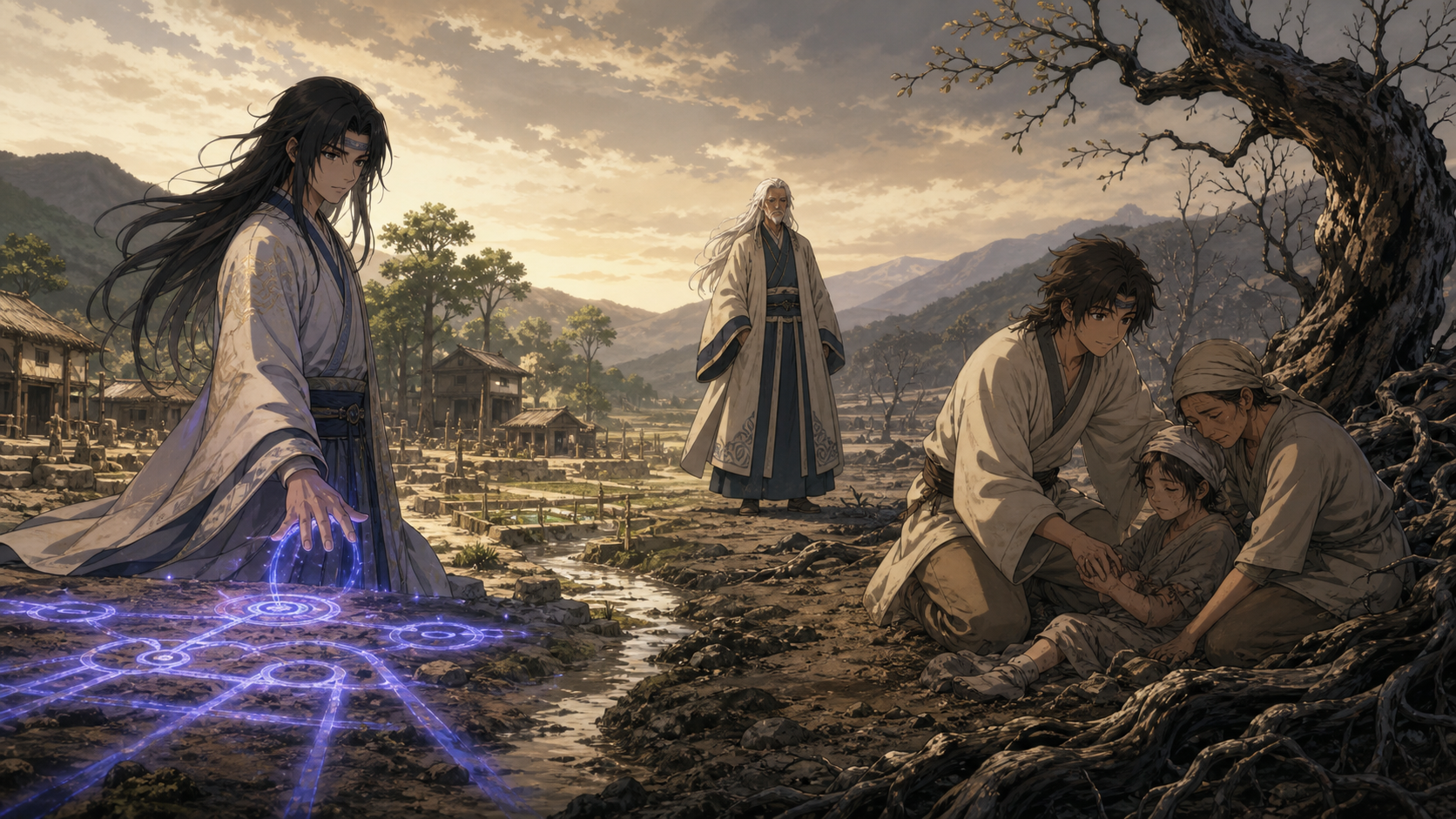
The Tumultuous Journey
Indra enforces order from above while Ashura learns that mercy matters only when care reaches the conditions making an entire community sick.
Bottom line
“The Tumultuous Journey” asks whether justice means enforcing a rule or understanding why somebody broke one, then makes both answers uncomfortable. Taizo lies to Asura and has trees cleared without community consent because his sick mother refuses Ninshu. Indra sees unauthorized damage and responds with restraint, public judgment, and deterrence. Asura sees a desperate son and responds by breaking him free. Neither brother does enough listening before acting. Hagoromo notices the difference, yet turns a family rupture into a succession test without first repairing what has already broken. The mission sends each son toward a region scarred by the Ten-Tails. Asura reaches a frightened village living above poisonous God Tree roots, earns entry by healing an attacker, and learns that individual treatment cannot cure a structural source of harm. That discovery carries the episode. Mercy becomes useful only when care moves beyond one suffering body and confronts the conditions making an entire community sick.
Episode 466 is anime-original expansion
Episode 466 is titled “The Tumultuous Journey.” The Japanese title is “Shiren no Tabi.” The episode aired in Japan on June 30, 2016.
The succession conflict comes from Naruto's larger history, while this specific trial and village story were created for the anime.
Asura notices Indra's distance
Indra's harsher manner after awakening the Sharingan has begun pushing other students away. Asura recognizes a social problem before he understands its cause.
Concern alone cannot reopen a conversation his brother no longer trusts.
Taizo asks for a shortcut
Taizo wants trees cleared between fields and claims the route will help his mother travel. The request sounds domestic, modest, and urgent.
Asura accepts the explanation because friendship supplies credibility.
The trees do not belong to one person
Clearing shared land changes access, crops, boundaries, and future use for everyone nearby. A helpful shortcut can still violate communal rights.
Good intentions do not create consent.
Asura uses power before checking authority
He acts on Taizo's story without speaking to affected neighbors or the boy's mother. His willingness to help moves faster than responsible inquiry.
Compassion becomes reckless when verification feels insulting.
Taizo's lie has a real reason
His mother is ill, and the new path would shorten the trip required to obtain medicine. Fear drives the deception.
Need explains his choice without making every consequence disappear.
His mother rejects Ninshu
Taizo did not ask Asura to heal her because she distrusts Hagoromo's practice. Her refusal introduces a limit the movement's believers rarely face.
Help cannot be forced simply because a healer feels certain.
Indra investigates the visible offense
He discovers the unauthorized clearing, identifies Taizo's deception, and restrains him. The facts Indra gathers are accurate but incomplete.
Procedure finds the breach before hearing the pressure beneath the breach.
Asura is judged gullible
Indra blames his brother for believing the false explanation. The criticism lands because Asura failed to confirm basic facts.
Trust should not require surrendering judgment.
Indra spares Asura formal punishment
Because Taizo deceived him, Asura is treated as a manipulated participant rather than the author of the plan. That distinction shows Indra can assess different levels of responsibility.
His justice is severe, not mindless.
Punishment becomes a public lesson
Indra wants consequences strong enough to discourage future violations. Deterrence places the community's next decision above the offender's present circumstances.
Fear becomes part of governance.
Hagoromo questions the severity
He reminds Indra that people make mistakes and suggests mercy. The intervention protects Taizo from a rigid response.
Hagoromo still offers a principle instead of a clear, fair process.
Indra fears inconsistency
If every offender can excuse harm with a personal story, rules may lose meaning. His concern is not imaginary.
A community needs both context and standards capable of surviving favoritism.
Taizo's confession changes the moral frame
Medicine for his mother makes the lie easier to understand. The new information should change the response without erasing the neighbors whose land was altered.
Repair requires every affected voice.
Asura offers healing after the fact
He says Ninshu could have helped Taizo's mother. The offer assumes access, trust, and consent that were never present.
A rejected service cannot become the measure of another person's reasonableness.
Refusal carries historical weight
People remember Kaguya, the God Tree, chakra extraction, and devastation. Suspicion of a new chakra creed may come from lived injury rather than ignorance.
Ninshu must earn trust where chakra once meant control.
Night turns disagreement into defiance
Asura frees Taizo without negotiating restitution or appealing through a shared process. He substitutes private conscience for Indra's private authority.
Mercy becomes another unilateral decision.
Indra catches the escape
The older brother treats the release as a direct rejection of law. Their disagreement moves from argument to physical enforcement.
Neither brother has built a method for resolving conflict between them.
Indra defeats Asura
Superior training lets him stop the escape quickly. Power settles the immediate dispute without proving the judgment wise.
Victory can enforce an answer while leaving the question untouched.
Hagoromo watches from a distance
Their father observes rather than interrupting early. He is gathering information about possible successors while his sons experience the moment as family pain.
Evaluation replaces mediation.
Shiro's anniversary returns
Asura and Hagoromo remember the dog killed during the boar attack. Grief remains a marker in the family's timeline.
The conversation links Indra's changed eyes with a loss nobody adequately processed together.
Asura asks about the Sharingan
He understands that Indra changed after Shiro died but lacks the secret lesson Black Zetsu supplied. His question reaches Hagoromo after distance has hardened.
Missing knowledge keeps the family from naming manipulation.
Difference becomes destiny too easily
Hagoromo contrasts Indra's solitary strength with Asura's dependence on others. The distinction contains truth, yet repeated labels can push children toward assigned roles.
Description can become expectation.
The succession decision arrives
Hagoromo announces that one son will inherit leadership of Ninshu. A spiritual practice built around connection now needs institutional continuity.
Leadership introduces rank into a creed wary of domination.
Each brother receives a scroll
The scrolls identify separate regions still damaged by the war against the Ten-Tails. Both sons must discover the local problem and produce a solution.
The test measures judgment outside familiar authority.
Results will determine the heir
Hagoromo gives enormous political weight to two assignments with different people, histories, and conditions. Comparing outcomes across unequal villages risks false precision.
No neutral mission exists.
Asura does not seek leadership
He assumes Indra should inherit Ninshu and would rather support him. The lack of ambition may protect against vanity, but leadership cannot rest on reluctance alone.
Service still requires competence.
Nomination changes the brothers' relationship
Even before a result, Asura's inclusion tells Indra that mastery no longer guarantees succession. The contest converts difference into rivalry.
Hagoromo has made recognition scarce.
Gamamaru hears Hagoromo's concern
The toad sage discusses the sons after their departure. Hagoromo hopes the journeys will reveal how each man responds to suffering.
His wisdom remains partly experimental, with communities bearing the test.
Taizo follows Asura
The boy chooses to accompany the person who freed and defended him. Loyalty becomes the first resource Asura carries.
His strength begins with somebody willing to walk beside him.
Taizo's mother grants her blessing
After hearing what Asura did, she tells her son to help on the journey. Her approval complicates her rejection of Ninshu.
She can distrust a movement while recognizing care from one practitioner.
Trust attaches to conduct
Asura did not win Taizo through superior technique or institutional title. He responded to a frightening circumstance with solidarity.
Personal loyalty arrives before doctrinal agreement.
The journey reaches the former God Tree region
Their destination sits where ancient extraction damaged land and bodies. The past remains physically present beneath the settlement.
History has roots, not merely stories.
Villagers meet strangers with weapons
The community mistakes Asura and Taizo for robbers and attacks. Their fear reflects previous encounters rather than random hostility.
Isolation has made suspicion protective.
A defender injures another villager
During the confused attack, one person's strike wounds a companion. Fear turns community defense inward.
Protective systems can harm the people they were built to guard.
Asura heals before demanding trust
He treats the injured woman instead of retaliating or insisting on an apology. Care changes the encounter more effectively than a display of dominance.
The village sees a useful intention in action.
Kanna becomes the human bridge
The healed woman, Kanna, helps move Asura from suspected threat to welcomed guest. Her changed judgment gives the strangers social entry.
Trust spreads through testimony.
Hospitality has a boundary
The villagers accept Asura and Taizo but refuse access to the area where he senses the God Tree. Welcome does not erase guarded knowledge.
Community consent remains partial and conditional.
The forbidden place draws attention
Strong chakra beneath the settlement suggests that the village's illness and secrecy share a source. Asura notices without immediately forcing entry.
Suspicion begins as observation rather than accusation.
Kanna asks for her mother
Her gratitude becomes a request to heal another sick family member. The private household reveals a crisis larger than the first injury.
Care opens the door to evidence.
The illness resists direct treatment
Asura senses powerful chakra connected to Kanna's mother but cannot remove the condition through ordinary healing. Individual technique reaches a limit.
The body points toward an environmental cause.
Failure becomes useful information
Asura does not declare the woman beyond help or blame her for resisting treatment. His inability forces a wider investigation.
Honest limitation can improve diagnosis.
Taizo finds the graves
Multiple villagers have died from the same condition. The burial ground proves the illness is patterned, longstanding, and collectively known.
Silence has not protected the community.
Secrecy may come from survival
The villagers fear outsiders, robbery, and whatever remains beneath the God Tree. Guarding the source may reflect shame, coercion, or failed attempts at help.
Disclosure needs safety.
Kanna chooses investigation
She joins Asura and Taizo despite the village boundary. Her participation prevents the outsiders from claiming sole authority over the problem.
An affected resident helps direct the inquiry.
The cave turns history into geography
The three descend among enormous roots left by the God Tree. Ancient violence occupies the ground supporting present life.
The village cannot heal while treating the source as untouchable.
Roots connect every sick household
The chakra Asura sensed is not a private defect inside Kanna's mother. A shared environment links many bodies to the same danger.
Structural harm often appears first as individual illness.
The assignment tests more than strength
Destroying an obstacle may be easy for either brother. Understanding why people protect, fear, or depend on the obstacle requires relationship.
The mission rewards diagnosis before force.
Indra's path remains outside the frame
The episode withholds his village and solution, leaving viewers inside Asura's slower uncertainty. Speed cannot yet be compared with sustainability.
The missing half keeps judgment open.
Asura carries his earlier mistake forward
He trusted Taizo without verification when the trees were cleared. In Kanna's village, he gathers bodily evidence, burial evidence, local testimony, and direct observation.
Compassion begins learning method.
Mercy needs repair
Freeing Taizo answered an immediate injustice but did not restore the altered land or include affected neighbors. The village mission raises the scale of responsibility.
Care must address consequences, not only punishment.
Law needs context
Indra correctly identified deception and unauthorized action, yet ignored why medicine and distrust shaped the offense. Rules without investigation can criminalize desperation.
Justice needs facts about pressure as well as conduct.
Hagoromo designed an incomplete test
The sons face different conditions with no stated timeline, common standards, or requirement for community consent. Their father wants character revealed, not a reproducible evaluation.
The final choice will still carry institutional force.
The episode's strongest image is underground
A village appears functional above the surface while poisonous roots bind its households below. The visual turns inherited violence into infrastructure.
People can normalize harm when survival requires building around the source.
The next chapter must test endurance
Finding the roots is not the same as restoring water, health, or trust. Asura will have to remain after discovery and share labor with people who initially attacked him.
Connection must survive inconvenience.
Taizo’s need does not erase the neighbors
His mother is sick, the route to medicine is punishing, and her distrust of Ninshu removes the easiest answer Asura can imagine. Those pressures make the lie understandable. The cleared trees still belonged to a community whose access and boundaries changed without consent.
Context should change the response, not delete every person affected by the desperate choice.
Indra identifies responsibility too narrowly
He sees deception, unauthorized damage, and the danger of rules becoming optional whenever somebody offers a sympathetic story. Those facts matter. His response becomes unjust when deterrence replaces investigation and punishment arrives before the community can discuss repair.
Law needs consistency, but consistency without proportion can make desperation the easiest conduct to criminalize.
Asura makes mercy unilateral too
Freeing Taizo protects him from Indra’s severity and honors the circumstances behind the offense. It also bypasses everyone whose land was altered and offers no plan for restoration.
Private conscience is not automatically democratic because it feels kinder. Mercy needs a process capable of including victims, pressure, accountability, and a realistic route forward.
Hagoromo observes when the family needs mediation
He watches his sons collide, gathers evidence about their leadership styles, and later turns the conflict into a succession trial. The distance may reveal character, but it also lets resentment harden around an argument no shared process resolves.
A parent evaluating future leaders still has a present responsibility to help two sons speak before their pain becomes policy.
The trial uses communities as evidence
Each village contains people living with consequences left by the Ten-Tails. For Hagoromo, their problems reveal which son should inherit Ninshu. For residents, the assignment determines whether water, illness, security, and trust improve.
The difference in stakes matters. A leadership test should not make vulnerable communities props in somebody else’s family decision.
Kanna’s village corrects Asura’s method
He begins by healing an injured stranger rather than demanding entry. When Kanna’s mother resists treatment, he does not blame her body or declare his technique sufficient. Graves, testimony, chakra, and the cave widen the diagnosis.
Compassion becomes more responsible because it gathers evidence instead of treating trust as a replacement for evidence.
Poisoned roots make history an environment
The God Tree is gone as a visible ruler, yet its remains continue entering bodies beneath ordinary homes. People inherit damage through soil, water, fear, secrecy, and the survival patterns built around all four.
Ending a tyrant does not end the infrastructure tyranny produced. Reconstruction has to reach what remains underground.
Healing one person can reveal why healing fails
Asura’s inability to cure Kanna’s mother is not useless. The limit proves the illness is not an isolated defect and pushes the group toward a shared source.
A healer becomes dangerous when every failure is blamed on the patient. Asura grows because he lets failure correct his understanding.
Leadership cannot be measured only by who arrives fastest with a solution. It also appears in who stays long enough to learn why the first solution failed, who shares authority with affected people, and who repairs consequences after good intentions cause harm inside an already wounded community.
RaeRae’s verdict
“The Tumultuous Journey” refuses a clean split between Indra’s law and Asura’s mercy. Indra sees conduct without enough pressure. Asura sees pressure without enough repair. Both make unilateral decisions, and Hagoromo studies the results when he should also be building a fairer method with them.
The village story finally gives Asura that method. Care opens the door, but evidence changes the diagnosis. Kanna, graves, sick bodies, guarded memory, and poisoned roots reveal a structural crisis. Leadership begins when helping one person leads toward changing the conditions hurting everyone.
Final verdict
“The Tumultuous Journey” gives the succession story a useful political problem before reaching the mythic answer. Indra is right that deception and unauthorized land clearing cannot be ignored. Asura is right that punishment without circumstance becomes cruelty. Both brothers fail when they treat private judgment as sufficient. Hagoromo recognizes their difference but avoids the harder family repair, sending them into communities as candidates for authority. The second half improves the premise by making Asura confront harm no healer can solve one body at a time. Kanna's mother is sick because the village remains tied to the God Tree's buried legacy, and the graves prove that private treatment has never been enough. The episode ends at the proper threshold. Leadership will not be demonstrated by arriving with the strongest technique. Leadership begins when somebody learns that a community's visible crisis may be rooted beneath every household.
RaeRae’s call
Indra is right that rules and communal consent matter. Asura is right that circumstance and mercy matter. Neither is right to make the final decision alone. Taizo’s need does not erase altered land, and punishment does not cure his mother. Kanna’s village supplies the better model: offer care, gather testimony, accept failed treatment as evidence, follow the harm underground, and let affected people participate. Justice becomes credible when it can hold conduct, pressure, repair, and consent together.
Episode details and viewing routes
- Official episode reference: Naruto Official episode guide
- Licensed episode route: Crunchyroll licensed episode page
What I am carrying forward
Indra punished Taizo for unauthorized land clearing while Asura freed him after learning his sick mother needed medicine. Both brothers acted unilaterally, and Hagoromo converted their conflict into a succession trial.
Asura reached a village above poisoned God Tree roots. Healing Kanna earned trust, but her mother’s illness resisted individual treatment. Graves and the underground chakra source revealed a community-wide crisis. Episode 467 tests whether Asura can turn diagnosis into shared repair.