
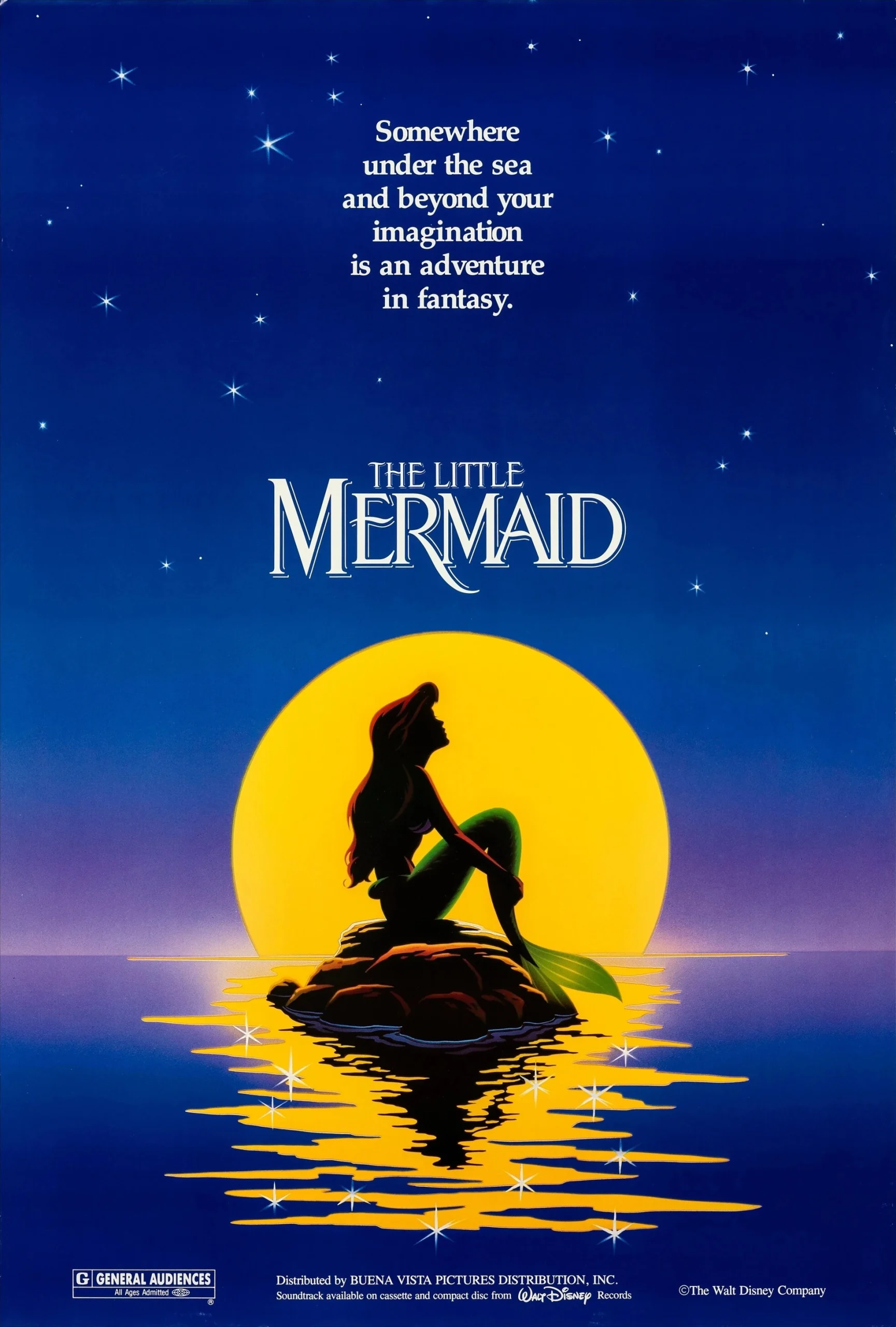
RaeRae Review · The Little Mermaid · 1989
She Did Not Trade Her Voice for a Man
Ariel wanted the human world before she knew Eric’s name. Ursula knew exactly how to turn that desire, Triton’s violence, and one impossible deadline into a contract everybody still blames on the girl.
Review receipt
Film: The Little Mermaid (1989). Directors and screenwriters: Ron Clements and John Musker. Producer and lyricist: Howard Ashman. Music: Alan Menken. Principal voices: Jodi Benson, Christopher Daniel Barnes, Pat Carroll, Samuel E. Wright, Kenneth Mars, Buddy Hackett, Jason Marin, René Auberjonois, Ben Wright, and Paddi Edwards. Verdict: one of the sharpest animated musicals ever built, carrying an ending and gender argument that deserve more resistance than nostalgia usually permits.
This is a spoiler-complete review. It treats the film as a work of animation, a musical, a father-daughter conflict, a migration fantasy, a coercive-contract story, a queer-influenced performance text, and the industrial turning point it later became. It also refuses the lazy sentence that Ariel gave everything up because she saw a handsome man.
The argument starts before Eric appears
Ariel misses the concert because she is exploring a wreck with Flounder. That sequence establishes motive with unusual clarity. She is not collecting bridal magazines or imagining one particular prince. She is conducting unauthorized research into a civilization her father has prohibited her from knowing. The questions are material: What are these objects? How are they used? Why do humans build them? What else exists above the boundary?
Eric intensifies the desire because he is living evidence that the human world contains a person worth knowing. He does not create the desire. This distinction is not a minor defense of a favorite princess. It is the difference between reading Ariel as a girl who abandons a life for a stranger and reading her as an intellectual dissident whose first contact turns a prohibited field of study into a relationship.
The grotto is a museum built without permission or reliable labels
Ariel’s collection is often treated as teenage clutter. It is closer to an archive assembled under conditions of censorship. She recovers artifacts from wrecks, groups them, preserves them, asks an outside informant for interpretation, and constructs a theory of human life from fragments. The work is messy because Triton has made legitimate education impossible. There is no library she can visit, no teacher authorized to answer, and no exchange program between kingdoms.
Scuttle’s errors are funny, but they also show the cost of knowledge prohibition. When institutions refuse to teach, misinformation does not vanish. It becomes the only available curriculum. Ariel uses a fork as a hair tool because the source she trusts confidently invents an answer. The joke lands on Scuttle, yet the larger failure belongs to a world that forces a princess to learn anthropology from a seagull.
Triton mistakes authority for evidence
Triton’s position is simple: humans are dangerous, contact is forbidden, and a daughter’s questions count as disobedience. He has reasons for fear. Humans hunt and eat sea life, sail into marine territory, and can cause enormous damage without understanding the communities below. Later franchise material adds family trauma. None of that makes every claim he offers equally true or every method acceptable.
The king never gives Ariel the evidence necessary to evaluate risk. He gives her a conclusion and demands obedience. That is not education. It is rule enforcement. When she persists, he interprets curiosity as a challenge to his status, which means the conflict stops being only about safety. It becomes a fight over whether the father’s fear has the right to define the daughter’s mind.

Destroying the grotto is parental violence
The trident scene is routinely softened into a father losing his temper. Look at what he actually does. Triton enters a private space, sees a collection that represents years of labor and attachment, and destroys it object by object while Ariel begs him to stop. The power is spectacular, but the emotional mechanism is familiar: I cannot control what you want, so I will make wanting it hurt.
His regret after the damage matters, but regret does not undo the event. Ariel is left isolated among the remains of her work, with the person who should be safe established as capable of annihilating what she loves. Ursula’s agents approach after that rupture because predatory recruiters understand timing. They do not invent Ariel’s conflict with her father. They arrive when his violence has made dishonest help look like the only help in the ocean.
Ursula does not offer freedom; she offers a rigged version of it
Ursula’s genius is not that she can transform bodies. It is that she can identify a true grievance and attach an exploitative solution. She accurately sees that Triton is controlling, that Ariel wants a life unavailable under his law, and that the princess has no legitimate route to negotiate change. Every true observation makes the false bargain easier to trust.
The contract gives Ariel three days to receive a kiss of true love, takes her voice as payment, restores her mermaid form if she fails, and converts her into Ursula’s captive. That summary still understates the fraud because Ursula later deploys Flotsam and Jetsam to sabotage the lagoon and transforms herself into Vanessa to use Ariel’s stolen voice against Eric. The seller is actively preventing the buyer from satisfying the terms.
Consent cannot be measured by whether a pen touched paper
Ariel signs. That fact matters. She makes a risky choice while grieving, angry, and desperate. Agency does not disappear simply because the choice was manipulated. At the same time, a signature is not magical moral detergent. Ursula controls the information, the environment, the deadline, the witnesses, the enforcement mechanism, and the hidden plan to interfere. She knows more about the consequences than Ariel and conceals the information that would change the decision.
Modern contract language calls attention to unequal bargaining power, misrepresentation, duress, unconscionable terms, and interference with performance. The film is not a legal textbook, but its drama understands the principle. Ursula wants the visual of voluntary agreement because the appearance of choice will help everyone blame Ariel for a process designed to make her fail.
The price is not just a voice; it is credibility
Ariel’s voice is musical talent, self-expression, identification, evidence, and the specific sound Eric associates with the person who saved him. Taking it does more than make communication difficult. It removes the easiest way Ariel could prove her history and places that proof in Ursula’s possession. The villain does not merely silence a client. She steals the client’s claim to her own action.
That theft becomes explicit when Vanessa appears and sings with Ariel’s voice. Eric responds to the sound because he has been searching for it. Ursula converts Ariel’s identity into portable authentication and uses it to redirect recognition. The horror is not that Eric prefers a better singer. It is that he is magically compelled by stolen evidence while the person who earned his attention stands nearby unable to reclaim it.

“Poor Unfortunate Souls” is a sales presentation that admits the scam
Howard Ashman structures Ursula’s number like a master class in pressure. She establishes authority through supposed success stories, mocks hesitation, accelerates the clock, reframes sacrifice as practical, and supplies a gender ideology that tells Ariel silence may even make her more desirable. The performance is funny because Ursula enjoys herself. It is frightening because every flourish is attached to a sales technique.
The lyric about men preferring women who do not speak is not the film’s neutral advice. It comes from the predator selling silence. The number makes misogyny part of the fraud. Ursula packages a social rule women already recognize, then presents herself as the savvy older woman willing to explain how the world really works. Cynicism becomes another product feature.
Pat Carroll lets pleasure become evidence
Pat Carroll gives Ursula appetite without making the character careless. The laugh, the low conversational confidence, the sudden bite on a word, and the full-body enjoyment of performance tell us the sea witch does not merely want Triton’s crown. She loves the process of making people participate in their own dispossession.
That pleasure matters because it prevents the contract from looking like an unfortunate business arrangement. Ursula knows the pain she is arranging. She is entertained by Ariel’s vulnerability, irritated when the girl approaches success, and furious when her subordinate eels die in the conflict she created. Carroll holds comedy, camp, menace, and genuine attachment together without cleaning any of them into innocence.
Ursula’s drag inheritance is part of the film’s power
The character’s design is famously connected to Divine, the performer associated with John Waters, and Howard Ashman’s theatrical sensibility shaped the role’s performance language. The influence is not a trivia sticker to place beside a villain. It helps explain why Ursula understands self-invention, spectacle, outsider charisma, and the social weaponry of gender performance better than anyone else in the film.
The uncomfortable part is that the most overtly queer-coded adult becomes the predatory villain. The valuable part is that queer artistry also helped give the whole movie its voice, emotional grammar, and Broadway confidence. A serious reading can celebrate the drag lineage, honor the artists, and still ask why animation repeatedly makes nonconforming bodies carry danger for a supposedly normal family order.
Ariel does communicate without speech
The land section is often discussed as proof that Ariel sacrificed her ability to be known. The film shows something more complicated. She gestures, points, listens, imitates, laughs, reacts, makes decisions, and participates in activities. Her expression remains exceptionally active. The absence of speech changes the burden of communication. It does not turn her into an empty body waiting for Eric to provide a personality.
The people around her reveal their ethics through how they respond. Grimsby and Carlotta make space for a stranger. Eric asks questions, reads her reactions, and spends time with her even when she cannot supply the voice he has idealized. Scuttle tries to help and creates chaos. The sequence understands that communication is collaborative. A listener has responsibilities too.

Eric is not a reward standing on a beach
Prince Eric receives less interior material than Ariel, but the film gives him more than a handsome silhouette. He works on a ship, resists Grimsby’s pressure to marry for appearance, takes physical risks during the storm, cares for Max, plays music, and remains preoccupied with the unknown person who saved his life. His longing is attached to gratitude and an incomplete memory, not merely to a face.
He also has to outgrow his own fixation. The voice becomes so central that he nearly misses the person in front of him. His days with silent Ariel create a competing body of evidence: shared humor, curiosity, attraction, and comfort. The lagoon almost resolves that conflict before sabotage. The film’s romantic question is therefore not whether he can identify a sound. It is whether he can recognize a person beyond the clue he was given.
The rescue reverses the passive-princess arrangement
Ariel saves Eric from the wreck before he can save her from anything. The labor is physical. She navigates fire, water, debris, and his unconscious weight, then brings him to shore and monitors whether he lives. The image that remains in Eric’s mind is incomplete because he is barely conscious. The action that remains in the story is not incomplete at all. She acted first.
This makes later accusations that Ariel did everything for a man especially thin. She risks herself because a human being is dying in front of her and because the human world already matters to her. Attraction enters the scene, but rescue is not a wedding audition. Compassion and fascination exist before any promise of being chosen.
“Part of Your World” is an intellectual want song
The song catalogs objects, but its real subject is participation. Ariel does not only want to look at the human world. She wants to ask questions in it, move through it, understand its language, and be recognized as someone capable of belonging. The repeated spatial language turns knowledge into a place from which she has been excluded.
Jodi Benson’s performance keeps wonder and frustration in the same breath. Ariel is not singing from ignorance about everything she possesses. She knows the collection is large. She knows her father’s kingdom has beauty. Abundance does not cancel a boundary when the boundary determines which questions a person is allowed to pursue.
Howard Ashman understood that the “I want” song had to stay
The number was famously vulnerable during development because a test-screening distraction made executives question its pace. Removing it would have left a functional adventure and destroyed the movie’s inner map. Without the song, Ariel’s later choices would look sudden, romance-driven, and thin. With it, every event can be measured against a desire established before the plot starts bargaining with her.
The survival of the song is not merely a story about one creator winning an argument. It is a reminder that narrative efficiency can become hostile to interiority. A quiet character declaration may look removable when judged only by incident count. The film lasts because somebody recognized that wanting is an event.

The musical numbers are load-bearing architecture
Ashman and Menken did not write a dramatic scene, stop the film, and add a song. “Part of Your World” states motive. “Under the Sea” presents the establishment’s counterargument through pleasure. “Poor Unfortunate Souls” performs the transaction. “Kiss the Girl” turns collective persuasion into a romantic deadline. Reprises mark when desire changes direction or loses access to speech.
That structure is one reason the film feels faster than its emotional content should allow. Songs compress exposition, argument, atmosphere, and character action without collapsing them into summary. A single number can move the plot while showing who controls the room and what a character is not ready to say in dialogue.
“Under the Sea” is persuasive, beautiful, and unable to listen
Sebastian’s great number gives Triton’s side its strongest case. The ocean is musically abundant, socially connected, colorful, and alive. Human life contains labor, danger, extraction, and culinary horror. Sebastian is not lying when he argues that Ariel overlooks the richness around her.
The failure is that he treats appreciation as a cure for curiosity. He performs at Ariel rather than asking what she knows, fears, or needs. The spectacle becomes so committed to proving home is sufficient that Ariel can leave the number. That is the entire family problem in miniature: everyone can describe why she should be content, and almost nobody can remain quiet long enough to learn why she is not.
Color changes argument, not just location
The surface opens in restrained fog and muted color, then the camera passes below into a brighter kingdom. The filmmakers describe saving the color for the underwater reveal. Later numbers push beyond literal blue because emotional heat becomes more important than naturalistic expectation. “Under the Sea” earns oranges and reds as its persuasion expands.
This matters to the film’s politics. Neither world owns beauty. The ocean is not a gray prison, and the surface is not automatically enlightened. Each location receives seduction and danger. The conflict cannot be solved by choosing the prettier palette because the film has made both places visually capable of wonder.
The hand-drawn water is labor hiding in motion
Underwater animation cannot let hair, fabric, particles, and bodies rest in the same way they can on land. The filmmakers describe the constant secondary motion as extra work audiences may not consciously notice. Bubbles, refraction, waves, fog, fire, magic, and storm effects build a physical world around the character animation.
That invisible labor deserves attention because “timeless” animation is often praised as if beauty simply appeared from talent. The film was made by departments, assistants, effects artists, painters, camera crews, editors, sound workers, performers, and story teams solving thousands of problems. The illusion of effortless water is evidence of effort.

The storm sequence proves the production wanted danger to have weight
The shipwreck is not a decorative obstacle placed between songs. Rain, fire, ocean surface, wind, rigging, animals, sailors, and changing scale all have to remain legible while the sequence moves quickly. The effects workload gives Ariel’s rescue a world that resists her rather than a convenient wave that carries Eric to safety.
Fire and water also refuse a simple symbolic division. The human ship brings flame into the storm. The ocean can kill, but it is also where Ariel has the skill to save. The surface world produces danger and the sea woman becomes the capable responder. Neither environment stays morally pure.
The lagoon is a rigged exam disguised as romance
“Kiss the Girl” can feel like charming communal encouragement, and much of it is. Sebastian tries to create conditions in which two shy people can act. Yet the entire scene exists inside Ursula’s countdown, which has made a kiss the proof of love, the key to Ariel’s body, and the difference between freedom and enslavement.
Then the eels attack the boat. The failure is not evidence that Ariel and Eric lacked connection. It is evidence that Ursula never intended to honor the deal. Reading the scene as a neutral test repeats the villain’s framing. The better question is why viewers keep evaluating Ariel’s romantic performance when the contract author is underwater kicking the table.
Vanessa reveals that the villain fears Ariel might succeed
Ursula transforms and goes to land because passive confidence is no longer enough. Ariel has built a relationship without her voice, and Eric is close to choosing her despite the missing clue. The sea witch therefore escalates from sabotage to identity theft, magical compulsion, and a false wedding.
That escalation is a backhanded confirmation of Ariel’s agency. If the girl were merely beautiful and mute, Ursula could wait. Instead, Ariel’s presence is working. The villain must steal the exact evidence Eric remembers and place it inside a more controllable body. Vanessa is not a superior romantic option. She is forged documentation.
Triton’s sacrifice is love arriving after accountability became unavoidable
When Triton finally confronts Ursula, royal force cannot simply cancel a contract he allowed his daughter to enter through isolation. He trades himself for Ariel. The act is loving, immediate, and costly. It is also the first time he accepts a consequence rather than delivering one.
The film does not give him a long apology, which means viewers often let the sacrifice complete all repair. It should not. Saving Ariel matters. Recognizing that his daughter has grown matters. The destroyed grotto, years of prohibition, and failure to listen remain part of the family history even after he changes her body for the ending.

The climax lets Eric act without making Ariel irrelevant
Eric pilots the wrecked ship into the giant Ursula and delivers the decisive blow. That gives the prince an active role beyond romance and repays Ariel’s earlier rescue with one of his own. The staging can still frustrate viewers who want Ariel to defeat the villain controlling her voice and body.
The fairest reading holds both responses. Ariel resists capture, breaks the shell’s control, recovers her voice, and participates in the struggle. Eric uses the skill and object available to him. Triton’s stolen power has enlarged Ursula beyond individual combat. The outcome is collaborative, even though the final image of action belongs to the man.
“More Die Hard” changed the moral scale of the ending
The filmmakers’ commentary records the studio demand for a larger climax, expressed through the contemporary success of Die Hard. An earlier version did not make Ursula enormous. The finished film turns a family and contract conflict into a kaiju-scale maritime battle because spectacle was expected to prove completion.
The result is undeniably effective. It also changes what resolution feels like. Ursula is not defeated by exposing fraud, invalidating the bargain, organizing her victims, or Ariel mastering the magic used against her. She is destroyed by a ship after becoming too physically large for subtle coercion. The legal and psychological villain becomes an action target.
The ending is love, migration, and paternal permission at once
Triton gives Ariel a human body after watching her grieve Eric’s departure. The transformation acknowledges that the desire was not a passing tantrum. Ariel reunites with Eric, leaves the sea, and marries him. The film frames the departure as mutual love and a father finally releasing control.
It is also migration. Ariel leaves language community, species, family proximity, physical environment, and the archive she built. The story does not show what citizenship, adaptation, homesickness, or return access will look like. A happy ending can be emotionally sincere and structurally incomplete. Love does not erase the cost of crossing.
The father still controls the body in the final scene
Ariel’s transformation is benevolent because Triton now agrees with her desire. That does not eliminate the power pattern. He remains the person whose magic determines which body she can inhabit permanently. The ending resolves control through approval rather than through Ariel gaining independent access to transformation.
Children may experience the scene as beautiful parental recognition, and it is. Adults can also notice the condition underneath: freedom arrives when the king changes his mind. A more radical ending would build a lawful route for movement between worlds that does not depend on paternal permission or villainous debt.

The film changes Andersen by refusing annihilation as the price of desire
Hans Christian Andersen’s tale follows a harsher spiritual and bodily logic, with pain, failed love, attempted violence, dissolution, and a path toward an immortal soul. The 1989 adaptation retains the voice bargain, bodily transformation, and unequal risk while replacing the conclusion with rescue, romantic reciprocity, and family reconciliation.
That change is not simply making darkness safe for children. It moves the story’s moral center. The mermaid no longer earns transcendence through self-denial after a man chooses someone else. She survives, is chosen, and participates in reshaping the father’s boundary. The adaptation grants desire a future while leaving the power mechanics available for critique.
The movie revived a studio without knowing it was history
The film is now routinely described as the beginning of the Disney Renaissance, which can make its success sound planned and inevitable. John Musker has described uncertainty inside the production: the studio had not made a fairy tale in decades, the team loved the songs and characters without knowing whether audiences would, and an adult preview changed assumptions about how the movie should be marketed.
Historical labels arrive after risk has been survived. The artists were not walking into work under a banner that said Renaissance. They were arguing about hair color, schedule, budget, story structure, climax scale, and whether an audience would accept characters singing with theatrical sincerity. The category should not erase the contingency.
Why the red hair matters beyond branding
Ariel’s red hair distinguishes her against the blue-green environment and became inseparable from the character’s image, but the choice faced resistance. Musker has recalled having to defend a red-haired mermaid when executives treated blonde as the obvious default. The argument reveals how quickly familiarity can masquerade as natural law.
Visually, the red creates movement the eye can follow through complex water effects. Narratively, it prevents Ariel from dissolving into the kingdom’s palette. The character who refuses the available boundary is designed as a warm interruption inside cool space. A production fight becomes part of the film’s grammar.
The verified Easter eggs are better than the fake ones
In the filmmakers’ commentary, Musker and Clements explicitly point out Mickey, Donald, and Goofy among the audience during Triton’s entrance. That is a confirmed cameo, not a shape somebody decided looked royal after freezing a compressed stream. The same commentary identifies a tiny kazoo performance beneath Sebastian’s less impressive fanfare, a joke hidden in the sound rather than the drawing.
They also explain that Attina’s name references an earlier Howard Ashman musical and that Andrina was connected to Musker’s aerobics teacher. Those details are production fingerprints, not plot revelations. They show artists putting pieces of their lives into a large industrial object. The pleasure comes from connection, not from pretending every background curve forecasts a cinematic universe.

The opening contains a reveal the palette has been preparing
The filmmakers describe beginning on the surface with restrained color and saving the full underwater palette for the descent, comparing the transition to entering Oz. That is not a hidden character cameo, but it is an Easter egg in the broader sense of craft waiting to be noticed. The movie trains the eye to experience the kingdom as revelation.
The ship moving through fog also combines computer-generated geometry with traditional ink-and-paint treatment, according to the commentary. The shot is easy to overlook because the technology serves atmosphere instead of announcing itself. Innovation is most persuasive when the viewer notices the world before the method.
The palace shot marks the end of one production era
The first approach to Triton’s palace uses multiplane photography to create depth. The film arrived near the transition to the CAPS digital system, and the final scene was used as a test case for the newer process. That places the movie across two production languages rather than cleanly inside one nostalgic category.
Calling it “hand drawn” is accurate but incomplete. Pencil drawing, cels, paint, optical camera work, computer elements, compositing experiments, sound design, and large effects pipelines coexist. The film’s historical importance is not that it protected a pure old method. It is that artists used every available method to make a musical world cohere.
The sisters’ names carry studio-room jokes, but the sisters deserve more than jokes
The commentary’s name origins are charming, yet the film gives Ariel’s sisters limited individuality. They function as a colorful overture, a source of impatience about Ariel’s absence, and evidence that the royal family is larger than the central conflict. The prequels later try to fill the gap.
This imbalance matters because Triton’s parenting cannot be evaluated through Ariel alone. Six other daughters live under the same authority and watch how he responds to difference. The 1989 film does not ask what they want, whether they share the human prohibition, or how Ariel’s departure changes the family hierarchy. The musical opens the door and then swims past it.
Sebastian is caregiver, employee, artist, and frightened middle manager
Samuel E. Wright makes Sebastian’s anxiety precise. The crab wants to protect Ariel, fears Triton, takes pride in music, and repeatedly chooses improvisation over admitting that the situation has exceeded him. He is not simply a sidekick assigned to produce songs. He is an employee tasked with managing the king’s daughter under threat from the king.
That position explains his worst and best behavior. He spies because authority demands it, lectures because he believes safety requires compliance, then helps Ariel because proximity makes her need harder to ignore. His journey is an institutional one: loyalty to the office gradually yields to responsibility toward the person the office is harming.

Flounder is brave because fear remains present
Flounder’s nervousness never disappears, which is why his loyalty matters. He follows Ariel into the wreck, faces the shark, supports the rescue, and helps during the contract deadline without being rewritten as fearless. Courage in this film is often social. Characters act because another person needs them, not because danger stops registering.
His friendship also predates the romance and survives the transformation. That continuity protects Ariel’s story from becoming entirely organized around Eric. The final farewell is not only a father giving away a daughter. It includes friends who helped build the life she is leaving.
Scuttle is misinformation delivered with love
Buddy Hackett makes Scuttle’s confidence hilarious because the bird wants to be useful. He does not deliberately deceive Ariel. He fills gaps with invention and mistakes enthusiasm for expertise. The film understands how misinformation often travels: not through a villain, but through a trusted person who cannot say “I do not know.”
Scuttle later becomes practically useful when he recognizes Vanessa’s deception and disrupts the wedding. Being wrong about forks does not make him worthless. The better lesson is epistemic humility. A community can value someone’s loyalty and observation without treating every confident explanation as fact.
The film’s gender politics are better and worse than the slogan war
One slogan says Ariel is a bad feminist because she gives up her voice for a man. Another says she is an empowered explorer whose father should stop controlling her. Both isolate a truth and flatten the rest. She does sign away her voice inside a romantic deadline. She also wants a world before the romance, acts decisively, rescues the prince, and is targeted by adults exploiting a family rupture.
Feminist criticism is not improved by transferring all blame from controlling adults to the young woman with the least information. It is also not improved by pretending every choice she makes is liberatory because the desire is sincere. The film is valuable because agency, coercion, curiosity, sexuality, family power, and social silence occupy the same story without becoming the same thing.
Ariel’s age should make adults more careful, not more contemptuous
The film identifies Ariel as sixteen. That makes her impulsiveness unsurprising and the adults’ responsibilities larger. Triton responds to adolescent risk with destruction. Ursula targets a distressed minor with a lethal contract. Sebastian withholds information while trying to manage both sides. Eric does not know the full situation. The power map is not balanced.
Calling Ariel stupid may feel like mature distance, but it often reproduces the story’s refusal to listen. A more useful question is what structures would let a curious teenager explore safely, challenge family rules, learn reliable information, and make decisions without needing a sea witch. Prevention is not the same as obedience.
What the film gets right about crossing cultures
Ariel’s first days on land are sensory, social, and embarrassing. She misreads objects, lacks language, receives clothing and food from strangers, and depends on observation. The comedy does not erase the vulnerability. She is navigating a culture whose ordinary rules were never available in her education.
At its best, the human household responds with welcome instead of demanding immediate fluency. That makes the palace a counterexample to Triton’s certainty that humans are uniformly monstrous. Hospitality becomes evidence. The film does not develop politics of nation, class, or species deeply, but it understands that one kind encounter can destabilize inherited prejudice.
What the film avoids about permanent assimilation
The wedding allows both families to witness the union, yet Ariel is the person whose body and residence change. Eric does not spend part of the year underwater, learn marine governance, or surrender a human capacity. The compromise is emotionally mutual and materially asymmetric.
A sequel could have treated mobility as an ongoing negotiation: visits, bilingual practice, political agreements, technologies for safe transformation, and conflicts about where children belong. Instead, the first film uses the visual clarity of shore. That is enough for romance and not enough for the life after it.
The final grade cannot be separated from the final argument
As an animated musical, The Little Mermaid is astonishingly efficient. The songs reveal character and move plot. The voice performances carry theatrical scale without losing intimacy. The effects make water feel inhabited. Ursula remains one of animation’s most complete villains because style, psychology, design, performance, and function agree.
As a family resolution, the film is moving and incomplete. Triton learns to release rather than listen through a longer process. Ariel reaches the world she wanted but gains access through paternal magic after surviving predatory magic. Eric recognizes and fights for her, yet migration settles almost entirely on her side. The contradictions do not ruin the movie. They are why the movie can survive a serious conversation instead of needing protection from one.
Jodi Benson gives Ariel thought before she gives her volume
Benson’s performance is remembered through the reach and clarity of the songs, but the spoken work is just as important. Ariel thinks in real time. Her attention jumps toward an object, softens around Flounder, tightens under Triton’s judgment, and turns breathless when a discovery makes the forbidden world feel close. The performance does not wait for a lyric to prove there is an interior life.
Ashman reportedly coached from an unusually close position during recording, treating the song as acted drama rather than a vocal exhibition. You can hear the benefit in the shifts inside “Part of Your World.” Benson does not sing every line as a dream at the same temperature. Inventory becomes irritation, irritation becomes imagination, and imagination becomes a declaration she is almost afraid to admit. The voice follows the mind instead of displaying itself above it.
That detail makes the theft more painful. Ursula does not take a generic princess sound. She takes an instrument the film has already taught us to hear as thought. When the shell captures it, the silence contains all the phrasing we know Ariel is still capable of producing. The audience remembers the missing voice while other characters have to decide whether they can perceive the person without it.
Ariel’s body has already been political before the transformation
It is tempting to say Ursula makes Ariel’s body political when she replaces a tail with legs. Triton has already done that. He treats the tail as evidence of where Ariel belongs, the species boundary as law, and the surface as a place her body must never enter. Her anatomy is made to carry citizenship before the villain writes a contract.
Ursula offers mobility while making the new body conditional. Legs are not liberation if they expire under a hiddenly sabotaged deadline and revert into a form that can be imprisoned. The transformation sequence is dazzling because the body changes with impossible speed. The ethics are ugly because every bodily state remains controlled by someone else’s magic.
Triton’s final transformation removes Ursula’s debt and grants the form Ariel wants. It still leaves bodily access in royal hands. The film chooses the kindest available ruler rather than imagining bodily autonomy outside a ruler. That is a fairy-tale resolution, emotionally legible and politically smaller than the questions the movie created.
The polyps show Ursula has done this many times
The little creatures lining Ursula’s lair are former clients, not scenery. Their presence turns one bad bargain into a business model. Ariel enters a room full of evidence that the service has repeatedly converted distressed people into property. Ursula brushes past them because suffering has become inventory.
This detail changes how we read her sales pitch. She is not an eccentric adult making one improvised offer. She has a process, a customer base selected through vulnerability, a standardized punishment, enforcement agents, and a private collection of defaulted bodies. The contract economy is mature enough to decorate the office.
Ariel sees the polyps but lacks the context and time to interview them. Ursula controls the tour. A predatory institution can place evidence in plain sight when it also controls the explanation. The warning becomes part of the atmosphere instead of information the client can use. By the time the victims reach toward Ariel, forward motion and intimidation have already narrowed her attention.
Ursula is right about the palace and wrong about freedom
The strongest villains do not need to lie in every sentence. Ursula knows Triton’s temper, recognizes his rigidity, and understands that royal families often confuse obedience with love. Her critique gives her credibility because Ariel has just watched the king prove part of it.
What Ursula cannot offer is a relationship without domination. She criticizes Triton for controlling Ariel and immediately builds a more total form of control. The father destroys objects to force compliance. The sea witch takes speech, rigs time, steals identity, and claims the body after failure. Opposition to one authority does not make another authority liberating.
This is a useful warning beyond the fairy tale. Predatory recruiters often begin with accurate language about a target’s mistreatment. They do not need the old system to be good. They need their alternative to look like the only door. Ariel’s mistake is not recognizing that home was harmful. It is being denied enough support to test whether the rescuer is harmful too.
Sebastian’s Caribbean identity is musical invention and cultural compression
The Library of Congress exhibition notes that Ashman changed an English-butler crab concept into the Jamaican-inflected Sebastian and that the score shifted with him. That decision gave the film rhythmic identity and created an indelible performance opportunity for Samuel E. Wright. It also places a Caribbean-coded character inside a kingdom whose rulers do not share that coding.
Sebastian is court composer, conductor, anxious servant, comic caregiver, and the voice of the film’s most celebratory number. His culture supplies Atlantica’s joy while his employment keeps him frightened of royal punishment. The movie does not pause to ask whether this is his home culture, a performance tradition he brought to court, or a fantasy of Caribbean sound designed by American theater artists. The coding is specific enough to produce recognition and loose enough to avoid geography.
That mixture should be discussed without pretending enjoyment is theft-proof. Wright’s performance is extraordinary. The number opened mainstream animated space for a Black Broadway voice. The lyrics and accent also participate in a long entertainment habit of using Caribbean sound as instant warmth, ease, sensuality, and natural rhythm. Celebration and simplification can occupy the same song.
“Under the Sea” hides a labor argument inside paradise
Sebastian contrasts human work with ocean pleasure. Above the water, fish end up on plates and people labor in the sun. Below it, the band is always ready and the community appears able to sing all day. The joke persuades because the ocean looks like abundance without a visible economy.
Yet the sequence itself is labor. Sebastian is performing because the king has assigned him to manage Ariel. Musicians appear on cue. Creatures become instruments and dancers. The number requires enormous coordinated effort inside the story and outside it. Paradise is produced by workers whose work the lyric converts into evidence that nobody works.
Ariel leaves because spectacle cannot answer governance. The ocean may contain beauty, community, and safety. It also contains a father who prohibits knowledge, a court employee spying on a princess, a ban on contact, and no legitimate channel for dissent. Material abundance does not automatically create political freedom.
Chef Louis turns the food chain into class comedy
The kitchen sequence is broad slapstick, but it carries the surface world’s threat into the safest human household. Sebastian is not wrong that humans eat sea creatures. Chef Louis treats killing, preparation, and presentation as professional joy. The crab suddenly experiences the human palace from the position of food rather than guest.
René Auberjonois gives the chef operatic enthusiasm, turning culinary violence into a performance that parallels the film’s larger musical structure. The joke works because Sebastian is agile and the chef becomes increasingly ridiculous. It also ensures Triton’s fear is never dismissed as pure prejudice. Human culture really can be lethal to the people below.
What changes the argument is not proof that humans are harmless. It is proof that humans are not interchangeable. Carlotta offers care. Eric listens. Grimsby protects. Louis hunts a crab in the kitchen. A mature cross-cultural relationship requires risk knowledge without categorical hatred. The film starts moving toward that distinction even when the comedy refuses to hold still for it.
Eric’s household accepts a stranger before it understands her
Carlotta bathes, clothes, feeds, and welcomes Ariel without demanding a coherent origin story first. Grimsby is surprised but not cruel. Eric brings her home because she is vulnerable and because he suspects a connection he cannot name. Their hospitality is imperfect and class-bound, but it creates safety before certainty.
That order is the inverse of Triton’s rule. The king demands that the unknown be proven safe before contact, an impossible standard that keeps the boundary permanent. The human household allows provisional care while questions remain. Not every institution could or should operate without identity checks, but the moral principle is clear: uncertainty does not eliminate another person’s immediate need.
Ariel’s access is also shaped by beauty and royal proximity. A visibly distressed stranger who did not attract a prince might receive a different welcome. The film uses fairy-tale privilege to make hospitality easy. A deeper adaptation would ask whether the kingdom extends care beyond a woman whom its heir already wants to know.
Max recognizes what the human eye keeps overthinking
Eric’s dog responds to Ariel through scent, behavior, and remembered presence. He does not need the voice to connect the person on shore with the rescuer from the wreck. The animal’s recognition becomes another piece of evidence that identity exceeds the clue Eric has elevated above everything else.
The film uses Max for warmth and plot pressure, but the device also critiques romantic idealization. Eric has turned the voice into a symbol so powerful that direct evidence struggles to compete. Max has no idealized singer in his head. He recognizes the body that was actually there.
This does not make Eric foolish. Trauma leaves fragments, and the voice is the fragment he consciously remembers. It makes the romance a story about updating a memory. He must allow present experience to revise the image created during rescue instead of demanding that reality reproduce the one sensory trace he kept.
The voice is not soul, even when the film treats it as signature
Ursula’s magic lets a voice operate like identity authentication. Eric hears it and accepts Vanessa as the rescuer despite other contradictions. The plot needs that equivalence, but Ariel’s days on land simultaneously argue against it. She remains herself without the sound.
The contradiction is productive. Voice can mean testimony, style, social power, and recognizability without containing the entire person. Losing it is devastating because others rely on speech and because Ursula weaponizes the missing evidence. It is not proof that Ariel has lost intelligence, humor, desire, or moral agency.
That distinction matters when viewers discuss disability. A story about magical muteness should not be generalized carelessly into a lesson about real non-speaking people, but it can expose hearing culture’s assumptions. The surrounding characters decide whether they will do the work of communication or treat speech as the admission price for personhood.
Ariel and Eric build intimacy through shared activity
Their land montage is sometimes dismissed as attractive people spending two days together. The compressed time remains a fairy-tale problem, but the activities are chosen carefully. They travel through Eric’s community, respond to children and animals, move through public space, attempt unfamiliar customs, and create private jokes. The relationship develops through doing rather than biography.
Ariel is not auditioning for palace femininity with flawless manners. She drives recklessly, examines objects, laughs, and uses a pipe in a way that surprises Eric. The same curiosity that defined her underwater becomes the source of connection on land. He is not only attracted to silence. He is attracted to the visible mind working behind it.
The limitation is that Ariel learns far more about Eric’s world than he learns about hers before marriage. He cannot ask the right questions because he lacks the truth. Once the voice and body are restored, the film rushes to the wedding instead of giving the couple the conversation the contract prevented.
The deadline makes emotional development answer to a clock
Three days is not enough to establish lifelong compatibility, and the film knows it. The deadline belongs to Ursula, not to healthy romance. Every attempt at closeness is pressured by the possibility that failure will cost Ariel freedom. Sebastian’s anxiety turns courtship into project management because he understands the stakes the couple cannot discuss openly.
This is why judging Ariel for trying to secure a kiss misses the coercive frame. She is not simply impatient for a proposal. She is trying to avoid enslavement under conditions she cannot disclose. Eric experiences ordinary uncertainty. Ariel experiences uncertainty plus a concealed existential timer.
The movie lets the audience feel the charm and the wrongness simultaneously. “Kiss the Girl” is gorgeous because the environment briefly cooperates with intimacy. It is uncomfortable because a whole ensemble is manipulating two people toward physical contact. Romantic orchestration can be affectionate and still reduce room for consent when nobody explains the emergency.
Flotsam and Jetsam make sabotage look like bad luck
The eels’ most important function is invisibility. They watch Ariel before recruitment, guide her during distress, flank the contract, monitor progress, and overturn the rowboat when a kiss becomes likely. Each intervention protects Ursula’s distance from the harm.
Sabotage works best when the target blames timing, clumsiness, or personal failure. Ariel cannot accuse an enemy she does not see. Eric cannot understand why the evening collapses. Sebastian sees pieces of the attack but has no authority capable of invalidating the agreement. The system preserves the appearance that Ariel simply failed her chance.
Their deaths later expose the disposability of subordinate agents. Ursula calls them beloved and grieves them, but she sends them into a conflict created for her rise. Affection inside hierarchy does not guarantee safety. They possess enough agency to harm Ariel and too little power to survive the leader’s escalation.
Vanessa is how stolen labor gets rebranded
Ariel performs the rescue, sings on the shore, and becomes the memory Eric pursues. Ursula takes the voice, moves it into a new body, and presents Vanessa as the source. The villain is not just impersonating a woman. She is taking another woman’s labor and attaching it to a more strategically controlled identity.
The wedding preparations show how quickly institutions accept polished evidence. A prince announces a bride, the court mobilizes, and very few people ask why the decision has become unnaturally abrupt. Grimsby’s earlier pressure to marry may help the process feel plausible. The machinery was waiting for any answer that looked official enough.
Scuttle breaks the spell because he observes the private mechanism. He sees the reflection reveal Ursula and carries information back to Ariel. The bird who mislabels human artifacts becomes accurate when the stakes require direct witnessing instead of invented expertise. His redemption is epistemological as much as comic.
The wedding disruption is collective action
Ariel cannot stop Vanessa alone because she is racing against time without voice or magic. Scuttle recruits birds and animals. Sebastian and Flounder assist. Max resists the false bride. The attack is chaotic, undignified, and effective enough to break the shell containing the voice.
This is the film’s clearest answer to Ursula’s controlled environment. The villain’s power depends on isolation, secrecy, and precise timing. The resistance brings witnesses, noise, physical interference, and multiple species into the same space. Nobody has to defeat her alone to make her mechanism visible.
The moment also restores Ariel’s voice through action before anyone grants it to her. The shell breaks amid disruption. She does not complete a polite appeal to authority. A coalition makes the theft materially unstable. The film understands, for one sequence, that rigged contracts are not always defeated inside the rules that produced them.
Triton’s court has no visible checks on the king
The trident can destroy property, transform bodies, imprison enemies, and rewrite physical reality. No council reviews its use. No law constrains a furious father. Sebastian fears punishment but has no independent office to report danger. The royal family’s emotional life and the state’s coercive power are held in the same hand.
This concentration is why Ariel’s family disagreement becomes an international and bodily crisis. Triton does not need to persuade anyone before attacking the grotto. Ursula’s long resentment is tied to exclusion from power, though her solution is to seize the same absolute instrument rather than democratize it. Both antagonist and king imagine justice as having the trident.
The ending returns the weapon to the nicer ruler. Fairy tales often do this because legitimate kingship provides visual closure. The review should still notice what the story has shown: Ariel’s safety depends on whether one powerful adult is angry, deceived, sacrificed, or finally compassionate. Love is doing work that institutions should share.
Ursula’s body is allowed appetite and punished through monstrosity
Ursula is large, glamorous, tactile, hungry, and unashamed. She occupies space differently from the narrow heroine and the rigid king. Her design refuses the idea that female power must look delicate. That refusal has made her beloved far beyond her function as villain.
The climax enlarges her until size itself becomes catastrophe. Her body rises above ships, displaces the ocean, and becomes a target that must be penetrated by a wreck. The spectacle turns traits that once signaled confidence and theatrical abundance into literal excess. The story punishes political appetite by making physical appetite monstrous.
None of this makes Ursula secretly correct or her victims unimportant. Representation critique is not acquittal. It asks why the film gives its most transgressive visual and performance language to the person exploiting a teenager, then restores order through a slender heroine, handsome prince, and rehabilitated patriarch. The answer includes queer artistry, villain tradition, comedy, and the era’s limits.
A classic can be foundational without becoming innocent
The film’s influence is enormous. It demonstrated that theatrical animation could carry musical sincerity, adult attention, technical ambition, romance, comedy, and commercial force. The National Film Registry recognition reflects cultural, historical, or aesthetic significance, not a declaration that every value inside the film is correct.
Influence multiplies both achievement and limitation. Later movies borrowed the want song, the heroine design, the comic sidekicks, the transformation, the villain number, and the climactic spectacle. They also inherited assumptions about beauty, monarchy, heteroromance, cultural coding, maternal absence, and what kind of female desire receives punishment before approval.
Loving a foundational work should increase our willingness to know what it founded. Nostalgia that forbids analysis reduces the movie to merchandise. This film is better than that. Its craft can withstand the question, and its contradictions are more interesting than another round of calling the colors magical.
The restoration of family should include the daughters left behind
Ariel’s departure resolves Triton’s conflict with the child who challenged him. It does not show how he parents Attina, Alana, Adella, Aquata, Arista, and Andrina afterward. Do they receive more freedom? Does he explain his mistake? Are human artifacts legal now? Can any daughter choose another world, or was Ariel granted a singular exception because the crisis became impossible to deny?
A changed parent demonstrates change across relationships. The wedding gesture is powerful because Triton risks separation and publicly accepts Eric. The unshown test begins after the ship sails: whether the king creates rules that respect curiosity before another child needs to break them.
The franchise’s later stories expand family history but often continue centering the youngest daughter. A complete ecosystem should use character profiles and lore guides to recover the sisters as people, not just names in a song. Their position is part of the political receipt for Triton’s growth.
The ending needs return rights
Ariel says goodbye from a ship while her family remains in the water. The image is emotionally clean and logistically vague. Can Triton transform her temporarily for visits? Can Eric enter the ocean safely? Who controls the route? What happens when grief, conflict, illness, or ordinary homesickness makes one world feel too far away?
Migration becomes more humane when return is not treated as failure. Ariel can love Eric, choose land, and still need access to her first language, siblings, friends, landscape, and archive. A body capable of crossing should not be granted once as a wedding favor and then made administratively mysterious.
The later sequel uses Melody to revisit the border from the next generation, proving the question never disappeared. The first film’s romantic ending creates a family whose child belongs to both worlds. What looks final from the wedding deck is actually the beginning of cross-border governance.
What I would keep exactly as it is
I would keep the opening descent from fog into color, the grotto’s sense of accumulated obsession, Benson’s entire want song, Wright’s full commitment to Sebastian, Carroll’s performance, the storm rescue, the dinner’s physical comedy, the lagoon’s visual rhythm, Scuttle’s wedding alarm, and the farewell’s refusal to make Triton emotionally neat.
I would keep Ariel imperfect. A version that makes her completely informed, cautious, and strategically correct would lose the adolescent urgency that gives the story heat. The answer to a manipulated choice is not a heroine who never risks anything. It is a world where adults do not punish questions until a predator becomes the only available guide.
I would also keep Eric active in the climax while redistributing the last decisive beat. Reciprocity matters. He should save the person who saved him. The strongest revision would let his nautical skill and Ariel’s recovered ocean knowledge combine so that neither becomes the other’s passenger.
What I would change without sanding off the movie
I would give Ariel and Eric one post-restoration conversation before the wedding, long enough for him to hear the truth and for her to decide with the voice returned. I would let Triton apologize for destroying the grotto rather than allowing transformation to substitute for accountability. I would show that the collection survives or is rebuilt with legitimate knowledge.
I would make Ursula’s sabotage legally and magically relevant, so breaking the terms weakens her claim instead of leaving violence as the only remedy. The polyps could testify or participate. Ariel could use her voice not merely as a recovered song but as evidence that exposes how the system works.
Finally, I would end with a route between sea and land rather than one permanent directional departure. The wedding can remain. The love can remain. The father can let go. The image would become richer if letting go did not require closing the water behind her.
Menken’s score remembers what the dialogue cannot keep explaining
Alan Menken’s score carries motifs across locations so that the worlds never feel as separate as Triton’s law demands. The watery musical figure heard during the descent establishes a signature the filmmakers discuss in their commentary, while melodic material connected to Ariel’s desire can return after circumstance has changed. The score remembers for characters who are too busy acting to restate what an earlier scene meant.
That memory is crucial once Ariel loses her voice. The film does not lose her musical interior because orchestration can still carry emotional information around her. Silence in dialogue does not become silence in the movie. The score refuses Ursula’s claim that taking the sound means taking the person. We continue to inhabit Ariel’s longing even when she cannot announce it to Eric.
Menken also distinguishes menace, court ceremony, surface adventure, domestic comedy, and romantic suspension without making the movie feel like a sampler. Harmonic and rhythmic identities move into one another because the story is already about borders failing to remain sealed. The music achieves politically what the kingdoms resist geographically.
The sound department makes water present even when nobody mentions it
The filmmakers credit the sound team with developing a fuller underwater effects track than their earlier animated work. That challenge is easy to underestimate. If every movement receives a literal watery filter, the soundtrack becomes monotonous. If nothing sounds different, the ocean becomes a painted room. Variety has to create immersion without obscuring dialogue and music.
Bubbles, movement, distant life, palace scale, wreck interiors, magical energy, and surface transitions establish layers of space. The audience can feel whether a scene is enclosed, open, deep, near shore, or disturbed by force. Sound gives geography to backgrounds that might otherwise read as one continuous field of blue.
The contrast with land is especially important during Ariel’s mute section. Human environments contain wheels, hooves, utensils, cloth, architecture, crowds, and ordinary friction. Her body has entered a louder material world just as her own vocal sound disappears. The movie surrounds her with evidence of participation while withholding the instrument that could explain why she is there.
Awards can confirm craft without finishing the criticism
The film won Academy Awards for original score and for “Under the Sea,” and its later inclusion in the National Film Registry confirms its place in American film history. Those honors make sense. The musical achievement is not incidental decoration around a popular cartoon. It is central to why the story remains legible across generations and why the studio’s later films pursued similar theatrical structure.
Awards do not settle interpretation. A score can be historically important while a lyric contains gender ideas worth examining. A film can revive an industry division while relying on cultural shorthand. A Registry selection preserves significance, not innocence. Treating honor as the end of analysis would misunderstand preservation. We preserve work so people can keep encountering it, not so they must stop asking questions.
The most useful legacy conversation therefore moves in two directions. It recognizes the artists whose labor changed expectations for animation, including Ashman’s queer theatrical contribution and Wright’s vocal performance. It also tracks the formulas the success made attractive, because industrial praise turns individual choices into repeatable templates.
The Renaissance label should not swallow the people who made the film
Once a period receives a triumphant name, every earlier struggle can look like the first chapter of an inevitable rise. The production testimony says otherwise. Artists worried about whether audiences would respond, debated marketing, defended character choices, worked under budget and schedule pressure, and solved effects problems without knowing that future historians would call the result a rebirth.
The label is useful for grouping a run of films and recognizing a shift in commercial and artistic confidence. It becomes misleading when it turns The Little Mermaid into a corporate miracle rather than a collaboration among named people. Renaissance language can make the studio sound like the creative subject and the workers sound like evidence of its genius.
A receipt-driven review keeps names attached to decisions: Clements and Musker shaping story and direction, Ashman changing musical theater’s relationship to animation, Menken building the score, Benson and Carroll making interiority audible, Wright giving Sebastian life, story artists testing structure, effects teams making water move, and departments across locations finishing frames the audience experiences as one continuous world.
The movie’s greatest trick is making disagreement feel pleasurable
Nearly every major song is an argument. Ariel argues that possession without participation is not enough. Sebastian argues that home contains abundance the dreamer refuses to see. Ursula argues that power can be purchased through strategic self-erasure. The lagoon ensemble argues that attraction should become action before speech can complicate it. The audience enjoys melody while being asked to choose among positions.
That pleasure prevents the movie from becoming a lecture, but it also allows harmful claims to travel beautifully. Children may remember Ursula’s advice before they understand the villain is weaponizing misogyny. Viewers may dance through Sebastian’s cultural shorthand without considering who the court asks to perform its happiness. Musical analysis has to hear argument and seduction together.
The film remains alive because no number is merely correct. “Under the Sea” contains truth about community and danger while failing to listen. “Part of Your World” contains legitimate aspiration and incomplete knowledge. “Poor Unfortunate Souls” contains accurate critique inside predation. The songs last because the people singing them want something complicated enough to keep exceeding the chorus.
The full editorial verdict
The Little Mermaid is not iconic by accident, and it is not iconic because childhood memory put a protective bubble around it. It is iconic because motive, melody, movement, design, voice performance, comic timing, and industrial risk converge with extraordinary precision. Ariel’s want song gives the film a mind. Ursula’s number gives coercion a theater. Sebastian’s number makes the counterargument irresistible enough to deserve an answer. The animation makes water feel like a medium bodies must continuously negotiate.
The film is also more morally unsettled than its wedding suggests. Ariel’s curiosity is treated as danger until a man becomes attached to it. Triton’s control is repaired through loving permission rather than shared power. Ursula’s exploitation is destroyed instead of institutionally exposed. The heroine crosses the border by changing her body, and the burden of permanent movement falls on her. Those are not reasons to flatten the film into a bad lesson. They are reasons to refuse the flat good lesson people often substitute for it.
My final grade is an A. The missing distance between an A and perfection belongs to the rushed accountability, the asymmetric migration, the court’s unchecked power, the cultural compression around Sebastian, and the choice to make Eric’s action the final blow in Ariel’s bodily conflict. The grade remains high because the movie itself provides the tools for that criticism. It teaches us to value a girl’s questions, then creates enough contradiction to make questioning the ending an act of attention rather than betrayal.
The final receipt is simple. Ariel did not trade her voice for a man. She entered a predatory contract to reach a world she had studied before meeting him, after her father used violence to close every legitimate route. Eric became part of the desire, then part of the rescue and future. Ursula converted the desire into debt. Triton learned that love without release becomes possession. The movie gave all of that a melody so durable that people still sing the simplified version. The review is here to keep the complicated one audible.
Sources and production receipts
Production claims in this review were checked against the Library of Congress Howard Ashman collection exhibition, the Animation World Network conversation with John Musker, D23’s Jodi Benson interview, the 2006 audio commentary by Ron Clements, John Musker, and Alan Menken, and the National Film Registry listing. Commentary-only details are identified as production recollections rather than universal facts.
Keep exploring The Little Mermaid
Return to The Little Mermaid hub for the sequels, remake, character files, Reacts, rants, lore, and guides.