
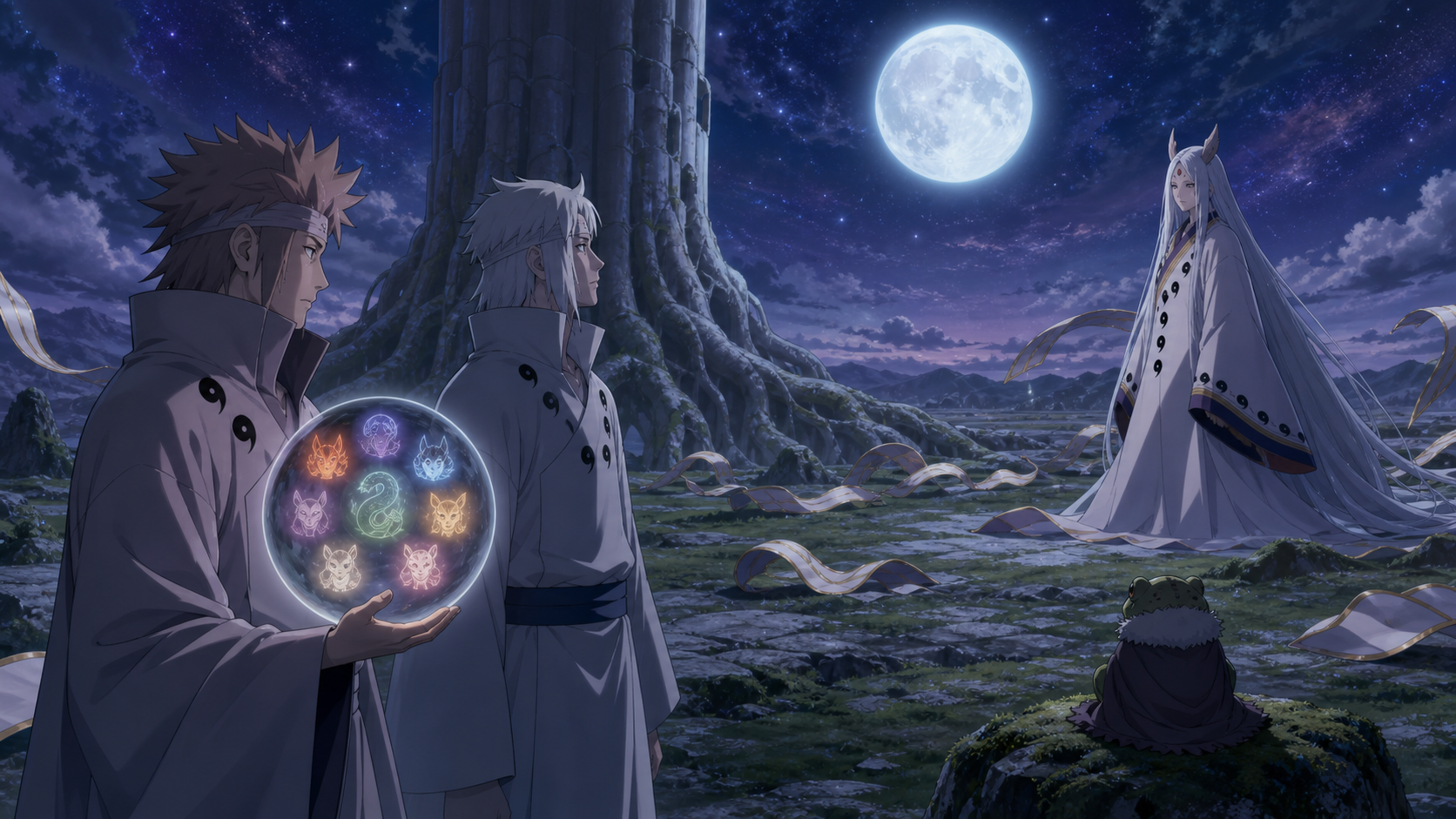
A Fabricated Past
Black Zetsu altered records and nudged generations, but human history cannot become one villain’s résumé without erasing every choice that sustained it.
Bottom line
“A Fabricated Past” gives Naruto's creation myth a family tragedy and then nearly buries human responsibility under Black Zetsu's claim that he engineered everything. Hagoromo discovers people bound to the Divine Tree, trains with Gamamaru, returns to challenge Kaguya, and finds Hamura weaponized against him. He nearly kills his own brother before the shock awakens the Rinnegan. The brothers then fight their mother and the Ten-Tails for months, seal Kaguya, free her captives, and divide the beast's chakra into nine lives. Those events explain where the tailed beasts came from and why the Moon holds Kaguya's prison. The title still lands on the dangerous part: Black Zetsu altered records and nudged generations, but shinobi history cannot become his solo achievement without shrinking every war, grievance, ambition, and betrayal into one villain's résumé.
Episode 462 closes the anime-expanded origin
Episode 462 is titled “A Fabricated Past.” The Japanese title is “Tsukurareta Kako.” The episode aired in Japan on May 26, 2016.
The story finishes the anime's expanded account of Kaguya, Hagoromo, Hamura, and the sealing that created the Moon.
Hagoromo crosses the forbidden peak
The disappearance of Haori and Kaguya's refusal to explain the ritual force him beyond the boundary. He seeks evidence rather than accepting another sacred answer.
The discovery destroys his remaining trust in the official story.
Human beings hang from the Divine Tree
The selected people are not serving in a ceremony and returning home. They are bound, drained, and transformed through Kaguya's system.
The ritual is forced conversion hidden behind tradition.
Haori becomes one captive among many
Hagoromo's personal concern leads him to a larger crime. Her face prevents the victims from becoming anonymous historical material.
One relationship opens his eyes to a structure harming everyone.
The God Tree is consuming the land
Gamamaru's warning proves accurate. Life energy flows toward the same structure taking human bodies.
Kaguya's promised protection is weakening the world she claims to defend.
Hagoromo cannot confront her unprepared
Seeing the truth gives him moral certainty, not enough power to free the captives. Kaguya can dominate minds, wield the Byakugan, and command chakra beyond his current ability.
Opposition without preparation would waste the evidence and his life.
Gamamaru brings him to Mount Myoboku
The toads offer knowledge outside Kaguya's rule. Natural energy gives Hagoromo a source of power not controlled by the Divine Tree.
The mountain becomes a school for resistance.
Sage training requires relationship with the land
Hagoromo learns to sense and balance energy already present in nature. The method contrasts with Kaguya's extraction.
One practice joins an existing flow. The other pulls every flow toward one owner.
Training takes time Kaguya can use
Every day away lets the ritual continue. Hagoromo accepts that painful delay because an unready confrontation would fail immediately.
Preparation carries its own moral cost when victims remain captive.
Hamura stays behind
The younger brother remains closer to Kaguya and the people while Hagoromo trains. Their separation creates vulnerability.
Kaguya can reach one son without the other present.
A messenger toad brings bad news
Kaguya has returned, and nobody can contact Hamura. The missing brother signals that family conflict has moved beyond argument.
Hagoromo must act before training feels comfortably finished.
Hagoromo evacuates the village
He warns people and moves them away from the coming confrontation. The decision treats civilian survival as part of the mission rather than collateral luck.
Leadership begins before the battle.
Gamamaru gives him the sage tag
The toad's treasure can restore sage power at a critical moment. The gift is not another attack.
Its greatest use will be saving Hamura after Hagoromo wounds him.
Kaguya faces a son who now knows
Hagoromo returns with proof of the captives and understanding of the Divine Tree's drain. He can no longer accept necessity as an explanation.
The confrontation is political and painfully domestic.
He asks why she chose coercion
Hagoromo knows Kaguya suffered love and betrayal among humans. He wonders whether those experiences created the anger driving her rule.
Empathy does not make him surrender the victims.
Kaguya sees broken law before broken trust
She focuses on his violation of the forbidden boundary and his challenge to her authority. The truth he found matters less to her than the fact that he looked.
Control cannot survive independent verification.
Mother and son cannot reach agreement
Kaguya believes the ritual prepares for a threat her sons do not understand. Hagoromo sees living people sacrificed without consent.
Shared fear of future violence cannot bridge incompatible treatment of present lives.
Hamura appears beside Kaguya
The missing brother returns, but his behavior immediately feels wrong. Kaguya has taken control of him.
Family becomes another weapon in her defense.
Hamura attacks Hagoromo
The brothers who investigated the Peak of Demise together are forced into combat. Hagoromo cannot assume that love will let Hamura resist every command.
Kaguya turns his strongest relationship into the first obstacle.
Mind control repeats her political method
The Divine Tree takes bodies. Infinite Tsukuyomi takes waking lives. Hamura's control takes immediate action.
Kaguya solves disagreement by removing the disagreeing person's will.
Hagoromo hesitates against his brother
He must protect himself without treating Hamura as an enemy who chose the attack. Restraint creates danger because controlled violence remains physically real.
Compassion does not eliminate the need to stop the blow.
Hagoromo deals a fatal wound
The fight forces him past the safe limit. Hamura falls with an injury that should kill him.
For one terrible moment, resisting Kaguya appears to cost the brother he wanted beside him.
Shock changes Hagoromo's eyes
His Sharingan develops into the Rinnegan under the pain of nearly killing Hamura. The anime expansion visualizes another ocular evolution through trauma.
The mechanism does not align neatly with every later explanation, so the continuity label remains necessary.
Power arrives after the damage again
Like Itachi's Sharingan and Amaterasu, the stronger eye appears when someone close has already fallen. Naruto repeatedly ties capacity to grief.
The pattern can explain power without making trauma desirable.
The sage tag restores Hamura
Hagoromo uses Gamamaru's gift to heal his brother. The object designed to replenish natural energy becomes a route back from death.
Preparation turns a fatal mistake into a recoverable one.
Hamura returns to himself
Freedom from Kaguya's control lets him choose the coming fight. He does not join Hagoromo because a technique compels him.
The brothers face their mother through shared consent.
Kaguya calls on the Divine Tree
The structure she used for ritual and extraction becomes a combat force. The tree transforms into the Ten-Tails.
The ruler and the system sustaining her rule become physically inseparable.
The Ten-Tails gives accumulated harm a body
Land energy, captured humans, and the chakra fruit feed one monstrous form. The beast is not random destruction arriving from outside the story.
The Ten-Tails embodies what Kaguya gathered and refused to release.
The brothers fight for months
Sealing their mother is not one clean exchange between gods. The battle outlasts ordinary campaigns and tests every reserve they possess.
Ancient power does not make the victory effortless.
Hagoromo and Hamura must stay coordinated
The Six Paths sealing technique requires them to act together. Losing either brother would end the attempt.
Their partnership anticipates Naruto and Sasuke's role in the present.
Kaguya remains their mother during the fight
They oppose a tyrant and still carry the history of being her children. Combat cannot turn the relationship into a simple hero-versus-monster frame.
Sealing becomes both world defense and family rupture.
Six Paths Chibaku Tensei closes around her
The brothers place complementary seals and draw a massive body of earth upward. The technique creates a prison rather than pretending Kaguya can be defeated through ordinary injury.
Her power is contained at planetary scale.
The Moon becomes the seal
Material pulled into the sky forms the celestial body that will hold Kaguya and the Ten-Tails. Later generations see a moon without knowing the imprisoned history inside.
Geography becomes an archive of conflict.
Kaguya creates Black Zetsu before confinement
Her will separates into a being capable of operating after she is sealed. The sons defeat her body without ending her plan.
Black Zetsu begins a long project built around revival.
The hidden will escapes notice
Hagoromo and Hamura believe the sealing solved the immediate threat. They do not know that a piece of Kaguya remains active outside the Moon.
Incomplete information shapes the peace that follows.
The Divine Tree releases its captives
People bound through the ritual regain freedom after Kaguya's defeat. The ceremony ends because the system enforcing the ceremony has been broken.
Liberation confirms that sacrifice was never an irreversible law of nature.
Hagoromo separates the Ten-Tails' chakra
He divides the enormous power into nine distinct beings. The choice prevents one entity from holding the entire destructive reserve.
Distribution becomes an answer to Kaguya's concentration of ownership.
The tailed beasts begin as lives, not weapons
Shukaku, Matatabi, Isobu, Son Goku, Kokuo, Saiken, Chomei, Gyuki, and Kurama receive separate identities. Hagoromo treats them as children capable of relationship.
Later villages will reduce many of them to military assets.
Creating nine beings does not guarantee humane treatment
Hagoromo's intention cannot control future governments. Shinobi capture, seal, trade, and weaponize the tailed beasts across generations.
Distributed power still requires ethical relationships to remain free.
Hamura chooses the Moon
He leaves Earth to watch over Kaguya's seal. The decision gives the prison a guardian connected to both sides of the family conflict.
His descendants will carry that lunar responsibility into later stories.
Hagoromo remains with humanity
He begins sharing chakra through Ninshu, intending connection and mutual understanding. The gift answers Kaguya's ownership model with circulation.
People will later turn that connection into ninjutsu and warfare.
Good intent cannot freeze future meaning
Kaguya wanted defense and built domination. Hagoromo wanted understanding and helped enable shinobi combat. Neither founder controls every later use of the system created.
History contains inheritance and new choices together.
Black Zetsu alters the Stone Tablet
He changes the record Hagoromo left so Uchiha descendants will follow a route toward the Rinnegan and Infinite Tsukuyomi. Fabricated authority guides people who believe they are recovering sacred truth.
The lie works because real grief and ambition already exist.
Indra does not become innocent by manipulation
Black Zetsu can encourage resentment without creating every feeling from nothing. Indra still makes choices inside a family and political conflict.
Manipulation changes responsibility without erasing agency.
Madara remains responsible too
The altered tablet deceived him, and Black Zetsu encouraged the Moon's Eye Plan. Madara still recruited Obito, attacked the world, and chose forced dreams as peace.
Being used does not undo the people a person used.
The title warns against a single-author history
Black Zetsu claims centuries as the product of his design. The boast fits a creature who sees people as tools.
Real history is messier because systems, individuals, accidents, love, fear, and material pressure interact.
The anime expansion creates its own fabrication risk
Episodes 460 through 462 supply useful emotional detail while adding mechanics later franchise material complicates. Viewers should keep adaptation layers visible.
One animated account cannot silently replace every canonical source.
A Fabricated Past returns the question to Naruto
Black Zetsu wants the captured boys to believe all shinobi struggle served Kaguya's revival. Naruto has spent the series proving that inherited cycles can be interrupted.
His answer will come through the most unpredictable tactic available.
Finding Haori turns suspicion into obligation
Hagoromo did not climb the peak looking for an abstract reason to rebel. He followed one missing person and found an entire population suspended inside the system. Haori’s face keeps the discovery from becoming mythology before it becomes grief.
Once he knows, returning to ordinary administration would make him part of the concealment. Knowledge creates responsibility because the people being drained cannot deliver their own testimony.
Training does not erase the cost of waiting
Gamamaru is right that Hagoromo cannot defeat Kaguya through moral certainty alone. Time at Mount Myōboku gives him a chance to survive, free the captives, and challenge the structure rather than die at its edge.
Those months still belong to the victims. Strategic delay may be necessary, but necessity should never make the suffering during preparation invisible. Leadership has to carry both truths without pretending one cancels the other.
Hamura’s body becomes Kaguya’s argument
Kaguya cannot persuade Hagoromo that forced sacrifice is protection, so she removes Hamura’s will and sends him forward as proof of her authority. The person most able to reach her son emotionally becomes a weapon against him.
That is domination in its clearest form. Mind control does not win a disagreement. It prevents a person from participating in the disagreement at all.
Hagoromo’s restraint has a physical limit
He understands that Hamura did not choose the attack, but understanding cannot make the blows harmless. The fight forces him to stop his brother with enough power to nearly kill him.
Naruto often asks people to preserve compassion inside combat, not float above its consequences. Hagoromo can refuse to hate Hamura and still be responsible for the wound his hand delivers.
The sage tag makes preparation relational
Gamamaru’s gift matters because victory does not come only from acquiring a stronger eye. Hagoromo survives the worst moment through something another being prepared and entrusted to him.
Kaguya concentrates every resource around herself. Hagoromo’s resistance grows through shared knowledge, natural energy, brotherhood, and a tool whose purpose becomes rescue. The contrast matters more than another power ranking.
Months of battle refuse the easy creation myth
The sealing is not a single destined pose performed by two perfect sons. It requires endurance, coordination, failure, recovery, and a relationship strong enough to survive Kaguya’s attempt to break it from within.
The Moon looks clean after the fact. The struggle that created it was not. Myth smooths duration into an emblem, while the episode restores some of the labor hidden inside that emblem.
Nine lives answer one owner
Hagoromo divides the Ten-Tails’ chakra instead of inheriting Kaguya’s position as the sole person entitled to possess it. Shukaku, Matatabi, Isobu, Son Gokū, Kokuō, Saiken, Chōmei, Gyūki, and Kurama become individuals capable of names, preferences, anger, affection, and memory.
Later villages betray that beginning when they classify those lives as weapons. Distribution alone cannot preserve freedom if institutions keep rebuilding ownership around the pieces.
Black Zetsu weaponizes the authority of an archive
Changing Hagoromo’s tablet works because descendants believe the record carries wisdom beyond their own experience. Black Zetsu does not need to command every Uchiha directly. He alters the source they trust and waits for grief, pride, and political exclusion to make the false route persuasive.
The manipulation is profound, but it is not total authorship. A forged map influences travelers. It does not take every step for them or create the terrain they cross.
Victims can remain responsible for later victims
Madara was deceived about Infinite Tsukuyomi and used as material for Kaguya’s return. He also deceived Obito, weaponized Nagato’s work, captured tailed beasts, and imposed a dream state on the world.
Both facts belong in the same sentence. Harm received can explain the shape of harm delivered. It cannot make the second group of wounded people disappear.
A fabricated past still needs real conditions
Black Zetsu could alter text and whisper at vulnerable moments because clan hatred, village inequality, bereavement, and political ambition already existed. Treating him as the author of everything lets the shinobi system escape the consequences it repeatedly produced.
A manipulator is most effective when a society has built the wounds he can exploit. Removing him does not automatically repair those wounds.
History remains human because manipulation never removes every choice people make.
RaeRae’s verdict
“A Fabricated Past” is moving when it stays close to relationship: Haori among the captives, Hamura forced to attack, Hagoromo using a mentor’s gift to bring his brother back, and nine new beings receiving lives beyond the monster that contained them. Those choices make creation feel like responsibility instead of trivia.
Black Zetsu’s boast is the weak seam and the useful warning. He changed records and manipulated generations, but nobody gets to claim every human choice as a personal masterpiece. That fantasy mirrors Kaguya’s belief that all chakra belongs to her. History, like chakra, becomes dangerous when one voice insists it owns the whole thing.
Episode 462 closes history and resumes the fight
Hagoromo and Hamura's origin has established the seals, Moon, tailed beasts, Black Zetsu, and Kaguya's first defeat. The present team now knows the scale of the plan around them.
Episode 463 will return to the lava dimension, where Naruto rejects Black Zetsu's authorship claim and shocks Kaguya with a transformation nobody in ancient prophecy prepared for.
RaeRae’s call
Black Zetsu altered the archive, but he did not become the sole author of every wound that followed. Kaguya, Hagoromo, Hamura, Indra, Madara, villages, clans, and institutions still made choices inside the history he manipulated. The episode works when it gives those choices bodies: Haori bound to the tree, Hamura stripped of consent, and nine tailed beasts created as lives rather than inventory. Explanation should complicate accountability, never erase it.
Episode details and viewing routes
- Official episode reference: Naruto Official episode guide
- Licensed episode route: Crunchyroll licensed episode page
What I am carrying forward
Hagoromo found Haori and the other ritual victims bound to the Divine Tree, trained with Gamamaru, healed Hamura after Kaguya forced the brothers to fight, and joined him in sealing their mother and the Ten-Tails inside the Moon.
Hagoromo freed the captives and divided the beast’s chakra into nine lives. Black Zetsu escaped, altered the Stone Tablet, and claimed generations of shinobi history as his design. Episode 463 returns to Naruto and Sasuke, who must reject that claim while escaping Kaguya’s control.