
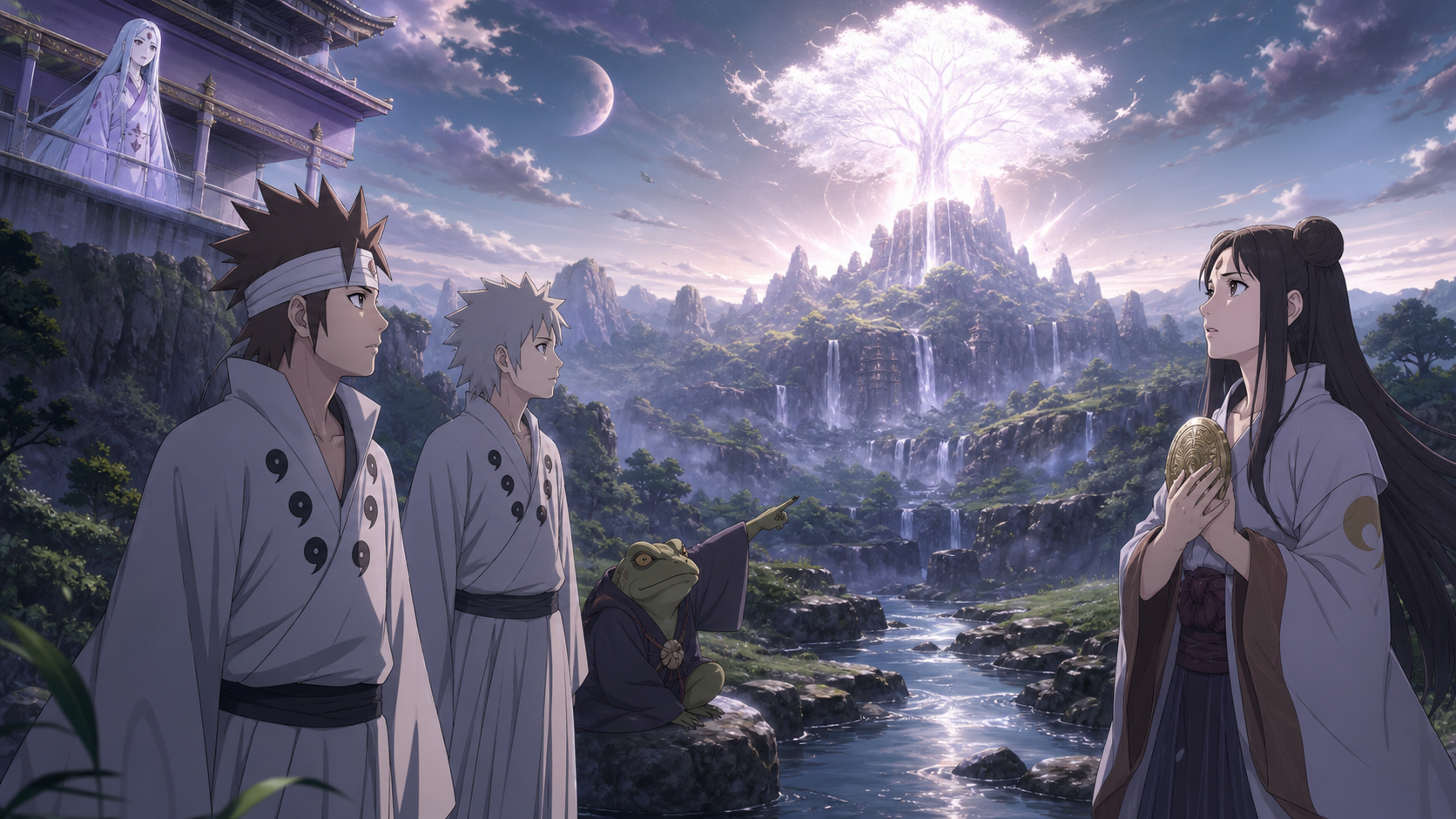
Hagoromo and Hamura
The origin of Ninshu begins when Gamamaru offers evidence instead of obedience and Hagoromo learns that authority cannot make a lie true.
Bottom line
“Hagoromo and Hamura” shows how tyranny survives by renaming disappearance a ritual and curiosity disobedience. Kaguya's sons grow up believing the Divine Tree sustains the land. Farmers see streams dry, chosen people walk toward the Peak of Demise and never return, and nobody is allowed to ask what happens beyond the mountain. Haori's selection makes the system personal. Hagoromo cares about her, so the official explanation stops being enough. Gamamaru does not hand him a rebellion speech. The sage toad blocks a stream, makes the brothers investigate cause and effect, and tells them to verify the truth themselves. That teaching matters. Kaguya demands obedience because she claims superior knowledge. Gamamaru offers evidence and expects Hagoromo to think. The origin of Ninshu begins with a young man learning that authority cannot make a lie true.
Episode 461 follows Kaguya's sons
Episode 461 is titled “Hagoromo and Hamura.” The episode aired in Japan on May 19, 2016.
The anime-expanded history moves forward to the brothers' youth under Kaguya's rule and the Divine Tree ritual.
Black Zetsu continues shaping the account
He tells Naruto and Sasuke what happened while draining their chakra beside Kaguya. His version supplies names, relationships, and events absent from the brief manga history.
The speaker remains an interested party, not a neutral archive.
Kaguya has taken the chakra fruit
The power that saved her from Tenji's soldiers also placed her beyond ordinary human challenge. She ended conflict through overwhelming force.
Peace arrived because resistance became impossible.
Hagoromo and Hamura inherit chakra
Kaguya's twin sons are born with abilities no other humans possess in this era. Their bodies carry the beginning of several bloodlines that will shape later shinobi history.
Inherited power does not guarantee inherited obedience.
The brothers grow under their mother's rule
They know Kaguya as parent, sovereign, and source of the social order around them. Questioning government therefore means questioning family.
That overlap makes dissent emotionally dangerous.
Kaguya still watches the sky
Her sons notice the same distant gaze Aino once saw. They wonder what she expects or fears beyond the world they know.
Kaguya keeps the answer about “the others” to herself.
Fear has replaced the earlier longing
Looking upward once suggested homesickness and reflection. Under her rule, the repeated gesture carries vigilance.
Power has not made her feel safe.
Gamamaru watches the family
The young sage toad observes Hagoromo and Hamura from a nearby stream. Natural energy gives him access to truths outside Kaguya's political story.
He waits until the brothers can investigate rather than simply obey him.
Farmers bring a water dispute
Two groups need the same shrinking stream and accuse each other of taking too much. Scarcity turns neighbors toward conflict.
The problem is practical before becoming philosophical.
Hagoromo and Hamura accept responsibility
They go to the source rather than issuing a judgment from a distance. Both understand that resolving the dispute requires finding why the water changed.
Leadership begins with inspection.
A bear makes the source dangerous
People avoid the upper stream because a large animal lives nearby. Fear prevents anyone from checking the physical cause of the shortage.
The unseen problem gains room to grow.
Hamura uses the Byakugan
His vision reveals a massive boulder blocking the water. The dispute below came from an obstruction above, not selfish farmers.
Better information changes the moral story immediately.
Gamamaru admits placing the boulder
The toad created the blockage deliberately. His action caused hardship, which makes his method ethically uncomfortable even as a test.
He wanted the brothers to prove how they respond to a hidden cause.
The test rewards investigation over blame
Hagoromo and Hamura did not punish either farming group based on accusation. They traced the effect upstream.
That habit becomes essential when they examine Kaguya's rule.
A bear approaches during the conversation
The animal turns the controlled test into an immediate threat. Hagoromo and Hamura prepare for danger.
Gamamaru handles the bear without panic.
Gamamaru drives the animal away
His power surprises the brothers because his small body does not match their assumptions about strength. Another visible category fails to predict capacity.
Respect grows from what he demonstrates.
Hagoromo removes the boulder
Before leaving, he restores the stream. Learning the lesson does not excuse leaving farmers with the cost of Gamamaru's test.
Repair comes before the next question.
Water returns to the farms
The original conflict can ease because the material shortage has been addressed. Moral lectures would have achieved less than removing the obstruction.
Peace needs resources and accurate causes, not only good intentions.
Gamamaru points toward the mountains
He directs the brothers' attention to the region around the Divine Tree. The larger blockage affecting the land sits beyond an official boundary.
The stream lesson becomes preparation for political investigation.
The Peak of Demise is forbidden
Kaguya has ordered everyone to stay away except people chosen for the ritual. The name itself carries warning and death.
Prohibition keeps witnesses from seeing what the ceremony produces.
Kaguya says the Divine Tree sustains life
The official teaching presents the tree as the reason the land thrives. Gratitude makes questioning the ritual sound like disrespect toward the source of prosperity.
The claim reverses the actual flow of energy.
Gamamaru says the land is weakening
Natural energy reveals that the tree absorbs life from the surrounding world. Growth at the center produces exhaustion everywhere else.
The celebrated source is also the drain.
A sacred story hides extraction
Kaguya's rule frames the tree as giver while people and land feed the tree. Ritual language turns forced transfer into honor.
The structure resembles Infinite Tsukuyomi on a smaller historical scale.
Gamamaru refuses to demand blind belief
He tells the brothers to go beyond the peak and see the truth. His claim comes with a route to verification.
That difference separates teaching from command.
Hagoromo becomes curious rather than instantly rebellious
He does not reject his mother because one toad contradicts her. The new information creates a question he can no longer ignore.
Curiosity is a responsible response when authorities offer incompatible explanations.
Hamura remains more cautious
He understands Kaguya's power and the consequences of violating her order. Fear does not make him weak or morally indifferent.
The risk includes losing their mother as well as punishment from a ruler.
Haori makes the ritual personal
The young woman shares time with Hagoromo and Hamura before receiving notice that she has been selected. Her ordinary presence gives the coming disappearance a face.
She is not a symbolic villager chosen from nowhere.
Selection offers no real choice
Haori says she must serve the Divine Tree. Tradition and Kaguya's authority make refusal unthinkable.
Calling the selection an honor cannot create consent.
Haori asks the brothers to remember her
She knows enough to fear that the ritual may separate them permanently. Her farewell carries resignation rather than celebration.
The request exposes the ceremony's public lie before the mountain does.
Nobody returns from the Peak of Demise
Hagoromo has noticed the pattern. People enter Kaguya's ritual and disappear from community life.
An institution cannot call repeated permanent loss temporary service forever.
Hagoromo confronts Kaguya
He asks his mother to end the Divine Tree ritual. The request begins respectfully because he still hopes family conversation can correct policy.
Kaguya treats the challenge as defiance.
Kaguya says the ritual cannot stop
She presents necessity as the complete answer. No timeline, limit, or account of the people selected follows.
Necessity becomes a shield against scrutiny.
Her sons are not exempt from obedience
Kaguya says she will tolerate no defiance even from Hagoromo and Hamura. Motherhood does not soften sovereign authority.
The family relationship now serves the state rather than restraining Kaguya's authority.
Hagoromo asks where people go
He names the factual question beneath the moral argument. Why does nobody return after serving the tree?
Kaguya refuses to provide a direct answer.
Kaguya mentions “the others”
She says the ritual remains necessary until other beings arrive. The line reveals an external threat her sons do not understand.
Her fear may have a real object, but concealed danger cannot justify unlimited sacrifice without explanation.
Kaguya withholds the larger threat
She decides Hagoromo and Hamura do not need to know yet. Secrecy prevents them from evaluating whether her response is proportionate or whether another defense exists.
Protection again becomes control through withheld truth.
She leaves the brothers in charge
Kaguya departs and instructs them to manage affairs. She trusts their labor while denying their questions.
Responsibility without information is another form of obedience.
Hagoromo decides to climb the peak
Haori's selection and Kaguya's refusal make passive waiting impossible. He chooses direct evidence over the official story.
The decision begins his separation from his mother's rule.
Hamura warns about the consequences
He reminds his brother that Kaguya will be furious. The warning is accurate and rooted in love for both family members.
Hamura still follows because leaving Hagoromo alone would not protect anyone.
Brotherhood makes investigation possible
Hagoromo brings moral urgency. Hamura brings caution and Byakugan perception. Neither brother has to carry the discovery alone.
Their partnership contrasts with Kaguya's isolated authority.
Beyond the peak waits the real ritual
The brothers will find people bound to the Divine Tree rather than honored participants returning home. The ceremony converts human beings into material for Kaguya's preparation.
Haori's fate becomes evidence, not rumor.
The episode connects ancient ritual to Infinite Tsukuyomi
Kaguya's selected people foreshadow the global population trapped in the present. Both systems hide bodily extraction behind an imposed state presented as necessary.
History repeats because the controlling logic never changed.
Gamamaru teaches a Naruto-style lesson
Truth is found by following consequences, checking claims, and seeing who pays the cost. Rank and sacred language cannot replace that work.
The method fits a series built around looking beneath village labels.
Kaguya's external fear does not erase her victims
Later knowledge about incoming Ōtsutsuki can explain why she wanted an army. Haori and the other selected people still lacked consent, information, and a path home.
A real threat can coexist with an abusive response.
Hagoromo begins as a listener
Before becoming the Sage of Six Paths, he solves a water problem, accepts correction, asks his mother a direct question, and seeks evidence. His moral authority grows from process rather than birth alone.
That foundation matters more than a list of future powers.
Hamura begins as the cautious partner
He does not receive as much ideological focus, but his loyalty gives Hagoromo the support needed to act. Caution helps measure risk without becoming surrender.
The brothers' differences strengthen the investigation.
The anime expansion works best at human scale
Farmers need water. A young woman fears disappearing. Sons realize their mother lies. Those details make ancient chakra history readable.
The continuity becomes shakier when later lore adds facts the expansion never anticipated.
The episode also understands that a political system becomes visible through ordinary consequences. A missing stream, a frightened neighbor, and a forbidden path reveal more than a ruler’s speech. Hagoromo begins resisting Kaguya only after connecting official language to the lives that language conceals.
The stream dispute is the episode’s political thesis
Two farming groups look selfish because both need water that no longer reaches them. If Hagoromo had ruled from the accusation alone, he could have punished neighbors for a shortage neither created. Walking upstream changes the story. A hidden obstruction, not moral failure below, caused the conflict.
Naruto returns to this lesson constantly. Institutions blame the person displaying pain while leaving the machinery producing it untouched. Hagoromo’s first strength is not inherited chakra. It is the willingness to inspect what power would rather call obvious.
Gamamaru’s lesson is useful and ethically messy
The toad placed the boulder, which means real farmers carried the cost of his teaching exercise. His willingness to reveal the act and let Hagoromo remove it separates him from Kaguya, but it does not erase the manipulation.
Good instruction should not require vulnerable people to suffer without consent. The scene works because repair follows discovery, yet the discomfort belongs in the reading. A mentor can point toward truth and still owe accountability for the method used.
Haori turns a system into one stolen future
“Chosen for the ritual” is administrative language. Haori is a young woman with relationships, fear, and plans beyond the mountain. Once she asks the brothers to remember her, the official category cannot contain what is being taken.
This is why image-card fandom writing cannot reduce a character to a plot function. Haori is not merely the clue that motivates Hagoromo. Her disappearance is the human cost that makes his awakening necessary.
An honor without refusal is an order
Kaguya’s ritual is described as service to the Divine Tree. Selection sounds prestigious, and sacred purpose discourages questions that ordinary forced labor would invite immediately. Nobody returns, yet the community has been trained to repeat the ceremonial explanation.
Consent requires a meaningful no, accurate information, and freedom from punishment. Haori receives none of those things. Calling her chosen beautifies coercion without changing it.
Kaguya’s real fear cannot make every sacrifice necessary
She knows other Ōtsutsuki may arrive and believes preparation cannot stop. That danger gives her secrecy a motive, not a moral blank check. Her sons cannot evaluate alternatives because she refuses to explain the threat, timeline, scale, or purpose of the people taken.
“You do not understand enough to question me” is how protection becomes permanent rule. Kaguya keeps all knowledge, declares all costs essential, and then uses the absence of informed resistance as proof of obedience.
Responsibility without information is controlled labor
Kaguya leaves Hagoromo and Hamura to govern while denying them the facts required to judge her policies. They can settle disputes, enforce order, and absorb public frustration, but they cannot examine the system consuming the population.
That arrangement is familiar. Authority delegates consequences while hoarding decisions. The brothers receive enough status to maintain the machine and not enough truth to challenge its destination.
Hagoromo earns authority by remaining corrigible
He listens to farmers, checks the source, accepts that a tiny toad knows something he does not, repairs the blockage, questions his mother, and seeks evidence when her answer fails. None of those choices depends on being the strongest person present.
His later role as teacher begins here. Moral authority grows because he can be corrected and still act. Kaguya’s authority decays because correction itself has become forbidden.
Hamura’s caution is part of courage
Hamura knows what their investigation could cost. He loves his mother, understands her power, and does not pretend crossing the peak is a harmless adventure. Following Hagoromo anyway is a deliberate choice made with fear intact.
Courage is not always the loudest demand for truth. Sometimes it is the person who names the danger clearly, then refuses to let somebody face it alone.
The Divine Tree reverses the story told about it
People are taught that the tree sustains the land. Gamamaru observes that it drains natural energy while ritual participants vanish into its roots. The giver is an extractor whose appetite has been disguised as public benefit.
That reversal prepares viewers for Infinite Tsukuyomi. Beautiful dreams and sacred service perform the same political trick: the person being consumed is told the system exists for them.
Truth needs a route anybody can test
Gamamaru does not demand that Hagoromo replace one unquestioned authority with another. He points to the mountain. The claim can be checked through observation, and the brothers remain responsible for deciding what the evidence means.
That is the difference between teaching and recruitment. One expands another person’s capacity to judge. The other supplies a conclusion and treats doubt as betrayal.
RaeRae’s verdict
“Hagoromo and Hamura” makes ancient mythology work by bringing it down to water, friendship, family fear, and a young woman who knows she may never return. Haori gives the ritual a face. The farmers show how hidden extraction creates visible conflict among people who did not cause it. Gamamaru offers a method for looking past both problems.
Kaguya remains understandable without becoming right. She prepares for a threat her sons cannot see, but secrecy makes proportional judgment impossible and ritual language erases consent. Hagoromo begins resisting not because he stops loving his mother, but because love cannot require pretending missing people came home.
Hagoromo and Hamura turns curiosity into resistance
The brothers begin by repairing a stream and end by crossing a forbidden boundary. Both choices follow the same principle: find the hidden cause before judging the people suffering below.
Episode 462 will reveal the captives, send Hagoromo to train with Gamamaru, and force the brothers into battle against Kaguya and the Divine Tree.
RaeRae’s call
The strongest power in this episode is not chakra. It is the decision to follow consequences upstream. Farmers are fighting because water was blocked. Haori disappears because coercion was renamed service. Kaguya’s sons obey because their mother controls the information needed to judge her. Hagoromo begins becoming a teacher when he stops accepting authority as evidence. Hamura becomes brave when he carries fear without abandoning his brother. Truth matters because people remain free to verify it and act.
Episode details and viewing routes
- Official episode reference: Naruto Official episode guide
- Licensed episode route: Crunchyroll licensed episode page
What I am carrying forward
Hagoromo and Hamura solved the farmers’ dispute by tracing the missing water to its source. Gamamaru then directed them toward the larger extraction hidden behind Kaguya’s sacred story of the Divine Tree.
Haori was chosen for a ritual nobody returns from. Kaguya refused to stop it, invoked an unnamed external threat, and denied her sons the information needed to judge the sacrifice. The brothers chose to cross the forbidden peak together. Episode 462 reveals the captives and turns investigation into open resistance.