
RaeRae Reacts · One Piece Episode 144
The Log Pose Points Straight Up
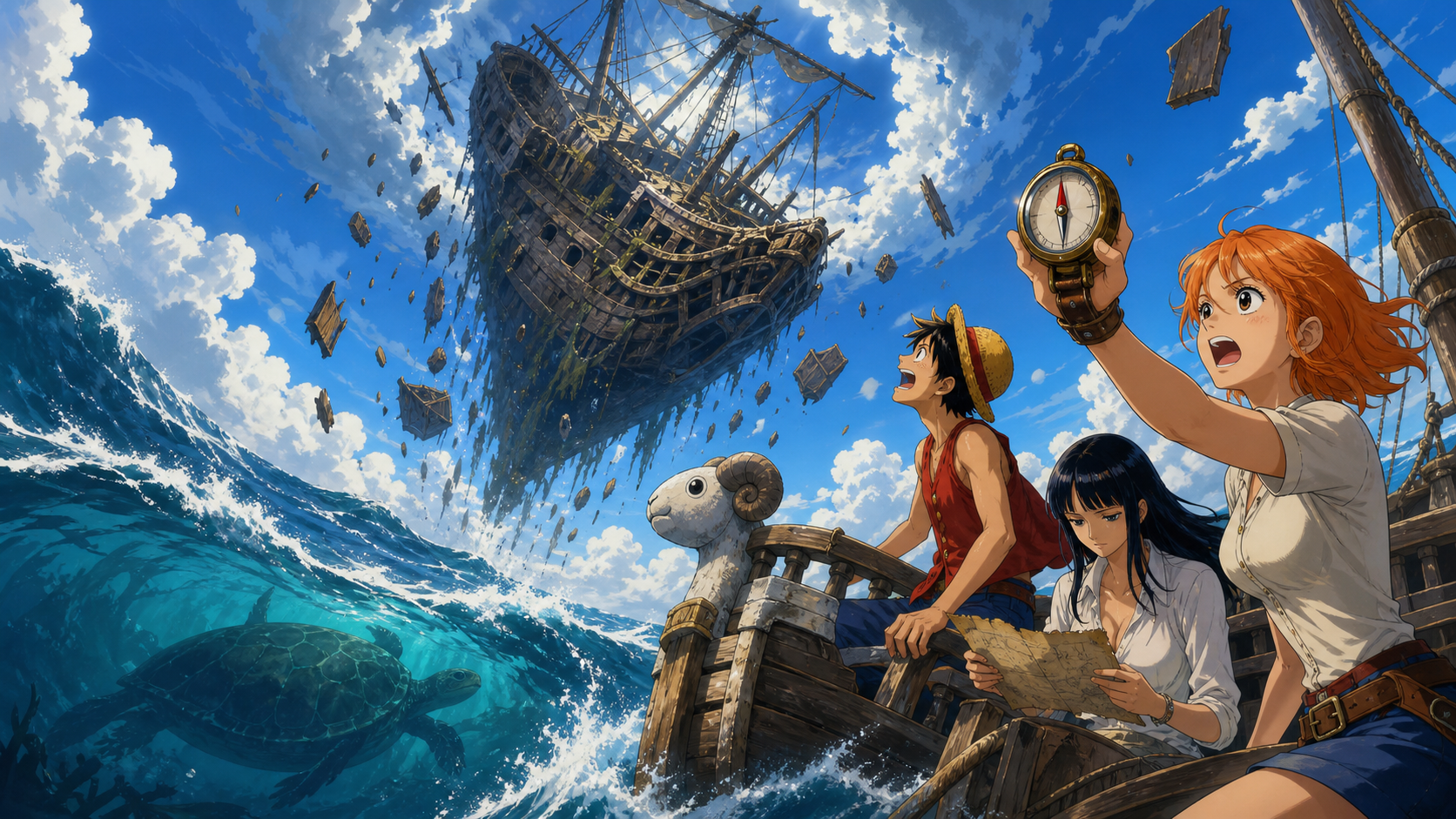
One Piece Episode 144 begins Jaya with a falling galleon, an upward Log Pose, the Skypiea map, Masira’s salvage claim, and a turtle-sized disaster.
A ship falling from the sky turns wonder into an immediate hazard
Episode 144 begins with fragments dropping around the Going Merry before an entire ruined galleon crashes from the clouds. The crew has seconds to move before waves and debris overwhelm the deck.
Curiosity must wait until everyone is accounted for. Falling timber, rigging, cargo, metal, and human remains can strike long after the main hull enters the sea.
Nami should order sails reduced, Usopp should secure loose equipment, Chopper should establish a protected medical point, and Zoro and Sanji should keep people away from damaged rails.
The crew also needs to mark the wreck position without approaching the impact zone too quickly. Secondary collapse and trapped air can send more material back to the surface.
The Log Pose points upward because the world refuses to stay flat
Nami sees the Log Pose needle standing toward the sky and assumes the instrument has failed. Every route she knows depends on the needle translating magnetic fields into a usable direction.
Robin argues that the device may be working exactly as designed. An impossible reading can reveal an incomplete model rather than broken equipment.
They should test the casing, compare the needle against another compass, record movement over time, and note whether distance from the wreck changes the angle.
Nami does not lose credibility by questioning the reading. A navigator protects lives through skepticism. The next step is disciplined verification, not blind trust or automatic rejection.
Robin treats oral history as a lead rather than a joke
Robin explains that stories describe an ocean and islands in the sky. She has never visited one and does not pretend rumor equals proof.
That honesty gives the crew a research question: does the upward magnetic signal connect to the falling ship and the stories preserved across different communities?
They should separate what they observed, what records claim, and what remains speculation. The wreck fell from above. The Log Pose points above. A sky ocean remains a hypothesis until more evidence appears.
Oral accounts deserve attribution and comparison, especially when official maps omit the same place. Dismissing stories because institutions failed to record them can erase the people who survived enough to tell them.
Luffy announces a destination before anyone has a route
Luffy hears Sky Island and immediately wants to go. His excitement protects the possibility that a strange destination exists, but desire cannot make the Merry fly.
Nami and Sanji need propulsion, altitude, weather, oxygen, vessel limits, and an approach method before accepting the destination as safe.
The captain can set exploration as a goal while giving specialists authority over departure conditions. Leadership should make room for wonder and constraint at the same time.
No crewmate should be mocked for fear. A vertical route may involve falling, pressure changes, lightning, cold, and ship damage. Consent needs actual risk information, not a cheerful order followed by improvisation.
The dead sailor’s skull carries medical and historical evidence
Robin studies a skull recovered from the debris and identifies signs of an ancient cranial procedure. The remains help date the wreck to roughly two centuries earlier.
Human remains are not props. The crew should document the recovery location, avoid unnecessary handling, and keep bones separated from loose cargo.
Robin can record visible features without making a definitive identity claim. A procedure may suggest time and culture, but one skull cannot describe every person aboard.
If the crew later reaches authorities or descendants connected to the ship, they should transfer the remains with notes and respect. Discovery creates a duty of care toward people who cannot speak for themselves.
The St. Briss deserves a record before salvage changes the scene
Robin identifies the vessel as the St. Briss, an exploration ship from the South Blue. The name turns an anonymous wreck into a lost voyage with an origin and possible descendants.
Before anyone removes objects, the crew should sketch the debris field, photograph or draw markings, list visible cargo, and note damage created by the fall.
Context makes an artifact meaningful. A loose object may become impossible to date or interpret after separation from the cabin, crate, or body beside the object.
The crew cannot preserve an entire underwater site during an emergency, but a basic record can prevent the search for Sky Island from erasing the story that supplied the evidence.
Luffy dives without respecting his own drowning risk
Luffy enters the water to investigate even though his Devil Fruit makes swimming impossible. He needs others to pull him back before the discovery becomes a death.
Known vulnerability should shape the plan before entry. A tether, surface observer, retrieval signal, and strict time limit are minimum requirements.
Zoro and Sanji can dive while Luffy coordinates from the deck or uses a secured line. Being captain does not require taking the role with the highest predictable risk.
Chopper should evaluate aspiration, exhaustion, and impact after recovery. A person who coughs and jokes may still develop breathing complications after inhaling seawater.
The Skypiea map changes rumor into a specific claim
Luffy recovers a map marked for Skypiea from the wreck. The document connects the falling ship to the destination suggested by the Log Pose.
Nami correctly asks whether the map is authentic and whether the document shows a route. A destination label without scale, date, orientation, or approach instructions cannot guide a ship.
Robin should inspect paper, ink, language, wear, and whether the map matches known St. Briss records. The crew should store the document dry and flat rather than passing the map around with wet hands.
The map supports the existence of a belief or expedition toward Skypiea. Combined with the wreck and magnetic signal, the claim becomes strong enough to investigate, not strong enough to sail upward without a method.
Nami proposes salvage because the missing route may remain below
Nami decides that the sunken hull may contain logs, charts, instruments, or records explaining how the St. Briss reached the sky. The goal is information, not random treasure.
The crew should define target items before diving: captain’s log, navigation room contents, route charts, ship registry, weather notes, and durable containers.
Removing fewer, better-documented objects reduces damage and dive time. Each item should receive a recovery location and condition note.
The operation needs depth, current, visibility, air, entanglement, structural stability, and ascent planning. An old hull that survived a fall can still collapse when divers disturb one beam.
Masira arrives with experience and an ownership claim
Masira and his crew appear with specialized salvage equipment and announce that wrecks in the area belong to them. Their practical expertise is obvious; their legal and ethical claim remains unproven.
Regular work in a region does not automatically create ownership over every lost ship, body, artifact, or historical site. Salvage rules should consider identification, abandonment, cultural value, and descendant claims.
The Straw Hats also cannot assume first discovery gives them unrestricted rights. Both crews should pause removal, exchange objectives, and establish safety boundaries.
Masira’s team can provide equipment and local knowledge. The Straw Hats can provide the ship identity, map context, and evidence of a sky route. Cooperation would protect more information than a territorial fight.
The monkey jokes turn a negotiation into humiliation
Masira’s appearance prompts laughter and comparisons that land as ridicule. He responds with anger because the encounter begins by denying him ordinary respect.
The crew should correct the insult directly rather than hide behind intent. Apology needs to name the behavior, stop repetition, and avoid demanding that Masira laugh along.
Masira must also keep his response proportionate. Humiliation does not justify violence around divers, unstable wreckage, or heavy machinery.
Clear introductions and role statements can reset the conversation: Nami seeks navigation records, Robin identifies the wreck, and Masira leads the local salvage crew. People cooperate better when they know what each group actually needs.
Nami lets the salvage crew raise the wreck for a reason
Nami recognizes that Masira’s equipment can lift the St. Briss more safely than improvised diving alone. She allows his operation to proceed while Luffy, Zoro, and Sanji search inside.
That decision needs explicit coordination. Raising a hull while people remain inside can shift walls, seal exits, snap lines, and change pressure.
Divers and surface operators should share a countdown, abort signal, entry map, and confirmation that every person has cleared moving sections.
Nami’s strategy uses another crew’s expertise without surrendering her objective. Fair cooperation should include credit, compensation, and agreement about which records leave the site.
The underwater team enters a structure that can become a coffin
Luffy, Zoro, and Sanji move through the sunken ship searching for records. Low visibility and narrow passages make separation dangerous.
They need a continuous guide line, paired movement, marked rooms, light redundancy, and a turn-back pressure or time. Nobody should chase a promising object beyond the agreed limit.
Luffy requires direct physical support because any lost grip can leave him unable to surface. Zoro’s strength cannot replace route memory, and Sanji should not become the only person tracking both men.
Structural sounds, shifting silt, or changing line tension should trigger immediate withdrawal. A logbook is valuable only when the person carrying the logbook returns alive.
Salvage machinery introduces force the wreck may not survive
Masira’s crew attaches lifting gear and begins raising the wreck. The operation applies new stress to timber already weakened by age, impact, and water.
Load should be distributed across reinforced points, increased gradually, and monitored for cracking or sudden tilt. One enthusiastic pull can destroy the evidence everyone wants.
Surface workers need exclusion zones around cables and winches. A snapped line can cut or strike with lethal force.
The crews should also agree who can stop the lift. Any diver, line tender, or structural observer must have authority to call an immediate halt without waiting for Masira or Luffy.
The giant turtle turns ownership arguments into survival
A colossal turtle rises and swallows the wreck with people still inside. The animal does not care which crew claimed salvage rights.
Surface teams should signal the divers, release lifting lines that could drag the salvage vessel under, and move clear of the animal’s mouth and wake.
Chopper should prepare for crush injury, drowning, decompression stress, and contaminated water exposure. Nami needs to track where the turtle moves rather than assume the swallowed hull remains stationary.
The emergency also proves why a wreck site needs wildlife assessment. A large carcass, cargo, or trapped air pocket can attract animals and change local behavior.
Evidence for Sky Island survives even when the wreck disappears
The turtle removes the most obvious source of information, but the crew still has the upward Log Pose, the Skypiea map, the St. Briss identity, and Robin’s dating evidence.
Losing access does not erase observations already documented. That is why notes, custody, and duplication matter during fieldwork.
The crew should create a shared evidence list and distinguish confirmed facts from next questions. They know something came from above; they still need a route capable of carrying the Merry.
Masira may know local currents, falling debris patterns, and nearby islands where other salvage crews gather. Treating him as a source rather than an obstacle could lead to the missing method.
Jaya becomes the practical next step without replacing the real destination
The crew needs local knowledge, equipment, and people familiar with unusual wrecks. Jaya offers a reachable place to investigate while the Log Pose remains fixed upward.
An interim route should not become accidental abandonment of Sky Island. Nami must preserve the Log Pose reading and track any change near Jaya.
The crew should seek shipwrights, navigators, salvagers, weather records, and accounts of objects falling from the sky. Every source needs independent comparison because a pirate port may reward convincing lies.
They also need to repair any damage from the falling ship before attempting a vertical journey. The next clue will not matter if the Merry cannot survive ordinary water.
Episode 144 makes impossible evidence earn serious attention
The episode does not ask the crew to believe in Sky Island because Luffy wants another adventure. A wreck falls from above, a magnetic instrument points above, an old map names Skypiea, and a documented exploration ship connects the clues.
Nami’s skepticism and Robin’s openness work best together. One protects the crew from fantasy presented as fact; the other protects them from rejecting evidence because the existing map feels safer.
RaeRae’s verdict: keep this one. Episode 144 starts Jaya by putting the impossible on the deck hard enough to raise a wave. The smartest response is neither blind faith nor smug refusal. Observe, document, protect the dead, respect local expertise, control the dive, and let multiple pieces of evidence change the route. Dreams deserve more than belief. They deserve competent preparation.