

Character File · The Little Mermaid · Music, Motherhood, and Memory Used as Law
Queen Athena
Atlantica remembers the queen through one terrible loss. Her profile has to recover the musician, mother, partner, and public woman who existed before everybody else began deciding what her memory meant.
Quick file
Primary appearance: The Little Mermaid: Ariel’s Beginning (2008). Performer: Sally Field. Family: King Triton’s wife and the mother of Attina, Alana, Adella, Aquata, Arista, Andrina, and Ariel. Defining associations: music, the family music box, the surface tragedy, and the grief that Triton later turns into a kingdom-wide ban.
Athena is a retroactive prequel character. She is absent from the 1989 film, which leaves Ariel’s mother unexplained, and the 2008 story inserts her death into the family history. That distinction matters because the prequel is not merely revealing an answer that always existed on screen. It is choosing a new answer capable of organizing a new film.
The movie gives her minutes and asks those minutes to carry years
Athena has little screen time, yet the plot depends on the audience accepting her as the emotional center of a family and a kingdom. The opening must establish a loving marriage, seven daughters, public music, domestic ease, and a recognizable personality quickly enough that her death can explain Triton’s transformation years later.
That is an enormous narrative burden. The shorthand works because music connects nearly every element. Athena performs, the daughters respond, Triton gives her a music box, and the family’s happiness takes a form that can later be banned. A song becomes evidence that joy existed before fear governed the palace.
She is not important because she dies
The dead-mother structure can trick a profile into treating Athena’s death as her most meaningful action. It is not. Her importance comes from the life the opening lets us glimpse: a woman participating in family culture, receiving affection, raising seven very different children, and modeling pleasure without apology.
Death changes what other characters do, but it should not become the definition of the person who died. If every sentence about Athena begins with how Triton felt afterward, then even a sympathetic analysis repeats the film’s central limitation. It lets the widower’s wound occupy more space than the woman he lost.

Music is labor, not a decorative personality trait
Athena’s musicality is often summarized as sweetness, as though the only relevant fact is that a kind mother liked songs. The family scene suggests more. Music coordinates a group, teaches timing, invites response, and gives seven sisters room to participate without requiring them to become identical. Athena is doing cultural and emotional labor while everybody is enjoying the result.
That work also has a public dimension. A queen who helps make music part of Atlantican life is not simply entertaining her household. She is participating in what the kingdom values and how it gathers. Triton’s later ban therefore erases part of her contribution while claiming to honor her.
Seven daughters require more than generic maternal warmth
Attina, Alana, Adella, Aquata, Arista, Andrina, and Ariel cannot be parented as one interchangeable school of mermaids. Even in their compressed appearances, the sisters carry different temperaments, roles, and relationships to palace expectations. Athena’s ease with the group implies practiced attention rather than magical maternal perfection.
The sequence also complicates the idea that Ariel alone inherited Athena’s love of music. Ariel may become the child through whom the prequel resolves the ban, but the older sisters lived with their mother longer. Their memories, losses, and musical connections should not disappear merely because the youngest daughter becomes the franchise protagonist.
Athena and Triton look like partners before grief changes the story
The opening presents affection that is visible in ordinary family rhythm. Triton is not only a king offering a ceremonial gift. He is a husband who knows music matters to Athena and wants an object to carry their song. The tenderness makes his later collapse understandable without making every consequence defensible.
A serious reading separates explanation from permission. Losing Athena explains why the surface and music become fused with terror in Triton’s mind. It does not grant him the right to convert that association into law for his daughters, his staff, and every citizen under his authority.

The music box holds love and becomes dangerous evidence
The music box is intimate because it materializes a shared memory. It can be held, hidden, reopened, and heard after a voice is gone. Objects like that help grief because they give the bereaved somewhere to place attention when memory feels too large and unstable.
The same object becomes dangerous when it is treated as a complete version of Athena. A music box cannot disagree with Triton’s ban, remind him that Athena loved music, ask what their daughters need, or object to being used as proof that silence equals devotion. The object preserves a tune while losing the woman’s agency.
The pirate collision is human violence, not proof that all humans are one threat
Athena dies after danger from a pirate ship interrupts the family’s time near the surface. She helps her family escape and is killed in the collision. The event is horrific, sudden, and specifically caused by people operating that ship. Triton later expands the trauma into a categorical fear of the human world.
That expansion is emotionally legible and intellectually unstable. One violent encounter does not establish that every person above the water is identical. Ariel’s future relationship with Eric forces the family to confront the cost of letting a single event become the only permitted interpretation of an entire population.
Grief becomes policy when the king cannot tolerate reminders
Triton does not keep his mourning private. He bans music across Atlantica, regulates his daughters’ behavior, and creates a palace culture where ordinary joy can be treated as disobedience. His authority lets one person’s coping mechanism become everybody else’s condition of life.
That is the political heart of the prequel. A ruler’s untreated pain does not remain personal when he controls institutions. Staff members enforce it, children organize themselves around it, and ambitious people learn that loyalty can be performed by punishing whatever the leader fears.

Athena’s memory is used to prohibit what Athena loved
The ban contains a brutal contradiction. Music is one of the clearest things the film tells us Athena valued, yet Triton suppresses it because music brings her absence too close. He protects himself from memory by eliminating part of her legacy from the lives of their children.
This is not unusual grief behavior, but royal power magnifies it. A private widower can avoid a song. A king can make avoidance compulsory. The result is a memorial practice that feels reverent from his position and looks like erasure from almost everywhere else.
The daughters lose a mother and then lose permission to grieve in their own language
The sisters are not only bereaved. They are raised inside the father’s chosen response to bereavement. If music was part of family connection before Athena’s death, banning it removes one of the very practices through which the daughters might remember her together.
Children often protect a grieving parent by hiding their own needs, particularly when the parent’s sadness arrives with authority and anger. The palace encourages that protection. The daughters learn that certain memories may destabilize their father, so silence becomes both obedience and emotional caretaking.
Ariel’s rebellion is also an argument about inheritance
Ariel’s determination to restore music is usually framed as the youngest daughter challenging a joyless rule. It is also a dispute over who gets to interpret Athena. Triton behaves as though his grief gives him final authority over her meaning. Ariel insists, through action, that a daughter has inherited something too.
She does not need a perfect autobiographical memory of her mother for that claim to matter. Family inheritance includes stories, tendencies, objects, practices, and the versions of a person carried by siblings. Ariel’s hunger for song becomes a refusal to let the prohibition be the only surviving monument.
The older sisters should not become background grief
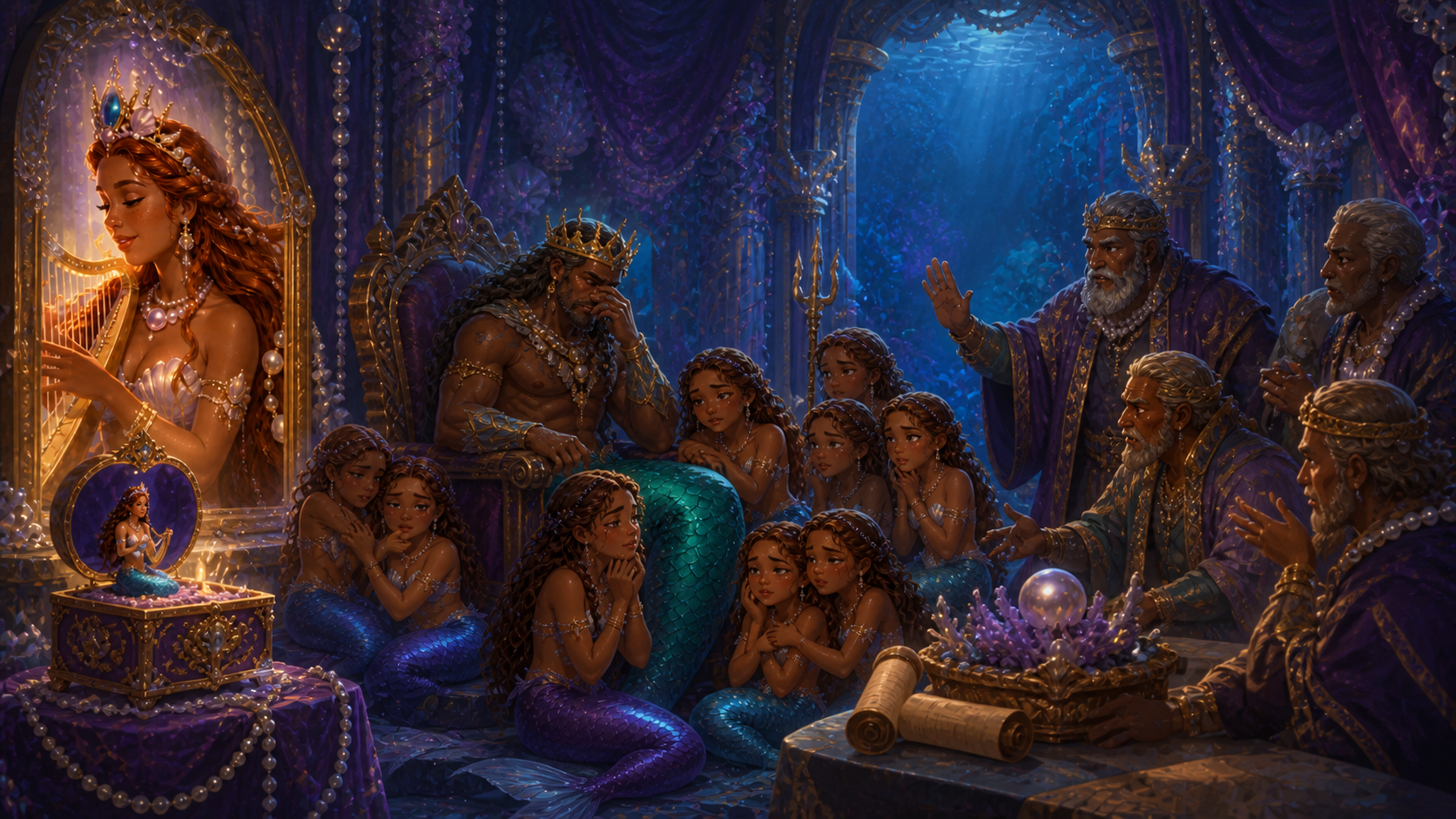
Because Ariel drives the plot, the older sisters are frequently reduced to a chorus of palace frustration. Yet Attina and the others experienced Athena at different ages. Some would remember conversations, routines, corrections, and private jokes that Ariel could not. Their knowledge should make them central to any honest family archive.
A fuller version of the story would let the sisters disagree about their mother. One might idealize her, another might remember conflict, another might resent being expected to reproduce her, and another might barely remember enough to separate memory from family legend. Love does not require identical testimony.
Sebastian preserves the culture the palace criminalizes
Sebastian’s connection to underground music is more than comic rebellion. He helps keep alive a practice associated with Athena and with Atlantica before Triton’s fear reorganized public life. The secret club becomes an unauthorized archive made of performance rather than paperwork.
That choice also places Sebastian in a complicated position. He serves the crown while violating its rule, protects musicians while concealing the truth, and eventually needs Ariel’s disruption before the contradiction becomes impossible to manage. Resistance inside an institution is rarely clean.
Marina Del Rey turns the king’s wound into an opportunity
Marina does not create Triton’s grief, but she understands the professional value of appearing to enforce his preferences. A court organized around one unprocessed trauma rewards people who can convert the leader’s fear into discipline, surveillance, and punishment.
Athena’s absence therefore shapes careers as well as family life. Nobody can ask the dead queen whether she wants music criminalized, whether Marina speaks for her values, or whether loyalty should be measured by severity. Silence creates a vacancy, and opportunists are very good at filling vacancies.
Sally Field has to suggest a complete relationship quickly
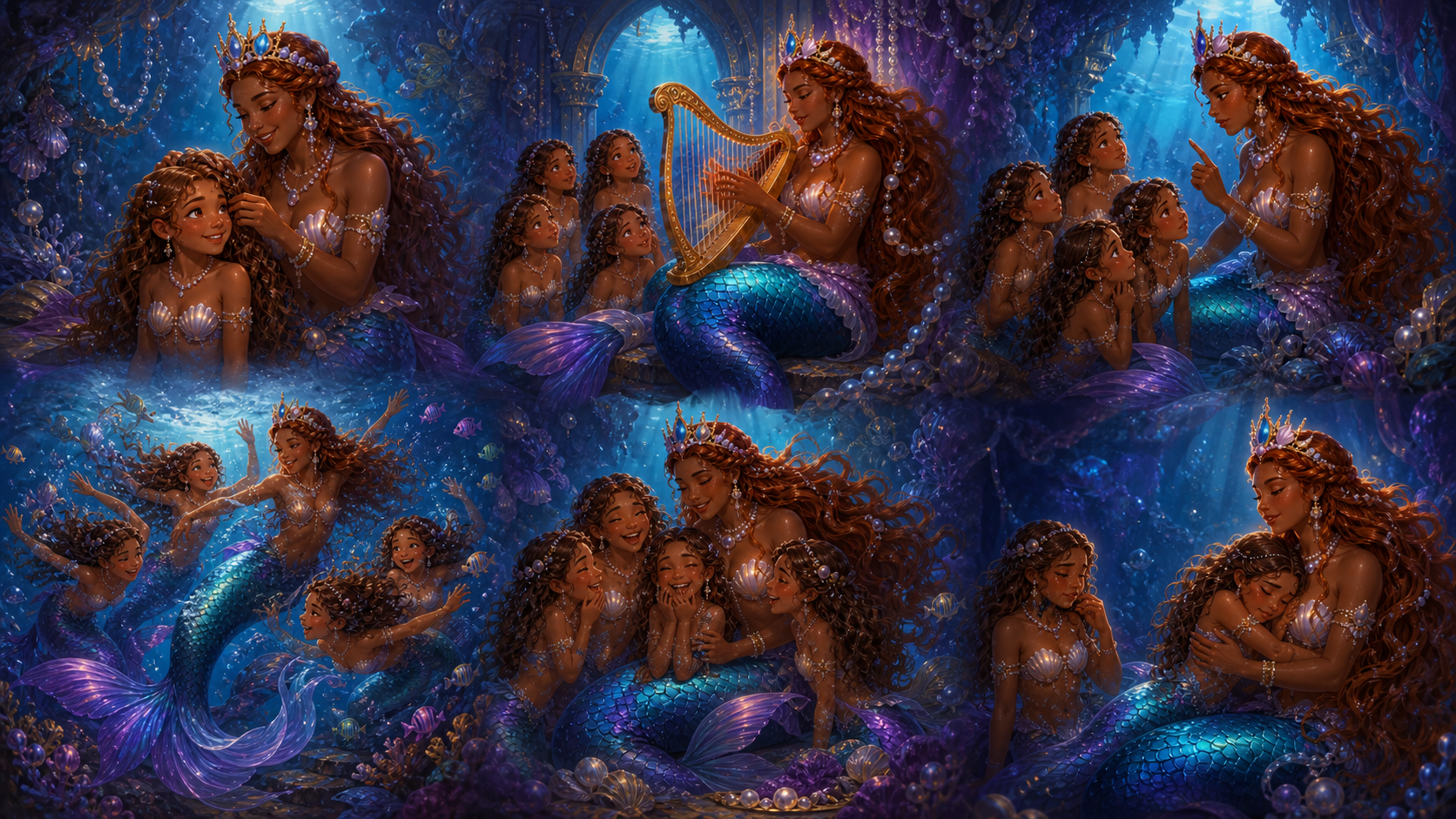
Sally Field’s casting brings familiar emotional authority to a role with limited dialogue and screen time. The performance does not have room for a long biography, so warmth, playfulness, attention, and the ease of a settled partnership must register almost immediately.
The effect is useful and revealing. Star recognition can help a film produce emotional history faster than the screenplay earns it on the page. Field’s presence encourages the audience to trust Athena as a fully inhabited adult even while the story gives that adult only a narrow window in which to exist.
The prequel solves a continuity blank by creating a new problem
The 1989 film never explains Ariel’s mother or describes a kingdom that once banned music. Ariel’s Beginning uses that silence as space for a backstory. The choice gives Triton a more explicit wound and connects Ariel’s musical identity to family history.
It also raises questions the earlier film cannot answer because those ideas did not structure it. If music was once prohibited so completely, how did Atlantica arrive at the musical public culture visible later? How much do Ariel’s sisters remember? Why does the family not speak about Athena when another human crisis begins? Retcons can add meaning while creating seams.
A dead mother can become too convenient for everybody except herself
Animation repeatedly uses maternal death to explain a father’s fear, a child’s independence, or a kingdom’s emotional weather. The device is efficient because the absent woman cannot complicate the lesson. She cannot be selfish, politically opinionated, occasionally wrong, exhausted by royal parenting, or angry about how her image is used.
Athena receives enough warmth to matter but not enough time to become inconvenient. That is why a deep profile should resist praising only her goodness. Perfect dead mothers are often less like people than emotional infrastructure built for surviving characters.

We should be careful not to invent a flawless queen
The film establishes Athena’s love of music, affection for her family, and protective action during the pirate danger. It does not establish her full politics, her approach to punishment, her relationship with every daughter, or whether she ever disagreed with Triton about the surface before the tragedy.
Fan art and analysis can restore imaginative room without pretending speculation is canon. The council image on this page asks what Athena’s public voice might have looked like. It does not claim the film showed her governing in precisely that way.
Public memory always edits
A royal memorial can unite a community, preserve grief, and give citizens language for a shared loss. It can also simplify the person being honored until only officially useful traits remain. Musician becomes martyr. Partner becomes symbol. Mother becomes justification for whatever the surviving ruler already needs.
The ethical question is not whether Atlantica should honor Athena. It should. The question is whether remembrance leaves room for records, testimony, disagreement, and the living practices she valued, or whether one authorized story replaces the woman.
What repair would have required from Triton
Repair would begin with admitting that the music ban served Triton’s avoidance rather than Athena’s values. He would need to apologize publicly, end punishment, reopen cultural spaces, and let his daughters speak about their mother without managing his reaction for him.
He would also need support that does not come from his children. A king can grieve without making seven daughters responsible for keeping him emotionally stable. Counselors, trusted adults, musicians who knew Athena, and political checks on royal orders would all matter more than one dramatic change of heart.

What the sisters deserve from the family archive
Each daughter deserves access to stories, objects, recordings, and witnesses that are not filtered through Triton alone. The older sisters should be invited to record what they remember, and Ariel should be allowed to ask questions without being told curiosity is betrayal.
A healthy archive would preserve contradiction. Athena could be loving and imperfect, musical and politically serious, protective and capable of disagreement. The daughters need a mother they can know, not a saint they are required to imitate or a tragedy they are forbidden to touch.
The music box should reopen as a conversation
When the box returns, its best function is not to prove that grief has ended. Grief does not end because a mechanism plays the right notes. The object can instead become a prompt for stories: where the tune came from, why Triton chose it, how Athena reacted, and what each daughter remembers hearing.
That turns the object from a sealed relic into a shared practice. Memory becomes something the family makes together, with space for tears, laughter, disagreement, and new music that does not pretend the old life can be restored exactly.
Her legacy reaches the 1989 story even though she is never named there
Once the prequel exists, Ariel’s conflict with Triton can be read against Athena’s absence. The king again turns fear of humans into control over a daughter. Ariel again connects music with a world Triton cannot tolerate. Eric’s humanity eventually forces the categorical story to break.
This is retrospective interpretation, not evidence that every detail was planned in 1989. The distinction keeps the analysis honest. Later canon can change what an earlier film means to viewers without having been present in the earlier production process.
Athena is a warning about loving somebody through control
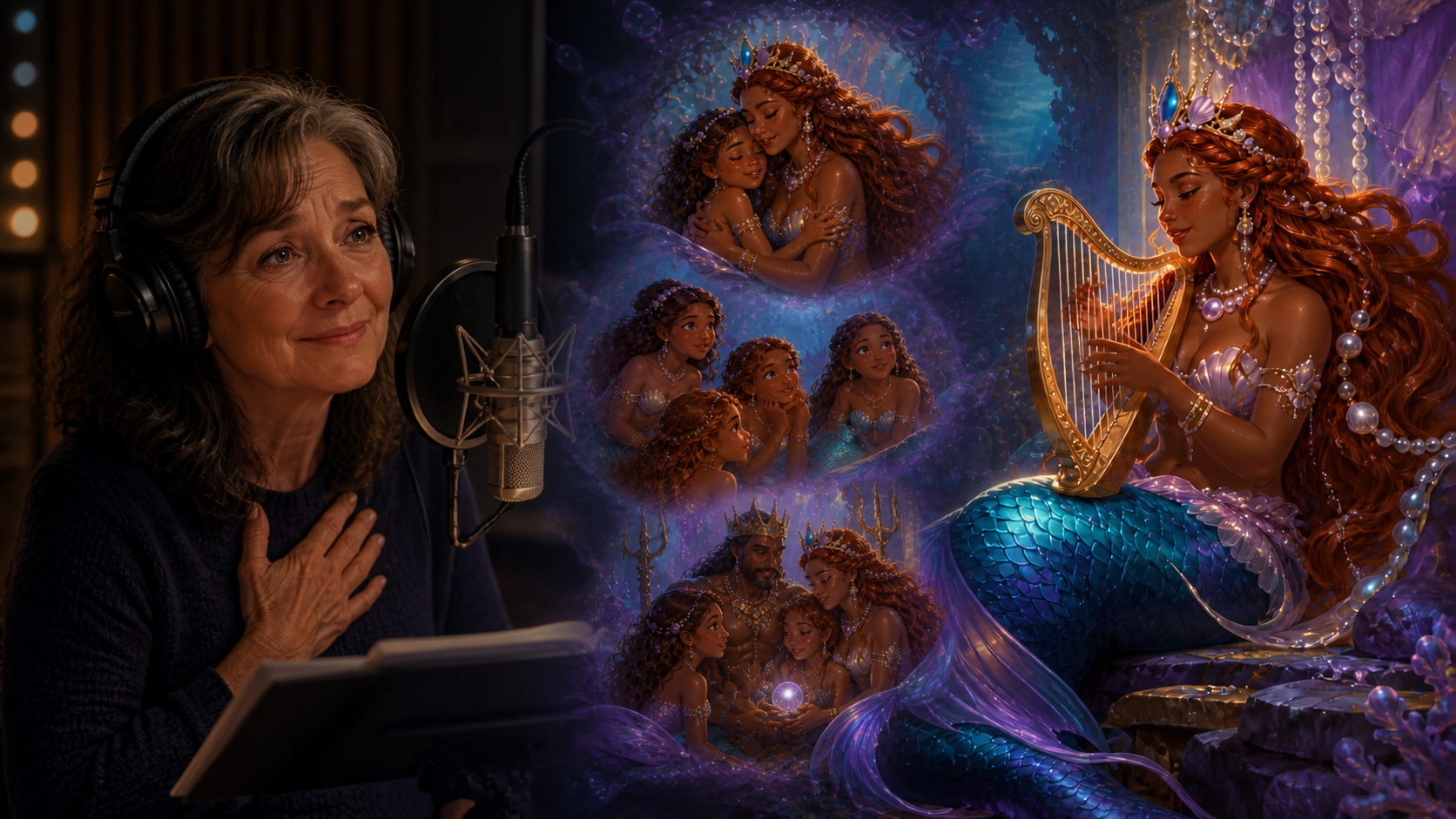
Triton’s love is not fake. His grief is not fake. The harm begins when he assumes those feelings authorize him to decide how everyone else must remember the same woman. Love becomes control when the beloved person’s imagined wishes are used to end other people’s choices.
The prequel resolves that pattern through the return of music, but the deeper lesson should remain uncomfortable. Good intentions do not neutralize institutional damage, and sincere grief can still require accountability when it governs other lives.
Final character receipt
Queen Athena is the emotional premise of Ariel’s Beginning, but she deserves to be read as more than a premise. She is a musician whose work holds a family together, a mother of seven distinct daughters, a partner in a visible marriage, a queen whose public identity remains underwritten, and a woman whose memory is commandeered after she can no longer object.
Her absence explains Triton. It does not excuse him. Her music inspires Ariel. It does not belong to Ariel alone. Her death changes Atlantica. It should not be allowed to erase her life. The most faithful way to honor Athena is to reopen the room her story closes and ask what she might have said before everybody else began speaking for her.

Athena’s seven daughters make birth-order questions unavoidable
Attina, as the eldest, would have carried a different relationship to Athena than Ariel did. Older children are often given more responsibility during a family emergency and more memory afterward. Even if the film does not document who performed which task, the age spread means the sisters cannot have experienced the same mother from the same position. A character guide should mark that difference instead of treating all seven daughters as one decorative set.
Birth order also changes what grief asks of a child. An older sister may be expected to help hold routines together, comfort younger siblings, or become a substitute source of steadiness before she has processed her own loss. A younger child may inherit polished stories rather than complicated memories. Neither position is easier. They simply create different relationships to the dead parent and to the surviving one.
The film compresses a long family rupture into one forbidden subject
Years pass between Athena’s death and Ariel’s effort to restore music. During that time, the palace must still celebrate birthdays, educate princesses, receive visitors, manage conflict, and prepare an heir. Music’s absence would touch ceremonies, childhood instruction, worship, entertainment, labor, and public mourning. The ban is not one rule sitting quietly in the background. It would reshape ordinary Atlantican life.
The prequel cannot show every consequence, but the scale matters when judging Triton’s eventual reversal. Ending the ban is necessary. It is not the same as repairing years of discipline, fear, lost work, and distorted family communication. People who were punished would still need acknowledgment. Musicians whose livelihoods disappeared would still need restoration. Children raised to associate song with danger would not all become comfortable at once.
A queen’s artistic work can disappear because family memory absorbs it
Athena’s music is presented through marriage and motherhood, which makes it easy to call her talent a family quality instead of a body of work. We do not learn what she practiced, whether she composed, whom she learned from, how she collaborated, or what songs existed before the family performance. The omission mirrors a broader habit of remembering women’s creative labor through the people it supported rather than through the craft itself.
The musician-collaboration image on this page deliberately asks for a larger frame. If Athena helped shape Atlantica’s musical culture, then archives should contain scores, rehearsal accounts, performances, and testimony from other artists. Recovering those materials would let her daughters encounter a working adult, not only the gentle figure preserved in domestic scenes.
The surface is both the site of trauma and a world Athena willingly approached
The opening does not show the family hiding deep underwater from everything human. They spend time near the surface before the pirate ship creates danger. That context complicates the later claim that strict separation simply preserves the family’s original values. Athena’s life included enough openness for the outing to occur in the first place.
Triton’s policy therefore does more than protect the boundary where harm happened. It rewrites the family’s prior relationship with that boundary. Fear makes the old openness look irresponsible, and the tragedy is used to prove that withdrawal was always the wiser position. Ariel’s curiosity threatens that revised history because she embodies the possibility that Athena’s world was not defined entirely by terror.
Ariel cannot heal Triton by winning an argument for music
The plot needs Ariel’s rebellion to force change, but a daughter should not be responsible for curing a parent’s trauma. She can reveal the cost of the ban, defend the underground musicians, and insist on her own inheritance. She cannot perform grief work on Triton’s behalf, nor should reconciliation depend on her finding exactly the memory that makes him soften.
This distinction protects Ariel as well as Athena. Otherwise Athena becomes the lost woman whose death damages the father, and Ariel becomes the living girl assigned to repair him. Both women are organized around Triton’s emotional journey. A healthier resolution makes Triton responsible for seeking help, listening without punishment, and changing how he uses power.
Sally Field’s casting creates a bridge between maternal warmth and adult authority
Field’s screen history makes audiences prepared to read intelligence, resolve, humor, and maternal feeling into a brief animated performance. That cultural memory supplies texture the screenplay has little time to develop. It is one reason Athena can feel familiar without the film offering a full account of her daily life.
The shortcut is effective, but analysis should still notice the missing material. Casting can suggest depth. It cannot replace scenes in which Athena makes difficult decisions, disagrees with Triton, speaks to each daughter separately, or acts as queen outside a family outing. The performer helps the character feel whole while the narrative continues using only selected parts of that wholeness.
The ethical memorial is a living practice, not permanent silence
If Atlantica wanted to honor Athena faithfully, it could sponsor music education, preserve the work of artists endangered by the ban, invite the daughters to contribute memories without forcing agreement, and create public records that distinguish the pirate attack from humanity as a whole. Remembrance could increase the kingdom’s ability to think instead of narrowing it.
A living memorial would also permit new music. Grief sometimes treats novelty as disloyal because a new song proves life continued. Athena’s legacy becomes more humane when later musicians are allowed to answer her work, change it, argue with it, and make sounds she never heard. Preservation without continuation can become another beautiful form of burial.
Keep exploring The Little Mermaid
Return to The Little Mermaid hub for films, reviews, Reacts, rants, lore, guides, and the full character directory.