
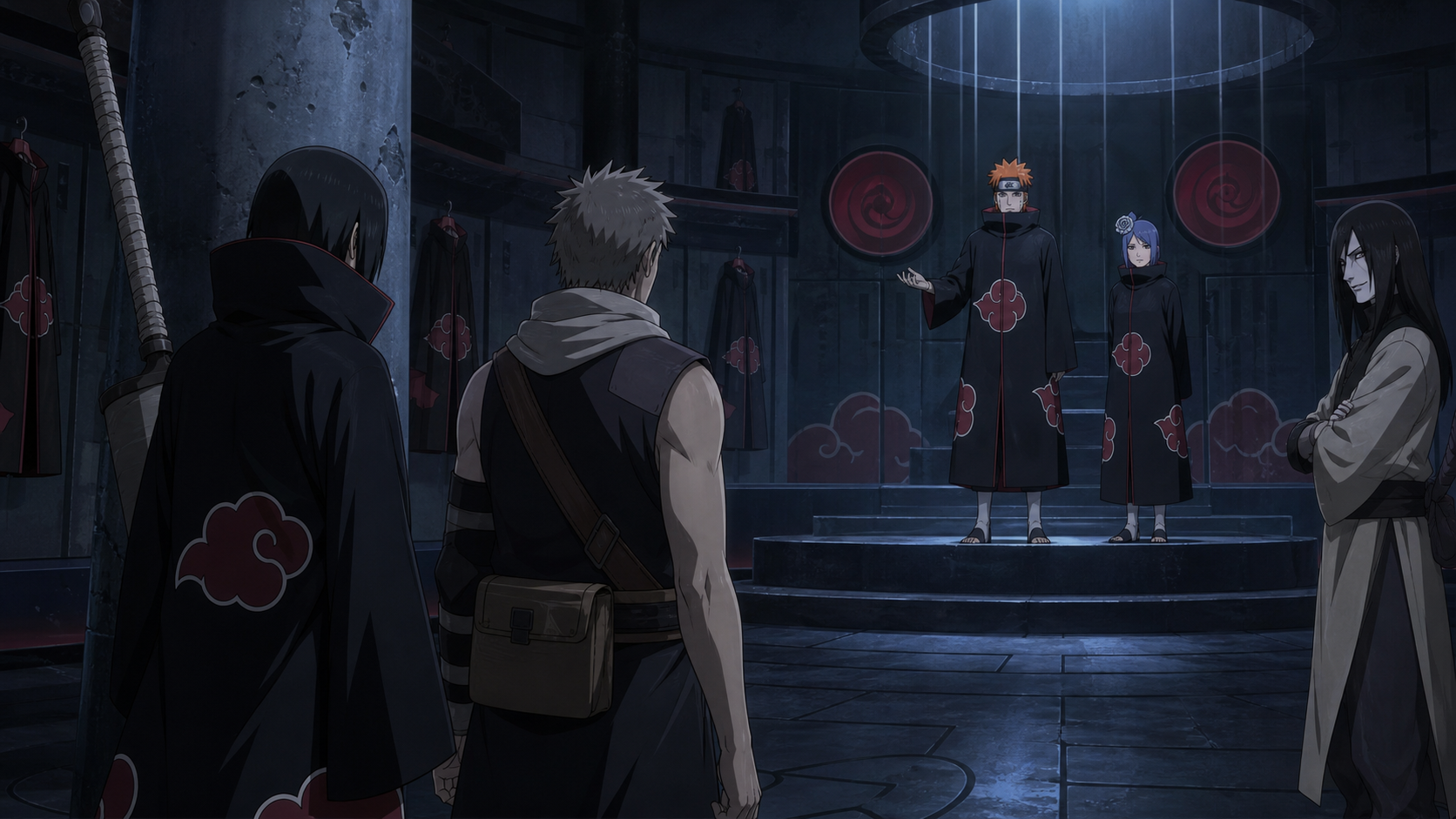
Itachi’s Story: Light and Darkness – The Darkness of the Akatsuki
Akatsuki speaks about partners and peace while treating unbearable loss as a vacancy, making its real darkness institutional rather than theatrical.
Bottom line
“The Darkness of the Akatsuki” shows Itachi entering a criminal organization that talks about partners while expecting every member to die alone. Jūzō Biwa is rough, practical, and far more human than the disposable missing-nin introduction suggests. He asks Itachi about Might Duy, discusses their specialties, gives clear instructions for capture, and ultimately shields his young partner from Yagura's Tailed Beast Ball. Jūzō dies impaled by a piece of his own broken sword. Itachi answers with Amaterasu, gaining another feared technique through another unbearable loss. Akatsuki records the death as a vacancy. That response reveals the real darkness: Pain's organization can speak about peace, reputation, and future plans while treating broken partnerships as routine staffing problems.
Akatsuki receives reputation instead of a person
Pain introduces Itachi through ANBU service and the massacre attributed entirely to him. That story makes the recruit useful before anybody knows his motives, grief, age, or continuing concern for Sasuke and Konoha.
The organization does not need the truth. It needs a feared identity that can attract clients, intimidate enemies, and fit the cloak. Itachi enters exile already trapped inside somebody else’s version of his crime.
Jūzō builds trust through clear limits
He explains his weapon, specialties, history, and what Itachi must do if capture becomes unavoidable. The request is brutal, but it gives the younger partner information before the crisis rather than demanding blind obedience during it.
For Itachi, practical honesty may be the safest intimacy available. Jūzō does not promise permanent loyalty. He tells him exactly how survival works in territory that wants them both dead.
The capture rule exposes the poverty of their options
Kill me before they take me is not a healthy partnership standard. It is what a world of torture, classified intelligence, and disposable missing-nin makes sound reasonable. Jūzō calls the boundary because the institutions around him offer no safe surrender.
Itachi understands immediately because Danzō trained him inside the same arithmetic. Preventing a larger danger keeps being used to justify killing the person already cornered.
Jūzō saves Itachi after asking for no rescue
His own rule rejects an impossible gamble if he is captured. When coral traps Itachi, Jūzō still intervenes. He does not calculate that the prodigy is replaceable or retreat while the younger partner becomes Yagura’s prisoner.
The choice turns tactical coordination into care. Partnership becomes real when Jūzō accepts danger he never demanded Itachi accept for him.
Amaterasu arrives too late to be a reward
The black flame defeats Yagura after the blade breaks and its fragment impales Jūzō. Power appears at the point where it cannot reverse the death that called it forward.
That timing matters. The Mangekyō does not compensate Itachi for loss. It leaves him more useful to violent organizations and more convinced that closeness always ends with another purpose he must carry alone.
Akatsuki reproduces the village machinery it condemns
Pain speaks about peace while assigning pairs, collecting bodies, planning tailed-beast extraction, and treating deaths as vacancies. The missing-nin escaped different villages only to recreate secret orders, expendable personnel, and missions valued above people.
The organization’s darkness is not the cloak or cave. It is the ability to absorb grief into workflow without changing the plan.
Jūzō and Yagura both need fuller recognition
Jūzō is more than an anime-only stepping stone toward Kisame. His humor, caution, memory of Duy, and final protection give Itachi a relationship between massacre and later partnership. Yagura is more than the boss who triggers Amaterasu.
The episode narrows the Mizukage’s history to overwhelming force. RaeRae editorial should name that limitation instead of treating every powerful opponent as scenery for Itachi’s development.
The episode remembers that survival can deepen isolation when every rescue arrives through another person’s irreversible loss and nobody stays to share its meaning with him.
RaeRae’s verdict
“The Darkness of the Akatsuki” works because Jūzō earns emotional weight without becoming soft or sentimental. He shares useful information, respects danger, protects Itachi when the plan breaks, and dies through the weapon most associated with his identity. That is enough. The episode does not need a friendship speech to prove another person reached Itachi.
Akatsuki’s response makes the title land. One partner shields a child from a Tailed Beast Ball. Another member kills his assigned teammate. Pain records both outcomes as staffing. The system keeps moving because individual attachment is never allowed to outrank the mission. Itachi survives with Amaterasu and one more reason to fear connection. Akatsuki gains a stronger operative. Those are not the same victory.
Episode 456 follows Itachi into Akatsuki
Episode 456 is titled “Itachi's Story: Light and Darkness – The Darkness of the Akatsuki.” The Japanese title is “Akatsuki no Yami.” The episode aired in Japan on April 14, 2016.
The official premise introduces Itachi as a rogue ninja and pairs him with Jūzō Biwa for work in the Land of Water.
Akatsuki welcomes a child through his crimes
Pain introduces Itachi as a former Leaf ANBU and the man blamed for destroying the Uchiha clan. The reputation arrives before the person.
Akatsuki values exactly the violence that made Konoha cast him out.
Orochimaru notices the Uchiha body
Orochimaru's attention carries a predatory interest in Itachi's eyes and physical potential. The new recruit enters a room where talent creates danger from supposed allies.
Leaving Danzō does not end the struggle over who gets to use him.
Jūzō Biwa becomes his first partner
The former member of the Seven Ninja Swordsmen of the Mist understands exile and lethal work. He does not approach Itachi with sentimental promises.
Their relationship begins through practical survival.
Jūzō asks about Might Duy
He wants to know about the Leaf genin who confronted the Seven Swordsmen. Itachi recognizes the story of Might Guy's father.
Duy's reputation survives because one underestimated man opened all Eight Gates against elite killers.
Duy defeated four legendary swordsmen
Jūzō describes how the supposedly unimpressive shinobi killed four members of the group. The memory gives Itachi another example of visible rank failing to measure a person's capacity.
Genius and reputation do not own courage.
Jūzō respects the threat without romanticizing the death
He survived a fight that destroyed most of his unit. His account recognizes Duy's power and the cost carried by everyone present.
The conversation gives old enemies room to exist as more than village labels.
The partners compare specialties
Jūzō uses the Executioner's Blade, reach, and direct combat pressure. Itachi brings genjutsu, fire, precision, and Sharingan perception.
Understanding each other's strengths lets them divide work without pretending trust already exists.
Partnership begins as tactical information
They do not confess their histories or promise friendship. They establish how each person fights and what the other should expect.
For Itachi, that limited honesty may feel safer than emotional closeness.
Their first assassination is efficient
The pair completes a killing assignment with little wasted movement. Akatsuki receives proof that the new arrangement works.
Operational success hides how young Itachi remains beneath the cloak.
Killing now serves a different organization
ANBU called assassination village protection. Akatsuki calls the same act paid work or strategic progress.
The target changes while the demand for silence and obedience stays familiar.
Pain gathers the members
Akatsuki meets to review progress and reputation. The organization is becoming known beyond the small circles that hire missing-nin.
Growth brings ambition as well as greater scrutiny.
Reputation becomes an operating tool
Fear can attract clients, deter enemies, and make future recruitment easier. Akatsuki builds power partly through stories told about its members.
Itachi's massacre identity becomes organizational currency.
Pain introduces the tailed-beast plan
He tells the group that collecting the tailed beasts belongs to Akatsuki's future. The plan converts living beings and their human hosts into assets.
Peace language will later sit on top of a program built around capture and extraction.
Itachi hears the threat to Konoha
Naruto carries the Nine-Tails, and Akatsuki's goal will eventually point toward the village Itachi still wants to protect. Membership gives him proximity to that threat.
Surveillance and participation become difficult to separate.
Jūzō receives a Land of Water mission
Pain sends the pair into Jūzō's former country. The assignment forces him back into territory where hunter-nin have personal and institutional reasons to pursue him.
His displeasure comes from experience, not cowardice.
Returning home means entering enemy ground
Kirigakure knows Jūzō's techniques, history, and value as a source of information. Familiar geography offers no comfort when the government wants his body.
Exile turns home into the most dangerous destination.
Jūzō sets a capture rule
He tells Itachi to kill him if Mist forces take him alive. The order prevents interrogation, torture, and recovery of village secrets.
Akatsuki partnership includes an agreement to become executioner when rescue fails.
The request sounds cold because the world is cold
Jūzō does not ask Itachi to gamble both lives on an impossible rescue. He defines the line before panic can make the decision.
Clear instructions are his version of trust.
Itachi understands the logic too well
He has already killed people he loved under a theory of preventing larger disaster. Jūzō's rule fits the same brutal arithmetic.
The familiarity should worry the viewer.
The mission itself succeeds
Itachi and Jūzō complete the assigned work in the Land of Water. Their planning holds while they control the encounter.
Escape becomes the real battle.
Mist ANBU pursue the pair
Hunter-nin close around them before they can leave. Kirigakure treats retrieval or elimination of missing-nin as protection of state secrets.
Jūzō's warning becomes immediate rather than hypothetical.
Yagura leads the response
The Fourth Mizukage appears with the authority of a village leader and the power of the Three-Tails' jinchūriki. The pursuit jumps far beyond an ordinary hunter squad.
Akatsuki's two-man structure suddenly looks very small.
The anime creates a continuity-specific confrontation
This Jūzō partnership and direct battle with Yagura belong to the anime's expanded telling. Other versions of Itachi's Akatsuki history arrange partners and events differently.
The React should judge the episode shown without pretending every continuity detail fits perfectly elsewhere.
Jūzō knows Mist tactics
His former service helps him read the ANBU formation and respond quickly. Knowledge of home becomes a weapon against former colleagues.
Defection leaves skills intact while reversing their target.
The pair eliminates the ANBU escorts
Itachi and Jūzō use complementary attacks to break through the hunters. Their earlier conversation about specialties pays off in real combat.
Partnership has become practiced coordination.
Yagura draws on Isobu
The Mizukage channels the Three-Tails' chakra and changes the scale of the fight. A jinchūriki leader brings state authority and tailed-beast power into one body.
The Akatsuki plan has just named creatures like Isobu as future targets.
Coral immobilizes Itachi
Yagura's power grows coral across Itachi and restricts movement. The prodigy cannot simply outthink every physical effect before the trap closes.
For once, his partner must save him.
Jūzō breaks Itachi free
He intervenes rather than following a cold calculation that might favor retreat. The man who asked to be killed if captured refuses to leave Itachi trapped.
Their tactical arrangement has become personal responsibility.
Yagura forms a Tailed Beast Ball
The compressed chakra threatens to erase both missing-nin at once. No sword should be expected to hold against that force.
Jūzō still places himself between the attack and Itachi.
The Executioner's Blade takes the blast
Kubikiribōchō blocks part of the attack and breaks under the impact. The famous blade cannot remain an untouchable legend when a tailed beast fires at close range.
The broken weapon shows the cost before the body does.
A fragment impales Jūzō
His own sword becomes the source of the fatal wound. The weapon that defined his status and survival turns against him under impossible pressure.
No heroic pose can soften the physical cruelty of that ending.
Jūzō saved Itachi at the cost of his life
He could not stop the attack cleanly, but his intervention gives the younger shinobi another chance to move. The rescue contradicts the idea that Akatsuki partners share only convenience.
Jūzō's action says more than any friendship declaration would.
Another partner falls in front of Itachi
Tenma died after Itachi began admitting their team mattered. Shisui died after entrusting him with a future. Jūzō dies after shielding him.
Connection keeps arriving with a body attached to the memory.
Amaterasu awakens under pressure
Itachi's Mangekyō releases black flames against Yagura. The technique appears when ordinary fire and movement are no longer enough.
Once again, grief and danger reveal a stronger weapon.
Black fire overwhelms the Mizukage
Amaterasu burns Yagura and leaves him near death. The attack establishes why enemies will fear Itachi even among Akatsuki members.
The victory does not restore Jūzō.
Power cannot reverse the order of events
If Amaterasu had emerged moments earlier, viewers can imagine another outcome. Trauma often creates that cruel timing: the survivor gains capacity only after the loss.
Itachi can defeat the threat and still fail to save his partner.
Jūzō dies without becoming sentimental
His final moments remain consistent with the practical man introduced at the start. The episode does not need a long speech to prove the partnership mattered.
His broken sword and Itachi's response carry the meaning.
Kirigakure recovers part of its history
The Executioner's Blade belongs to the Seven Swordsmen tradition and will later become associated with Zabuza Momochi. Jūzō's death returns the weapon to the Mist's orbit.
One missing-nin disappears while the office and blade continue.
Akatsuki treats death as roster movement
At the next gathering, Jūzō's absence becomes an organizational fact. A vacant partnership must be filled so missions can continue.
Grief has no formal place in the meeting.
Kakuzu has killed another partner
The group also learns that Kakuzu's teammate died by Kakuzu's own hand. Pairing dangerous missing-nin does not create loyalty by itself.
Akatsuki accepts internal death as a management problem.
Jūzō and Kakuzu reveal opposite partnership models
Jūzō dies saving Itachi. Kakuzu kills the person assigned beside him. Both men belong to the same organization and wear the same cloak.
Symbols cannot guarantee what one partner will do when survival becomes difficult.
Pain's system keeps moving
The leader does not pause the tailed-beast plan because members die. Akatsuki's mission is designed to outlast individuals.
That structure resembles the villages its members often condemn.
Itachi becomes more isolated after surviving
He has lost another person who learned how to fight beside him. Remaining emotionally closed now looks like evidence-based self-protection.
The cost is that future partners receive less access to the person behind his reputation.
Orochimaru sees opportunity in the loss
Akatsuki's unstable pairings leave room for ambitious members to approach Itachi. Orochimaru's interest centers on possession rather than companionship.
The next relationship begins under predation.
Jūzō deserves more than filler dismissal
The anime-original expansion may not align perfectly with every source, but his role has a clear dramatic function. He gives Itachi an adult partner who earns trust through practical action.
Calling the episode skippable erases the emotional bridge between massacre and later Akatsuki life.
Yagura deserves more context than a boss fight
He is the Fourth Mizukage, Isobu's jinchūriki, and part of the Hidden Mist's violent political history. The episode mainly uses him as overwhelming opposition.
That narrow treatment creates spectacle while leaving his own tragedy outside the frame.
The fight previews Akatsuki's future targets
Itachi has now faced a jinchūriki after hearing Pain announce the collection plan. He sees how much force a tailed beast can project and how much danger surrounds the host.
Future captures will demand more than ordinary assassination tactics.
The darkness is institutional, not decorative
Akatsuki members live outside village law, yet they reproduce village habits: secret orders, disposable agents, violent advancement, and missions that matter more than people.
The cloak changes. The machinery feels familiar.
Itachi keeps surviving other people's sacrifices
Shisui gave him an eye and a mission. Fugaku and Mikoto gave up resistance and asked him to protect Sasuke. Jūzō takes the Tailed Beast Ball.
Each survival deepens the belief that he must carry every dead person's purpose alone.
Episode 456 makes Amaterasu emotionally expensive
Black flames can look like another exciting Mangekyō upgrade. The episode places the technique beside Jūzō's shattered body so the audience cannot honestly treat power as a free reward.
The eye grows stronger because Itachi's world keeps getting smaller.
The Darkness of the Akatsuki ends with another vacancy
Jūzō is dead, Kakuzu needs a new teammate, and Akatsuki continues building toward the tailed beasts. Itachi remains useful enough to receive another partner.
Episode 457 will bring Kisame into that position and show how Akatsuki recruits talent through coercion, humiliation, and shared alienation.
RaeRae’s call
Jūzō deserves to be remembered as a partner, not a vacancy before Kisame. He gives Itachi clear limits, practical trust, and protection when the fight turns impossible. Amaterasu wins only after the person it might have saved is gone. Akatsuki turns that loss into roster maintenance and keeps the tailed-beast plan moving. The organization’s darkness is institutional: it knows how to use grief, reputation, and partnership without creating any place where members may safely mourn.
Episode details and viewing routes
- Official episode reference: Naruto Official episode guide
- Licensed episode route: Crunchyroll licensed episode page
What I am carrying forward
Akatsuki received Itachi through the reputation attached to the Uchiha massacre and paired him with Jūzō Biwa. They developed practical coordination before entering Jūzō’s former country.
Yagura’s coral trapped Itachi. Jūzō freed him, shielded him from a Tailed Beast Ball, and died when his broken blade impaled him. Itachi awakened Amaterasu and defeated Yagura. Akatsuki treated the death as a partner vacancy. Episode 457, “Partner,” brings Kisame into that structure.