
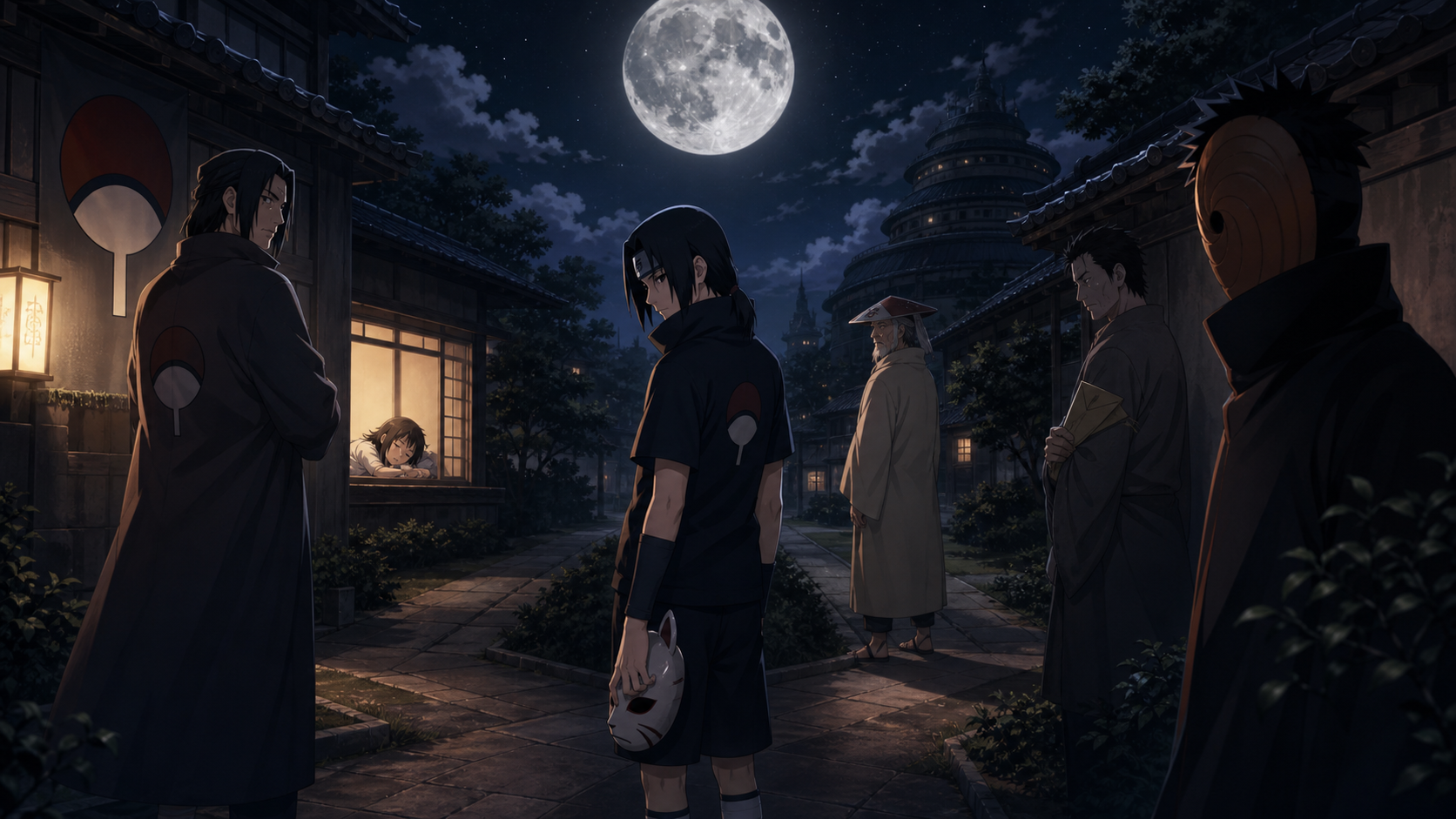
Itachi’s Story: Light and Darkness – Moonlit Night
Every institution protects its future by cornering the youngest person in the room, but coercion explains Itachi’s road without erasing his choice.
Bottom line
“Moonlit Night” is not proof that Itachi made the only possible choice. The episode shows a child cornered by adults who kept calling their demands loyalty. Fugaku wants his son to serve the Uchiha from inside ANBU. Hiruzen wants time for diplomacy but never creates enough safety for diplomacy to work. Danzō turns an approaching coup into an ultimatum: kill the clan and save Sasuke, or let the revolt bring destruction to everyone. Tobi helps turn that coercion into massacre. Itachi still chooses, plans, deceives, and kills. His trauma explains the road without wiping blood from his hands. The ugliest truth is that every institution involved protects its own future by placing the final moral burden on the youngest person in the room.
Danzō weaponizes every failed adult decision
Relocation, surveillance, clan resentment, Hiruzen’s delay, Fugaku’s coup, and the theft of Shisui’s eye all narrow the field before Danzō presents his ultimatum. He then describes the remaining options as though history naturally produced them.
That framing hides his authorship. He did not create every grievance, but he sabotaged peaceful intervention and used Sasuke’s survival to make extermination sound like the only serious protection left.
Fugaku’s bloodless plan still recruits his child
He wants political change without mass death and conceals his Mangekyō because clan hardliners might escalate toward Kurama. Those restraints matter. They do not make the coup harmless or release Itachi from being its covert mechanism.
Fugaku understands how power can consume desperate people, yet still asks his son’s eyes, office, and divided loyalty to carry the plan adults created.
The episode leaves no room for comfortable worship: tragedy can explain why a person chooses horror, but admiration cannot turn murdered families and stolen truth into moral cleanliness for anybody still living.
RaeRae’s verdict
“Moonlit Night” should never be flattened into saint Itachi making a pure sacrifice or monster Itachi acting without coercion. Danzō manufactures the binary, Fugaku advances the coup, Hiruzen fails to make diplomacy operational, Tobi assists the slaughter, and clan hardliners keep raising the stakes. Itachi chooses inside that field, and his victims still die by a plan he accepts.
The episode’s ugliest institutional victory is the cover story. Konoha survives, Itachi carries public blame, and Sasuke receives a lie designed to organize his entire life around hatred. Sparing his body is not the same as protecting his personhood. Love remains real inside the massacre. So do control, torture, and stolen truth. Explanation widens responsibility. It does not wash anybody clean.
Episode 455 compresses the Uchiha tragedy into one night
Episode 455 is titled “Itachi's Story: Light and Darkness – Moonlit Night.” The Japanese title is “Tsukiyo.” The episode aired in Japan on April 7, 2016.
The story moves from Shisui's death through the Uchiha massacre and Itachi's entrance into Akatsuki.
Team 7 still waits under Susanoo
In the present, Naruto, Sakura, Kakashi, and Sasuke remain protected from Infinite Tsukuyomi. Naruto hates waiting while people outside the barrier remain trapped.
Sasuke insists that leaving before the light fades would accomplish nothing.
Sasuke continues carrying Itachi's memories
The shelter gives him time to revisit what his brother transferred before the Reanimation Jutsu ended. Sasuke does not receive a clean confession organized for comfort.
He inherits a chain of pressure, secrecy, and blood.
Fugaku celebrates Itachi joining ANBU
The appointment confirms everything the clan expected from its prodigy. Fugaku tells his son that he is proud.
Recognition comes with an immediate reminder about who owns his loyalty.
Clan identity comes before ANBU service
Fugaku says Itachi remains an Uchiha first. The instruction turns a village post into a clan opportunity.
Itachi enters covert service already divided between two authorities.
Shisui names Itachi his closest friend
Shisui trusts him with the village, the Uchiha name, and the truth about what happened. Their bond carries the emotional weight missing from most of Itachi's adult relationships.
That trust becomes another responsibility rather than a place to rest.
Danzō has already taken one of Shisui's eyes
Shisui's plan to use Kotoamatsukami against the coup threatened Danzō's control over the outcome. Danzō responded by stealing the eye meant to prevent bloodshed.
The man claiming to protect Konoha sabotaged a peaceful intervention.
Shisui entrusts the remaining eye to Itachi
He gives Itachi the last Mangekyō Sharingan carrying Kotoamatsukami. The gift protects the eye from Danzō and leaves Itachi with a tool for some future emergency.
No child should receive that inheritance beside a friend's suicide.
Shisui asks Itachi not to stop him
He believes his death can prevent further conflict around his eyes and protect the clan's secrets. The request traps friendship inside obedience one last time.
Itachi must either violate Shisui's final decision or watch him die.
Shisui jumps into the Naka River
The friend who taught Itachi to intervene when Leaf shinobi fought one another now removes himself from the board. His death leaves the factions intact.
The sacrifice does not create the peaceful opening he wanted.
Grief awakens the Mangekyō Sharingan
Itachi's eyes change under the shock of losing Shisui. Once again, emotional devastation becomes visible power.
The Uchiha inheritance keeps rewarding survivors in the language the shinobi system understands best.
Shisui's note becomes evidence against Itachi
The message says he is tired of missions and sees no future for the clan. Suspicion still falls on the closest person to him.
The Uchiha cannot accept a death without searching for betrayal inside the family.
Inabi, Yashiro, and Tekka confront Itachi
The police officers accuse him of involvement in Shisui's death. Their questions reflect real uncertainty and the clan's growing mistrust.
They also approach a grieving boy as suspects confronting a threat.
Itachi attacks the men
He beats them down with a level of anger that breaks his controlled public face. Violence answers an accusation he cannot truthfully resolve.
The outburst reveals how close his restraint already is to collapse.
Fugaku interrupts the confrontation
The clan head stops the fight and demands an explanation. Sasuke watches the family rupture without understanding the forces behind the scene.
His brother suddenly looks frightening inside their own home.
Itachi says the clan has no future
The declaration echoes Shisui's note while expressing Itachi's own disgust with clan obsession. He sees adults narrowing identity to pride, grievance, and power.
His judgment is sharp and dangerously total.
Sasuke begs him to stop
The little brother's voice reaches Itachi where authority cannot. Sasuke does not argue politics. He asks the person he loves to return.
For a moment, Itachi remembers who is watching.
Itachi performs regret through Mangekyō
He lowers himself and appears to apologize while revealing the new eye. The display hides Shisui's trust and turns grief into intimidation.
Itachi hopes Sasuke will recognize the clan's shallowness, but a child cannot decode that private lesson.
Sasuke learns fear before truth
He sees his brother attack clan members, condemn the Uchiha, and reveal unfamiliar power. No explanation gives him a stable meaning for the change.
That confusion will make the massacre's later lie easier to believe.
ANBU promotes Itachi to captain
His rise continues despite the crisis at home. The village recognizes operational skill and gives him greater access.
Promotion increases the value both Konoha and the Uchiha place on controlling him.
Danzō claims authority over his unit
Although Itachi is not formally a Root member, Danzō expects direct reports and obedience. The distinction between Hokage ANBU and Foundation becomes deliberately blurry.
The same internal split Itachi witnessed in the forest now enters his chain of command.
Two subordinates join his covert work
Danzō presents agents who will serve under Itachi. Their presence looks like support while also giving Danzō eyes close to the young captain.
Trust inside this unit begins under surveillance.
Danzō assigns an assassination
The mission pushes Itachi deeper into state violence. Killing becomes routine employment before he has resolved the death that awakened his Mangekyō.
Konoha keeps turning pain into qualification.
The mission tests obedience more than skill
Danzō already knows Itachi can execute a target. The deeper question is whether the captain will carry out hidden orders without public scrutiny.
Every successful assignment strengthens Danzō's leverage.
Danzō asks about the Uchiha afterward
The official uses Itachi as an intelligence channel into his own family. A boy becomes the bridge between institutions that distrust one another.
Neither side allows him to remain only a son or brother.
Itachi reports the clan's resentment
He admits that Uchiha anger can no longer be ignored. Relocation, surveillance, blocked political power, and accumulated humiliation have moved the family toward revolt.
Reporting the danger does not mean endorsing Danzō's preferred solution.
Fugaku summons Itachi after a clan meeting
Father and son meet privately because public debate has reached a decisive point. Fugaku needs ANBU access and wants Itachi to understand the plan.
The conversation arrives years too late for uncomplicated trust.
The Naka Shrine holds the Stone Tablet
Fugaku brings Itachi to the Uchiha's hidden record. Sharingan strength determines how much of the inscription a reader can decipher.
Sacred clan knowledge becomes another hierarchy built around ocular power.
Fugaku expects the Mangekyō to read more
He knows Itachi's new eyes may reveal information unavailable to ordinary clan members. The request again treats personal grief as access to a resource.
Shisui's death becomes useful to clan strategy.
Itachi asks whether Fugaku wants him as a reader
The question exposes the transactional shape of the meeting. Fugaku needs his son's eyes, ANBU position, and judgment.
Itachi needs a father willing to see the cost behind those assets.
Fugaku reveals his own Mangekyō Sharingan
He awakened the eye after a comrade sacrificed himself during the Third Shinobi World War. Fugaku has carried comparable loss in secret.
The revelation gives father and son shared pain without creating shared honesty soon enough.
Fugaku concealed his power from the clan
He fears other Uchiha would push for direct use of the Nine-Tails if they knew he could control the beast. Keeping the eye secret has restrained the most dangerous factional fantasy.
His secrecy proves he understands how quickly power can radicalize a desperate group.
A genjutsu shows the catastrophic route
Fugaku lets Itachi see what open escalation could become. Control of the Nine-Tails, kidnapping Naruto, and violent seizure of power would bring disaster far beyond the clan.
He does not want that future.
Fugaku wants a bloodless coup
His plan uses Itachi's ANBU position to restrain village leaders while the clan forces political change. He imagines pressure without mass killing.
Calling a coup bloodless does not guarantee nobody will resist or die.
The clan wants Fugaku installed as Hokage
Uchiha members see leadership as a correction to exclusion. After years of suspicion, the Hokage office represents recognition and security.
The ambition also asks the village to accept power transferred under threat.
Fugaku still places the final mechanism on his son
Itachi must use covert access to control the upper administration. The father who wants to spare the clan from bloodshed assigns the riskiest moral work to his child.
Love does not prevent exploitation when duty defines the relationship.
Itachi reports the imminent coup to Konoha
He warns the village leadership because he believes revolt could restart war. The report crosses the clan loyalty Fugaku demanded.
Itachi chooses the larger population while still seeking a way to save his family.
Hiruzen calls for diplomacy
The Third Hokage wants negotiation rather than extermination. His preference matters because Danzō later behaves as though massacre is the only serious plan.
Wanting talks is not the same as making talks happen in time.
Hiruzen's delay has consequences
The village knew Uchiha anger was growing. Surveillance and relocation continued while meaningful political repair failed to reach the clan.
Passive moderation leaves room for extremists on both sides to set the deadline.
Danzō gives Itachi the ultimatum
He presents two futures: the coup brings war that kills the clan including Sasuke, or Itachi destroys the Uchiha first and preserves his brother. The framing makes coercion look like analysis.
Danzō chooses the options he offers and hides every path his own actions helped close.
Saving Sasuke becomes the lever
Danzō understands that Itachi can sacrifice himself but cannot willingly sacrifice Sasuke. The younger brother turns into bargaining power.
Protection is weaponized against the protector.
Itachi makes a choice under coercion
The ultimatum does not remove agency, and agency does not make the circumstances free. Itachi accepts a plan that requires deliberate killing.
Both truths must remain visible together.
He approaches Tobi for help
Itachi finds the masked Uchiha who has operated around the clan's tragedy. He trades cooperation for help carrying out the massacre and limits on future action against Konoha.
Working with the hidden attacker binds the solution to the force that deepened the crisis.
Tobi attacks the police force
The masked man targets armed clan members while Itachi moves through the residential compound. Dividing the work makes resistance harder.
The massacre is planned, coordinated violence rather than a sudden emotional break.
Izumi tries to resist Tobi
The girl Itachi once guided to shelter faces the man behind the Nine-Tails attack. Her effort cannot overcome his space-time ability.
This anime version places her death in Tobi's hands, which differs from other tellings of the massacre.
The adaptation contradiction matters
Earlier dialogue and the Itachi novels assign Izumi's death differently. Viewers should not force every version into one seamless account.
The episode's choice shifts one deeply personal killing away from Itachi and onto Tobi.
Itachi enters his parents' room
He expects Fugaku to resist and prepares for a fight. Instead, Fugaku and Mikoto wait together.
Their refusal to defend themselves denies him the emotional distance of combat.
Fugaku releases his shadow clone
The clan head had enough awareness and power to create another position. He chooses not to turn the room into a final battle.
Restraint arrives only after every political mechanism has failed.
Fugaku and Mikoto accept their son's hand
They understand his choice and ask him to care for Sasuke. Acceptance offers love while placing one final burden on him.
Their calm does not make the killing merciful or clean.
Itachi cries before killing them
The tears confirm love, not innocence. He kills the parents who refuse to fight him because he believes Sasuke's life depends on completing Danzō's demand.
The scene hurts because affection survives inside an unforgivable act.
Sasuke is spared and condemned to a lie
Itachi preserves his brother's body while preparing a false story that will direct Sasuke's life toward hatred. Survival comes with psychological torture and stolen truth.
Protection becomes another form of control.
Hiruzen receives the final report
Itachi returns to the Hokage after the massacre. The report closes an operation the Third Hokage wanted to prevent but failed to stop.
Institutional regret cannot restore the people killed under institutional pressure.
The village lets Itachi carry public blame
Konoha preserves stability by naming him a criminal and hiding the state's role. The clan disappears, and the surviving child grows up believing one brother caused everything alone.
Secrecy protects the administration at Sasuke's expense.
His former subordinates try to kill him
The ANBU agents introduced under Danzō move against Itachi as he leaves. Their earlier service was never trust.
He kills them and cuts another tie to Konoha's covert structure.
Itachi enters Akatsuki
He joins the organization as an apparent traitor while maintaining concern for Konoha and Sasuke. Exile becomes another long assignment built on concealed motives.
No community remains where he can speak honestly.
Jūzō Biwa becomes his first partner
The former Mist swordsman receives Itachi inside Akatsuki. Their pairing begins the next phase of his life among missing-nin and criminals.
The child once promoted for serving Konoha now wears the identity of its enemy.
Moonlit Night refuses a heroic reading
Itachi prevents one feared war by participating in extermination. The decision may have saved Sasuke's immediate life and still destroyed the boy's childhood.
Tragedy does not become virtue because the person suffering also loved deeply.
The adults created the false binary
Fugaku advanced a coup, Danzō sabotaged peaceful options, Hiruzen failed to act quickly, Tobi encouraged destruction, and clan hardliners demanded control. Itachi carried out the final plan.
Responsibility spreads across the system without disappearing from the hand holding the sword.
Episode 455 ends the clan and begins the cover story
The Uchiha compound falls silent while Konoha's official future continues. Sasuke will grow inside a manufactured explanation, and Itachi will police that lie from exile.
Episode 456 follows him into Akatsuki, where another organization will use his silence, skill, and grief for its own purpose.
RaeRae’s call
Danzō offers a false binary after helping destroy the peaceful alternatives. Fugaku asks a child to carry a bloodless coup. Hiruzen wants diplomacy without making it arrive in time. Tobi supplies murder. Itachi chooses the massacre and protects Sasuke’s body by destroying his access to truth. Responsibility is shared, but it is not vague. Every adult institution places survival above the Uchiha family, then lets the youngest decision maker carry the public crime alone.
Episode details and viewing routes
- Official episode reference: Naruto Official episode guide
- Licensed episode route: Crunchyroll licensed episode page
What I am carrying forward
Shisui died after Danzō stole one eye and entrusted the other to Itachi. Itachi entered ANBU leadership while reporting the Uchiha coup to Konoha and serving as the clan’s access to village authority.
Danzō ordered him to choose between extermination and a wider war that would kill Sasuke. Itachi recruited Tobi, killed his parents, spared Sasuke inside a manufactured lie, and entered Akatsuki. Episode 456 follows the exile and the organizations still using his silence.