
RaeRae Reacts · One Piece Episode 143
The Pumpkin Pirates Write Their Own Ending
One Piece Episode 143 closes Ruluka with the Pumpkin Pirates choosing the escape, surviving a fifty-year time loop, and returning to arrest Wetton.
Wetton converts an emergency route into a conveyor belt for theft
Episode 143 opens with Wetton’s guards moving treasure through Rainbow Tower while Ape’s Concert remains unstable. The same structure that could evacuate trapped people now serves an extraction line for property.
No one checks for survivors, identifies human remains, records cargo, or asks the Pumpkin Pirates whether armed workers may enter their shelter. Wetton treats access as ownership.
A legitimate emergency response would stop removal, establish a passenger count, mark hazards, and preserve evidence. Salvage can wait until every living person has a safe route and every wreck receives proper documentation.
Workers should also have the right to refuse. The tower is damaged, the mist distorts space and time, and guards enter without training or a guaranteed return. Wetton makes subordinates carry every consequence of his greed.
Luffy stands between Wetton and the people he calls treasure
Luffy confronts Wetton because the raid threatens his crew and the Pumpkin Pirates. He does not need a property deed or government order to recognize organized harm.
Wetton frames resistance as interference with authority. Luffy answers the reality in front of him: a pirate built political power, used public office as camouflage, and entered a children’s refuge with armed force.
Direct intervention becomes necessary when the official system belongs to the abuser. Even then, Luffy should protect evacuation routes and avoid striking near unstable machinery.
The crew needs a shared priority order: move children away from the tower, secure the Merry, stop active attacks, and preserve a path out. Defeating Wetton means little if the mist collapses around everyone.
Henzo finally chooses the Pumpkin Pirates over his life’s work
Henzo has spent fifty years studying the Rainbow Mist, but the collapsing space forces a decision between knowledge and people. Instruments, notes, treasure, and proof may disappear.
He must choose his friends without turning that sacrifice into a debt they owe. Research exists to support life, not to demand that people remain in danger so an experiment can finish.
Henzo should preserve the smallest possible record: observations, dates, diagrams, witness names, and known hazards. Robin can help carry one protected copy while every other hand supports evacuation.
Loss of data will hurt, yet no discovery justifies abandoning a child or delaying a departure. Henzo’s integrity becomes visible when he accepts that rescue may destroy the phenomenon he hoped to understand.
Wetton answers accountability with fire
Cornered by Luffy, Wetton retreats and uses the Flame Suit to ignite the tower. The attack destroys evidence, threatens his own guards, and turns escape infrastructure into a bomb.
Fire around old ships, rope, fuel, explosives, and enclosed passages can spread faster than anyone can coordinate. Smoke may become lethal before flames reach the group.
Everyone should move upwind where possible, cover mouths, avoid tower interiors, and account for people exposed to heat or falling debris. Chopper needs a triage point away from the blast path.
Wetton’s action also confirms intent. A leader interested in public safety would shut machinery down. A criminal protecting control destroys the route when other people begin using the route without permission.
The explosion destabilizes more than the tower
The blast disrupts Ape’s Concert, and the entire pocket of warped space begins to break apart. Wrecks shift, water surges, and the known loops stop behaving predictably.
Every earlier map becomes provisional. A route observed before the explosion may now lead into debris, open water, or another time.
Nami should take command of movement while Robin watches environmental changes and Usopp tracks passengers. Zoro and Luffy can clear physical obstacles without choosing direction on instinct.
The group needs one vessel, one departure signal, and one head count. Splitting across multiple wrecks would make a rescue impossible once the mist closes or redirects the ships into different eras.
Daylight offers evidence, not a guarantee
Rapanui identifies a bright opening as the likely way out. After years inside the mist, he recognizes the difference between another loop and a changing horizon.
His lived expertise deserves priority. The adults should still test air movement, water direction, debris flow, and whether objects crossing the light remain visible.
A small floating marker could reveal the current before the Merry commits. With collapse accelerating, the test must remain brief and tied to a departure deadline.
Rapanui should explain what he sees in his own words rather than having Henzo translate. The child has navigated Ape’s Concert longer than anyone aboard, and rescue planning should name him as an expert.
The Merry cannot move without wind
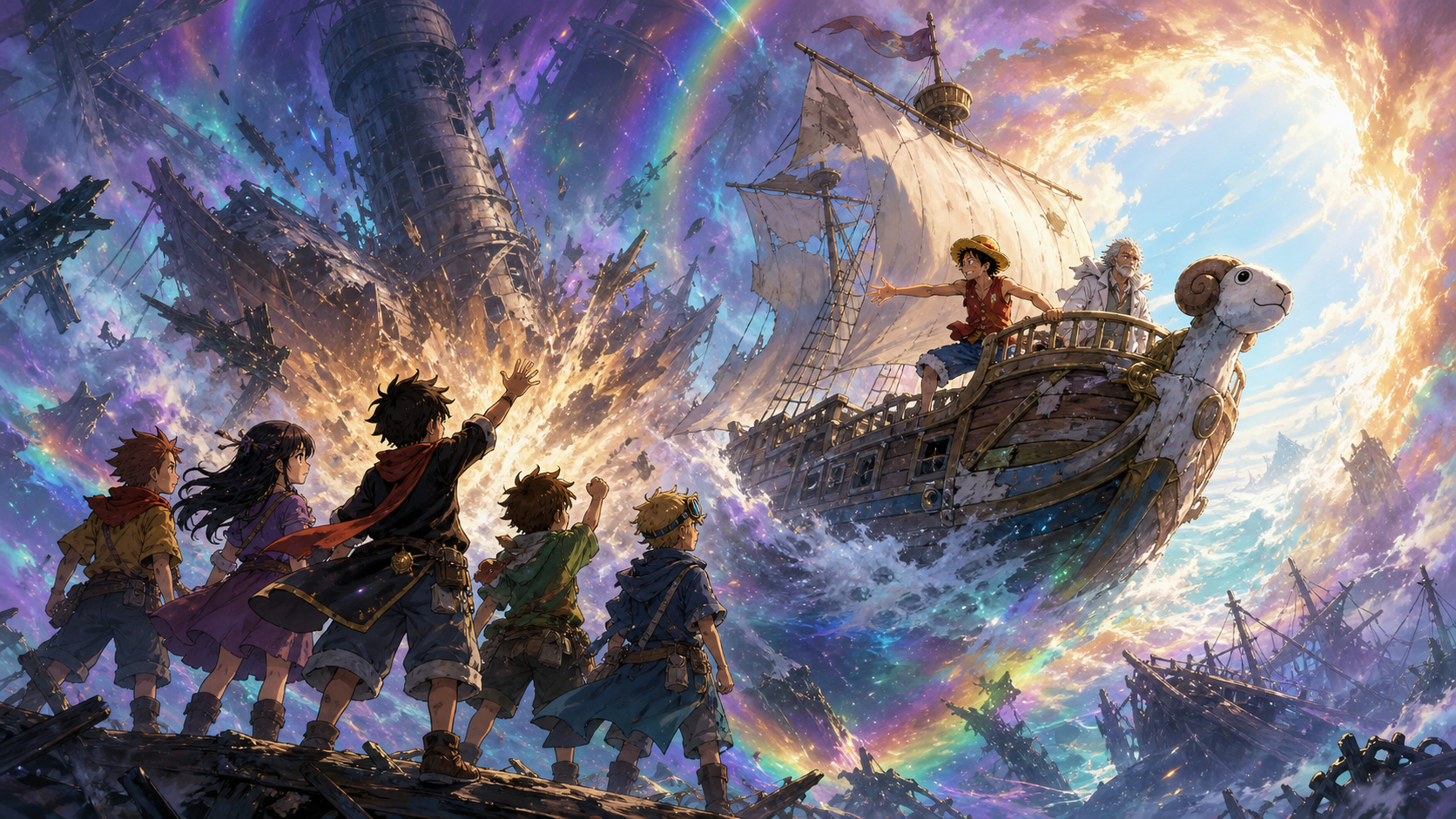
The opening appears, but the damaged Going Merry lacks the wind needed to reach the exit. Safety sits within sight while the vessel remains trapped.
The crew should check sail condition, rudder control, hull damage, weight, and every available source of propulsion. Treasure should leave the ship before any person does.
Rowing, towing, shifting weight, or using controlled air pressure may offer alternatives, but time and equipment are limited. Each option needs a clear failure point before everyone commits.
Nami cannot promise that the light will remain open. She can give the honest assessment: they need immediate force in the correct direction, and the plan must protect the weakest passengers from the acceleration.
Rapanui decides to create the wind with an explosion
Rapanui leaves the Merry and heads toward the Pumpkin Pirates’ ship, planning to detonate the vessel so the blast pushes the Straw Hats through the opening.
The choice carries extreme risk. Explosion pressure can splinter wood, rupture hearing, throw bodies into water, and send debris through the Merry’s hull.
A safer version would calculate distance, place charges away from fuel and people, provide flotation, and establish a pickup route. The collapsing mist leaves little room for that preparation.
Rapanui still deserves informed support rather than romantic praise for self-sacrifice. Courage should not make a child’s life seem expendable. Every adult present must search for a way to preserve both the escape and the person creating the force.
The other Pumpkin Pirates refuse to let him sacrifice alone
Isoka, Akibi, Pukau, and Rongo follow Rapanui back to their ship. Their decision expresses loyalty, but loyalty can spread danger when nobody challenges the first plan.
They should divide roles: one handles the fuse, one watches distance, one maintains a small escape craft, one signals the Merry, and one confirms that no person remains below deck.
Following together also keeps Rapanui from becoming the only child asked to absorb the cost of rescue. The group owns the decision instead of accepting a leader’s secret sacrifice after the fact.
Adults must resist calling that arrangement consent without examining pressure. Friendship, fear, and years of survival dependence shape every choice. The children need a genuine option to step back without shame.
Henzo hears another promise to return
Before the blast, Rapanui tells Henzo that the Pumpkin Pirates will come back. The line completes the reunion that the mist interrupted.
Henzo cannot know when, where, or in which form that return may happen. He can answer without false certainty by naming his love, respect, and commitment to keep looking.
He should not jump after them and create another person who needs rescue. Honoring the promise means surviving, preserving their names, and telling the truth about their choice.
The moment also frees Rapanui from proving that Henzo is still his friend through immediate physical contact. Trust becomes an action across uncertainty rather than a handshake completed on schedule.
The blast launches the Merry and destroys the known refuge
The Pumpkin Pirates detonate their ship, and the resulting force sends the Merry toward daylight. The plan works, but Ape’s Concert tears apart behind them.
Everyone aboard should brace low, protect heads, secure Chopper’s supplies, and keep clear of rigging. A successful launch can still cause fractures, falls, or people overboard.
Usopp should complete the head count immediately after crossing. Nami must confirm position and time, while Robin records what remained visible at the boundary.
The loss of the ship graveyard also means lost homes, graves, belongings, and evidence. Survival does not require pretending that destruction feels clean. The children saved the crew through a choice that erased the only world they had known for fifty outside years.
The Going Merry escapes with damage that cannot be ignored
The Merry reaches ordinary water but emerges badly damaged. Escape ends the immediate emergency, not the vessel’s need for care.
The crew should inspect the keel, hull seams, mast, rudder, sails, rigging, pumps, and stored water before resuming open-sea travel. Hidden structural damage may worsen under normal waves.
Chopper should assess every passenger for smoke exposure, blast injury, dehydration, hearing loss, and delayed shock. Adrenaline can hide symptoms until the ship is far from help.
A written damage record matters because repeated repairs can conceal a pattern. The Merry has carried the crew through extraordinary stress, and gratitude does not replace maintenance or an honest seaworthiness decision.
Wetton loses office before he understands that authority has changed
Back on Ruluka, Wetton expects rank, guards, and accumulated wealth to protect him. Marines arrive and place his treasure under government control.
Seizure needs an inventory, witnesses, chain of custody, and a process for identifying property taken through taxes, forced labor, or piracy. Government possession alone does not make recovery just.
Residents should receive a public accounting and a route to restitution. Workers coerced into Rainbow Tower deserve wages, medical care, and protection from retaliation.
Wetton tries to separate Mayor Wetton from pirate Wetton, but the same person used both identities to take by force. Public office cannot launder the conduct that created the fortune.
The Marines name Wetton’s confession clearly
When Wetton declares that he takes whatever he wants, the senior officer treats the statement as a confession. The uniform finally confronts the behavior instead of serving as decoration around power.
One confession should join broader evidence: resident testimony, tax records, labor rosters, tower orders, stolen treasure, weapons, and Ian’s participation.
Lake, Flip, guards, and workers need individual review rather than automatic collective guilt. Some enabled abuse willingly, while others may have acted under threats or dependency.
Ian should face separate accountability for hostage-taking, child endangerment, theft of the lifeline, and participation in the raid. Wetton’s arrest must not turn every lesser actor into invisible collateral.
The senior Marines are the Pumpkin Pirates
The officers reveal themselves as Rapanui, Isoka, and their friends, now elderly after living fifty years in the outside world. The mist threw them into the past when the refuge collapsed.
The twist confirms Robin’s conclusion that Ape’s Concert distorted time as well as space. The children escaped, but their route separated them from Henzo across another fifty-year path.
The reunion needs room for grief. Henzo meets the friends he searched for, yet both sides lost an ordinary shared life. Survival does not refund those years.
Medical records, identity evidence, and private conversation should support the transition. Their authority and age do not erase the children they were, while Henzo’s relief does not require instant emotional closure.
Rapanui used Marine authority to confront stolen authority
Rapanui explains that the group joined the Marines because Wetton had wrapped piracy in government office. They pursued enough rank to challenge his institutional protection.
The strategy shows patience and discipline, but the system required decades before residents received relief. Justice that depends on one survivor climbing a hierarchy leaves too many communities waiting.
Rapanui should support independent oversight after the arrest so his personal history does not become the only basis for prosecution. Strong evidence protects victims and prevents Wetton from reframing accountability as revenge.
He can remain a Pumpkin Pirate in loyalty while serving as a Marine in role. The uniform matters only when conduct matches the promise to protect people from those who abuse power.
The Rainbow Mist books preserve the children’s authorship
Rapanui writes the adventures of Ape’s Concert and records the crew that helped them. The books eventually become the legend Robin read before reaching Ruluka.
That authorship matters because the children define their own story before researchers, officials, or treasure hunters can reduce them to missing persons.
Copies should preserve original names, dates, illustrations, uncertainties, and the voices of all five members. Isoka, Akibi, Pukau, and Rongo deserve more than supporting roles in Rapanui’s account.
Henzo can add a separate outside chronology without replacing the lived record. Two timelines show how the same disappearance affected people inside and outside the mist.
Episode 143 lets the rescued children write the ending
The finale refuses a simple return to childhood. The Pumpkin Pirates save the Merry, cross into another time, build adult lives, document their survival, and return with enough power to stop Wetton.
The closed loop remains messy. Henzo’s decades of searching help create the rescue that sends his friends into the past, while their future books inspire the expedition that finds them. The emotional logic works because every link depends on someone refusing to forget.
RaeRae’s verdict: keep this one. Episode 143 understands that rescue should restore authorship, not merely relocate bodies. Rapanui and his crew choose the wind, preserve their story, and decide how to confront the man who destroyed their home. Henzo does not get the childhood reunion he imagined, but he gets something more honest: proof that his friends survived, remembered him, and returned on their own terms.