
RaeRae Reacts · One Piece Episode 142
Wetton Builds a Highway Into Theft
One Piece Episode 142 turns Nami’s rescue line and Wetton’s Rainbow Tower into competing routes shaped by courage, theft, and political power.
Ian treats a child’s mercy as an unlocked door
Episode 142 opens inside the wrecked Marine ship, where Ian hears that help may be coming and immediately performs helplessness for Akibi. He cries, begs, and waits for the kindest child in the room to confuse pity with proof.
Akibi releases him because captivity looks cruel and Ian knows exactly which feeling to exploit. The evil laugh that follows removes any doubt about intent. Ian did not earn trust, accept responsibility, or offer a verifiable route. He found the softest boundary and pushed through.
Children should never carry sole authority over a dangerous adult’s release. A safe decision would require the whole group, a plan for distance, and conditions Ian cannot rewrite once the door opens.
Mercy still matters, but mercy needs structure. Food, water, medical care, and humane treatment can continue without handing control back to a man who once used Rongo as a shield. Compassion does not require amnesia.
Rapanui needs truth before Henzo gets forgiveness
Rapanui still sees the elderly Henzo as someone who chose Wetton. Fifty years of research mean little to a child who experienced no fifty-year gap and remembers his village burning.
Usopp explains that Henzo stayed, endured Wetton’s control, and kept searching for the friends everyone else treated as dead. That defense adds missing context without ordering Rapanui to forgive.
Henzo offers himself for a punch because shame has convinced him that pain can settle the debt. That gesture may feel honest, but a child should not become the instrument of an adult’s absolution.
Rapanui needs records, choices, and time. Henzo can acknowledge every compromise, explain which decisions protected the search, and accept that reunion does not restore the relationship on command. Accountability lasts longer than one dramatic blow.
A reunion almost happens before the mist steals the moment
Rapanui cannot strike Henzo. Tears replace the attack, and the two move toward a handshake that finally recognizes their shared childhood.
Luffy then flies through the warped space, collides with Rapanui, and carries him into another opening before either person can finish the exchange. The interruption plays as chaos, yet the emotional cost remains real.
Henzo should not treat the unfinished handshake as rejection. Rapanui had moved from accusation toward contact, and that progress survives the interruption.
The group should record where the pair vanished, when the portal appeared, and which direction Luffy entered. Panic will not recover them. Careful observation may reveal whether the space repeats a route or merely creates the illusion of repetition.
Robin recognizes that broken time changes the rescue
Robin studies wreckage from wildly different eras, including an ancient vessel and debris that does not belong beside one another. Ape’s Concert does more than bend direction. Time inside the mist does not behave like time outside.
That finding changes every promise made to the Pumpkin Pirates. Returning home may mean arriving decades after departure, while another route could lead to a different point entirely.
Robin should build a chronology from dated cargo, ship construction, uniforms, logbooks, and decay. One strange object suggests distortion; multiple independent dates can define the pattern.
Any exit test needs a timestamp on both sides. A rope, clock, written message, and agreed signal could show whether seconds inside equal seconds outside. Rescue without temporal evidence may separate the children again.
Luffy and Rapanui cannot navigate by stubbornness
Luffy runs because standing still feels useless. Rapanui follows until exhaustion wins, then points out that instinct has produced no route and no reunion.
Movement can feel like leadership while consuming the strength needed for survival. They have no food cache, reliable landmark, medical kit, or confirmed return path.
The pair should stop, mark the location, check injuries, ration energy, and create a simple search pattern. Luffy’s durability does not make Rapanui equally safe.
They also need an audible signal and a time limit before returning to the last stable point. A rescue search becomes another disappearance when nobody knows the route, duration, or abort condition.
Rapanui’s father is a wound, not a navigation beacon
Rapanui explains that his father served as a Marine officer, left home, and later died. The child fears growing into someone who abandons people while calling duty an excuse.
When a figure resembling his father appears near a wreck, longing turns the image into a destination. Grief can make uncertain evidence feel certain.
Luffy should validate the hope without declaring the figure real. They can approach together, keep a return marker, and watch for environmental changes before chasing light through unknown space.
Rapanui deserves confirmed information about his father after rescue, delivered privately and with support. A government uniform does not cancel the family’s right to records, remains, belongings, or a truthful account of what happened.
Nami turns Henzo’s lifeline into a real rescue tool
Outside the mist, a Sea King blocks the approach while Wetton treats Nami’s danger as disposable. A Marine major drives the creature back, giving her one narrow opening.
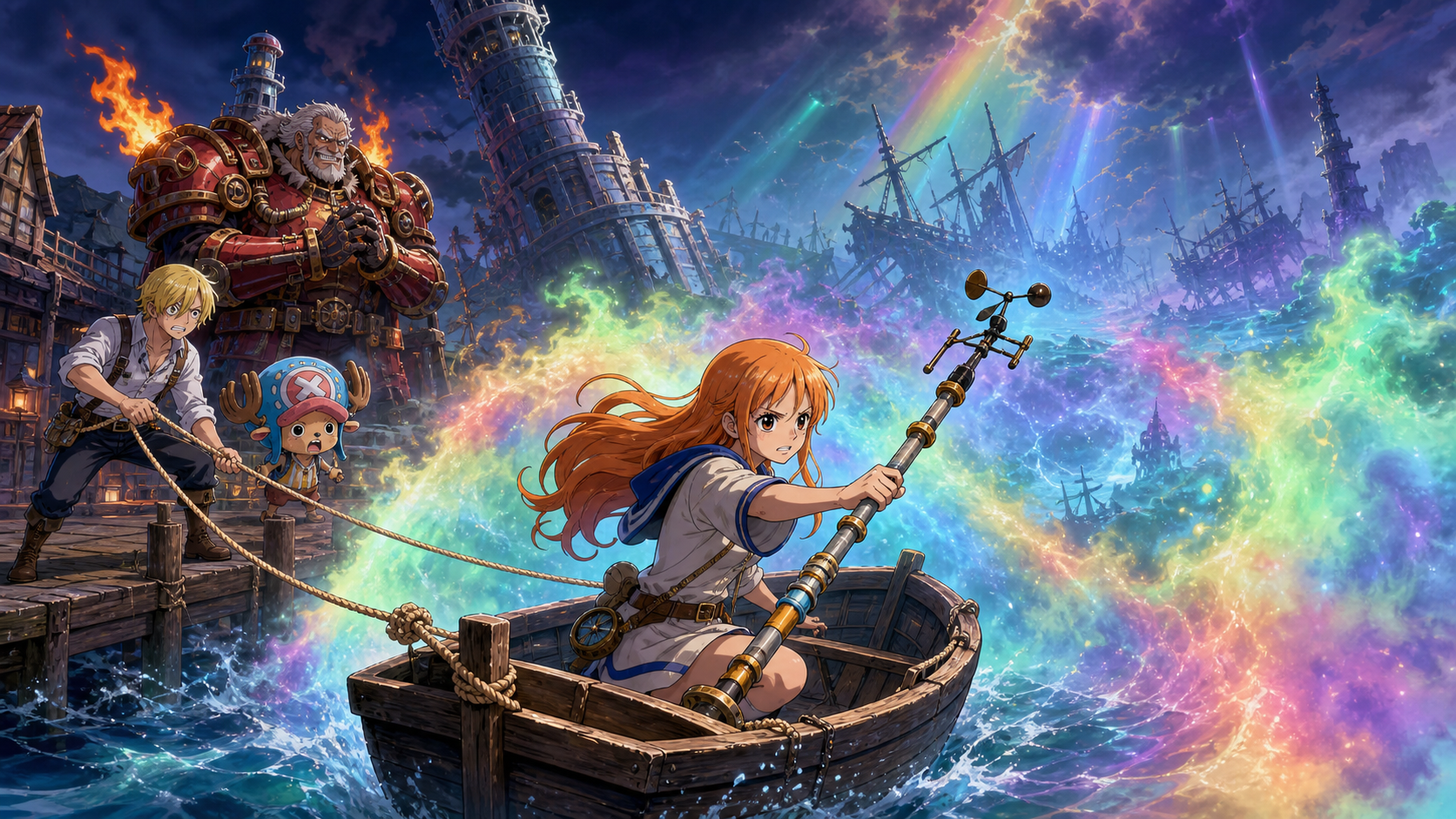
Nami ties Henzo’s lifeline to her Clima-Tact, sends the other end to Chopper, and establishes a pull signal before entering by rowboat. The plan finally connects navigation, communication, and retrieval.
The tether needs more than courage. Sanji and Chopper should inspect every knot, anchor the line to a fixed point, protect the rope from sharp edges, and agree on distinct signals for stop, return, injury, and slack.
Nami should also wear a secondary line and flotation support. If the primary tether breaks or someone takes control of the free end, a single rescue route becomes a trap.
Wetton watches a rescue because he wants the route
Wetton does not help Nami because he values her life. He allows the attempt because a successful return would prove that Henzo’s device can reach treasure.
That distinction matters. Passive observation can become participation when a public official controls the harbor, armed guards, and the infrastructure surrounding an emergency.
Witnesses should document his refusal, threats, and later use of Nami’s route. Henzo’s research belongs to rescue work, not Wetton’s private extraction scheme.
The lifeline design should be copied into protected records with authorship and safety limits. One corrupt mayor should not be able to seize the only functioning method and claim exclusive control over access.
The Flame Suit is intimidation dressed as engineering
Wetton changes into a massive Flame Suit while guards struggle to support the equipment. The armor projects power, but the shaking weapon reveals unstable machinery and a team forced to compensate for its weaknesses.
A flamethrower near rope, wooden docks, ships, fuel, and civilians creates an obvious mass-casualty risk. No one has established a safe perimeter or emergency shutdown.
Sanji and Chopper should prioritize distance and evacuation over direct confrontation. Chopper’s transformations cannot solve every mechanical hazard, especially while Lake and the guards control the space.
Workers operating the suit also face heat, burns, smoke, crush injuries, and retaliation if they refuse. Wetton’s spectacle depends on people whose safety he treats as another expendable resource.
Nami arrives with treasure and worse news
Nami reaches Ape’s Concert carrying a rowboat full of treasure, then learns that Luffy and Rapanui disappeared. Her successful entry does not mean the mission succeeded.
The group should move attention away from the cargo and toward missing-person recovery. Treasure adds weight, attracts violence, and can block space needed for passengers.
Nami correctly understands that riches have no value if nobody can leave. The line offers a route, but everyone needs an evacuation order based on injury, age, risk, and boat capacity.
They should send one written status message outside before loading anyone. Sanji and Chopper need the passenger count, missing names, rope condition, and expected signal so they do not pull at the wrong moment.
Ian takes Akibi hostage because the children know his record
Ian escapes with Akibi under threat, proving that the earlier release never represented change. He chooses the smallest person available as leverage and expects the adults to negotiate around the child’s body.
Nami does not recognize Akibi, which exposes a communication failure rather than a lack of care. No one briefed the outside rescue team on the Pumpkin Pirates’ names, faces, or immediate risks.
The group should use Akibi’s name, keep weapons lowered, create distance, and give Ian one clear path to release the child without humiliation. Competing threats can trigger panic and injury.
Afterward, Akibi needs medical assessment and trauma support without blame for opening the cell. Ian engineered the deception. Responsibility belongs to the adult who exploited trust.
Robin’s restraint works until sea-prism stone changes the balance
Robin uses her power to immobilize Ian without striking Akibi. The response is targeted, fast, and proportionate to a hostage emergency.
Contact with sea-prism stone weakens her, allowing Ian to escape. The failure does not make restraint foolish. The team lacked information about the material and had no backup position.
Future intervention should include a second rescuer outside Ian’s reach, a clear handoff for Akibi, and observation of weapons or restraints before Robin commits.
Usopp also needs a clean line of sight and permission to hold fire when a child or ally crosses the path. A rushed shot could turn rescue into friendly injury.
Ian steals the boat and the only tested exit
Ian takes Nami’s rowboat and follows the lifeline back toward Ruluka, leaving the others with treasure they cannot transport and no tested way home.
This theft proves why one tether was never enough. The route depended on equipment that no one secured against hostile control.
Nami and Henzo should preserve the remaining line position, avoid cutting any segment, and document the direction and pull pattern. Even a stolen boat may leave useful evidence about the exit.
Outside, Sanji and Chopper should not assume the returning passenger is Nami. They need a challenge signal before drawing the boat close, plus a protected anchor Ian cannot immediately seize.
Sanji and Chopper face force while holding the rescue line
Wetton’s guards attack the two people responsible for keeping Nami connected to the outside. Sanji is trapped, Chopper uses a Rumble Ball, and Lake’s weapon adds electrical force.
The fight threatens everyone inside the mist because the line remains part of their life-support system. Combat around the anchor should trigger an emergency protection plan.
One person should guard the tether while another moves civilians away from flame and electricity. A backup anchor farther from Wetton would reduce the chance that one capture ends the rescue.
Chopper’s Rumble Ball also has medical limits. He should not be forced into repeated transformations because public authorities chose violence. Rescue teams need enough people and equipment that survival does not depend on one doctor’s body.
Ian sells stolen knowledge to Wetton
When Ian emerges, he mistakes Lake for Wetton and then realizes the pirate he knew now rules through a third generation. The passage of time shocks him, but greed restores the alliance quickly.
Ian tells Wetton about the treasure inside Ape’s Concert. He converts the children’s home, the dead sailors’ remains, and Nami’s rescue route into market information.
Neither man has legitimate ownership. Shipwreck cargo may involve descendants, governments, insurers, cultural heritage, and human remains. Recovery requires documentation and respect, not armed looting.
Ian’s information should be treated as evidence from a self-interested source. Wetton instead rewards the claim because confirmation would slow the invasion he already wants.
The Rainbow Tower becomes a highway for armed theft
Wetton topples the Rainbow Tower toward the mist, turning years of forced labor and public resources into a physical bridge for his guards. The structure enters Ape’s Concert like a weapon.
No engineer checks load, stability, collision damage, evacuation, or the effect of distorted space. Workers ride a conveyor into an environment nobody understands.
The tower could crush wreckage, sever the lifeline, release fuel, disturb human remains, or trap guards beyond rescue. Wetton transfers every risk to people with less power.
A legitimate emergency authority would close the area, protect the tether, coordinate with the trapped group, and use the smallest tested access method. Wetton chooses maximum force because spectacle helps him confuse domination with competence.
Rapanui sees the invasion before he gets his reunion
The tower’s impact throws water through the distorted space and returns Luffy and Rapanui near the others. Rapanui immediately understands that armed outsiders are entering Ape’s Concert.
For him, the invasion repeats the original destruction of Ruluka. Wetton once burned the children’s home; his descendants now enter their refuge to take what remains.
Adults should not dismiss Rapanui’s response as possessiveness over treasure. The ship graveyard has functioned as shelter, history, and community for children trapped beyond normal time.
Henzo can support him by naming Wetton’s act clearly and refusing any deal that trades the children’s safety for access. Reunion becomes credible when Henzo protects them in the present, not only when he explains the past.
Episode 142 turns rescue design into a political test
The same tools can save people or expose them. Henzo’s lifeline gives Nami a path toward her crew. Wetton’s tower gives armed guards a path toward treasure. Engineering does not become ethical because a machine works.
The episode keeps asking who controls the route, who carries the risk, and who gets treated as cargo. Nami tests the line with her own body. Ian steals the result. Wetton forces workers and fighters into a raid while staying protected by rank and armor.
RaeRae’s verdict: keep this one. Episode 142 gives the Rainbow Mist arc its sharpest idea. Rescue infrastructure needs consent, redundancy, documentation, and public accountability because power will copy a successful route faster than safety can catch up. Akibi’s mercy, Nami’s courage, Robin’s restraint, and Henzo’s research all deserve better than becoming raw material for Ian and Wetton. The route home only counts as rescue when the people trapped inside retain the right to decide who follows.