
Comrade
Relationships Pain’s seals cannot account for restore Naruto’s choice, save Konoha and briefly interrupt the cycle Nagato mistook for justice.
Bottom line
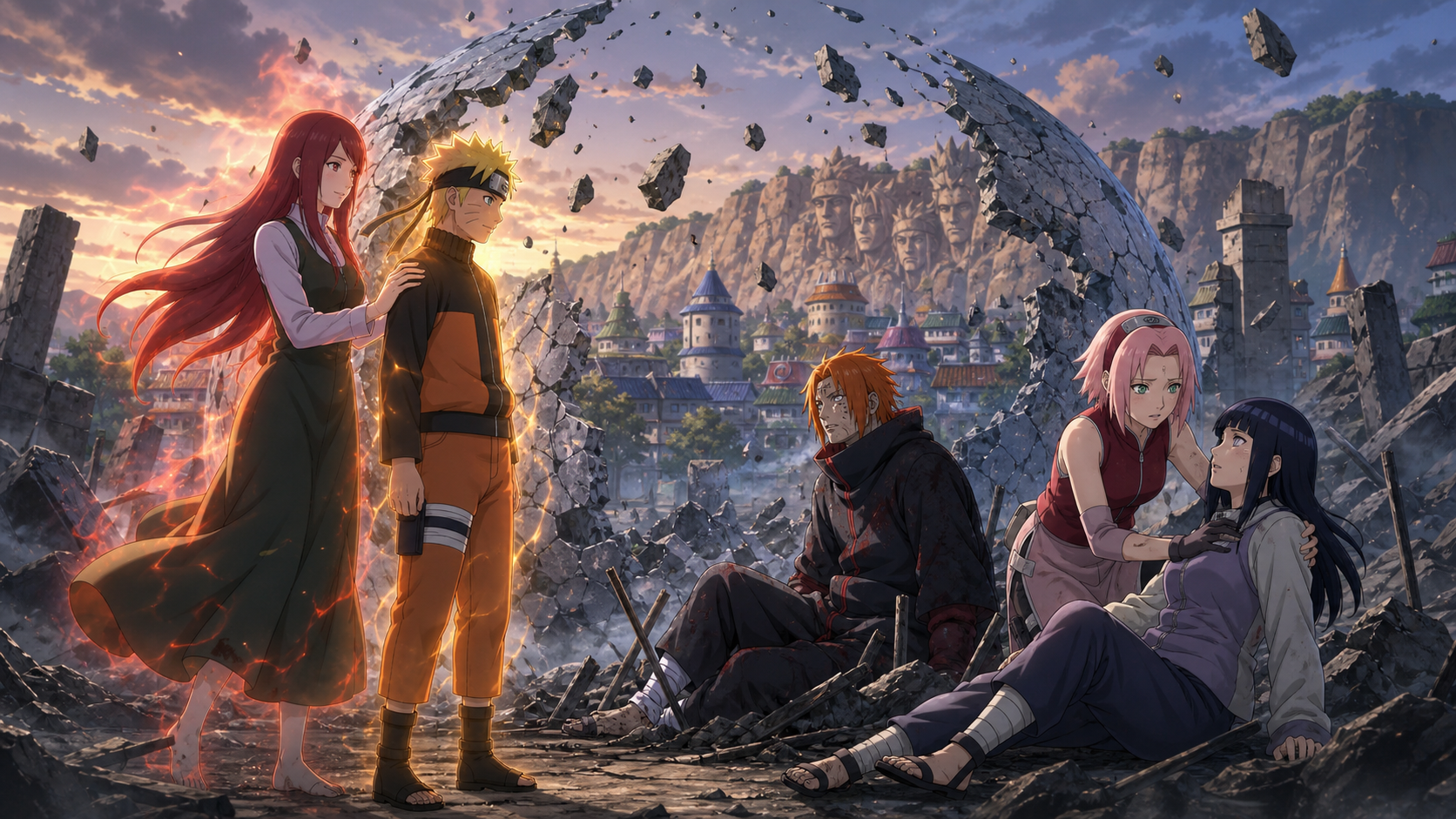
“Comrade” breaks Pain’s two artificial moons through relationships the sealed technique cannot account for. Sakura keeps Hinata alive. Ino carries Shikamaru’s report through the barrier. Kushina reaches Naruto through their connected Nine-Tails chakra and prepares to give him everything, even at the cost of her life. The fox stops that full sacrifice and says a portion will be enough. Naruto escapes, defeats the Deva Path, follows the chakra rods to Nagato, and asks him to reconsider the future Yahiko wanted. Nagato releases Konoha because Naruto’s refusal to reproduce his hatred reminds him of the friend whose body he weaponized. The episode then refuses a clean celebration. Fugaku admits to Minato that comparison helped drive Sasuke away. Sasuke defeats Orochimaru, wakes beside Sasori, accepts Akatsuki’s offer, and declares Konoha his target. Comrades help each other recover choice. Manipulators arrive when pain has made every choice look the same.
Sakura defeats Pain’s planned ending for Hinata
Pain strikes Hinata because he wants Naruto to believe the loss is complete and irreversible. Sakura’s medical work proves that spectacle is not the same as outcome. A person who appears finished can still receive care, skill, and time.
The philosophical rebuttal happens through treatment before Naruto ever reaches Nagato. Pain tries to manufacture a corpse. Sakura refuses to let his intended lesson decide what Hinata’s body becomes.
Communication breaks the first layer of confinement
The stone barrier blocks movement, teleportation, and ordinary coordination. Ino’s technique lets Shikamaru’s information cross anyway. That message gives Kushina enough knowledge to respond deliberately instead of sacrificing herself based on fear alone.
Power in this episode is often spectacular, but the decisive breach is a report delivered accurately. Isolation weakens when somebody can tell the people inside what is actually happening outside.
Kushina’s love needs a boundary
Her willingness to give Naruto everything is emotionally understandable. It is also unnecessary and potentially fatal. The fox becomes the unexpected voice saying enough, not all. Love does not lose meaning because somebody prevents it from becoming martyrdom.
The partial transfer is stronger editorially than a glorious death. Kushina helps her son, protects the village, and remains a person whose life matters beyond what she can donate in a crisis.
The Nine-Tails participates without owning Naruto
The fox warns him about control, limits Kushina’s transfer, and contributes to the escape. None of that turns the tailed beast into a harmless tool or erases the danger of six tails.
It shows a relationship beginning to contain negotiation rather than pure extraction. Naruto needs chakra, Kushina needs to survive, and the fox names a workable amount. Shared power becomes possible when every participant is more than inventory.
Naruto follows command back to the commander
Defeating the Deva Path stops the body acting in front of him. It does not free Konoha or address the person making decisions through that body. The chakra rods reveal a line from weapon to authority.
Naruto follows it because accountability should reach the decision maker. Destroying Yahiko’s face would provide emotional release while leaving Nagato, the seal, and the underlying argument untouched.
Listening does not require surrendering judgment
Naruto lets Nagato explain the history of small nations, Yahiko, and Konoha’s alleged attack. He does not answer by pretending the grievance is imaginary. He also refuses the conclusion that civilians must be crushed for history to feel acknowledged.
That balance is the hard part. Hearing why somebody caused harm is not forgiving the harm automatically. It is gathering the truth needed to interrupt repetition without replacing conversation with another body.
Nagato changes course before every fact is repaired
Naruto does not yet expose Sasori’s planted kunai or Deidara’s attack. He reaches the part of Nagato that remembers Yahiko’s hope and recognizes how far Pain’s method has moved from it.
This is not a complete political settlement. It is an emergency moral interruption. Nagato frees the village now, leaving evidence, institutional history, and accountability for later work.
Fugaku’s admission names a preventable wound
He finally recognizes that comparing Sasuke with Itachi did not motivate healthy growth. It taught one son that love required superiority and placed the other inside a role nobody could safely leave.
The admission matters because parenting is not exempt from accountability merely because Danzō and Orochimaru exploited the result. Fugaku did not design their schemes. He helped make their recognition feel necessary.
Sasuke keeps meeting recruiters at his weakest moment
Danzō approaches after public humiliation. Orochimaru receives him after isolation. Sasori appears after poison and conflict. The pattern is not accidental. Manipulators understand that pain can make conditional belonging feel generous.
Sasuke still chooses Akatsuki, and that choice will harm others. Naming predation does not erase agency. It explains why meaningful recovery must offer more than punishment after each recruiter succeeds.
The title belongs to a network, not a slogan
Hinata protects Naruto. Sakura protects Hinata. Ino carries Shikamaru’s knowledge. Kushina shares measured chakra. The fox sets a boundary. Naruto reaches Nagato. Villagers hold stone while leaders hold the seal.
No single relationship completes the rescue. Comradeship is the structure that keeps enough people alive, informed, and capable of choosing the next useful action.
RaeRae’s verdict
“Comrade” works because it makes recovery collective and refuses to confuse total sacrifice with perfect love. Sakura’s hands matter as much as Naruto’s attack. Ino’s communication matters as much as Kushina’s chakra. The Nine-Tails contributes by setting a limit nobody else is emotionally ready to set. Naruto wins because a network returns him to himself before greater power can erase the person using it.
Nagato’s reversal is an opening, not absolution. He releases Konoha after recognizing Yahiko’s hope in Naruto, but the planted evidence and the real violence of the great nations still demand answers. Meanwhile, Fugaku begins accountability only after Sasuke has entered another recruitment cycle. Sasuke defeats Orochimaru and still wakes beside Sasori because removing one manipulator does not heal the need manipulators target. Comrades restore options. Predators arrive when pain has narrowed options until obedience feels like freedom.
Episode 448 remains inside the dream manuscript
Episode 448 continues Jiraiya’s anime-original “Shinobi Handbook” story within Tsunade’s Infinite Tsukuyomi dream. The Japanese title is “Nakama,” meaning “Comrade.” The episode aired in Japan on February 11, 2016.
The story links Naruto’s rescue of Konoha with Sasuke’s deeper movement into Akatsuki.
Lee watches Pain from concealment
Rock Lee observes the battlefield after Pain repels his attempt to help Naruto. Moving recklessly would give Pain another easy target.
Watching becomes tactical discipline rather than cowardice.
Sakura treats Hinata
Hinata survived Pain’s attack because no vital point was destroyed. Sakura begins immediate healing while the battle continues nearby.
The apparent death that triggered Naruto’s rage is not the final truth.
Medical care interrupts Pain’s lesson
Pain wanted Naruto to experience irreversible loss at arm’s length. Sakura’s work refuses that conclusion.
Compassion does not argue with the philosophy. Compassion keeps the person alive.
Shikamaru studies the first artificial moon
The True Planetary Devastation still encloses Konoha while defenders hold the walls. Shikamaru evaluates a technique beyond ordinary tactical scale.
Analysis remains necessary even when no immediate countermeasure is obvious.
Naruto rages inside the second moon
Pain has sealed six-tailed Naruto in another gravitational sphere. Trapped anger pushes him toward still more Nine-Tails chakra.
The urge to escape and the urge to destroy have become difficult to separate.
Naruto demands more chakra
Inside his mind, Naruto asks the fox for greater power. He wants enough force to break Pain’s prison and save the village.
The request risks surrendering the person who understands why the village matters.
The Nine-Tails warns about control
The fox tells Naruto that he still cannot command the full power. More chakra will not automatically produce a more capable Naruto.
Even the source of temptation recognizes the vessel’s limit.
Hatred pushes against the seal
Pain’s attack on Hinata has given the Nine-Tails exactly the emotion needed to expand. Naruto’s body becomes the battlefield between care and rage.
The more he wants to protect a comrade, the less able he becomes to recognize comrades nearby.
Kushina senses the disturbance
Inside the trapped village, Kushina feels her share of the Nine-Tails grow unsettled. The connection tells her Naruto is in danger beyond the wall.
Mother and son cannot see each other, but chakra carries the alarm.
Minato uses Ino’s communication
Minato has Ino connect the leaders inside with the shinobi outside. The Yamanaka technique crosses a barrier that blocks ordinary movement and teleportation.
Communication becomes the first breach in Pain’s isolation strategy.
Shikamaru reports Naruto’s condition
Through Ino, Shikamaru explains the second Planetary Devastation and the tailed-beast transformation. The village learns that its defender is also trapped.
Accurate information allows Kushina to choose a response rather than react to fear alone.
Kushina considers a drastic transfer
She decides to reach Naruto through the linked chakra and give him her entire portion of the Nine-Tails. The plan may cost her life.
Her instinct is total sacrifice because her son appears moments from death.
Minato understands the possible cost
Kushina’s decision frightens him because full extraction can kill a jinchūriki. Their son and the village need help, but losing Kushina cannot be treated as a minor price.
Love creates urgency without making every sacrifice wise.
Kushina reaches Naruto’s inner world
Her chakra presence appears before Naruto inside the sealed mental space. The contact gives him a familiar person while anger has nearly erased language.
She reaches the son before transferring power to the fighter.
A mother interrupts the fox’s monopoly
The Nine-Tails had become Naruto’s only available voice inside the prison. Kushina introduces another relationship and another source of strength.
Isolation weakens as soon as Naruto can hear someone who wants his survival rather than his surrender.
Kushina offers everything
She prepares to pass her full share of the tailed beast to Naruto. The offer reflects the depth of her love and the extremity of the crisis.
The episode does not need her death to prove either truth.
The fox rejects unnecessary martyrdom
Naruto’s Nine-Tails says a complete transfer is not required. A portion of Kushina’s chakra will provide enough force.
An unexpected boundary prevents devotion from becoming self-erasure.
Enough power matters more than all power
The solution depends on matching the actual need rather than maximizing Naruto’s supply. Restraint preserves Kushina and restores her son.
Power becomes useful when measured, not worshipped.
Kushina shares a portion of chakra
The transfer strengthens Naruto without removing his need to direct that strength. Her contribution does not complete the battle for him.
Help expands agency instead of replacing agency.
Naruto breaks the second Planetary Devastation
With Kushina’s chakra added, Naruto bursts from Pain’s artificial moon. The prison built to contain rage cannot withstand coordinated power.
Mother, son, and tailed beast each contribute to the escape.
Naruto returns to himself
Breaking free is not enough if the six-tailed state remains in control. Kushina’s contact helps Naruto recover the person beneath the chakra.
The rescue succeeds because strength and identity return together.
Pain loses control of the battle
The Deva Path expected confinement to end Naruto’s resistance. The escaped fighter now understands more about the technique and carries renewed support.
Pain’s model cannot easily account for power shared without coercion.
Naruto defeats the Deva Path
He overcomes Yahiko’s body and ends the immediate assault outside Konoha. Victory stops the active caster but does not yet release the village.
The body before Naruto is a transmitter, not the person making the decision.
The chakra rods become a trail
Naruto uses Pain’s black receivers to sense the direction of the real controller. A weapon intended to transmit command becomes evidence leading back to Nagato.
Control creates a connection that can work in reverse.
Naruto chooses to meet Nagato
He follows the signal instead of destroying the fallen body and declaring the mission complete. Konoha remains trapped, so the choice carries urgency.
Naruto seeks the decision maker because only a changed decision can free everyone.
Nagato expects another exchange of violence
The man behind Pain has built his identity around receiving and returning suffering. Naruto arrives as the latest person with reason to kill him.
That expectation makes restraint harder and more meaningful.
Naruto names the shared teacher
Both young men learned from Jiraiya and inherited his question about peace. Their answers separated around loss, evidence, and trust.
Shared lineage creates an opening without settling the argument.
Nagato explains the pain behind judgment
He remembers people killed by great nations and the alleged Konoha betrayal that took Yahiko. His revenge grew from experiences no speech can erase.
Naruto listens without accepting collective punishment as the answer.
Naruto refuses to reproduce the same cycle
Hinata’s injury and Konoha’s captivity give him immediate reasons for revenge. He chooses conversation after defeating Pain.
The choice proves that pain can influence a future without owning that future.
Naruto reminds Nagato of Yahiko
His stubborn faith in comrades echoes the friend whose body became the Deva Path. Nagato confronts the distance between Yahiko’s hope and Pain’s method.
The face used to justify revenge becomes a memory arguing against revenge.
Jiraiya’s influence survives disagreement
Naruto does not present a finished peace plan. He presents willingness to continue seeking one without deliberately copying the wound.
Nagato recognizes the teacher’s unfinished hope in that refusal.
Nagato releases Konoha
He reverses or ends the sealing technique, freeing the village from the first artificial moon. The defenders’ labor bought enough time for Naruto to reach him.
Conversation succeeds because thousands of people held the walls while conversation became possible.
The village survives through distributed action
Sakura healed Hinata. Ino carried information. Shikamaru analyzed the attack. The clans pushed stone. Four leaders held the barrier. Kushina shared chakra. Naruto reached Nagato.
No single heroic image contains the full rescue.
Comrade names a system of mutual survival
A comrade does not always fight beside the visible hero. Someone heals, communicates, braces, waits, or refuses unnecessary sacrifice.
The title belongs to coordinated care rather than one dramatic bond.
Minato speaks with Fugaku afterward
Once the immediate crisis passes, the Hokage and Uchiha leader address Sasuke and Itachi. Political repair cannot ignore the family fracture behind Sasuke’s departure.
The village survived Pain while one of its sons remains missing.
Fugaku admires how Minato raised Naruto
He sees Naruto fight for Konoha without losing concern for individual people. Minato’s attention helped create strength anchored in belonging.
The comparison turns painfully back toward Fugaku’s own parenting.
Fugaku admits failure as a father
He recognizes that repeatedly measuring Sasuke against Itachi deepened insecurity and resentment. The admission arrives after Sasuke has already gone.
Late accountability cannot change the past, but refusing accountability would guarantee repetition.
Itachi’s apparent death changes Fugaku’s grief
Fugaku faces the possible loss of one son and the departure of another. His hierarchy between them now looks especially destructive.
Praise concentrated on Itachi did not protect either child.
Sasuke turns against Orochimaru
Away from Konoha, Sasuke attacks the Sannin whose power he sought. He no longer accepts the role of obedient vessel.
Rejecting one manipulator does not automatically restore the relationships he abandoned.
Orochimaru’s poison brings Sasuke down
Sasuke wins the confrontation or catches Orochimaru vulnerable, but poison collapses him. The body remembers the cost of entering forbidden mentorship.
Escape from control is not clean when control has already entered the body.
Sasuke wakes beside another recruiter
Sasori approaches after Orochimaru’s defeat and offers Akatsuki’s help. The timing mirrors Danzō’s earlier recruitment after Fugaku dismissed him.
Someone always appears when Sasuke is hurt enough to mistake exploitation for recognition.
Akatsuki offers shared purpose
Sasori frames the organization as a route toward Sasuke’s goals. The offer supplies allies, information, and a place beyond Konoha.
Belonging becomes conditional on directing anger where Akatsuki needs that anger.
Sasuke accepts the offer
He moves from Orochimaru’s private control toward an organization built through manufactured grief. Defeating one captor has not broken the pattern.
Sasuke changes handlers while preserving the wound that makes handling possible.
Sasuke declares Konoha his target
He says he wants to destroy the village. Fugaku’s rejection, Itachi’s apparent death, Danzō’s influence, and rivalry with Naruto collapse into one enemy image.
The declaration converts pain from family and institutions into punishment for an entire community.
Sasuke begins resembling Pain
Nagato attacked Konoha because planted evidence made the village responsible for Yahiko. Sasuke now blames Konoha after a sequence shaped by Danzō and Orochimaru.
Both men believe revenge is their own decision while manipulators arranged the available story.
Naruto and Sasuke leave the episode in opposite motion
Naruto receives help, regains himself, and persuades Nagato to free others. Sasuke defeats a manipulator, wakes isolated, and joins another manipulative group.
Power changes direction according to the relationships surrounding recovery.
Episode 448 ends with peace already threatened
Konoha survives Pain, but Akatsuki has gained Sasuke and still carries members tied to the original deception. Fugaku’s admission cannot reach his son yet.
Episode 449, “The Shinobi Unite,” must test whether the village can turn shared survival into coordinated action before Sasuke’s new alliance hardens.
RaeRae’s call
Comrades restore choices. Predators exploit untreated wounds. Naruto saves Konoha because a network keeps people alive and informed throughout the crisis.
Episode details and viewing routes
- Official episode reference: Naruto Official episode guide
- Licensed episode route: Crunchyroll licensed episode page
What I am carrying forward
Sakura kept Hinata alive while Ino connected Shikamaru with the leaders trapped inside Konoha. Kushina shared part of her Nine-Tails chakra, helping Naruto escape Pain’s second moon without sacrificing her life.
Naruto defeated the Deva Path, found Nagato, and persuaded him to release Konoha. Fugaku admitted his comparisons harmed Sasuke. Sasuke defeated Orochimaru, then accepted Sasori’s invitation to Akatsuki and named Konoha as his target. Episode 449, “The Shinobi Unite,” tests whether shared survival can become organized resistance.