
RaeRae Reacts · One Piece Episode 141
Ape’s Concert Has No Exit
One Piece Episode 141 turns Ape’s Concert into a rescue maze where distorted space, Ian’s manipulation, Rapanui’s distrust, and longing for home collide.
Henzo’s dream makes fifty years visible inside one race
Episode 141 opens with Henzo dreaming that the Pumpkin Pirates race toward treasure while his body suddenly becomes elderly and the children leave him behind. The dream compresses grief, aging, and survivor guilt into one image.
Robin notices him calling their names and understands that sleep has returned him to the loss. She offers observation without forcing disclosure.
Support should let Henzo choose whether to talk, rest, or seek privacy. A reunion does not erase decades of unresolved grief.
Recurring dreams may also affect concentration during a high-risk expedition. Henzo should not pilot, climb, or manage critical instruments while exhausted. Robin can help him create a written account after he is ready, separating memory from present observations.
Rapanui’s accusation about adults belongs in the reunion
In the dream, Rapanui says Henzo cannot keep up because he is an adult. The line reflects the child’s refusal to accept the old man’s identity and Henzo’s fear that time has made him unrecognizable.
Trust cannot be demanded through shared memories alone. Rapanui needs consistent behavior, answers he can verify, and permission to remain skeptical.
Henzo should not ask the children to comfort him about aging. Adults must hold the emotional burden of reunification without reversing caregiver roles.
The crew can make room for parallel truths: Henzo waited and searched for fifty years, while Rapanui experienced abandonment in a place where that duration made no sense. Neither person needs to surrender his own timeline before trust begins.
The repeated statue proves navigation has failed
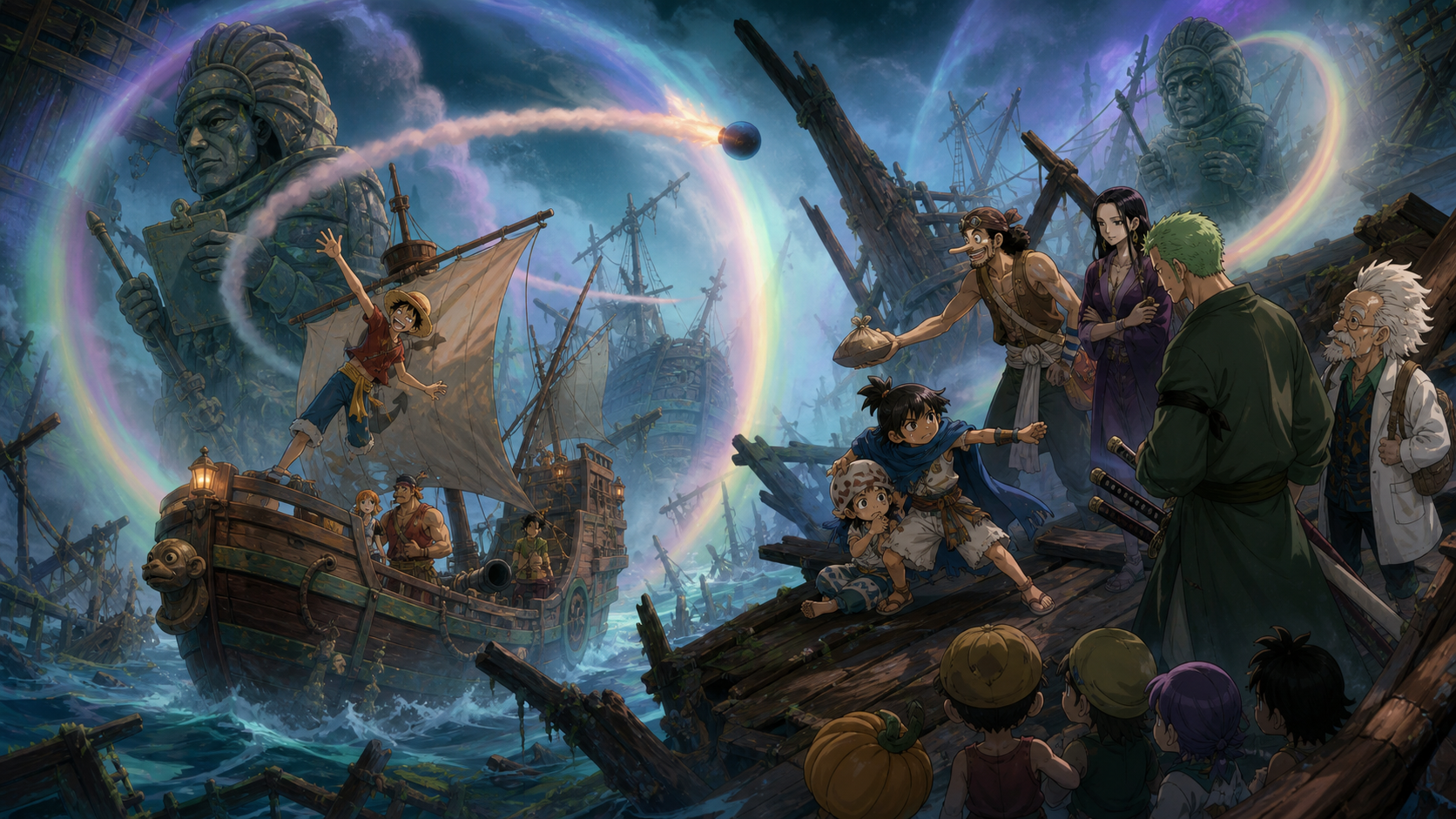
Luffy and the others keep passing the same carved statue while trying to move through Ape’s Concert. Familiar landmarks no longer indicate progress.
The crew should stop before fuel, food, and energy are wasted. They need a shared map, timed routes, marked objects, instrument readings, and paired scouts.
Continuing to sail by intuition could separate the Merry from wreckage that offers shelter or from the only people who understand the space.
Usopp can number temporary markers, Robin can maintain the log, Zoro can watch for repeated structures, and Luffy should stop changing course without agreement. Clear roles turn frustration into evidence rather than another loop.
A cannon test creates evidence and new danger
The crew fires a cannon to test the distorted space and watches the projectile behave impossibly. The experiment confirms that direction and distance do not follow normal rules.
Testing should use the least dangerous object available. A cannonball can strike unseen ships, children, trapped survivors, or unstable explosives when the return path is unknown.
Future experiments should use light, rope, floating markers, sound, or small harmless probes before another weapon enters the loop.
Every test needs one variable at a time. Direction, force, timing, and launch point should be recorded so the result can be repeated. A surprising cannonball path is only useful when the crew knows exactly how the shot began.
Luffy turns his own body into a probe
Luffy launches upward and falls back toward the ship from behind, demonstrating that the space folds around itself. He calls the result a mystery without understanding the mechanism.
Self-experimentation still requires informed risk assessment. A return point could place him inside wreckage, underwater, or beyond rescue.
The crew should attach a line, establish an abort signal, and have Chopper ready before anyone repeats the test.
Luffy’s unusual body may survive forces that would seriously injure another person, so his result cannot prove safety for Henzo or the children. Rescue plans must use the limitations of the most vulnerable traveler, not the durability of the captain.
Spatial distortion changes every rescue assumption
A direct route may return to its starting point, while a seemingly wrong direction may connect to another area. Standard bearings become unreliable.
Rescue planning should identify stable reference points, communication delays, time differences, and whether objects follow the same path as people.
No one should promise a quick exit to the Pumpkin Pirates. False certainty can pressure children into abandoning a shelter that has kept them alive.
The crew should establish caches of water, food, rope, light, and medical supplies at known stable points. If a scouting group loops away from the Merry, those stations could prevent a navigation error from becoming dehydration or exposure.
Robin proposes asking the people with lived expertise
Robin notices Pukau hiding near wreckage and suggests that the crew seek the Pumpkin Pirates’ knowledge. The children have survived where Henzo’s instruments and the crew’s instincts fail.
Expertise does not require adult credentials. Their maps, routines, warnings, and stories are essential evidence.
The adults should ask permission, offer something useful, and make clear that information will not be exchanged for control over treasure or shelter.
They should also credit the children when using their knowledge. Henzo’s research notes must not present survival routes as his discovery alone. Lived expertise deserves authorship, especially when the government may profit from any eventual entrance.
Pukau needs accompaniment without becoming a hostage
Pukau travels near the Straw Hats as they approach the hideout. Rapanui later sees him and assumes the adults captured his friend.
The crew should let Pukau walk freely, remain visible, and explain the plan in his own words. Holding, surrounding, or ordering him would confirm Rapanui’s fear.
One adult can stay back while Pukau makes first contact. Reunification works better when the child leads.
Pukau should know he can stop the meeting or return to the adults if Rapanui reacts violently. A child mediator must never become responsible for preventing conflict between armed groups.
Ian uses imprisonment to bargain for control
Inside a wrecked Marine ship, Ian tells Rongo and Akibi that he knows a route out if they release him from a cell. He offers information that cannot be verified in exchange for immediate freedom.
The children should not unlock the cell without a safety plan, adult support, and evidence. They can ask for route details first and test claims remotely.
Detention also needs basic standards: food, water, sanitation, medical care, and protection from revenge. Ian’s past danger does not erase those duties.
The cell and wreck should be checked for flooding, sharp metal, unstable beams, and blocked exits. If confinement cannot be maintained safely, the children need another plan that protects them without leaving Ian to die in a collapsing ship.
Isoka preserves memory when manipulation starts
Isoka reminds the group that Ian previously forced himself into leadership and endangered them. Her account prevents a desperate promise from rewriting history.
Groups need shared records of serious incidents so one persuasive person cannot exploit exhaustion or fear. Multiple children should confirm details without being pressured to agree.
Remembering harm is not the same as refusing every future change. Trust would require accountability, consistent behavior, and safeguards.
Isoka should not carry sole responsibility for preserving the group’s history. A shared written or symbolic record could document serious decisions, resources, injuries, and promises so younger members are not dependent on one person’s memory during crisis.
Ian threw Rongo toward a Sea King
During an earlier attack, Ian used Rongo as a shield against a Sea King. Rapanui rescued the child while Ian later claimed credit for everyone’s survival.
Using a child as expendable protection is abuse, not leadership. Emergency authority should prioritize the most vulnerable rather than sacrifice them.
Rongo may need care for trauma and reassurance that the attack was not his fault. Survival does not mean the harm has ended.
Ian’s later boast compounds the abuse by claiming leadership credit for a rescue Rapanui performed. Correcting the record matters because false hero stories can isolate victims and help an abuser regain authority.
Rapanui attacks because he believes Pukau was taken
Rapanui sees Pukau with the adults and charges with a sword. His response comes from a duty to protect, but the weapon increases risk to his friend.
Zoro disarms him without treating the child as a lethal enemy. Proportionate restraint prevents injury while preserving space for explanation.
The adults should return the sword only after immediate conflict ends and Rapanui agrees on safe boundaries.
Pukau should be invited to speak before the crew interprets his silence. He can confirm whether he came voluntarily, what he was promised, and whether he wants the adults to enter the hideout. His account should resolve the hostage assumption.
Food becomes trust-building only when no demand follows
Usopp offers food, drawing the Pumpkin Pirates from hiding. Hunger makes the offer valuable and also creates a power imbalance.
Food should be given without requiring information, surrender, obedience, or gratitude. The children need time to inspect packaging and divide portions by their own rules.
A longer plan should include water, nutrition, storage, and replenishment rather than one dramatic meal.
Chopper should screen for deficiencies and allergies before assuming ordinary crew rations meet every need. After years of limited food, sudden large meals may cause illness. Smaller portions and ongoing access are safer than a feast built around adult relief.
Rapanui refuses the idea that fifty years passed
Rapanui cannot accept that Henzo aged while the children remained young. The claim would mean families, homes, and the world outside changed without them.
Adults should provide evidence gradually: dates, objects, memories, observations, and outside communication. Shock should not be treated as dishonesty or defiance.
Chopper and Robin can help explain the difference between physical time, experienced time, and uncertainty without pretending they understand the mist completely.
The children may ask whether parents or siblings are alive. Henzo should not guess. He can promise to search records and provide confirmed information privately, with support present, instead of delivering rumors during a dangerous expedition.
The Den Den Mushi proves a communication path remains
Wetton’s call reaches Henzo’s Den Den Mushi, and Luffy eventually speaks with Sanji outside the mist. The link becomes the first reliable connection between trapped and external groups.
They should record call duration, signal strength, delay, position, and whether movement changes reception. Communication may reveal a route or support a tethered rescue.
Both sides need scheduled check-ins and concise information. Casual conversation can waste the only functioning channel.
Nami should receive the Merry’s position, passenger list, supplies, injuries, and current plan. The inside group needs Wetton’s movements, device details, outside weather, and a clear time for the next call. Written relay notes reduce errors.
Wetton prices entry at ten million berries
Wetton demands an enormous payment for access to the Rainbow Mist and threatens forced labor in Rainbow Tower when the remaining Straw Hats resist.
A public official cannot sell emergency rescue access or convert debt into involuntary labor. The demand exploits people trying to recover missing crewmates.
Residents should document the threat, protect witnesses, and seek outside review. Wetton’s ownership claim over the phenomenon has no legitimate basis.
Forced labor inside Rainbow Tower may expose people to height, machinery, electricity, and hazardous experiments. Anyone already detained there should be identified, medically assessed, paid restitution, and released through a process independent from Wetton.
Nami takes the safety device from Lake
Nami, Sanji, and Chopper obtain a device connected to safe entry from the gullible Lake and flee. The theft may be necessary to rescue people, but the equipment remains unfamiliar.
They should identify controls, power, limits, tether strength, maintenance status, and failure modes before use. A stolen tool without instructions can create another trapped group.
Whenever possible, they should preserve the device and return or document the taking after the emergency.
Nami’s urgency is justified because crewmates are missing, but Sanji and Chopper should still challenge unsafe assumptions. A navigator leads the route; she does not become the only person allowed to question the equipment.
Episode 141 makes home a right rather than a direction
The episode ends with a Sea King rising near the outside group while everyone inside remains trapped by warped space and distrust. Escape requires cooperation across both environments.
The Pumpkin Pirates deserve more than removal from the mist. Homecoming needs truth, family tracing, medical care, continuity with one another, and protection from Wetton.
RaeRae’s verdict: keep this one. Episode 141 refuses the easy rescue story. Henzo cannot ask fifty years to disappear, Rapanui cannot defend everyone through force, and the Straw Hats cannot navigate a folded world by confidence alone. The first real exit appears when adults listen to children, preserve communication, share food without conditions, and treat longing for home as a claim to safety rather than permission to take control.