

Character File · The Little Mermaid · Care Work, Household Power, and the Woman Who Notices
Carlotta
The palace calls her a maid because stories like simple job labels. The rooms call her something closer to infrastructure.
Quick file
Animated appearances: The Little Mermaid (1989) and The Little Mermaid II: Return to the Sea (2000). Performer: Edie McClurg in both films. Disney’s official cast pages include McClurg for each production, providing a stable performer receipt even when supporting-role listings are less detailed than the story deserves.
Position: palace housekeeper and household worker in Prince Eric’s home. Core function: care for Ariel after the rescue, prepare her for palace life, sustain the domestic institution around Eric, and provide warm human contact without demanding that the stranger first prove royal value.
The palace is a workplace before it is a fantasy
Eric experiences home as the place he returns to after adventure. Ariel experiences it as the first human institution that receives her body. Carlotta experiences it as a workplace whose beauty depends on recurring tasks completed before the royal family notices they were necessary.
Every clean sheet, hot meal, prepared room, washed garment, scheduled worker, and recovered disaster has a person behind it. The film uses that labor to make the palace feel safe while giving most of the narrative credit to the people safe enough not to perform it.
She meets Ariel before status can justify kindness
Ariel arrives unable to speak and without a verifiable name, family, nationality, or explanation. The household does not yet know she is King Triton’s daughter. That uncertainty makes Carlotta’s response ethically important because care begins before deference to rank can motivate it.
If kindness arrived only after the reveal, it would be court politics. Carlotta helps while Ariel is simply a vulnerable young woman. The act establishes that a stranger can deserve warmth, privacy, clothing, food, and patience without converting suffering into an audition for sympathy.

Rescue is not finished when the body reaches land
The romantic memory of Ariel saving Eric can make rescue look like one dramatic act. Carlotta’s work shows the less cinematic second half. A soaked person requires monitoring, clean bedding, nourishment, protection from exposure, and a room where strangers are not constantly entering.
Sustained care is what turns survival into recovery. It is also where harm can occur if helpers confuse unconsciousness, silence, or dependency with permission. A serious reading gives Carlotta competence while asking what consent-aware protocols the household should build around that competence.
Bathing and dressing contain power
Helping Ariel bathe and dress is presented as friendly bustle, but intimate care always contains an imbalance. The helper knows the space, language, objects, and rules. The guest cannot easily refuse, clarify, or explain what makes her uncomfortable.
Carlotta’s warmth matters because it can lower fear, yet warmth is not a substitute for choice. The strongest version of the scene offers options, gestures before touching, preserves privacy, and treats Ariel’s nonverbal communication as communication rather than as empty space.
Clothing can welcome without erasing
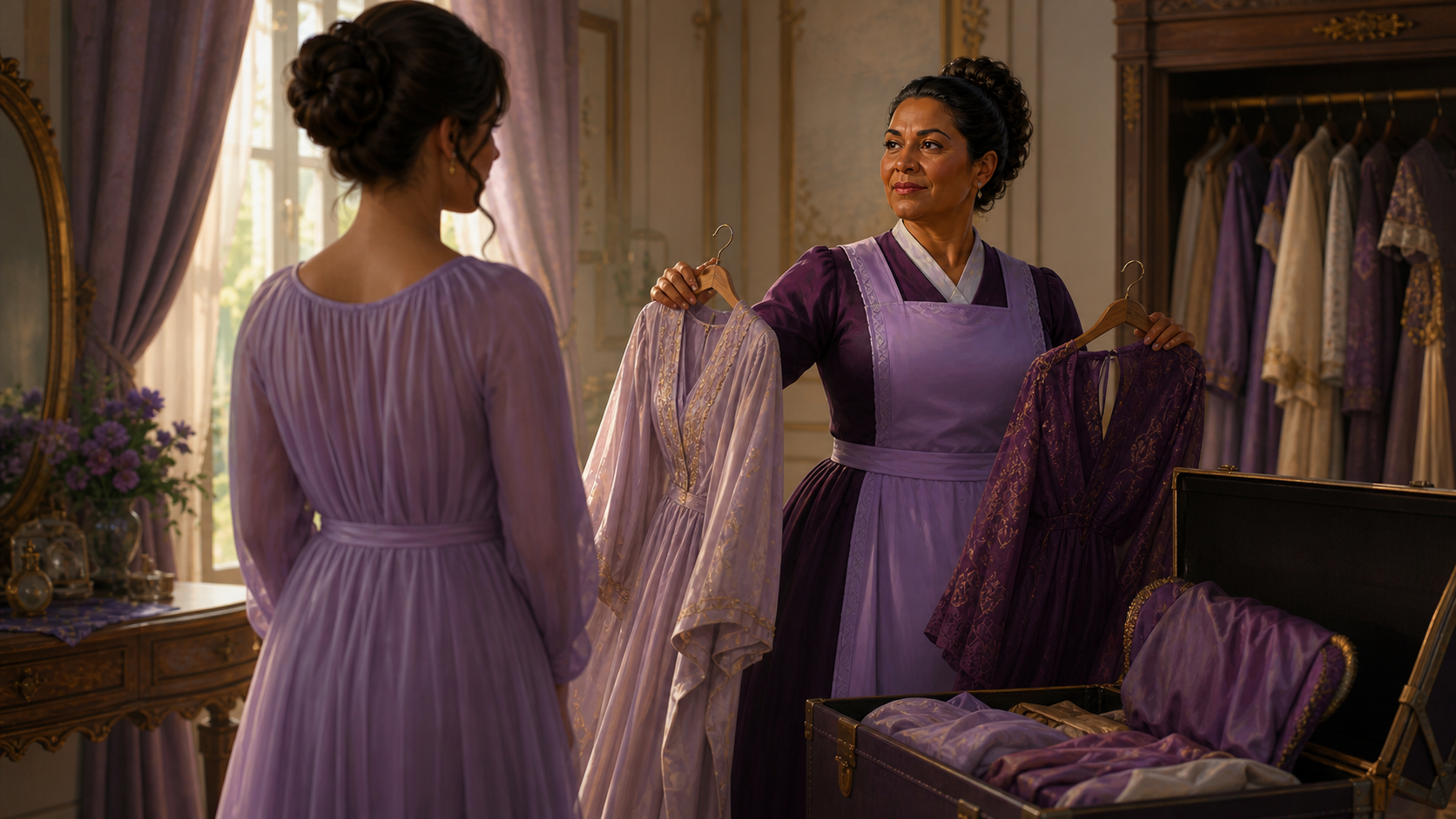
Human clothing helps Ariel move through the palace, but it also marks the first time the institution remakes her appearance to fit its expectations. Carlotta can mediate that process with generosity or become the smiling face of forced assimilation.
The film leans toward generosity because the interaction feels affectionate rather than corrective. Still, Ariel should be allowed to choose fabric, coverage, and style. Welcome means making the institution navigable, not demanding that the newcomer disappear into it.
Silence makes other people reveal themselves
Because Ariel cannot answer in speech, everyone around her decides how much personhood they believe communication requires. Some project fantasies onto her. Some treat her as mysterious. Carlotta speaks to her with ordinary warmth and attends to physical responses, which recognizes presence beyond voice.
That recognition is more than niceness. It is a practical accessibility skill. People communicate through expression, gesture, pace, refusal, attention, and the choices they repeat. A competent caregiver does not wait for conventional language before noticing them.
The fork scene is an etiquette test for the insiders
Ariel’s use of the fork as a hair tool can be staged as proof that she does not belong. The guests know the local convention and therefore hold social power. The humane question is not whether she made a mistake. It is what people with the advantage choose to do next.
Carlotta’s presence allows the household to soften the moment. Etiquette is morally useful when it prevents humiliation, gives newcomers quiet instruction, and keeps a small misunderstanding from defining a whole person. It becomes cruelty when insiders use it to enjoy somebody else’s uncertainty.
Warmth is part of her professional intelligence
Stories often treat cheerful service as personality rather than skill. Carlotta’s warmth helps Ariel regulate fear, helps the household accept an unknown guest, and makes correction possible without public shame. Those outcomes are operationally useful even if nobody writes them into a job description.
Emotional labor should not become an expectation that she must remain pleasant while everyone else creates chaos. Professional warmth deserves resources, authority, rest, and reciprocity. Otherwise the palace converts her strongest skill into an unlimited extraction point.
Chef Louis is funny until the kitchen becomes unsafe
The chase between Chef Louis and Sebastian is built as slapstick, but the kitchen is also a workplace with knives, fire, boiling liquid, heavy cookware, staff, and food safety obligations. A senior chef’s obsession can endanger more than the small creature he is pursuing.
Carlotta’s institutional role should include the authority to stop service, set boundaries, document what happened, and protect workers from retaliation. Culinary talent does not make chaos charming to the people required to clean it, cover it, and explain why dinner failed.
Domestic labor generates security intelligence
Household workers enter bedrooms, kitchens, corridors, guest rooms, docks, laundries, and ceremonial spaces. They notice altered routines, unexplained objects, sudden personality changes, missing supplies, overheard fragments, and visitors who behave differently when officials leave.
That access can become invasive if abused, but it also makes staff essential witnesses. The false-bride crisis demonstrates why a palace that dismisses domestic observations is choosing ignorance. Carlotta’s knowledge should have a protected route into security decisions.
The mystery singer search should include household receipts
Eric’s search focuses on a voice connected to the shipwreck. Once Ariel enters the palace and Vanessa later appears, staff observations could help distinguish chronology, behavior, objects, and changes in the prince. Carlotta sees the household side of the puzzle that sailors and courtiers cannot.
A resilient institution compares evidence across class lines. The worker who changed bedding may know when a guest arrived. The attendant who served dinner may notice recognition. The person handling garments may find the object everyone else treated as jewelry. None of that knowledge should require aristocratic sponsorship to count.

The rushed wedding is an operations alarm
A royal wedding requires food, rooms, clothing, transport, security, guests, schedules, and staffing. If it appears almost instantly, the people implementing it will see the abnormal compression before most political figures do. Urgency leaves receipts.
Carlotta should be empowered to say that the timeline is unsafe, especially when Eric’s behavior changes and the bride’s history remains uncertain. Protecting a ceremony cannot matter more than protecting the consent of the people inside it.
Carlotta and Grimsby hold different parts of one institution
Grimsby carries formal counsel, succession pressure, and the prince’s public obligations. Carlotta carries household continuity, embodied care, worker coordination, and the practical knowledge of rooms. Neither domain is complete without the other.
Treating them as professional equals would not mean identical rank. It would mean relevant expertise receives real weight. Grimsby should ask what staff observed. Carlotta should receive enough political context to recognize when ordinary disruption signals public danger.
Edie McClurg keeps kindness from becoming bland
McClurg’s vocal performance gives Carlotta buoyancy, curiosity, and a recognizable pleasure in welcoming Ariel. The warmth is specific enough to feel like a person, not a generic maternal sound assigned to move the heroine between scenes.
Her comedy does not depend on making Ariel stupid. It comes from Carlotta’s energy and the speed with which the household tries to absorb an impossible arrival. That distinction lets the performance remain affectionate without treating cultural unfamiliarity as a moral defect.

Return to the Sea makes her part of a long household memory
Edie McClurg returns in the sequel, connecting Carlotta to the family’s next generation. The palace worker who once received Ariel now exists in the home where Ariel and Eric raise Melody under the pressure of Morgana’s threat.
That continuity matters because institutions remember through people. Carlotta has seen a voiceless stranger become princess, watched magic breach ceremony, and lived through contact between land and sea. Her perspective should make twelve years of secrecy harder to normalize.
The seawall would change her work too
A wall designed to keep Melody from the sea affects patrols, supplies, movement, visitors, maintenance, and the stories workers are allowed to tell the child. The family decision becomes household policy, whether or not the people enforcing it helped make it.
Carlotta’s loyalty to Ariel should include honest concern about what secrecy does to Melody and to staff required to sustain the lie. Care cannot mean making a child comfortable inside an explanation everyone knows is false.
She is not automatically Melody’s substitute grandmother
Warm older women in service roles are often flattened into surrogate family without examining whether they chose that emotional obligation or receive recognition for it. Carlotta can love Melody and still remain a worker with boundaries, needs, and a life beyond the royal household.
Affection does not cancel employment. The family should not treat closeness as a reason to demand unlimited availability. Respect means wages, rest, authority, privacy, and the freedom to relate without every tender feeling becoming another assigned duty.

The 2023 film changes the household map
The 2023 adaptation does not simply reproduce Carlotta under her original name. It includes Lashana, played by Martina Laird, within Queen Selina’s island household. Similar narrative functions do not make the women interchangeable, and this profile keeps the distinction explicit.
Adaptation analysis can compare what each household role accomplishes while respecting separate identities. If a modern film redistributes care, humor, information, and authority across new characters, that redistribution deserves examination instead of forcing every beat back into a 1989 label.
Updating the image does not require erasing the original performer
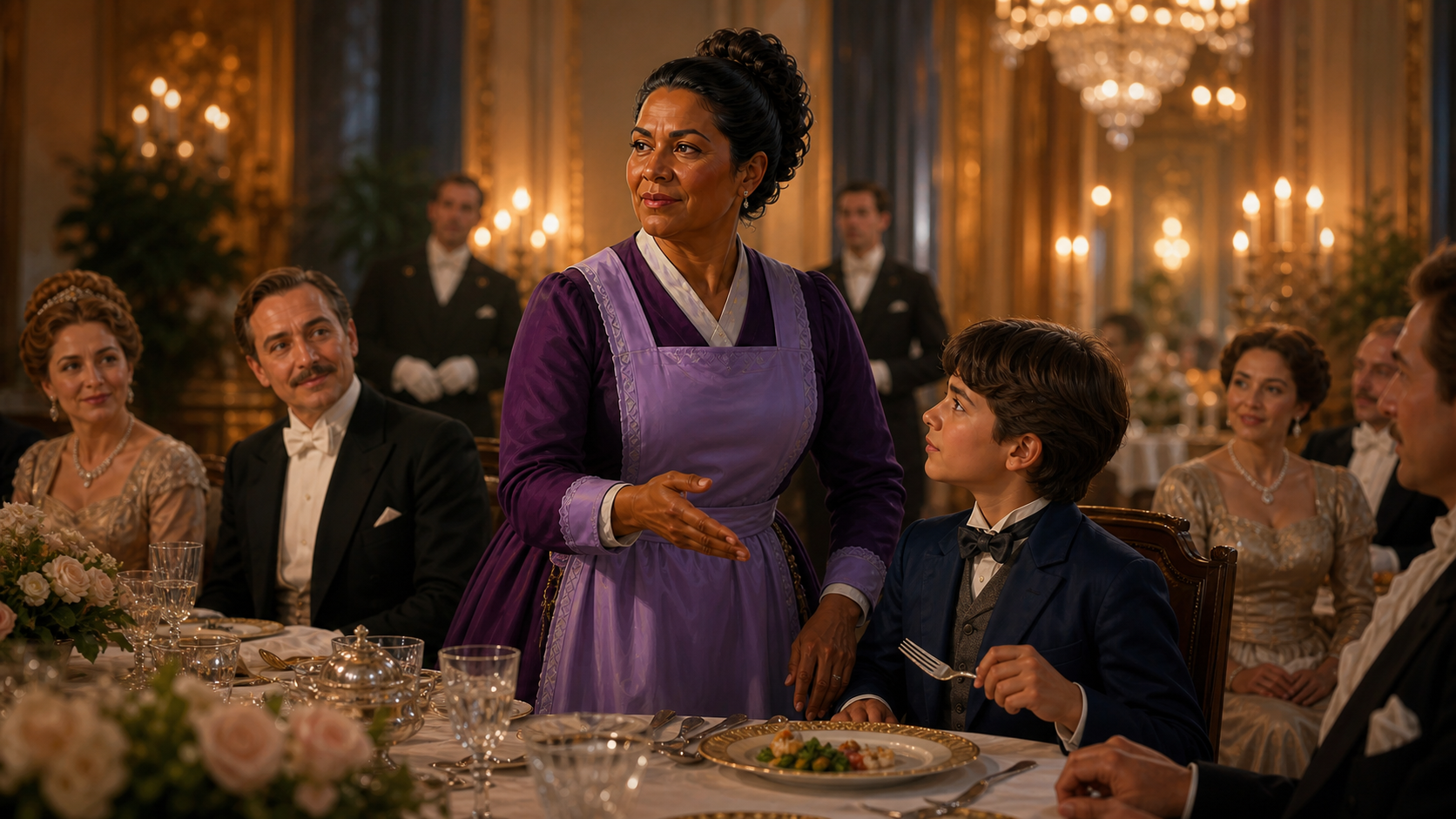
This profile’s original fan art imagines Carlotta as a warm brown senior housekeeper with visible managerial authority. The art is transformative editorial interpretation, not a claim that the 1989 design or Edie McClurg’s performance looked this way.
The distinction allows the site to make labor and leadership visually legible without rewriting production history. Credits remain precise. The new image asks what the character’s competence looks like when the camera treats it as central.
Management is not the same as solidarity
Carlotta may supervise other workers, which gives her authority inside a hierarchy that can still exploit everyone below the royal family. Being close to servants does not automatically make a manager fair, and being a worker does not remove her responsibility for schedules, discipline, and resource distribution.
A strong characterization lets her negotiate upward for staffing and safety while remaining accountable downward for how decisions land. The goal is not to romanticize the benevolent housekeeper. It is to show what ethical management would require in a palace built on unequal power.

What the palace owes its workers
The household owes more than gratitude. It owes clear roles, safe staffing, injury care, predictable rest, channels for complaints, emergency authority, privacy, and access to the information required to perform dangerous tasks responsibly.
When magic threatens the heir and an unknown guest arrives, workers should not be left to improvise without context. A palace that expects loyalty must provide the conditions under which loyalty does not require self-erasure.
A workers council would make the kingdom smarter
Carlotta’s best alternate future is not promotion into a lonely executive role. It is shared governance where cooks, cleaners, sailors, healers, attendants, gardeners, and maintenance workers regularly compare risks and propose changes.
The council could turn Ariel’s rescue into guest-care protocols, the kitchen chase into safety policy, the false wedding into evidence procedures, and the seawall into a reviewable measure rather than inherited secrecy. Institutional memory becomes durable when more than one beloved employee carries it.
The Easter eggs hidden in ordinary objects
Carlotta’s story lives in objects the movie treats as background: linens, dresses, forks, trays, keys, doors, schedules, and kitchen equipment. These are not Easter eggs merely because they appear on screen. They become analytical clues when they reveal who controls comfort and who absorbs disruption.
The keys visualize access and responsibility. Clothing visualizes adaptation. The fork visualizes cultural misunderstanding. The kitchen tools shift from craft to hazard during Chef Louis’s pursuit. A deep review should verify individual callbacks, but the profile refuses to turn random props into trivia padding.

Ariel’s three days are somebody else’s impossible deadline
The bargain gives Ariel three days to make Eric choose her, but the palace staff do not know they are working inside a magical countdown. They experience the deadline as a sudden guest, a prince behaving differently, new excursions, disrupted meals, and a wedding that materializes before normal preparation could be complete. The audience feels urgency as romance. Workers feel it as compressed labor.
Carlotta’s perspective exposes how private quests become public workloads. Eric and Ariel are not wrong for having emotional stakes, but neither sees every person required to make their story move. A mature ending would thank the workers and examine the conditions under which emergency effort was requested, not convert successful improvisation into the new normal.
Nonverbal communication requires patience, not mind reading
Carlotta’s ability to read expression should not become a fantasy that caring people automatically know what a nonspeaking person wants. Intuition can help, but it can also become projection. The responsible approach checks understanding through repeated options, visual cues, gestures, yes-or-no signals, pacing, and the willingness to accept refusal without demanding an explanation.
Ariel’s silence is magical and temporary, yet the scene still models how institutions treat people whose communication differs from the majority. The palace should not require one unusually perceptive worker to bridge every gap. It should build accessible methods so dignity does not depend on being lucky enough to meet Carlotta.
The maternal stereotype can hide an adult woman
Carlotta’s warmth invites audiences to describe her as motherly, a label that can be affectionate and flattening at the same time. Older women in domestic roles are often allowed to care for everyone while receiving no interior life, romantic history, family ties, ambitions, anger, or future beyond the household. Their personality becomes the comfort they provide.
A JIN-standard profile refuses to confuse nurturing behavior with a complete biography. Carlotta may enjoy care work, resent parts of it, mentor younger staff, protect a private life, and imagine retirement. None of those possibilities need to be invented as canon to expose what the script declines to ask.
Class intimacy is real and still unequal
Household workers can know royal families with extraordinary intimacy. They see illness, grief, clothing, meals, arguments, sleep, and the awkward hours official portraits remove. That closeness can produce genuine love, but it does not erase who owns the house, controls employment, and receives public credit.
Carlotta’s affection for Eric and Ariel should therefore be read on two levels at once. The bond can be emotionally sincere. The institution can still rely on her availability and deny her equal decision-making power. Naming inequality does not invalidate love. It explains why love alone cannot protect the worker.
The palace’s beauty is made from repetitive strain
Animated rooms appear polished without showing backs bent over floors, hands lifting wet linen, feet crossing corridors, burns in kitchens, or the cumulative fatigue of carrying supplies. The visual smoothness is part of the fantasy, but it trains the audience to experience labor only through its finished surface.
Carlotta’s profile makes the body return to the palace. Scheduling must include recovery. Equipment must fit the people using it. Injuries need treatment without lost livelihood. A worker should not have to perform cheerfulness while in pain because a royal guest expects the room to feel magical.
Food is care, culture, and potential coercion
Meals welcome Ariel into a human household, but food also carries rules she cannot know and ingredients she cannot question aloud. Carlotta’s coordination should include checking comfort, allergy, religious or cultural boundaries, and whether the guest actually wants what is placed before her. A full plate is not automatically hospitality if refusal is socially impossible.
Chef Louis represents craft without restraint. Carlotta represents the systems that make craft safe and relational. The contrast is not women’s care versus men’s artistry. It is accountable work versus ego that treats everyone else as scenery.
What she knows about Eric should not become gossip
Access to private rooms gives Carlotta information with social and political value. Ethical household intelligence requires boundaries: share immediate safety concerns, preserve medical and personal privacy, document evidence carefully, and resist the court’s appetite for rumor. Knowing more does not create permission to circulate everything.
A protected reporting channel matters because silence and gossip are not the only choices. Carlotta should be able to bring a concern to Grimsby or Queen Selina’s equivalent office without turning a vulnerable guest into entertainment or risking her job for questioning a royal decision.
Her sequel knowledge makes the family lie more painful
By Return to the Sea, Carlotta knows that Ariel came from the ocean, that marine life can speak, that magic can transform bodies, and that concealment once gave Ursula an opening. Watching Melody grow up under a different concealment should create moral tension even if the sequel keeps Carlotta at the edge.
She may understand why Ariel is terrified. She also has evidence that unspoken truth does not stay harmless. A loyal worker caught between a parent’s order and a child’s wellbeing needs more than private discomfort. The institution should provide a way to request review without forcing her to betray either person alone.
Credit after crisis is an accountability practice
When the kingdom celebrates Ariel and Eric, the story can acknowledge sailors, animals, staff, and advisers without diminishing the couple. Credit is not a limited resource stolen from the protagonists. It is a record of who carried risk and whose knowledge should shape the next response.
Carlotta deserves more than a smile in the background. Her labor should appear in reports, planning, compensation, promotion if desired, and the redesign of procedures. Otherwise the institution consumes competence during crisis and returns the worker to invisibility when the music swells.
The room feels safe because she keeps reading it
Carlotta’s most cinematic skill is not cleaning or dressing. It is attention distributed across a room. She notices who is frightened, who is pretending not to be, which joke is becoming humiliation, which worker is overwhelmed, and which disruption may be more than clumsiness. That social reading lets her intervene before a problem requires royal command.
The danger is making one woman responsible for everybody’s emotional weather. Observation should become shared practice, not a permanent burden assigned to the warmest person. Staff can be trained to notice distress, report risk, offer communication choices, and protect dignity. Carlotta’s excellence should raise the institution’s standard rather than excuse everyone else from developing the same care.
That standard also changes how the audience should watch the palace scenes. Instead of looking only at the center of the frame, look at who opens the door, carries the tray, changes the room, repairs the interruption, and remains after the principal characters leave. Carlotta becomes less “minor” the moment consequence, rather than screen time, determines importance. Her profile is a receipt for the work the fantasy needs while pretending comfort simply appears.
She is not background decoration. She is the person whose preparation allows everybody else to mistake preparedness for luck.
Final character receipt
Carlotta is not powerful because she secretly controls the palace from the shadows. That fantasy would reproduce the same invisibility by making her influence informal and unaccountable. She matters because her visible work keeps people alive, welcomed, fed, clothed, and observed.
Her strongest reading turns service into expertise without pretending expertise cures hierarchy. She offers Ariel care before rank, brings warmth without demanding speech, and stands where household knowledge meets public consequence. The palace is safer when it listens to her, and fairer when listening is matched by authority, protection, and credit.

Keep exploring The Little Mermaid
Return to The Little Mermaid hub for films, reviews, Reacts, rants, lore, guides, and the full character directory.
Carlotta’s domestic labor keeps Eric’s household emotionally functional while royal men occupy the official story. Her warmth should not make that work invisible. Care is part of the castle’s infrastructure even when the camera treats it as atmosphere.