
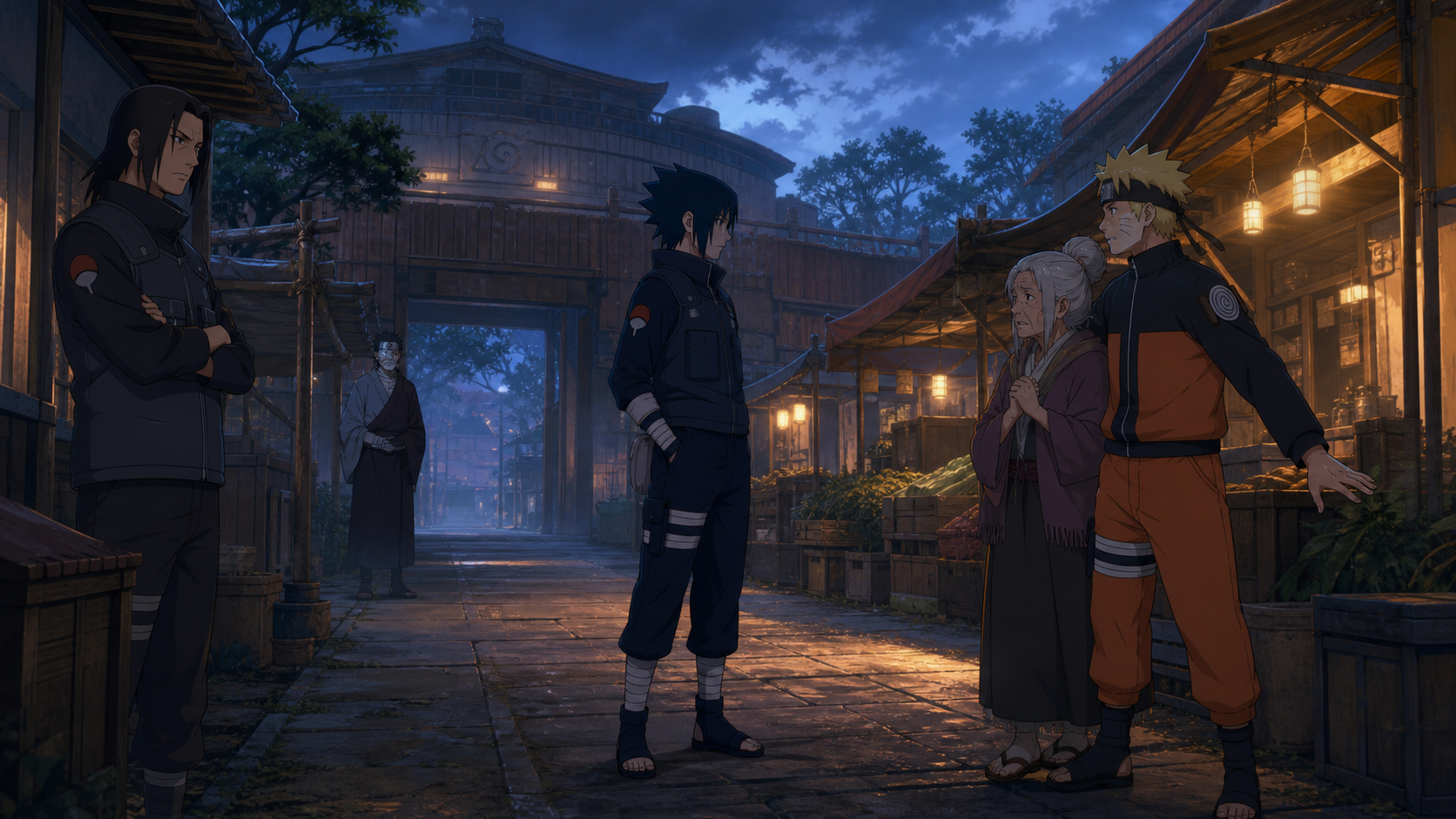
The Difference in Power
Naruto returns stronger enough to protect someone vulnerable, while Sasuke turns authority into humiliation and mistakes isolation for proof that he needs more power.
Bottom line
“The Difference in Power” is not measuring Rasengan against Chidori. The episode measures power used to protect against power used to humiliate. Sasuke becomes lieutenant of a police unit that beats defeated suspects, frightens vendors, and calls public fear crime prevention. Naruto returns from three years of training and immediately protects an elderly woman from that abuse. Their brief clash shows Sasuke that Naruto has grown, but Danzō turns the insecurity into recruitment. When Sasuke’s subordinates raid the Hokage’s home without authorization, Fugaku removes him from the force and repeats the sentence that has governed his childhood: he will never measure up to Itachi. Sasuke responds by accepting Danzō’s path to Orochimaru. He says beating Naruto matters more than the Uchiha or Konoha. That confession exposes the episode’s real difference in power. Naruto’s strength expands his ability to intervene for someone vulnerable. Sasuke’s need for strength has narrowed his world until one rival matters more than every bond around him.
The title asks what power is for
Sasuke and Naruto both return from three years of serious training, so the episode could have settled for a flashy comparison. Instead, it puts an elderly vendor between them. Naruto uses his growth to interrupt harm. Sasuke uses rank to defend the people causing it.
That difference matters more than which technique hits harder. Power reveals the obligation a person accepts when nobody nearby can force him to behave well.
Sasuke’s officers are not a separate problem
The unauthorized raid on Minato’s home is their decision, but Sasuke built the culture that made it imaginable. He praised severity, authorized punishment after surrender, and let frustrated officers confuse clan pride with public authority.
Fugaku is right to hold a commander responsible for the behavior he rewards. Accountability fails when he turns a specific leadership failure into another comparison with Itachi.
Fugaku delivers discipline as emotional demolition
Removing Sasuke from command protects the village and the police force. Telling him he will never measure up to his brother does nothing to repair either institution. It makes punishment confirm the oldest wound in the room.
A parent can impose consequences without declaring a child fundamentally lesser. Fugaku chooses a sentence that leaves Danzō an open door.
Danzō recruits the injury that authority helped create
He does not invent Sasuke’s humiliation. He waits for family and institution to concentrate it, then presents exploitation as the only adult recognition available. His praise sounds generous because it arrives after Fugaku’s contempt.
This is how manipulation works when it wears government robes. Danzō studies the need, isolates the target, and names the trap opportunity.
Naruto’s genin rank exposes the limit of official measurements
His friends have promotions and Sasuke held a lieutenant’s office, yet Naruto is the person who recognizes the marketplace emergency correctly. A title can record institutional progress without proving judgment, courage, or care.
Naruto does not intervene perfectly because he holds superior status. He intervenes because an older woman is being bullied in public and somebody has to say enough.
Sakura stands at the edge of another departure
She and Naruto imagine welcoming Sasuke back after his dismissal. That hope is sincere, but it arrives without knowledge of how completely shame has reorganized his thinking. Belonging cannot help if he reads every offer as evidence that others pity him.
Her glimpse at the gate matters because witnessing creates a chance to act. It does not make her responsible for curing a choice engineered by Sasuke, Danzō, Fugaku, and years of comparison.
RaeRae’s verdict
“The Difference in Power” earns its title by refusing to let strength remain a neutral statistic. Naruto returns with no promotion, sees a vulnerable person in danger, and uses what he learned to interrupt the abuse. Sasuke has rank, officers, clan prestige, and advanced technique, yet his authority shrinks into a machine for producing fear. The episode does not pretend the police invented Uchiha marginalization. It shows why real grievance never licenses cruelty toward people with less power.
Fugaku’s discipline is necessary and his comparison is vicious. Danzō knows the difference. He lets a father deliver the wound, then offers Orochimaru as medicine. Sasuke still makes a choice, and the harm he authorized remains his responsibility. Understanding the recruitment does not erase accountability. It explains why punishment without care can leave a wounded person easier for a predator to use. Naruto and Sakura want their teammate back. First they must catch him before his hunger to beat Naruto becomes the only relationship he believes.
Episode 443 remains part of the alternate manuscript
Episode 443 continues Jiraiya’s anime-original “Shinobi Handbook” story inside Tsunade’s Infinite Tsukuyomi dream. The Japanese title is “Chikara no Sa,” meaning “The Difference in Power.” The episode aired in Japan on December 24, 2015.
The alternate timeline preserves the Uchiha clan and Naruto’s parents, yet familiar conflicts return through different decisions.
Sasuke’s unit catches a gang of thieves
Three years after joining the Konoha Military Police Force, Sasuke leads a unit that defeats fleeing criminals. His subordinates celebrate his ability as the organization’s strongest lieutenant.
The capture should demonstrate competent public service. What happens after the surrender changes the meaning.
Defeat does not end the punishment
The police continue beating suspects who can no longer escape. Sasuke authorizes the usual treatment: teach them a lesson and make an example.
Force shifts from necessary restraint into deliberate humiliation.
The unit calls brutality prevention
Sasuke’s officers claim harsh punishment will stop future crime and frighten villagers away from wrongdoing. They even admit that violence lets them release frustration.
That admission removes the moral disguise. Public safety has become permission for personal aggression.
Lower crime does not prove justice
Officials later acknowledge that crime has fallen. The number cannot answer whether policing remains lawful or humane.
A frightened community may become quieter while trust collapses underneath the silence.
Villagers learn to fear the police
People whisper that the force has become extreme. They worry that criticism will make them the next targets.
Law enforcement loses legitimacy when ordinary speech feels punishable.
Sasuke becomes the unit’s pride
His subordinates praise him for breaking the stagnation they felt under Fugaku. Sasuke supplies decisive action where patience had produced few visible changes.
Their admiration gives him the recognition he chased for years. The source of that recognition should worry him.
Frustrated Uchiha rally around pressure
Younger officers believe the clan must force Konoha to respond. They view Fugaku’s willingness to wait as weakness.
Their frustration comes from real marginalization. Abusing civilians directs that grievance toward people with less power.
Sasuke inherits authority before wisdom
His skill earned promotion, but combat excellence does not automatically create sound judgment. Sasuke now controls officers eager to treat force as identity.
Leadership requires limits most when followers reward escalation.
Village leaders condemn the new methods
Hiruzen, Danzō, Minato, and Itachi discuss the police force’s behavior. The crackdown has reduced crime while increasing anxiety and resentment.
Their debate recognizes a political consequence Sasuke’s unit refuses to see.
Itachi favors patience
Itachi says Fugaku understands that change takes time. A reckless intervention from village leadership could trigger more resistance within the clan.
Patience here is not approval. Itachi wants correction that does not deepen the divide.
Danzō watches Sasuke’s isolation
Danzō identifies Sasuke as the gifted center of the younger faction. He studies the boy as a political instrument rather than a troubled officer.
Every unresolved insecurity makes recruitment easier.
The marketplace has lost its life
Shikamaru, Chōji, Sakura, and the others notice that familiar food stands have disappeared. Strict enforcement has emptied a once-busy public space.
Order looks successful from a report and miserable from the street.
Sakura wonders what Sasuke is thinking
His former teammates barely recognize the person behind the rank. Sasuke has become unapproachable during the three-year separation.
Power has increased while ordinary access to him has disappeared.
Naruto returns to a changed Konoha
Naruto arrives before Jiraiya and expects the noisy village he left. Missing vendors become his first evidence that home changed without him.
His return is cheerful until policing makes the difference visible.
His friends earned new ranks
Naruto learns that his classmates became chūnin and Neji became a jōnin. He remains a genin after years away.
The joke keeps rank separate from capability. Naruto’s training cannot be summarized by the title on his file.
Sasuke also remains a genin
Sasuke missed ordinary promotion routes while assigned to the feudal lord’s office and later serving the police. Institutional authority and shinobi rank have developed on different tracks.
His lieutenant title grants power without resolving the comparison he carries.
The police target an elderly vendor
An officer demands authorization from an older woman operating a stand and orders her taken away. The response is wildly disproportionate to the alleged violation.
She becomes a convenient display of control because resisting carries obvious risk.
Naruto intervenes immediately
Naruto objects that the officers are going too far. He does not need a briefing on Uchiha politics before protecting the woman.
Three years of training have not trained compassion out of him.
Sasuke calls Naruto immature
Sasuke frames the intervention as another refusal to follow rules. From his perspective, Naruto returned and immediately obstructed police duty.
The accusation ignores whether the duty itself has become abusive.
Naruto sees how much Sasuke changed
Naruto answers that Sasuke is the one who looks different. Uniform, subordinates, and formal authority have hardened their old conflict.
The boys meet as former teammates standing on opposite sides of a frightened civilian.
Chōji escorts the woman away from danger
While Naruto confronts the force, Chōji helps the vendor leave. Protection requires more than a dramatic challenge.
One teammate absorbs attention while another removes the vulnerable person from the threat.
Sasuke refuses to back down
He tells his officers that obstruction will not stop their duty. The language of procedure shields an emotional confrontation he has anticipated for years.
Sasuke has been waiting to measure himself against Naruto again.
Their first exchange reveals three years of growth
Naruto and Sasuke move with speed that surprises everyone watching. The brief encounter confirms that both training paths produced formidable shinobi.
The encounter cannot determine which life path deserves respect.
Danzō interrupts on a public road
Danzō stops the clash and notes that they are fighting in the middle of the village. Naruto calls him an old man without recognizing one of Konoha’s highest officials.
The comic disrespect denies Danzō the reverence his position expects.
Sasuke orders his unit to stand down
When Danzō appears, Sasuke tells the officers to continue their rounds. He recognizes the political danger and avoids a larger confrontation.
His restraint arrives for a powerful official after his unit showed none to an elderly vendor.
Danzō praises Naruto to provoke Sasuke
Danzō remarks that Jiraiya trained Naruto well and asks how long Sasuke will remain confined at his current level.
The question targets exactly the fear Sasuke cannot control.
Manipulation sounds like recognition
Danzō tells Sasuke he should be more than he is. After years of Fugaku’s dismissals, the statement can feel like someone finally seeing hidden potential.
Danzō sees vulnerability, not possibility.
Naruto learns whom he insulted
Sakura explains Danzō’s status and warns that Tsunade advised avoiding him. Naruto’s ignorance protects him from intimidation for a moment.
The warning also establishes that Danzō’s influence is dangerous even within official Konoha.
The rescued vendor thanks Naruto
The woman expresses gratitude, and Naruto treats the intervention as the obvious right choice. Her response provides a clearer measure of public service than the crime statistics.
Protection should make vulnerable people safer, not quieter.
Naruto repeats Jiraiya’s lesson
Jiraiya taught that a friend who wanders from the path must be pulled back. Naruto tells Sakura they will stop Sasuke next time.
He still defines confrontation as responsibility rather than permission to discard a bond.
Sasuke turns fear inward
After Naruto leaves, Sasuke admits privately that he is not strong enough. Naruto’s growth makes three years of effort feel worthless.
Comparison erases every skill that does not produce superiority.
Danzō recognizes useful eyes
Danzō observes that Sasuke has fine eyes. The appraisal treats Sharingan and resentment as resources available for cultivation.
He waits for Sasuke’s next humiliation to finish the recruitment.
Public gossip exposes selective enforcement
Villagers say the police terrorize common people but release the Hokage’s son. The complaint has force because the unit built its reputation through indiscriminate severity.
Once cruelty becomes policy, mercy looks like corruption rather than judgment.
Sasuke’s officers act without him
His subordinates interpret the command to use their own judgment as permission to raid Naruto’s home. They want to defend clan credibility through another show of force.
Sasuke empowered their worst instincts, even if he did not order this raid.
Kushina confronts the intrusion
The officers enter with dirty shoes and demand Naruto for questioning. Kushina refuses to accept their authority and threatens to tell Minato.
Their willingness to arrest her too reveals how far the unit has drifted.
The Hokage’s residence becomes another target
Raiding Minato’s home without authorization turns aggressive policing into a direct institutional crisis. The officers believe consistency justifies escalation.
Consistency in an abusive practice only multiplies abuse.
Itachi apologizes for the force
Itachi reports that Fugaku will discipline those responsible. Minato focuses on preventing injury and lowering tension.
The exchange shows leadership attempting repair after Sasuke’s unit destroyed trust.
Sasuke orders the officers imprisoned
He tells the guilty subordinates to be locked up. Their claim that they acted for the Uchiha cannot protect them.
The order is necessary, but arrives after Sasuke normalized making examples through violence.
Fugaku holds Sasuke responsible
Fugaku says Sasuke empowered fools to indulge in reckless behavior. Command responsibility extends beyond explicit instructions.
Sasuke created a culture where severity proved loyalty, then left followers to judge how far severity should go.
Fugaku repeats the Itachi comparison
He declares that Sasuke will never measure up to his brother. The criticism moves from specific leadership failure to total personal inadequacy.
Fugaku has a legitimate reason to remove Sasuke. He chooses the cruelest possible explanation.
Sasuke loses the police force
Fugaku strips the lieutenant rank and dismisses Sasuke from the unit. Three years of work disappear through one public failure.
Sasuke experiences accountability as confirmation that he was never worthy.
Team 7 still imagines a welcome
Naruto and Sakura discuss bringing Sasuke back into their team. They expect to greet him with warmth if the police force removes him.
Their plan assumes Sasuke can still recognize belonging as an offer rather than pity.
Sasuke asks what three years meant
Alone, Sasuke questions the value of everything he did during the separation. Rank, advanced Chidori, and clan reputation no longer feel real.
An identity built entirely around approval collapses when approval is withdrawn.
Danzō offers the answer Sasuke wants
Sasuke meets Danzō and asks what he can provide. Danzō predicts his desperation and points toward greater power.
The timing makes the offer feel like rescue when recruitment was the plan all along.
Sasuke abandons clan and village in words
He says defeating Naruto matters more than the Uchiha or Konoha. The boy who sought clan recognition now claims the clan means nothing.
Rejection has narrowed his goal until rivalry can replace every damaged bond.
Danzō introduces Orochimaru
Danzō describes a Sannin who deserted Konoha, committed crimes, and gained terrifying knowledge of forbidden techniques. Orochimaru becomes the dark counterpart to Jiraiya.
Naruto’s mentor teaches power within bonds. Sasuke is offered power priced through separation.
The warning about darkness is part of the lure
Danzō tells Sasuke that Orochimaru lives within darkness and that darkness will be the cost. The warning sounds honest enough to make the arrangement credible.
Sasuke accepts because danger now feels like proof that the power will be real.
Danzō weaponizes fear of the Nine-Tails
He claims Konoha needs strength against the monster sealed inside Naruto. Political prejudice becomes justification for targeting Minato’s son.
Sasuke’s rivalry and Danzō’s agenda meet around the same person for different reasons.
A border tower becomes the exit point
Danzō sends Sasuke to a tower before sunrise and promises to handle the rest. The plan converts private despair into physical departure.
Secrecy ensures no healthier relationship can interrupt the decision in time.
Sasuke leaves while Konoha sleeps
He moves toward the gate after midnight. Ordinary village life continues around a choice that will reshape every close bond.
The quiet departure contrasts with the loud authority Sasuke exercised as lieutenant.
Sakura sees movement in the dark
Sakura notices Sasuke heading out as the gate prepares to close. Her attention creates the first chance that his secret plan may not remain secret.
Episode 444, “Leaving the Village,” must decide whether concern can reach Sasuke before Danzō’s promised power closes around him.
RaeRae’s call
Naruto protects the vendor. Sasuke protects the authority frightening her. Fugaku removes a commander, then poisons the lesson by making Itachi the measure. Danzō harvests the damage. Sasuke owns his command and departure. Adults own worlds that made exploitation sound respectful.
Episode details and viewing routes
- Official episode reference: Naruto Official episode guide
- Licensed episode route: Crunchyroll licensed episode page
What I am carrying forward
Naruto returned from training and stopped Sasuke’s police unit from taking an elderly vendor. Their clash proved both had grown, but it also exposed how differently they use strength. Sasuke’s officers later raided Minato and Kushina’s home without authorization.
Fugaku removed Sasuke from the force and said he would never measure up to Itachi. Danzō used that humiliation to direct Sasuke toward Orochimaru. Sasuke left before sunrise, and Sakura saw him near the gate. Episode 444, “Leaving the Village,” begins with that final chance to intervene.