
RaeRae Reacts · One Piece Episode 140
Henzo Finds the Pumpkin Pirates
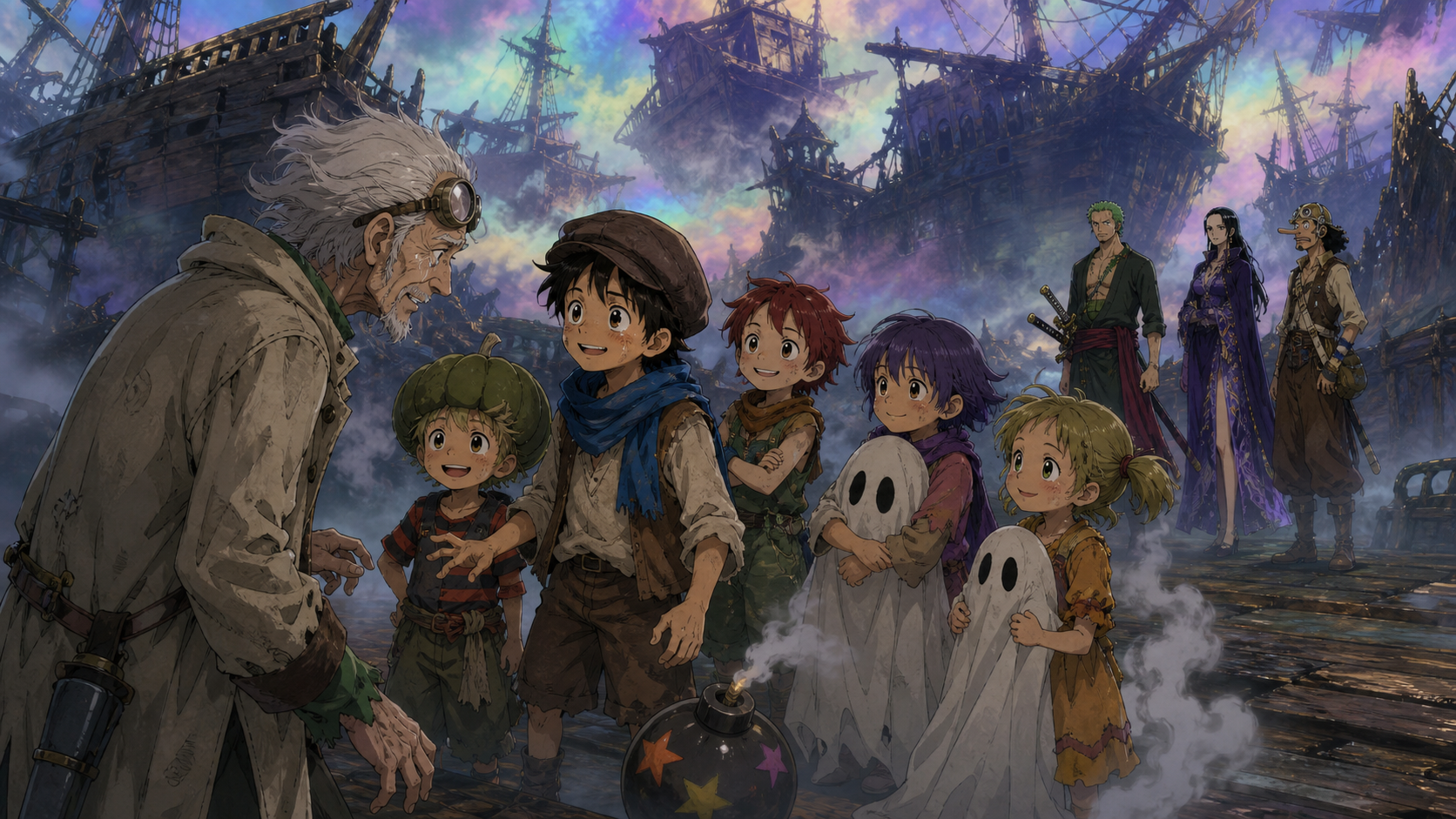
One Piece Episode 140 reveals the Pumpkin Pirates as five children trapped for fifty outside years inside the Rainbow Mist’s ship graveyard.
Ape’s Concert is a disaster site before becoming treasure
Episode 140 places the Merry inside a graveyard of wrecked ships called Ape’s Concert. The spectral fog makes the scene look timeless, but every hull represents a crew that vanished, died, escaped, or remains missing.
Exploration should begin with structural hazards, survivor searches, unstable cargo, fire, flooding, disease, and navigation. Treasure claims come after life safety and identification.
Henzo brought people into the space without a verified exit. His duty now is to share every observation, preserve resources, and help the crew create a return plan before research continues.
The Merry should anchor only after checking whether currents, gravity, and distances behave normally. Crew members need paired movement, marked routes, timed check-ins, and a reserve team aboard. Nobody should climb into a wreck alone or rely on shouted directions through fog.
Robin separates legend from the conditions around them
Robin recalls accounts of an eternal land beyond the Rainbow Mist, filled with wealth where inhabitants do not age. The description fits pieces of the environment without proving every claim.
She should mark which facts are visible, which come from texts, and which remain inference. A strange sky and preserved wrecks do not automatically prove immortality, divine protection, or safe passage.
Clear uncertainty helps everyone choose rationally. Mystery becomes more dangerous when poetic language is treated as an operating manual.
Robin can create a shared map that distinguishes observed wrecks, reported hazards, possible routes, and unexplored areas. Updating that record after every excursion would prevent one person’s memory from becoming the only navigation system.
Luffy removes treasure before ownership is known
Luffy brings a chest from a wreck onto the Merry and announces that more wealth is scattered across the graveyard. His excitement ignores evidence, ownership, and physical danger.
Objects on a missing ship may belong to survivors, heirs, governments, merchants, or communities. Salvage law requires documentation and notice rather than first possession by whoever can lift a chest.
The crew should return the chest to its recorded location or secure the contents as evidence with photographs, inventory, witnesses, and a plan for rightful claims.
Opening unknown containers adds chemical, biological, and mechanical hazards. Old locks may conceal traps, powder, medicine, spoiled food, or fragile records. Robin should supervise documentation while Zoro or Luffy provides lifting help only after the deck and chest are assessed.
A warning voice uses fear because direct contact failed before
A hidden voice threatens the crew with a curse unless they return the treasure and leave. Ghost figures appear, creating the impression that the dead defend the wrecks.
The deception may be a survival strategy used by people who cannot overpower armed adults. New arrivals should stop moving, lower visible weapons, return property, and ask who is speaking.
Threatening strangers can still provoke violence. A safer defense would use distant observation, clear boundaries, escape routes, and nonlethal alarms rather than close confrontation.
Zoro faces an arrow in a space full of unknown bystanders
An arrow nearly strikes Zoro, confirming that the warning group has real weapons behind theatrical disguises. The shot could kill or ricochet through unstable wreckage.
Archers should identify targets, backstops, allies, and paths before firing. Warning shots are not safe when ships, ropes, flammable cargo, and unseen people surround the line.
Zoro’s restraint matters. A lethal counterattack against an unseen shooter could turn a misunderstanding into harm against children.
Luffy unmasks children instead of actual ghosts
Luffy attacks the apparitions and discovers five children beneath simple ghost coverings. The revelation changes the power imbalance immediately.
Adults should stop force, create distance, identify injuries, and explain who they are. Children living without adult protection may expect exploitation from every newcomer.
The crew should avoid surrounding them, touching them without consent, or demanding immediate personal history. Safety and trust come before interrogation.
One adult should speak while the others keep hands visible. Offering sealed food and water can help, but the children should inspect supplies and choose whether to accept. A calm approach matters after Luffy has already broken their disguise by force.
The Pumpkin Pirates are an emergency youth community
Rapanui introduces the group as the Pumpkin Pirates. The name gives five children a shared identity, leadership structure, and claim to the space they have survived inside.
Calling themselves pirates does not give adults permission to treat them as enemy combatants. Age, capacity, coercion, and lived conditions matter more than a flag or title.
The children need food, clean water, medical assessment, safe shelter, education, contact with trusted family, and a way to leave. Their competence should be respected without erasing unmet needs.
They may also have created rules for sharing food, resolving conflict, guarding wrecks, and caring for injured members. Rescuers should learn those systems before replacing them. Sudden adult control can destroy routines that kept everyone alive.
A bomb threat lets a child control an armed encounter
Rapanui threatens to detonate a device if the Straw Hats refuse to leave. He uses the possibility of mass harm because ordinary warnings did not stop Luffy from taking treasure.
The crew should not rush, grab, or threaten him. One calm speaker should ask what the device does, who built the device, and what action would make the group feel safe.
Explosives near rotting ships can trigger fire, collapse, flooding, and secondary detonations. Nobody should assume a child-made object is harmless.
Zoro and Luffy should move away from the trigger zone while Usopp uses his familiarity with tricks and projectiles to ask technical questions. Negotiation gains credibility when the adults visibly reduce the danger they bring.
Henzo recognizes the children he lost fifty years ago
Henzo sees Rapanui, Isoka, Pukau, Rongo, and Akibi as the same friends who disappeared during his childhood. For him, half a century of grief collapses into one moment.
Recognition needs careful confirmation. Names, shared memories, scars, inventions, and private details can establish identity without forcing physical contact.
Henzo should allow the children to process his aged appearance. They experienced far less time and may not understand why their friend arrives as an elderly stranger.
He also needs space for his own grief. A reunion can bring relief, guilt, anger, and disbelief at once. Robin or Usopp can support the conversation without asking Henzo to perform happiness while he confronts fifty years the children never experienced.
Setting off the Ka-boom Mark 3 proves knowledge through risk
Henzo identifies the bomb as his own harmless trick invention and triggers the device to prove who he is. The demonstration shows intimate knowledge but bypasses consent from everyone nearby.
A prank device may still produce smoke, heat, fragments, panic, or breathing problems. Henzo should explain the mechanism and ask Rapanui to disarm or test the device safely.
Shared childhood technology is powerful evidence. That evidence does not require startling traumatized children inside a ship graveyard.
The smoke screen lets the children choose distance
Rapanui activates smoke, and the Pumpkin Pirates disappear among the wrecks. Retreat preserves control after an emotional revelation they have not had time to understand.
The crew should not chase blindly. Poor visibility adds fall, collision, separation, and accidental-force risks.
Henzo can leave a message, food, or familiar object in a neutral place and let the children decide when to return. Reunification should not become capture.
Wetton’s attack created the original child displacement
Henzo explains that Wetton’s pirate crew attacked Ruluka and set the town on fire fifty years earlier. The children fled because adults failed to keep their homes safe.
Fire response should prioritize evacuation routes, head counts, reunification points, burn care, and shelter. Children separated during chaos need named adults responsible for finding them.
Later political authority cannot erase Wetton’s role in the attack. Residents deserve records, testimony, restitution, and a government free from the person who caused the displacement.
Stealing a pirate ship becomes emergency evacuation
The Pumpkin Pirates took the attackers’ vessel to escape the burning town. Children operating an unfamiliar ship faced weapons, weather, rigging, navigation, and pursuit without trained supervision.
Taking the vessel was justified by immediate survival if no safer route existed. The goal was escape, not permanent ownership or profit.
Adults evaluating the event should avoid blaming children for imperfect decisions made under attack. Responsibility rests with Wetton and the armed crew who created the emergency.
The stolen vessel should be understood as a lifeboat of necessity. Any property claim by Wetton would be weaker than the children’s right to escape his violence. Records should describe the context so later authorities do not mislabel survival as ordinary piracy.
Henzo falling overboard leaves both sides without a child witness
During the confrontation, Wetton and young Henzo fall into the sea while the stolen ship continues toward the mist. The separation prevents Henzo from helping or knowing what happened next.
Any person overboard response needs an immediate alarm, flotation device, lookout, maneuver, and retrieval plan. Combat does not cancel rescue duties.
Henzo’s later obsession grows from survivor guilt and uncertainty. Research can seek answers, but no discovery can make a child responsible for friends taken by an adult attack.
Support for Henzo should include more than celebrating the reunion. He may need help separating responsibility for Wetton’s actions from regret about surviving, and time to hear what the children actually remember rather than filling every gap with his own worst assumptions.
Fifty outside years did not age the Pumpkin Pirates
The children remain physically young while Henzo has aged across five decades. Their bodies show that time in Ape’s Concert does not match time on Ruluka.
Chopper should assess growth, nutrition, development, sleep, memory, and exposure without treating them as specimens. Their consent and privacy remain essential.
Legal age becomes complicated when chronological and experienced time diverge. Authorities should protect the children while listening to the skills and decisions formed through their survival.
Reentry may create shock when homes, relatives, and customs have changed. A gradual transition, consistent caregivers, truthful explanations, and opportunities to remain together can reduce another forced separation. Rescue should not scatter the five children into unrelated institutions without necessity.
Lake accepts a coin as tax after being misled
Back on Ruluka, a coin strikes Lake, Wetton’s grandson, during his dispute with Sanji. Sanji, Nami, and Chopper claim Sanji threw the payment, and Lake formally welcomes them.
The lie resolves immediate danger but does not make the tax system fair. Payment should produce a receipt, rate explanation, and confirmation that no further harbor charge remains.
Lake’s willingness to accept a random coin shows how arbitrary enforcement has become. Public obligations cannot depend on the collector’s mood.
Lake reveals that Wetton wants the graveyard’s cargo
Lake explains that the mist contains untouched ships and treasure and that Henzo works for the government to find safe entry. The research program is therefore tied to Wetton’s extraction plan.
Henzo may believe he is rescuing friends, while Wetton funds him to recover wealth. Those competing purposes require disclosure and independent oversight.
Any recovered cargo should be inventoried, traced, preserved, and returned to rightful owners. Mayor control over both funding and claims creates an obvious conflict of interest.
Henzo should secure his notes outside Wetton’s office and name trusted custodians. If the mayor can seize the data, he can send unprepared crews into the mist, suppress evidence about the children, or claim every wreck before families know recovery is possible.
Episode 140 treats survival skills as evidence of abandonment
The Pumpkin Pirates can stage ghosts, build smoke devices, defend territory, and navigate wrecks. Their competence is impressive because nobody came to rescue them for fifty outside years.
Adults should not romanticize that independence. The children deserve an exit, safe reunification, medical care, education, and a say in what happens to the community they built.
Their Pumpkin Pirate identity may remain important after rescue. Supporters should preserve chosen names, friendships, stories, inventions, and memorial practices rather than insisting that recovery means pretending the ship graveyard never shaped them.
RaeRae’s verdict: keep this one. Episode 140 turns eternal youth into a record of institutional failure. Henzo finds the friends he lost, but recognition cannot repair fifty years alone. Repair begins when adults return stolen treasure, lower weapons, respect retreat, and stop treating five children as ghosts, pirates, research subjects, or keys to Wetton’s fortune before treating them as people.