
The Rules or a Comrade
Sasuke and Shikamaru both protect somebody, and the masked man turns their competing duties into evidence that Konoha has no moral center.
Bottom line
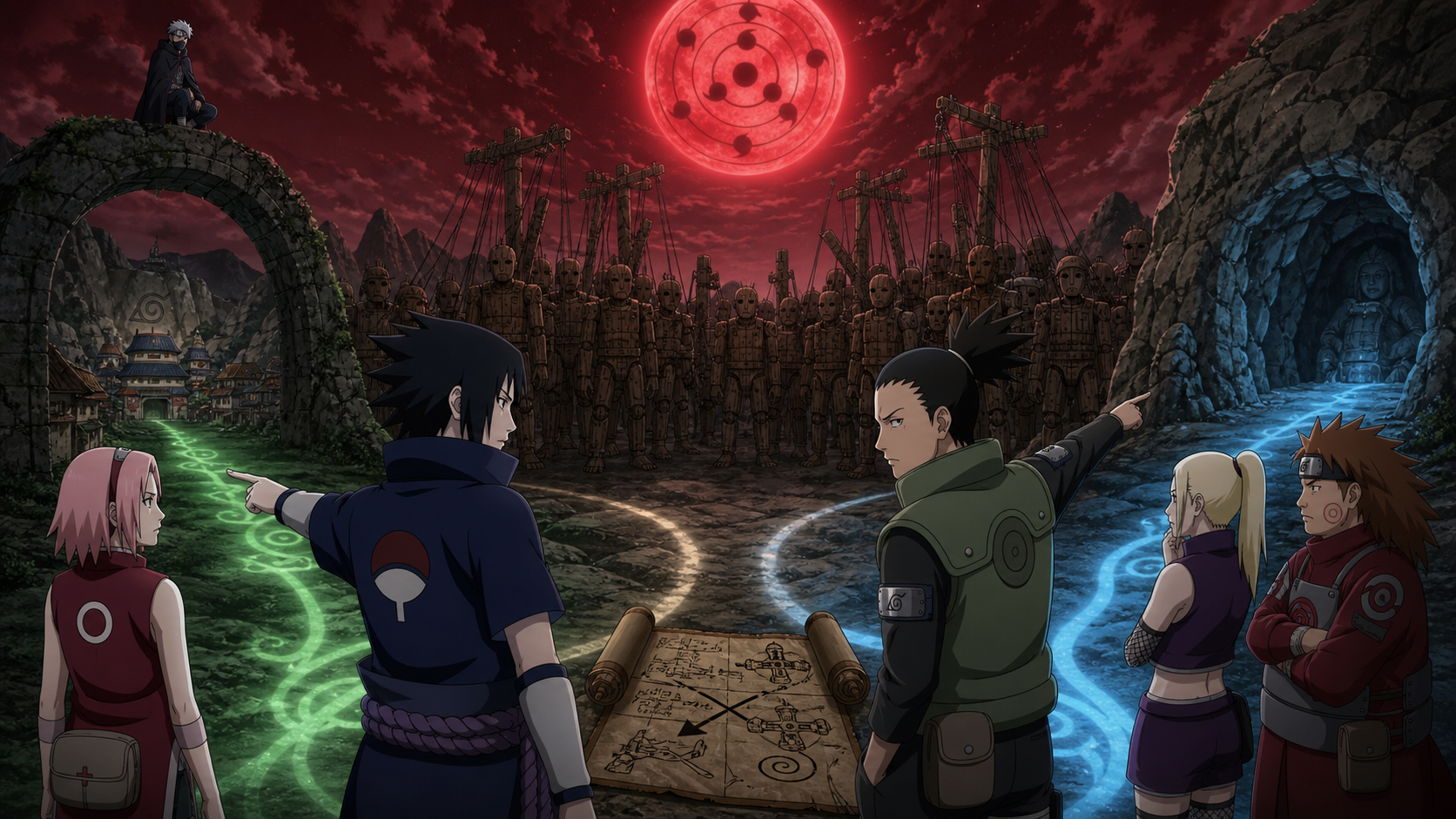
“The Rules or a Comrade” exposes the problem with turning a hard leadership decision into a two-choice slogan. Hiruko blocks the road to Konoha with one hundred puppets. Sasuke wants the rookies to break through, report to Minato, and follow the Hokage’s order. Shikamaru wants the full group to rescue the captured jōnin. Both plans protect somebody. Both plans leave somebody exposed. The masked man watches and smiles because he designed the field to make disagreement look like proof that Konoha has no moral center. Meanwhile Sakura fights Sasori for a poisoned Sasuke, and Jiraiya helps Naruto reach the Nine-Tails power sealed inside him. Nobody has the option to remain pure. A rule worth keeping must help people act together when duties collide. A comrade worth saving cannot become an excuse to create ten more captives.
Episode 438 turns debate into a blockade
Episode 438 continues the anime-original “Jiraiya Shinobi Handbook” arc inside Tsunade’s Infinite Tsukuyomi dream. The Japanese title is “Okite ka, Nakama ka,” meaning “The Rules or a Comrade.” The episode aired in Japan on November 19, 2015.
The title offers a binary that the episode itself keeps complicating. Rules can protect comrades. Rescuing comrades can fulfill the purpose behind a rule.
Tsunade objects to Jiraiya’s Sakura
Shizune brings food while Tsunade reads. Tsunade suddenly explodes over the manuscript’s portrayal of Sakura as meek and frightened.
Her anger is personal and professional. Tsunade trained Sakura and knows the work behind her strength. Watching Jiraiya reduce that student feels like watching him ignore evidence.
The complaint protects Sakura’s earned growth
Sakura did not become powerful because the story announced a promotion. She studied medical theory, built chakra control, trained under brutal standards, and learned to make decisions around injured people.
A fictional alternate world can change events. That freedom should not erase a character’s demonstrated capacity without consequence.
Tsunade still returns to the book
The rice ball is too salty, the tea is too hot, and Tsunade keeps reading. Her complaints create ordinary humor around a dangerous fact: Infinite Tsukuyomi has made the manuscript irresistible.
Even bad characterization cannot make her close Jiraiya’s final pages.
The masked man restrains Neji
Neji wants to intervene after seeing Sasuke, Sakura, and the other rookies face danger. The masked figure stops him.
The stranger insists that the test concerns the future of the Hyūga and the wider shinobi world. He treats his political theory as more important than Neji’s right to help friends.
He promises nobody will die
The masked man claims he will prevent deaths and orders Neji to watch until the rookies reveal their true nature.
That promise does not make the test ethical. He created or coordinated real poison, captivity, combat, and civilian danger to observe choices under pressure.
Controlled danger remains coercion
An examiner who says the blade will stop before death still forces the subject to feel the blade. Sasuke does not know poison will be reversed. Sakura does not know rescue is guaranteed.
Their fear and decisions are genuine because the information gap is part of the trap.
Neji becomes a captive audience
The masked man wants Neji to judge Konoha’s rookies but denies him the ability to join them. Observation replaces participation.
That arrangement mirrors the branch-family cage: someone else decides where Neji may stand and what purpose his eyes must serve.
Sakura faces Sasori
Sakura confronts the puppet master while Sasuke suffers from poison. The fight places her medical knowledge, combat strength, and emotional control under direct pressure.
Tsunade’s complaint about meekness meets the manuscript’s own evidence. Sakura acts because waiting will kill her teammate.
Sasori controls distance and hidden weapons
Hiruko’s armor, puppet mechanisms, poison, and concealed attacks make Sasori difficult to approach. He can punish direct movement before an opponent reaches his core.
Sakura needs timing and analysis rather than another declaration of determination.
Poison sets the real deadline
Sasuke may remain conscious or capable for part of the encounter, but the toxin keeps advancing. The battle clock exists inside his body.
Defeating Sasori matters only if Sakura can also preserve Sasuke long enough for treatment.
Sakura fights as medic and teammate
Medical shinobi rules traditionally ask healers to avoid the front line because losing the medic endangers everybody. Tsunade later revised that framework for a medic who mastered regeneration.
This alternate Sakura appears before that complete level of mastery. She still cannot treat rules as permission to watch Sasuke die.
The story underestimates her and needs her anyway
Jiraiya’s novel may portray Sakura as more frightened than Tsunade accepts. The mission still depends on her willingness to confront Sasori and understand the poison.
That contradiction proves Tsunade’s point. Calling her meek does not survive contact with her choices.
Naruto remains unable to join the fight
Naruto is separated and restrained while the others face the puppet threat. He knows power exists behind his seal but cannot safely access enough chakra alone.
The distance turns every sound or imagined danger into another accusation against his weakness.
Jiraiya reaches Naruto
Jiraiya appears and helps Naruto work with the seal. His presence changes the choice from a private bargain with the Nine-Tails into supervised risk.
An experienced adult cannot guarantee safety, but guidance provides more than Minato’s remembered faith.
The teacher begins loosening the seal
Jiraiya adjusts or weakens access so Naruto can draw more chakra. The action resembles his waking training methods, where he deliberately pushed Naruto toward the Nine-Tails power.
That training carries danger for both student and people nearby. Jiraiya accepts responsibility by standing within the risk.
Naruto attempts a summoning
Naruto tries to summon a toad and initially fails. The failed attempt shows that greater access does not instantly produce control.
Chakra volume, technique execution, emotional state, and contract knowledge remain separate problems.
Failure does not settle the decision
Naruto has already summoned Gamabunta in this alternate story under emergency conditions. One failure now does not erase that potential.
The question is whether he can reach the power deliberately rather than waiting for a fall to force the result.
Jiraiya provides a safer route to risk
He does not tell Naruto to avoid the Nine-Tails forever. He structures an attempt around knowledge of the seal and summoning technique.
Mentorship cannot remove danger. Mentorship can stop desperation from becoming the only teacher.
The rookies begin regrouping
Sasuke, Sakura, Shikamaru, Ino, Chōji, Hinata, Kiba, Shino, Lee, and Tenten converge after the scattered encounters. Naruto and Neji remain absent.
The group finally has enough people to compare information. Their leaders are still captive, Sasuke is compromised, and the route home is threatened.
Missing Naruto and Neji weaken the picture
The rookies do not know the full conversation happening with the masked man. Neji has seen the Hyūga Affair. Naruto is dealing with Jiraiya and the seal.
Any decision the group makes will rely on incomplete information from the two people most directly targeted by the test.
Hiruko blocks the way to Konoha
The puppet user places a massive force between the rookies and the village. One hundred puppets turn retreat and reporting into another battle.
The blockade ensures that obeying Minato’s order carries its own danger. The test does not allow an easy rule-following exit.
One hundred puppets create an attrition problem
The rookies may be able to destroy individual puppets. A hundred targets drain chakra, weapons, time, and attention.
Sasuke’s poison and the captured jōnin make every minute expensive.
Sasuke argues for reporting
Sasuke wants the group to defeat the blockade, reach Konoha, and report to Minato as ordered. His plan respects command structure and brings the Fourth Hokage’s power into the response.
Given Minato’s Flying Thunder God and the scale of the hidden operation, getting accurate information to him could save everyone faster.
Sasuke is not simply choosing rules over people
He knows a trained Hokage can organize rescue better than injured genin. Breaking through toward help is a comrade-protection plan.
Calling his position heartless would flatten the actual tactical reasoning.
Shikamaru argues for rescuing the jōnin
Shikamaru and others want the reunited rookies to move toward the captured leaders. They have seen that the operation uses captives as leverage and that delay gives the enemy more control.
Their plan responds to immediate known danger rather than assuming the route home remains possible.
Shikamaru is not simply breaking rules
He already demonstrated willingness to pause, gather information, and revise. His rescue position comes after evidence that the enemy isolates targets and manipulates reporting routes.
Following the original order blindly may serve the test instead of the mission.
The group divides over two defensible plans
Sasuke prioritizes reaching authority. Shikamaru prioritizes reaching captives. Each sees the other route as increasing risk.
The conflict emerges from different models of rescue, not from one caring side and one cold side.
Sakura’s view carries medical urgency
Sasuke’s poison changes what the group can afford. Returning to Konoha may offer treatment. Pursuing captives may move farther from medical support.
Sakura also knows that leaving poisoned and captured people untreated can become irreversible.
Hinata, Lee, Tenten, Kiba, Shino, Ino, and Chōji matter
The decision affects every rookie, not only Sasuke and Shikamaru. Each brings different sensory reach, mobility, combat style, loyalty, and personal connection to the missing leaders.
A real plan should allocate those capabilities rather than demand total agreement around one route.
Splitting the group has costs
Sending one unit toward Konoha and one toward the jōnin looks like a compromise. The enemy has already succeeded by isolating smaller groups.
Division may cover both priorities while making each team easier to capture.
Staying together has costs too
A single large group can bring maximum force to one route. The unchosen route receives nobody.
When poison and captivity run on different clocks, unity can become concentrated delay.
The masked man watches the argument
He observes from concealment and treats the disagreement as proof that the rookies’ real nature is emerging.
His satisfaction reveals the trap’s design. He wants their options to become mutually painful so any choice can support his accusation.
A rigged test cannot produce clean evidence
The masked man controls the captives, puppets, information, and observation. He can interpret obedience as heartlessness and rescue as recklessness.
When every possible answer confirms the examiner’s belief, the exercise measures power rather than ethics.
Fugaku and Itachi shape Sasuke’s rule sense
This alternate Sasuke grew up inside the Uchiha household. Fugaku’s expectations and Itachi’s example likely reinforce discipline, clan reputation, and responsibility.
His insistence on reporting does not grow from a vacuum. Family survival changed the source of his pressure without removing pressure.
Naruto’s absence changes the debate
Naruto would push hardest toward the captives, especially Kakashi. His voice could also provoke Sasuke into defending the opposite position more aggressively.
Without him, the group sees a disagreement between strategy leaders rather than the familiar rivalry consuming the room.
Neji is forced to watch the division
The masked man frames the rookies’ argument as evidence for Neji. He wants Neji to see Konoha’s rules separating comrades.
The young shinobi are actually debating how to save comrades under constraints the masked man manufactured.
The title repeats Sakumo’s wound
Sakumo chose comrades over mission completion and was destroyed by public condemnation. Kakashi later inherited a rule that placed comrades above rigid obedience.
Episode 438 recreates that history as a forced choice before the next generation.
Rules should carry their purpose
Minato’s instruction to report first exists because repeated rescue attempts can feed a trap. The purpose is preservation, not obedience for its own sake.
If the route to report becomes the trap, following the words may betray the rule’s purpose.
Comradeship should carry accountability
Choosing rescue does not authorize charging without formation, medical planning, or communication. Loyalty becomes vanity when the rescuer ignores predictable harm to the whole team.
Shikamaru’s plan must answer how the rookies will avoid becoming the next captured group.
The episode needs a third option
The strongest answer may involve signaling Minato, dividing roles carefully, using sensory shinobi to track captives, treating Sasuke, and preventing Hiruko from controlling the route.
Binary framing helps the masked man. Creative coordination threatens his conclusion.
Tsunade’s reaction becomes meta-criticism
Her anger at Sakura tells the audience that Jiraiya’s manuscript can be wrong about people even inside Tsunade’s dream. The text is not an infallible moral authority.
That signal gives viewers permission to challenge the story’s forced choices and distorted personalities.
The episode is transitional by design
Sakura’s fight, Naruto’s seal training, Neji’s observation, the puppet blockade, and the group debate all move toward later payoffs.
The broadcast ends with positions established rather than the central conflict resolved.
Sasuke is protecting the people who need information
Returning to Minato could activate reinforcements, update village defenses, and prevent more teams from entering a compromised area. Reporting is not emotional abandonment.
Sasuke’s plan values the people who cannot make informed decisions because the rookies are carrying evidence they have not delivered.
Shikamaru is protecting people whose danger is immediate
Captured jōnin may not survive the time required to withdraw, report, organize, and return. He sees delay as an action with its own casualties.
Breaking sequence can be justified, but Shikamaru still owes the group a route, roles, thresholds, and a way to stop rescue from becoming another disappearance.
Sakura changes the debate through medical time
Sasori’s poison means injury cannot be measured only by whether somebody remains conscious. Treatment windows close while tactical arguments continue.
Sakura brings knowledge about bodies, antidotes, transport, and who can safely fight. Her perspective should shape the plan before combat, not arrive afterward as cleanup.
The other rookies are decision-makers, not votes
Ino, Chōji, Hinata, Kiba, Shino, Lee, and Tenten each carry sensory, tracking, support, weapons, and rescue knowledge. Their positions cannot be reduced to which boy they follow.
A real team decision asks what each specialist knows and what risk each person is being asked to absorb.
Hiruko’s puppets punish every simple answer
A hundred bodies create hidden weapons, repeated angles, exhaustion, and the possibility that progress merely spends the team’s strength before the real enemy.
Charging for comrades and retreating for orders both require passage through the blockade, so the argument needs logistics rather than moral slogans.
Jiraiya models supervised access instead of surrender
Naruto cannot force movement, and Kurama’s offer would open dangerous power through desperation. Jiraiya enters the seal process with knowledge and relationship.
His presence does not make the choice harmless. It creates monitoring, technique, and another person capable of interrupting disaster if Naruto’s control fails.
Neji watches a conflict arranged for his recruitment
The masked man restrains him, promises safety, withholds context, and presents the rookies’ division as proof that Konoha cannot change.
A rigged test creates the pressure it claims merely to observe. Neji is denied the ability to question participants or see choices outside the captor’s frame.
The missing third option is coordinated escalation
The teams could send a messenger, mark a route, preserve medical support, assign a rescue unit, and keep enough strength to report if contact fails.
The episode sharpens drama through a binary, but accountable leadership should search for designs that protect comrades and the purpose behind the rule.
Rules earn loyalty by protecting named people
A command should explain whose safety it serves, what evidence can change it, and who reviews the harm caused by obedience. Comradeship needs the same honesty. Loyalty becomes exploitation when leaders celebrate sacrifice but refuse to redesign the conditions that keep demanding it from the same people repeatedly. That is accountable command.
RaeRae’s verdict
“The Rules or a Comrade” succeeds when Sasuke and Shikamaru sound like leaders protecting different failure points. Reporting to Minato could bring overwhelming rescue capability and treatment for Sasuke. Moving toward the jōnin could prevent the captors from completing the next stage. Neither side owns compassion.
The masked man wants the disagreement to prove Konoha’s moral failure, but his rigged field proves something else. Young shinobi can recognize multiple duties and argue about consequences instead of repeating one slogan. Their next challenge is building a third plan before the puppet army, poison, and captives make the choice for them.
RaeRae’s call
Sasuke is not choosing paper over people. Reporting could mobilize Minato and stop more disappearances. Shikamaru is not choosing friendship over thought. Captured jōnin may die while the group withdraws. Sakura adds the medical clock, and every other rookie brings knowledge that should shape the route. The masked man strips away that complexity because a forced binary helps recruit Neji. Meanwhile, Jiraiya gives Naruto supervised access to dangerous power instead of asking for blind surrender. The episode needs that same design outside the seal: roles, messengers, thresholds, rescue capacity, and a plan that protects both comrades and the purpose the rule was written to serve.
Episode details and viewing routes
- Official episode reference: Naruto Official episode guide
- Licensed episode route: Crunchyroll licensed episode page
What I am carrying forward
Tsunade objected to Jiraiya’s meek portrayal of Sakura. Inside the manuscript, the masked man prevented Neji from helping and promised that the rookies would not be killed while he observed their choices. Sakura fought Sasori while Sasuke suffered from poison. Jiraiya reached Naruto and began loosening access to the Nine-Tails chakra, though Naruto initially failed to summon a toad.
The rookies other than Naruto and Neji regrouped. Hiruko blocked the road to Konoha with one hundred puppets. Sasuke argued that they should defeat the puppets and report to Minato according to orders. Shikamaru’s side argued that the group should rescue the captured jōnin. The masked man watched their division as part of his continuing test. Episode 439 brings prophecy and Naruto’s sealed power into that crisis.