
Killer Bee Rappuden: Part 1
Bee dreams of becoming the hero who frees every jinchuriki, turning isolation into a loud rescue serial where partners can finally stand in public.
Bottom line
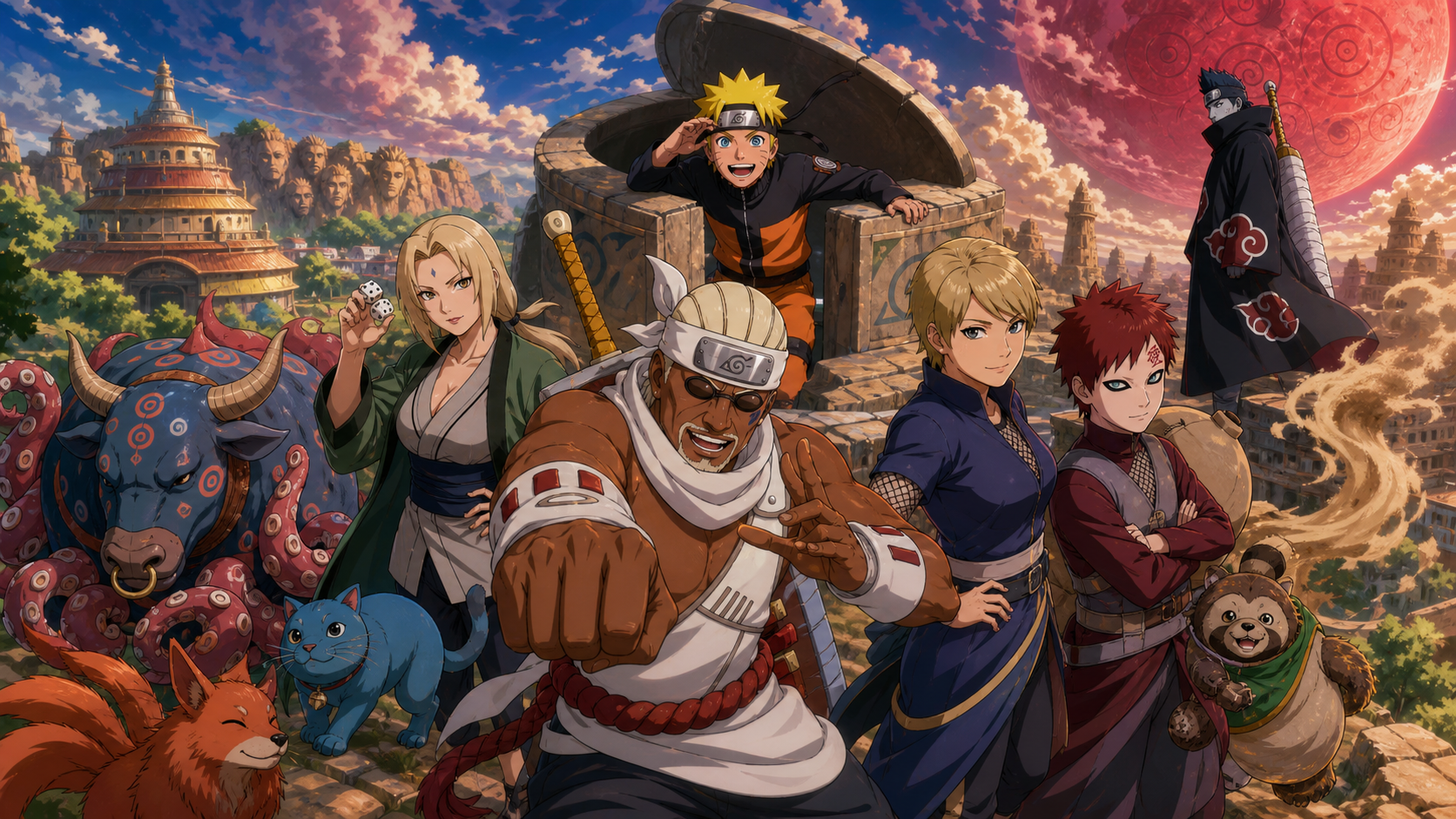
“Killer B Rappūden: Part 1” gives Killer B the kind of Infinite Tsukuyomi dream only B could produce: part rescue mission, part buddy comedy, part tailed-beast revolution, and completely unwilling to behave with dignity for longer than thirty seconds. B dreams that the jinchūriki can save one another before Akatsuki turns their bodies into containers to raid. Yugito Nii stands beside him. Matatabi and Gyūki walk around as tiny partners instead of hidden weapons. Gaara survives long enough to join the team. Naruto gets rescued from a prison built into Tsunade’s face, which is exactly the sort of nonsense B’s subconscious would consider reasonable architecture. The jokes never erase the wish. B wants a world where hosts share information, tailed beasts have voices, and nobody faces extraction alone.
Episode 429 begins Killer B’s dream
Episode 429 is the first half of a two-part anime-original story inside Infinite Tsukuyomi. The Japanese title is “Kirābī Rappūden: Ten no Maki,” commonly rendered as “Killer B Rappūden: Part 1” or “Scroll of Heaven.” The episode aired in Japan on September 10, 2015.
The dream follows Tenten’s two-part fantasy, but the mood changes immediately. Tenten fought the dream because the wrongness terrified her. B treats fantasy as a stage large enough for his personality. His mind does not build domestic comfort. His mind builds a shinobi adventure where every captive host can become part of one impossible crew.
The manga connection is only a doorway
The surrounding war material traces back to the Infinite Tsukuyomi aftermath in the manga, including B being caught in the technique. The rescue adventure itself is anime-original. Gaara’s imprisonment, Naruto’s ridiculous cell, the tiny tailed beasts, Tsunade’s gambling challenge, and the road toward Takigakure do not become hidden manga canon because the episode sits beside adapted material.
That boundary matters. Episode 429 uses canon wounds to build a comic dream. The emotional logic belongs to B, while the events belong to the anime’s fantasy.
B survives extraction before the dream takes him
The opening remembers something important about B. Gyūki’s severed tentacle allowed him to survive the Eight-Tails extraction. Infinite Tsukuyomi catches him afterward. His fantasy therefore begins beside the exact danger that has defined every jinchūriki in the war: somebody powerful wants the beast, and the host’s life counts as acceptable waste.
B rarely speaks about that position with Gaara’s solemnity or Naruto’s wounded anger. He raps, boasts, flirts, and keeps moving. The dream supplies the confession his public behavior avoids.
His perfect world starts with Yugito alive
Yugito Nii joins B as a capable partner from the beginning. That choice says plenty before the plot explains anything. In waking history, Akatsuki captured Yugito, extracted Matatabi, and killed her. B’s fantasy restores a fellow Cloud jinchūriki and places her beside him as an equal participant.
Yugito is not a memorial in this version. She plans, infiltrates, retrieves Gaara’s gourd, and carries her share of the mission. B does not dream about avenging her after death. He dreams that Cloud’s two hosts had enough time to fight the system together.
Matatabi and Gyūki become visible partners
Matatabi and Gyūki appear in small, almost mascot-like bodies. The visual gag is immediate because these creatures normally fill battlefields and terrify nations. Here they can stand in the room, argue, move independently, and take part in the plan.
The change also removes the prison wall between beast and host. Shinobi society treats tailed beasts as resources sealed inside human bodies. B’s dream lets everybody see the relationship. Gyūki is not a secret battery. Matatabi is not a payload. Both are teammates with names and opinions.
The rescue mission begins in Sunagakure
B and Yugito infiltrate Sunagakure to rescue Gaara and Shukaku. The target choice connects three jinchūriki who experienced their villages very differently. B earned standing in Cloud after years of fear and hostility. Yugito became a skilled Cloud jōnin but still died as Akatsuki prey. Gaara endured childhood isolation, became Kazekage, and then died during extraction before Chiyo revived him.
The dream skips diplomatic procedure and gets to B’s answer: hosts should go get one another.
Karasu becomes a giant jailer
The rescue runs into an enormous version of Kankurō’s puppet Karasu. Dream logic inflates a familiar Sand weapon into a prison guard. Gyūki restrains the puppet while B reaches Gaara.
The sequence establishes the episode’s operating style. Canon techniques and symbols remain recognizable, but proportion and context bend toward comedy. The silliness is deliberate rather than careless continuity. B’s fantasy remembers the ninja world, then remixes that world like a performer sampling a familiar track.
A fist bump carries the plan
B frees Gaara and transfers the mission details through a fist bump. In waking canon, the gesture represents more than friendliness. B uses physical contact to share awareness and coordinate with another person. Episode 429 turns that established connection into a compact briefing method.
The choice fits B better than a speech beside a prison door. He trusts rhythm, contact, and shared action. Gaara does not need a committee meeting. One bump places him inside the alliance.
Yugito retrieves Gaara’s gourd
While B handles the cell, Yugito and Matatabi recover Gaara’s sand gourd. The detail prevents Gaara from becoming luggage rescued by stronger people. His fighting method depends on sand and on the vessel he carries. Returning the gourd means returning his agency before asking him to join the next rescue.
That practical beat is easy to miss beneath the jokes. A rescue is incomplete when the rescued person remains stripped of every tool needed to act.
The team divides to find more hosts
B and Yugito split up to locate other jinchūriki. The mission expands beyond friendship or village loyalty. They are building a network of people targeted for the same reason.
Shinobi villages historically kept jinchūriki separated, guarded, feared, and politically useful. Akatsuki exploited that isolation one host at a time. B’s dream reverses the structure. Shared danger becomes the reason to organize before the hunters arrive.
B and Gaara head for Konoha
B and Gaara travel to Konoha for Naruto and Kurama. The pairing is funny because Gaara’s silence has to coexist with B’s nonstop performance. The mission still carries real history. Gaara and Naruto changed one another because each recognized the same childhood wound. B later became Naruto’s teacher because he understood partnership with a tailed beast.
Putting Gaara and B together makes Naruto’s rescue feel like two possible futures coming back for him.
Naruto is imprisoned in Tsunade’s face
Naruto and Kurama are locked inside the mouth of a huge Tsunade bust on the Hokage Rock. There is no respectable way to describe that prison, so I will not try. B’s subconscious apparently looked at Konoha’s monument and decided the village needed a booby-trapped Hokage mouth.
The gag also turns institutional authority into literal architecture. Naruto has been contained by the village, and the prison wears the face of the Hokage who cares about him. B’s dream can tease Tsunade without making her cruel.
Naruto starts a ramen disturbance
Naruto makes noise after being told to stay quiet. Food arrives, exposing the real plan behind his tantrum. He wants ramen. Of course he wants ramen. The world can be ending, Akatsuki can be hunting him, and Naruto will still negotiate through hunger.
The guards fall before he can enjoy the meal. B rescues Naruto and also ruins lunch. Heroism rarely arrives with proper timing.
Lariat opens the cell
B enters his Version 1 chakra cloak and uses Lariat to break the prison open. The attack carries a satisfying piece of character continuity. B does not need a new dream-only power to look impressive. His established speed, strength, and partnership with Gyūki already make him a rescue force.
The escape lasts about as long as any plan involving B, Naruto, and dream architecture should last.
The prison has another trap
A fail-safe pulls the group through the statue and underground. Tsunade, Shizune, and ANBU wait below. The sequence keeps stacking containment systems until the whole village feels like a machine designed to keep jinchūriki in assigned places.
Konoha’s fear is exaggerated for comedy, yet the underlying habit belongs to the real shinobi system. Villages call hosts precious assets and then restrict their freedom in the name of protection.
B gets distracted by Tsunade
B’s attention wanders toward Tsunade’s body while everybody else deals with capture. The joke is completely on brand and completely inconvenient. His fantasy does not transform him into a polished revolutionary hero. He remains the same loud man with terrible timing.
That imperfection helps the episode sound like B’s mind rather than a generic victory scenario. He wants to save every jinchūriki and still cannot stop being embarrassing during negotiations.
Tsunade chooses gambling
Tsunade proposes settling the conflict through dice rather than allowing three jinchūriki to wreck Konoha. The decision bends her famous gambling habit into conflict resolution. Since Tsunade is legendary for losing, B’s crew should have an easy route out.
Dream Tsunade apparently knows her own reputation and still sits down at the table. Confidence has survived every available receipt.
Gaara asks to inspect the dice
Gaara requests a closer look at the dice, giving Shukaku an opening to replace them. The quiet Kazekage becomes part of the cheating scheme without suddenly talking or behaving like B. His contribution stays controlled and tactical.
The scene also lets Gaara cooperate directly with Shukaku. Waking canon had to rebuild that relationship after years of hatred and forced sealing. B’s dream skips to the partnership Gaara deserved to develop sooner.
Shukaku cannot hold the disguise
Shukaku transforms into a copy of the dice, but Tsunade shakes them so hard that the transformation begins to fail. The plan collapses because the strongest medical ninja alive takes gambling equipment personally.
The physical joke works because everybody contributes according to established traits. Shukaku uses transformation. Gaara supplies the quiet deception. Tsunade attacks chance like chance insulted her family.
Gyūki covers the escape
Gyūki releases ink and fills the room with a dark cloud. The rescue party uses the cover to flee. Once again, a tailed beast solves a practical problem as a person on the team, not as ammunition fired through a host.
B’s ideal world does not remove danger. His ideal world changes who gets to participate in answering danger.
Konoha sends a pursuit team
Tsunade dispatches Yamato, Yūgao Uzuki, and ANBU after the escapees. The dream recasts familiar Konoha shinobi as pursuers without turning them into monsters. They defend village orders while B’s crew pursues a larger mission.
That conflict fits the franchise better than a simple evil-village story. Institutions can contain decent people and still enforce the wrong priority.
The trail points toward Takigakure
The pursuit learns that B’s group is heading toward Takigakure. That destination matters because Fū, the Seven-Tails’ jinchūriki, comes from the Waterfall Village. The rescue network is moving toward another host Akatsuki killed in waking history.
The episode does not pause for a lecture about Fū. Fans who know her outcome can feel the purpose under the road comedy.
Naruto stops for ramen again
During a conversation about Akatsuki’s threat, Naruto notices a ramen shop. The urgent mission immediately loses a round against noodles. B’s dream understands Naruto at the level of affectionate parody.
The joke could make Naruto look useless, but the larger pattern feels warmer. B imagines allies with recognizable habits, not obedient pieces in his own heroic fantasy.
The pursuers catch them
Yamato, Yūgao, and the ANBU corner the group, leading to a fight. The jinchūriki force Konoha’s team to retreat. B’s rescue crew can defend the mission without killing village shinobi or turning the disagreement into a blood feud.
Dream conflict remains recoverable. That may be another wish hiding inside the action. B wants a world where resistance does not automatically create permanent enemies.
Akatsuki waits outside Takigakure
Itachi, Sasori, and Deidara confront the team near Takigakure. The episode ends with the rescue mission meeting the organization built to hunt them. Akatsuki becomes the clear external enemy after the village chases and comedy traps.
The cliffhanger promises a fight, but the emotional contest is already visible. Isolation made Akatsuki’s work easier in waking history. Solidarity changes the odds inside B’s dream.
Akatsuki becomes a simpler enemy here
The official episode description frames Akatsuki as a group seeking tailed-beast power to change the world. B’s fantasy strips away much of the organization’s political tragedy and individual contradictions. These figures operate mainly as hunters blocking the rescue.
That simplification is not the deepest possible Akatsuki analysis. The episode has another job. B needs a villain large enough to justify bringing every jinchūriki together.
The dream answers the loneliness of extraction
Every extraction in waking history happened after separation. Gaara fought Deidara while protecting the Sand. Yugito faced Hidan and Kakuzu. Fū was taken away from the village life she wanted. Naruto spent years under threat before the war finally forced nations to cooperate.
B’s dream responds with an early-warning network. A fist bump replaces secrecy. Shared movement replaces isolated defense. The hosts rescue the next person before Akatsuki completes another hunt.
Yugito exposes Cloud’s unfinished grief
Cloud valued strength, yet strength did not save Yugito from being sent into a fatal encounter without the support needed to survive. Restoring her beside B quietly indicts that failure. The dream gives Cloud a second jinchūriki partnership that waking leadership never protected.
B does not stand over Yugito’s grave and explain the lesson. His mind simply refuses to leave her dead.
The episode is anime-original filler with purpose
Viewers who want only manga-adapted war progression can skip this two-part dream without losing the main battle plot. That practical classification should be honest. Calling the episode filler does not finish the conversation.
The story uses anime-original space to examine B’s values through comedy. The execution is broad, yet the underlying wish grows directly from jinchūriki history.
The pacing behaves like a serial adventure
The episode moves from prison break to prison break, chase, food stop, battle, and Akatsuki cliffhanger. Scenes rarely sit still long enough for grief to become explicit. B’s dream keeps running because stillness might force him to name everybody already lost.
That speed can feel shallow if a viewer expects war-arc gravity. The same speed also reveals avoidance as part of B’s emotional method.
The title turns B into a legend
“Rappūden” plays with the franchise’s naming language while centering B’s rap identity. The “Scroll of Heaven” subtitle gives his chaotic rescue story mock-epic weight.
B has always narrated himself as larger than the room. Infinite Tsukuyomi hands him a whole legend and lets him perform inside that title.
Where the episode falls short
Yugito gains action but not enough interior life. The episode restores her mainly as B’s ideal partner and fellow host. Gaara fares better because his existing relationships and recognizable restraint create more texture.
The chase also spends more time on gags than on the political reason villages might resist a roaming jinchūriki coalition. A little more argument could have made B’s dream sharper without killing the comedy.
Where the episode succeeds
The episode understands that B’s fantasy should not sound like Gaara’s, Tenten’s, or Tsunade’s. His wish arrives through performance, teamwork, absurd confidence, and refusal to mourn quietly. The tailed beasts get bodies in the room. Dead hosts get another chance. Rescue becomes contagious.
That character specificity saves the story from becoming another generic alternate world.
Public partnership is Bee’s impossible wish
Matatabi and Gyūki stand beside their hosts instead of being hidden as military inventory. Bee’s fantasy is loud because secrecy was part of the harm. He wants partnership visible enough that nobody can pretend the person and the beast are merely one weapon.
RaeRae’s verdict
“Killer B Rappūden: Part 1” is loud, ridiculous, and more emotionally honest than the giant Tsunade-face prison suggests. The episode lets B imagine the response shinobi society should have built years earlier: jinchūriki sharing knowledge across borders, tailed beasts participating as people, and every rescue creating another rescuer.
The jokes sometimes crowd Yugito and the political stakes, but the core lands. B does not ask the dream to erase Akatsuki. He asks for enough friends to face Akatsuki together. That difference turns a comedy detour into a revealing piece of character work.
RaeRae’s call
Bee dreams in the shape of a rescue serial because heroism lets him rewrite the system that made jinchūriki endure isolation before anyone celebrated their power. Yugito is alive. Matatabi and Gyūki can stand in public. Gaara and Naruto become teammates in a mission to free other hosts. The emotional wish underneath remains entirely precise. He does not imagine becoming the only respected jinchūriki. He imagines a world where every host can be found, freed, and seen beside the tailed beast whose life was also contained.
Episode details and viewing routes
- Official episode reference: Naruto Official episode guide
- Licensed episode route: Crunchyroll licensed episode page
What I am carrying forward
Infinite Tsukuyomi placed Killer B inside a world where Akatsuki hunts jinchūriki for tailed-beast power. B and Yugito, accompanied by small visible forms of Gyūki and Matatabi, infiltrated Sunagakure and rescued Gaara and Shukaku. B shared the wider mission with Gaara through a fist bump, while Yugito recovered Gaara’s sand gourd.
B and Gaara traveled to Konoha, broke Naruto and Kurama out of a prison inside a Tsunade monument, escaped Tsunade’s underground trap through a rigged dice game and Gyūki’s ink, and fought off Yamato, Yūgao, and ANBU pursuit. Near Takigakure, the group encountered Itachi, Sasori, and Deidara. Episode 430 continues B’s dream and the jinchūriki rescue mission.